Moving a piano is nothing like shifting a sofa or a wardrobe. It is a complex, high-stakes operation where poor planning can result in a cracked soundboard, a damaged staircase, or an injured mover. Many people assume that a piano move simply requires a few strong pairs of hands and a large van. In reality, the difference between a safe, smooth move and a costly disaster often comes down to one thing: logistics. This guide walks you through exactly how professional logistics makes piano moving safe, efficient, and genuinely stress-free.
Table of Contents
- Why logistics is essential in piano moving
- Key logistical factors in piano transport
- How professionals guarantee safe piano transport
- Real-world scenarios: The impact of logistics
- What most people miss about piano logistics
- Safe, stress-free piano moving: Your trusted logistics partner
- Frequently asked questions
Key Takeaways
| Point | Details |
|---|---|
| Logistics protects pianos | Smart logistics reduces risk of damage, injury and delays during piano moving. |
| Professional equipment matters | Using specialist tools and vehicles is essential for safe piano transport. |
| Route planning is crucial | Careful selection of routes and timings avoids obstacles and ensures a smooth move. |
| Choose trusted movers | Experienced logistics providers offer guarantees and insurance for peace of mind. |
Why logistics is essential in piano moving
A piano is not just heavy. It is structurally complex, acoustically sensitive, and extraordinarily valuable, both financially and emotionally. An upright piano can weigh anywhere between 150 and 270 kilograms, while a grand piano can exceed 500 kilograms. The weight alone makes moving one a serious undertaking. But it is the combination of weight, fragility, and awkward shape that makes logistics absolutely essential.
Logistics, in this context, means far more than loading a piano onto a van. It covers everything from the initial survey of your property to the final placement of the instrument in its new home. Piano transport essentials include assessing doorway widths, staircase angles, floor load ratings, and access routes before a single piece of equipment is brought to your door.
Here is why professional logistics firms treat every piano move as a unique project:
- Structural risk: Pianos contain thousands of moving parts. A single hard knock can knock the instrument out of tune or cause internal damage that costs hundreds of pounds to repair.
- Property risk: Narrow hallways, tight corners, and freshly decorated walls are all vulnerable. Without careful planning, your piano move can leave scratches, dents, and scuffs behind.
- Personal injury risk: Improper lifting techniques and insufficient equipment put movers at serious risk of back injuries and crushes.
- Acoustic risk: Vibration and sudden changes in temperature or humidity during transit can affect tuning and even warp the wooden components of the instrument.
Nationwide piano logistics specialists follow strict industry-approved protocols to manage every one of these risks systematically, rather than relying on improvisation on moving day.
Did you know? Professional logistics firms estimate that the majority of piano damage incidents occur not during transit, but during loading and unloading, precisely the stages where planning and specialist equipment matter most.
With a clear understanding of why logistics matters, let us explore the main factors logistics experts use when planning piano moves.
Key logistical factors in piano transport
Knowing the factors involved is important, but how do professional logistics providers actually ensure safety and efficiency? There are four pillars that underpin every successful piano move: equipment, route selection, timing, and contingency planning.
1. Specialist equipment
Standard removal equipment simply is not built for pianos. Professional movers use skate boards (low wheeled platforms designed for heavy loads), piano straps, padded blankets, and specialist lifting boards. For grand pianos, the legs are carefully removed and the body is placed on a padded piano board before being secured with straps and moved on a trolley. This is not guesswork. It is a practised, methodical process.
When moving grand pianos, each component is wrapped individually to prevent surfaces from rubbing together during transit. The vehicle used must have a tail lift and sufficient internal space to secure the piano without it sliding. No improvising with ropes tied to a railing.
2. Route selection
Before moving day, a logistics professional will identify the best route from the piano’s current location to the vehicle and from the vehicle to its destination. This includes measuring doorways, assessing staircase gradients, checking for low ceilings, and identifying any obstacles such as tight bends or steps with no handrails.
Fast piano delivery logistics providers also plan the road route carefully, choosing roads that avoid heavy vibration from potholes and road works wherever possible. This matters more than you might think: repeated vibration during a long journey can cause the piano’s strings to shift, requiring expensive retuning or, in worse cases, internal damage.
3. Timing and coordination
Moving a piano through a busy building at peak hours is asking for trouble. Professional logistics teams coordinate their arrival times to avoid bottlenecks, ensure lifts are reserved where needed, and confirm that adequate staff are on site. This is especially important in flats, blocks of offices converted to residential use, and period properties.

Understanding piano mover costs often reveals that the price reflects this level of coordination. You are not simply paying for the van and the movers. You are paying for the planning, the specialist equipment, and the professional accountability that comes with experienced logistics teams.
4. Contingency planning
Even the best-planned moves encounter surprises. A door that seemed wide enough turns out to be half a centimetre too narrow. A lift is out of service. It is raining heavily and the ramp becomes slippery. Professional logistics firms build contingency plans into every job, ensuring that solutions are already identified before problems arise.
Here is a quick comparison of what differentiates planned versus unplanned piano moves:
| Factor | Professional logistics | Unplanned DIY move |
|---|---|---|
| Equipment | Specialist boards, straps, tail lift | General purpose trolleys |
| Route survey | Pre-move site visit | On the day assessment |
| Contingency plan | Pre-identified solutions | Improvisation |
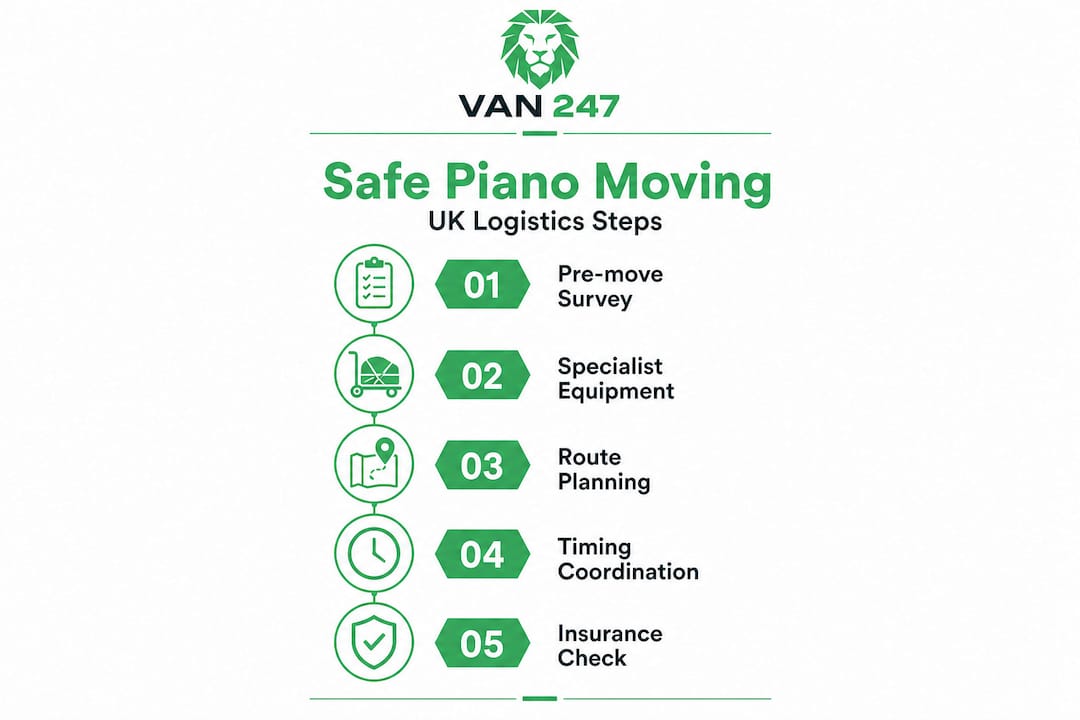
| Insurance | Instrument-specific cover | Limited or no cover |
| Risk management | Systematic and documented | Reactive |
Pro Tip: Always ask your logistics provider whether they conduct a pre-move survey. If they are willing to book a job without one, that is a warning sign worth taking seriously.
How professionals guarantee safe piano transport
After looking at professional guarantees, let us compare real-world scenarios to highlight the strategic difference logistics brings.
A key distinction between professional and amateur piano moves is the use of individual risk assessments. Every property is different. A terraced house in Leeds has entirely different access challenges to a ground floor flat in London or a farmhouse in Somerset. Experienced piano movers assess every move individually, treating it as a fresh logistical problem rather than applying a one-size-fits-all approach.
According to experienced piano mover safety protocols, reputable logistics companies follow documented procedures that include:
- A detailed pre-move checklist covering access, equipment requirements, and staffing
- Use of climate-controlled vehicles when weather or journey length demands it
- Comprehensive insurance that covers the full replacement value of the instrument
- Clear communication with the client at every stage, from booking to delivery
- Post-move checks to confirm the piano has arrived undamaged and in position
The value of targeted insurance cannot be overstated. Standard home contents insurance rarely covers a piano during a move. If your instrument is dropped or damaged in transit without specialist cover, you could be facing repair bills that run into thousands of pounds. Professional logistics providers include instrument-specific insurance as standard, giving you genuine peace of mind.
Keeping pianos safe during transit also involves understanding the effect of environmental conditions. Temperature and humidity changes can cause wooden components to expand and contract, affecting tuning and structural integrity. Climate-controlled vehicles address this directly, maintaining stable conditions throughout the journey.
By contrast, well-intentioned DIY movers or general removal companies without piano experience tend to overlook these details. They may use inadequate padding, skip the pre-move survey, or underestimate the importance of fleet risk management practices that professional logistics companies apply to every job.
“The most expensive piano move is the one that goes wrong. The cost of a specialist is always less than the cost of a repair.”
Pro Tip: When booking a piano mover, always ask specifically whether their vehicle insurance and goods-in-transit cover extends to musical instruments. A genuine logistics professional will be able to confirm this immediately.
Trusted piano movers in the UK are distinguished not by size but by their approach to detail. The questions they ask you before booking tell you more about their professionalism than any website badge ever could.
Real-world scenarios: The impact of logistics
Now that you have seen what professional logistics involves, consider what happens when it is absent or inadequate. These scenarios are not hypothetical. They represent the kinds of situations that arise regularly when piano moves are underplanned.
Scenario 1: The unlucky DIY attempt
A family decide to move their upright piano themselves with the help of friends and a hired van. They measure the doorway but forget to account for the piano’s depth when turning the corner in the hallway. The piano gets stuck, damaging the door frame and scratching the piano’s side panel. What began as a cost-saving exercise ends up costing more in repairs than a professional move would have.
Scenario 2: The general removal company
A couple hire a general removal company for their full house move. The company agrees to include the piano. On the day, the team arrives without a piano board or skate. They improvise with furniture blankets and a standard trolley. During unloading, the trolley slips on wet pavement and the piano sustains a crack to its casing. The company’s goods-in-transit insurance does not cover musical instruments.
Scenario 3: The professional logistics approach
A music teacher books local piano moving companies for the move of her vintage upright, a 90-year-old German instrument worth over £8,000. The logistics team conduct a pre-move survey two days before the job. They identify a tight turn on the staircase that requires the piano to be tilted at a specific angle and establish that they will need an additional team member on the day. The move completes without incident, and the piano arrives in perfect condition.
Here is what a structured logistics approach includes at each stage:
- Pre-move survey: Assess property access, measure doorways and staircases, confirm equipment requirements.
- Equipment preparation: Prepare specialist boards, straps, padding, and vehicle.
- Team briefing: Confirm roles, lifting techniques, and contingency procedures.
- Safe loading: Secure the piano using manufacturer-approved methods.
- Transit management: Monitor conditions, take a planned route, avoid unnecessary vibration.
- Safe unloading: Reverse the loading process with equal care.
- Post-move check: Inspect for any transit damage and confirm positioning.
Industry-standard guidance consistently shows that moves following this structured process result in significantly fewer claims, less property damage, and better client outcomes than unplanned or improvised moves.
What most people miss about piano logistics
Here is an honest perspective from years of experience in piano logistics: most people focus almost entirely on the physical challenge of moving a piano and almost entirely miss the situational and environmental factors that make the job genuinely complex.
Seasonal weather is a perfect example. Moving a piano in January across three flights of stairs in a rain-soaked property in Manchester is a fundamentally different challenge to the same move on a dry day in July. Wet surfaces increase slip risk dramatically. Cold temperatures make certain materials stiffer and less forgiving. Yet the vast majority of people booking a piano move never think to mention the time of year or the weather forecast when discussing logistics.
Property access is another one. Period properties, narrow Victorian terraces, and converted flats often have access challenges that no amount of physical strength can overcome without the right equipment and forward planning. We have seen moves where the only viable access route required temporary removal of a window frame. That kind of solution requires not just experience but creative logistical problem-solving that only comes with genuine expertise.
The logistics job details professionals need before booking a piano move are more detailed than most people expect. And rightly so. The more information a logistics team has upfront, the better protected your instrument will be.
Insurance is the third overlooked factor. Many people assume their home insurance covers everything during a move. It rarely does. Specialist instrument insurance, held by the logistics company and applied to your specific job, is the only reliable protection during transit. Always confirm this before signing anything.
The truth is that professional logistics does not just reduce risk. It transforms a potentially stressful, unpredictable event into a calm, managed process where you know exactly what is happening at every stage. That peace of mind is worth every penny.
Safe, stress-free piano moving: Your trusted logistics partner
Whether you are moving a family upright or a professional concert grand, getting the logistics right is what stands between a smooth move and a very expensive mistake.
At Van-247 Delivery, our experienced piano movers handle every job with the care, planning, and specialist equipment your instrument deserves. From pre-move surveys to climate-aware transit, we cover every detail so you do not have to worry. Our nationwide piano logistics service covers the length and breadth of the UK, and for those who need it, we also offer fast piano delivery for urgent, time-sensitive moves. Get your instant quote today and let us take the stress out of moving your most precious instrument.
Frequently asked questions
How does logistics prevent piano damage during moving?
Logistics ensures proper packing, specialised equipment, and route planning to protect your piano from shocks, moisture, and mishandling throughout every stage of the move.
Why are professional movers recommended for piano transport?
Professionals bring specialist knowledge, dedicated tools, and instrument-specific insurance to handle the heavy, delicate nature of pianos safely and efficiently, minimising the risk of costly damage.
What logistical considerations are vital before moving a piano?
Key logistics include surveying site access, planning the road and property route, selecting the right vehicle, and confirming insurance cover before the move begins.
Can logistics help with last-minute piano moves?
Yes. Efficient logistics providers can accommodate urgent moves by optimising scheduling and deploying ready teams with the appropriate equipment, even at short notice.