Getting commercial delivery right is one of those things that looks simple until it isn’t. Missed time slots, damaged goods, confused drivers, and unhappy customers can stack up quickly when your commercial delivery process lacks structure.
This guide walks you through the practical side of setting up and managing commercial deliveries, from preparation and planning to execution and troubleshooting. Whether you’re looking at how to start commercial delivery for your business or trying to fix the gaps in an existing operation, you’ll find concrete steps here that actually work.
Table of Contents
- Key takeaways
- Commercial delivery how to: getting the basics right
- Planning and setting up your delivery process
- Loading, transporting, and delivering efficiently
- Troubleshooting and improving your performance
- My honest take on commercial delivery
- How Van-247delivery can support your operation
- FAQ
Key takeaways
| Point | Details |
|---|---|
| Prepare before you dispatch | Sort your vehicle, compliance, and tracking tools before your first delivery goes out. |
| Plan routes around real data | Use demand forecasting and route sequencing to cut wasted journeys and avoid delays. |
| Load vehicles with purpose | Zone-based loading means your first deliveries are at the door, reducing time on every stop. |
| Communicate at every stage | Proof of delivery and live updates protect your business and build customer trust. |
| Measure what actually matters | Track on-time rates, failed deliveries, and cost per drop to find where you can improve. |
Commercial delivery how to: getting the basics right
Before a single parcel leaves your premises, you need three things in order: the right vehicle, the right paperwork, and the right tools. Skipping any of these creates problems you’ll spend far more time fixing than setting up properly from the start.
Vehicle and equipment checklist part off commercial delivery how to
Your vehicle choice should match your typical load. A transit van works well for parcel runs and furniture drops. Larger panel vans or light goods vehicles suit pallet deliveries. Specialist loads such as chilled goods come with their own cost implications. Refrigerated vans cost £15,000 to £35,000 used, with refrigeration unit repairs potentially running into thousands. Factor that into your cost model early.
Pre-trip vehicle checks covering fluids, tyres, lights, mirrors, and safety gear are not optional. They are the difference between a clean run and a costly breakdown mid-route.
Here is a quick-start equipment checklist:
- Load-securing straps, blankets, and corner protectors
- A working sat nav or route planning app
- A mobile device with your delivery management software installed
- A proof-of-delivery method (photo, signature, or electronic confirmation)
- High-visibility jacket and basic first aid kit for the driver
- Pallet truck or sack barrow if handling heavier consignments
Legal and compliance basics
You need the correct driving licence category for your vehicle weight. For loads over 3.5 tonnes, that means a Category C licence and, depending on frequency, an operator’s licence. Public liability insurance and goods-in-transit cover should be in place before you take on any commercial work.
Incoterms in shipping contracts are worth understanding even for domestic deliveries. They clearly define who is responsible for the goods at each stage, preventing disputes over damage or loss.
Technology tools worth using
Delivery management software supports route planning, driver assignment, real-time tracking, and proof of delivery in one place. For small operations, even a free tool like Google Maps with waypoints is a step forward. As volumes grow, dedicated platforms pay for themselves quickly in saved driver hours.
Pro Tip: Set up a shared digital dashboard where your dispatcher and drivers can see the same route and stop data. It removes the need for calls back and forth and keeps everyone on the same page.
Planning and setting up your delivery process
Good planning is what separates a delivery operation that runs smoothly from one that constantly firefights. The commercial delivery process starts long before the van leaves the depot.
Forecasting your delivery volumes
Predictive analytics and demand forecasting allow you to allocate vehicles, drivers, and time slots before orders are even confirmed. This prevents the expensive scramble of same-day arrangements when a large order lands unexpectedly. Even a simple spreadsheet tracking weekly order patterns can reveal your busiest days and help you staff accordingly.
Building an effective route
Route sequencing is where many businesses leave time and money on the table. Follow these steps to build a route that works:
- Group stops by geography. Cluster deliveries in the same postcode area together rather than zigzagging across a city.
- Sequence by time commitment. Put time-sensitive or time-slot deliveries at fixed points and build the flexible stops around them.
- Account for access restrictions. Some business parks, city centres, and loading bays have timed access windows. Missing these wastes the whole trip.
- Build in a buffer. Allow five to ten minutes per stop beyond your estimate. Traffic, difficult access, and customer delays are normal.
- Review the route the evening before. Road closures and events can change everything overnight.
Understanding how pallet deliveries fit into a network helps too. The way pallet delivery networks operate means your freight often passes through a hub before reaching its final destination. Knowing this helps you set accurate delivery windows with clients.
Inventory staging and load planning
Before loading, organise your parcels and pallets in stop order. This sounds basic, but doing it at the warehouse saves significant time at every delivery point. For larger operations, colour-coded zones or numbered staging areas work well.
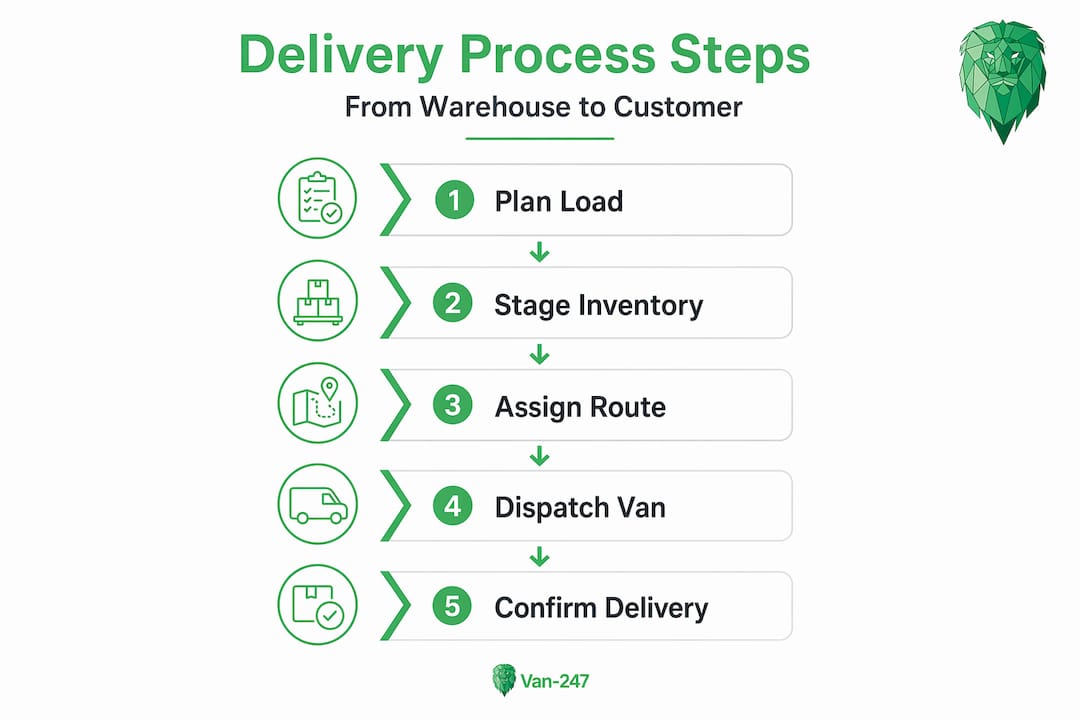
For commercial furniture deliveries, realistic timescales matter. Standard delivery times for commercial furniture typically run from three to ten working days, excluding manufacturing lead times. Set client expectations at booking, not at the point of a complaint.
Pro Tip: Integrate your order management system with your delivery platform so that confirmed orders automatically generate a delivery task. Manual data entry between systems is where errors creep in.
Loading, transporting, and delivering efficiently
Execution is where plans meet reality. A well-planned delivery that is poorly executed still produces a bad result. Here is how to get the physical part right.

Loading the vehicle correctly
The zone-based LIFO loading method is the professional standard. LIFO stands for Last In, First Out. The last stop on your route goes in first, at the far end of the vehicle. Your first stop is loaded last, right at the door. This means you never have to unload half the van to reach a package.
Here is a simple load order approach to follow:
- Load stop 5 items first, positioned at the vehicle’s far end
- Load stop 4 items behind those
- Continue back towards the door for stops 3, 2, and 1
- Secure every layer with straps before closing the vehicle
Heavy items go on the floor. Fragile goods go on top or in padded areas. For guidance on safely transporting large items, proper wrapping and positioning prevents the kind of damage that costs you more than the delivery earned.
Securing the load and driving safely
A shifting load causes damage and can affect vehicle handling. Use ratchet straps across pallet loads and non-slip matting under loose cartons. Check the load is secure before every departure, not just at the start of the day.
A driver who arrives safely ten minutes late is worth more than one who rushes and arrives with damaged goods. Build a culture where safety and accuracy come before speed.
Proof of delivery and customer communication part off commercial delivery how to
Send customers a delivery notification the day before and a narrower time window on the morning of delivery. On arrival, collect a signature or take a timestamped photo of the delivered goods. Electronic proof of delivery through an app is ideal because it time stamps, geo tags, and stores the record automatically.
Delivery experience directly affects customer retention and lifetime value. A botched delivery erodes trust in ways that no marketing campaign easily repairs.
Pro Tip: If a customer is not in, leave a clear card with a contact number and a one-click redelivery option if possible. It saves you a full second trip and leaves the customer feeling looked after.
Troubleshooting and improving your performance
Even a well-run operation hits problems. The difference between businesses that grow and those that stagnate is how they handle the problems they know will come.
Common delivery issues and how to handle them
| Issue | Likely cause | Practical fix |
|---|---|---|
| Failed delivery (no one home) | No advance communication | Send ETA notification the morning of delivery |
| Wrong item delivered | Picking or loading error | Cross-check manifest against load before departure |
| Damaged goods | Poor load securing | Use zone loading and protective materials consistently |
| Route running late | Underestimated stop times | Add buffer time per stop and flag delays early |
| Package on manifest but not in vehicle | Loading oversight | Mark as missing, move on, and investigate after the route |
That last issue, sometimes called a false load error, is more common than most managers expect. The right response is to note the missing item and continue the route. Spending twenty minutes searching a van mid-route is a poor use of time and delays every customer after that point.
Metrics worth tracking part off commercial delivery how to
Measuring delivery performance gives you the data to make good decisions. Focus on these:
- On-time delivery rate. The percentage of deliveries completed within the agreed window
- Failed delivery rate. How often a first delivery attempt fails, and why
- Cost per drop. Total route cost divided by number of successful deliveries
- Customer feedback scores. Post-delivery ratings or complaints by route or driver
High-performance delivery operations in competitive markets are pushing towards 99% on-time rates within short windows. That is a useful benchmark even if your operation is smaller. Review your metrics weekly, not monthly. Problems that have been running for a month are much harder to fix.
My honest take on commercial delivery
I have worked with businesses at every stage of setting up and improving their delivery operations, and there is one mistake I see more often than any other. Managers treat delivery as a cost to be managed rather than a function that drives revenue. That framing shapes every decision badly.
Customer retention is increasingly determined by the delivery experience. When someone receives their order on time, in good condition, with clear communication throughout, they come back. When they don’t, they quietly go elsewhere. The business owner often never knows why.
The second thing I see is a disconnect between sales and operations. Sales promises delivery timescales that operations cannot meet. Successful commercial delivery requires alignment across sales, operations, and customer service. Those conversations need to happen before a customer order is confirmed, not after it goes wrong.
My practical advice: start with your worst delivery day from the past three months and work backwards. What broke down? Was it loading, routing, communication, or a compliance gap? Fix that one thing first. Meaningful improvement comes from solving real problems, not from reading frameworks and doing nothing.
— Claudiu
How Van-247delivery can support your operation
If you are setting up or scaling a commercial delivery service and need reliable, flexible support, Van-247delivery has been helping UK businesses do exactly that for over 15 years. From same-day pallet transport to flexible man with a van services for smaller or urgent loads, the team handles everything from single drops to regular commercial runs. All deliveries are insured, tracked, and handled by experienced drivers who understand the pressure of business timescales. Get an instant quote and see how straightforward professional commercial delivery can be.
Frequently Asked Questions
What do I need to start a commercial delivery service?
You need a suitable vehicle, the correct driving licence for your load weight, goods-in-transit insurance, and a basic route planning or delivery management tool. For loads over 3.5 tonnes, an operator’s licence is also required.
How do I reduce failed first-time deliveries?
Send customers an ETA notification the morning of delivery and offer a narrow time window where possible. Clear communication before arrival is the single biggest factor in reducing missed deliveries.
What is the best way to load a delivery vehicle?
Use the zone-based LIFO method. Load the last stop first, deepest in the vehicle, and work forward so your first delivery is closest to the door. This avoids mid-route shuffling and protects cargo from unnecessary movement.
How should I measure commercial delivery performance?
Track on-time delivery rate, failed delivery rate, cost per drop, and customer feedback scores. Review these weekly to catch problems before they become patterns.
How long does commercial delivery typically take?
Timescales depend on the goods and service level. Standard commercial furniture deliveries run three to ten working days. Express services and same-day options are available for urgent loads and should be factored into your service offering where customer demand exists.