Congestion charge delivery: most delivery vans and cars entering central London during charging hours must pay the Congestion Charge daily, and as a driver or fleet operator, that cost sits on you unless your booking terms say otherwise. The current charge is £18 if you pay on the day or in advance, rising to £21 if you leave it until up to three days after travel. Your one immediate move: check your vehicle’s registration on TfL’s site and, if it’s electric, register for Auto Pay straight away so you’re not overpaying for weeks without realising it.
TL;DR:
- Vehicles inside the congestion zone pay £18 daily if they settle on time, or £21 if paid within three days; late or missed payments can lead to enforcement actions.
- Electric vehicles qualify for discounts only if registered on Auto Pay, with electric cars getting 25% off and electric vans 50%, but registration is mandatory.
- The congestion charge applies during specific hours on weekdays and weekends, with zero charges between Christmas and New Year’s, and missing the charging window costs the same regardless of the crossing duration.
- Accurate pre-job checks of postcodes, vehicle registration, emissions status, and timing are essential to avoid unexpected charges and disputes with clients.
Table of Contents
- What does the congestion charge delivery zone actually cover?
- Which vehicles pay, and how does the Cleaner Vehicle Discount work?
- How do you check if a delivery job will be charged?
- What happens when charges stack: congestion charge delivery plus ULEZ
- A pre-job, on-job and admin checklist for compliance
- How can planners reduce congestion charge exposure without cutting service?
- Why choose Van-247delivery for congestion charge delivery jobs
- Why the real cost isn’t the charge itself
- Book zone-aware deliveries with Van-247delivery
- Sources
- FAQ
What does the congestion charge delivery zone actually cover?
Here’s the bit that catches out even seasoned drivers: the zone runs to a fixed schedule, and missing that window by ten minutes can cost you the same as missing it by five hours.
The Congestion Charge applies within the central London boundary, roughly bordered by the Inner Ring Road, and it’s charged once per calendar day no matter how many times you cross in and out. Drive in at 8am, pop out for a coffee run, come back at 2pm? Still one charge. That’s genuinely useful for multi-drop routes, because you’re not stacking fees every time you cross the boundary line.
The operating hours are:
- Weekdays: 07:00 to 18:00, Monday to Friday
- Weekends and bank holidays: 12:00 to 18:00, Saturday, Sunday and bank holidays
- No charge at all between Christmas Day and New Year’s Day bank holiday, every year
Fees, as confirmed by TfL, sit at £18 when you pay on the day or in advance. Wait beyond the day itself, and it climbs to £21 if paid within three days of travel. Miss that three-day window entirely, and you’re into penalty territory, which we’ll cover shortly.
London residents living inside the zone get a substantial discount on the standard charge, but that’s tied to the resident’s registered address, not to delivery vehicles passing through on a job. If you’re running deliveries into a client’s postcode inside the zone, that resident discount does nothing for your van. It only matters if you’re the one registered as living there.
Which vehicles pay, and how does the Cleaner Vehicle Discount work?
Cars, vans, HGVs, minibuses and quadricycles all fall under the Congestion Charge, and it applies regardless of whether the vehicle meets ULEZ emissions standards. That’s the confusion point for a lot of new couriers: passing ULEZ compliance does not exempt you from paying the Congestion Charge. They’re two entirely separate schemes with separate criteria, and both can bite on the same trip.
Where things get interesting is the Cleaner Vehicle Discount, and it only applies if you’re signed up correctly.
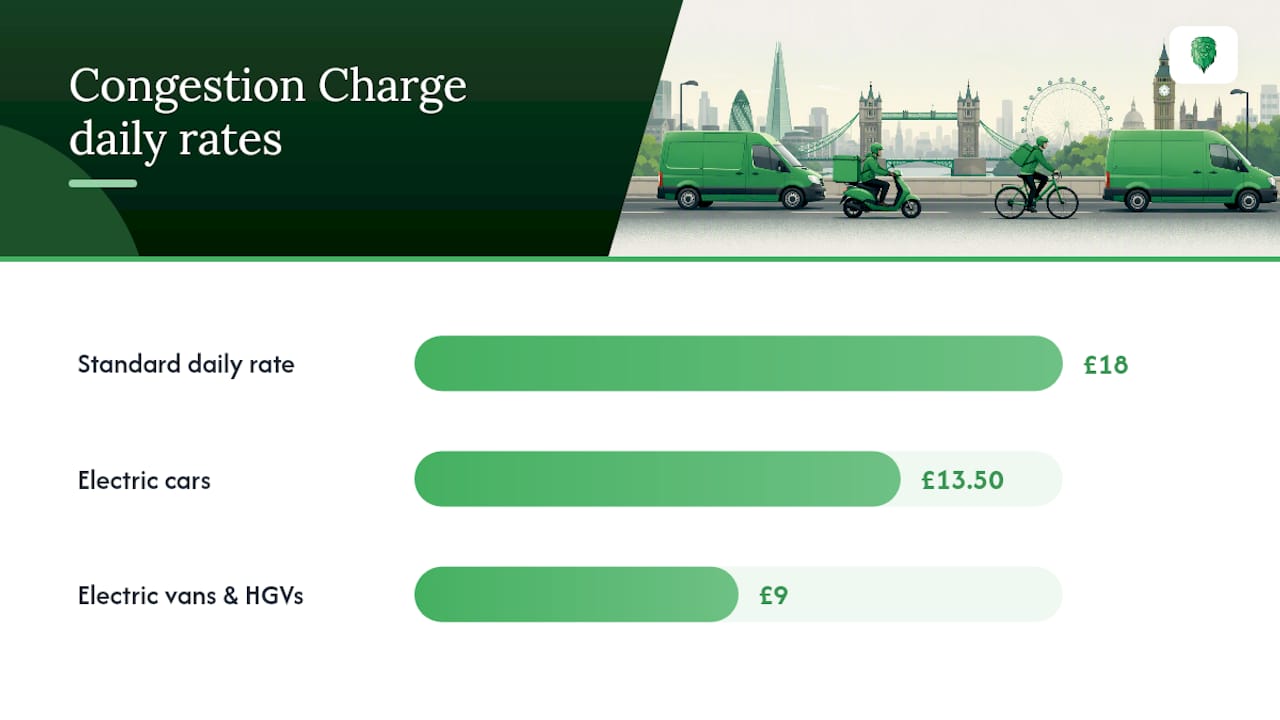
- Electric cars get a 25% discount, dropping the daily rate from £18 to £13.50.
- Electric vans, HGVs and quadricycles get a 50% discount, dropping the rate to £9.
- The discount only applies when the vehicle is registered on Auto Pay — pay-as-you-go or one-off online payments don’t qualify, full stop.
That last point trips up more electric van operators than anything else on this list. TfL is explicit that the reduced rate isn’t automatic just because your van is zero-emission. You have to actively register it. Skip that step and you’re paying the full £18 on an electric vehicle that should only be costing £9.
Setting up Auto Pay takes a few minutes on TfL’s website. You register your vehicle registration mark, link a payment card, and TfL then charges you automatically for any day the vehicle enters the zone during charging hours. Fleet operators can register multiple vehicles under one account, adding or removing registrations as your fleet changes, which matters if you’re running seasonal capacity or swapping vans in for repairs.
Pro Tip: Set a calendar reminder to audit your Auto Pay vehicle list every quarter. Vans get sold, leased vehicles get swapped, and a registration sitting on your account for a vehicle you no longer run is an easy way to lose money on charges nobody’s actually incurring.
How do you check if a delivery job will be charged?
Before accepting a job that routes through central London, two quick checks save you from an unwelcome surprise on your invoice.
- Run the destination postcode through TfL’s zone checker to confirm it actually sits inside the charging boundary. Some postcodes just outside feel like they should be in scope but aren’t.
- Check your vehicle’s registration against TfL’s compliance checker to confirm its emissions category and whether it’s due the Cleaner Vehicle Discount.
- Confirm the time of travel against the charging hours. A drop scheduled for 6:45pm on a weekday might slip outside the window entirely.
- Keep a screenshot or record of the checker result for jobs where you’re billing the charge back to a client. It’s your evidence if a dispute comes up later.
Registering for Auto Pay is still the cleanest route for regular operators, whether you’re running a single van or a fleet of twenty. Individual drivers register one vehicle and card; fleet administrators can manage a full list under one account, with consolidated statements that make invoicing clients far less painful than chasing down twenty separate payment confirmations.
Here’s the number that should focus minds on this: paying late pushes the £18 charge to £21, and TfL’s own guidance confirms that missing payment altogether escalates into enforcement action, not just a bigger bill. For a courier doing the same central London run five days a week, that gap between £18 and £21 adds up to £15 extra a week for doing nothing differently except paying a few days later than you should have.
Auto Pay solves that timing problem entirely, because the payment happens automatically rather than relying on someone remembering to log in and pay within three days.
What happens when charges stack: congestion charge delivery plus ULEZ
This is where a lot of quoting goes wrong. Operators price a job around the Congestion Charge and forget that ULEZ is a completely separate charge that can apply on the exact same trip.
ULEZ charges £12.50 daily for vehicles that don’t meet emissions standards (Euro 6 for diesel), and it operates 24 hours a day, seven days a week, across the whole of Greater London, not just the central zone. A van can dodge the Congestion Charge by delivering at 6am and still owe ULEZ for the same trip, because ULEZ doesn’t care what time it is.
Then there’s a third layer that catches people out even more often: the Blackwall and Silvertown tunnel charges. These are billed independently by their own system and typically don’t sync with your Congestion Charge Auto Pay account. Cross either tunnel on a job and assume the two schemes talk to each other, and you’ll likely find an unpaid tunnel charge sitting on your account weeks later.
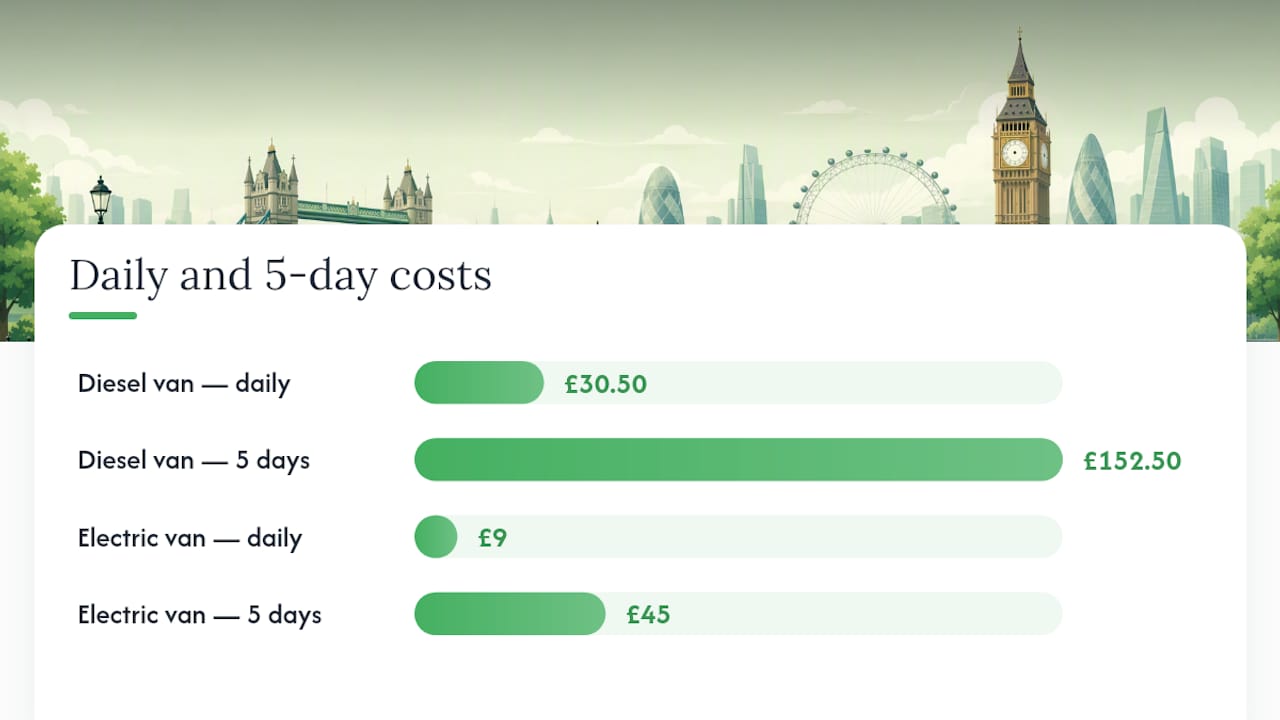
Here’s how the numbers actually play out for three common scenarios:
That £30.50 figure for a non-compliant diesel van isn’t a worst-case scenario. It’s the standard combined daily cost couriers report for a routine central London run in an older van. Swap that same van for an electric one registered properly on Auto Pay, and the daily cost drops to £9. Over a five-day working week, that’s the difference between £152.50 and £45. If you’re planning fleet upgrades, that gap is the actual business case, not the emissions targets.
For a fuller breakdown of how ULEZ interacts with removals and larger vehicles specifically, our ULEZ guide for London moves covers the vehicle categories in more detail.
A pre-job, on-job and admin checklist for compliance
Getting this right isn’t complicated, but it does need a routine. Here’s the sequence worth building into every job.
- Pre-job: confirm the recipient’s postcode against the zone boundary, check the planned route for zone crossings, and verify the vehicle’s registration and emissions standard on TfL’s checker.
- Pre-job: if the job falls inside charging hours and the vehicle isn’t on Auto Pay, decide now whether to pay in advance or accept the risk of a late payment.
- On-job: use authorised loading and unloading bays rather than kerbside stops that risk a separate parking penalty on top of any road charge.
- On-job: note arrival and departure times against the charging window, and keep any payment confirmation or receipt for the job file.
- Admin: confirm Auto Pay and fleet reconciliation are active and up to date, particularly after adding or removing vehicles from the fleet.
- Admin: where you’re passing the charge on to a client, show it as a separate line on the invoice rather than folding it into the delivery fee, so the client can see exactly what they’re paying for.
Pro Tip: If you’re quoting a job that might cross the zone boundary depending on traffic diversions, price in the charge anyway. It’s far easier to explain an unused contingency to a client than to explain an unexpected charge after the fact.
Our practical guide to commercial delivery walks through how this checklist fits into a wider invoicing and compliance process for businesses running regular routes.
How can planners reduce congestion charge exposure without cutting service?
The real lever here isn’t avoiding London deliveries. It’s reducing how many times a vehicle actually crosses into the zone on a charged day, and logistics industry guidance backs consolidation as the most reliable way to do that.
Route optimisation and geofencing help you spot repeated crossings that a manual planner might miss. If three separate vans are each entering the zone once for a single drop, that’s three charges where consolidated planning might get it down to one. Telematics data, cross-referenced against your route plans, shows you exactly which vehicles are racking up the most paid entries, which is often not the vehicle you’d expect. A practical approach to exporting this fleet tracking data daily and matching it against actual routes catches exposure that invoicing systems alone tend to miss.
Micro-hubs positioned just outside the zone boundary let you consolidate parcels for a single afternoon run into the centre, rather than sending vehicles in and out all day. Combined with scheduling drops for outside charging hours where the client allows it, this can cut a vehicle’s charged days from five a week to two or three without slowing delivery times meaningfully.
For last-mile drops specifically, cargo bikes and foot couriers sidestep the charge entirely and often move faster through congested streets anyway. If electric vans are part of your longer-term plan, factor in charging infrastructure access near your depot now rather than scrambling once the fleet’s already committed.
Our guide to scheduling van deliveries across the UK covers timing strategies that pair well with zone-avoidance planning.
Why choose Van-247delivery for congestion charge delivery jobs
Some UK logistics and moving service providers offer experience in handling logistics challenges, including fragile goods, large items and tight scheduling for London deliveries. Instant online quotes and tracking services help customers know costs upfront, and insured transport options reduce uncertainty when moving valuable or awkward loads through charging zones. These features aim to reduce the administrative burden of reconciling road charges against jobs, enabling drivers and planners to focus more on delivery tasks.
Author: Claudiu
*Credentials:
Why the real cost isn’t the charge itself
The Congestion Charge gets treated as a fixed cost of doing business in London, and that’s the mistake. £18 or £21 a day isn’t the number that hurts fleets. The number that hurts is the gap between what a badly managed Auto Pay account costs and what a properly managed one costs, which the electric van example above shows can be over £100 a week for identical work.
Conventional advice tends to stop at “check TfL’s website and pay on time.” That’s necessary but nowhere near sufficient. The operators actually protecting their margins are treating paid zone entries as a number to measure, not a cost to accept. Daily telematics exports matched against route plans expose which vehicles are quietly racking up unnecessary crossings, and that’s the fix most fleets skip because it takes more effort than just paying the bill.
If you take one thing from this: audit your Auto Pay registrations before you optimise anything else. A vehicle sitting on the wrong tier, or not registered at all, will undo every routing improvement you make elsewhere.
— Claudiu
Book zone-aware deliveries with Van-247delivery
You can choose a delivery service that handles TfL checkers, Auto Pay logins and tunnel charge portals as part of the job, avoiding surprises on your invoice.
Whether you need a single man with a van for a same-day drop into central London, pallet transport for commercial goods, or a full office relocation that has to route through the charging zone, our quotes account for road charges upfront rather than adding them after the fact. Every invoice shows congestion, ULEZ or tunnel charges as a separate, transparent line, so you know exactly what you’re paying for and why. Get an instant quote today and find out what a zone-aware delivery actually costs before you commit to a booking.
Sources
- Congestion Charge – Transport for London
- Congestion charges, ULEZ and Clean Air Zones for couriers in 2026 – Courier Exchange
FAQ
How do I check if I’m due to pay the Congestion Charge?
Enter your vehicle registration and travel postcode into TfL’s online checkers to confirm whether your route falls inside the zone boundary during charging hours.
Do you get notified of a Congestion Charge?
TfL doesn’t send automatic reminders for pay-as-you-go payments, which is exactly why late payments happen and the charge rises from £18 to £21; Auto Pay avoids this by charging automatically.
Which UK cities have congestion charges?
London operates the UK’s main Congestion Charge scheme; other cities run separate clean air or low emission zone charges with their own rules and fees, which aren’t the same scheme as London’s.
How much is car delivery per mile?
Delivery pricing depends on vehicle type, distance and any road charges incurred, so Van-247delivery provides instant quotes that factor in congestion, ULEZ or tunnel costs rather than a flat per-mile rate.
Does the Cleaner Vehicle Discount apply automatically to electric vans?
No. The discount only applies once the electric vehicle is registered on Auto Pay; without that registration, you’ll be charged the full £18 rate regardless of emissions.