The safest choice for most house moves is a double-wall dish pack (also called a dish barrel) fitted with a cell divider, or a compact dish saver kit if you’re only moving a few boxes’ worth of crockery. Double walls resist crushing when boxes are stacked, and dividers or foam pouches stop plates and glasses knocking against each other. That combination gives you the best balance of protection, stacking strength, and easy handling.
TL;DR:
- Using double-wall dish boxes with a 51 ECT rating and proper dividers reduces the risk of breakage during stacking and transit.
- Pack dishes on edge with individual wrapping, filling every void with paper, and avoid stacking plates flat to prevent impact damage.
- Split larger or fragile sets across multiple boxes instead of packing entire collections together to minimize total loss if a box drops or gets damaged.
- Consider professional packing services for high-value, antique, or bulky collections, especially on tight schedules or long-distance moves.
- Supermarket boxes are generally unsuitable for crockery, as they often lack the necessary double-wall strength to withstand stacking pressure.
Table of Contents
- What are dish packing boxes and which type do you need?
- How do you pack dishes safely, step by step?
- What packing supplies do you actually need to buy?
- How much weight can a dish box safely hold?
- What professional movers know about packing crockery
- What the guides don’t tell you about packing dishes
- Let Van-247delivery take the packing off your hands
- Sources
- FAQ
What are dish packing boxes and which type do you need?
Dish pack boxes (often called dish barrels) are tall, square boxes built specifically for crockery and glassware, and they’re not the same as your average moving box. The most common size you’ll find from removal suppliers is around 18" x 18" x 28", built with double-wall corrugated cardboard for extra rigidity when the box is stacked or squeezed in a van. That extra layer of board matters more than people expect: a single-wall box will bow and buckle under the weight of six or seven stacked boxes, and a bowed box is a cracked-plate box.
If you’ve only got a cupboard or two to pack, a dish saver kit is the easier route. These pair a smaller box with a cell divider and a set of reusable foam pouches, and a typical kit accommodates up to eight place settings per box.
When you’re comparing options, check for:
- Hinged hand holes on either side, which make lifting far more controlled than gripping a bare edge
- Skip-slot tabs on the base, so you’re not hunting for tape to close the bottom
- Printed handling arrows showing “this way up,” which matters more than it sounds once boxes are buried in a van
- Board strength rating, ideally quoted as ECT (edge crush test); 51 ECT double-wall construction is the benchmark for a box that will genuinely hold its shape under a stack
How do you pack dishes safely, step by step?
Getting the sequence right matters more than the wrapping material you use. Rushing the order is how plates end up loose halfway through a move.
- Set up your station first. Pick your box size, tip out the kit and check you’ve got enough cell dividers and pouches for what you’re packing, and lay two inches of crumpled paper across the base as a cushion.
- Wrap and stand plates on their edge. Wrap each plate individually in paper, then stand it upright in a cell rather than laying it flat. Plates take impact far better standing on edge than stacked flat, where the weight transfers straight through to the bottom plate.
- Nest bowls and pans with padding between each one. A sheet of paper between every bowl stops the rims grinding against each other in transit. Where cell space allows, stand these on edge too.
- Give cups and stemware their own pouch. Slide each cup or wine glass into its own foam pouch, or use a dedicated cell if the kit includes stemware-sized partitions. Stems are the most fragile part of any glass, so pack them upright and never let them touch another item directly.
- Fill every void with paper. Gaps are what let items shift, so scrunch paper into any empty corner until nothing moves when you gently shake the box.
- Pad the top, seal, and label. Add a final layer of crumpled paper before closing, then tape the base and top in an “H” pattern for strength.
Pro Tip: Before you load a packed box into the van, lift it by the hand holes and let it settle for a second. If it tilts to one side, something inside has shifted, and it’s worth opening and repacking rather than risking a mid-transit collapse.
What packing supplies do you actually need to buy?
You don’t need a warehouse of materials, but buying the wrong quantities of the right things wastes money either way. A sensible shopping list for a full kitchen looks like this:
- Double-wall dish pack boxes or complete dish saver kits (box, cell divider, and foam pouches together)
- Spare cell dividers if you’re mixing plate sizes across boxes
- A bundle of packing paper, not newspaper, which can leave ink marks on glazed crockery
- Heavy-duty tape, ideally a proper tape gun rather than a small roll that runs out mid-box
- A thick marker for labelling
When comparing kits, check the foam pouch count matches what you’re actually packing, confirm the box’s stated weight rating, and measure a few of your largest plates against the box dimensions before you commit to a bulk order. Some suppliers offer a buy-back or return policy on unused boxes bought locally, worth asking about if you’re ordering more than you’re sure you’ll need. For a handful of odd items rather than a full cupboard, bubble wrap and a small standard box is a perfectly reasonable shortcut. For everything else on your supplies run, our full packing materials checklist covers tape, paper, and boxes for the rest of the house.
How much weight can a dish box safely hold?
Weight is where most DIY packing goes wrong, because a box that’s easy to fill is not always easy to carry. Keep dish boxes on the lighter side and use more of them rather than cramming one box to the brim; a fully-loaded 18" x 18" x 28" dish pack gets heavy fast once you’ve stacked a dozen plates and a few pans into it.
- Split heavier sets like dinner plates and pans across two boxes rather than one
- Label clearly with the room, contents, “fragile,” and which side faces up
- Load boxes upright in the van, never on their side, and never with heavier boxes stacked on top of dish packs
- Keep stemware boxes separate from everything else so they’re not buried under weight they weren’t built to carry
- If you’re using a removals company, declare fragile or high-value boxes explicitly so they’re covered properly under the firm’s insurance
What professional movers know about packing crockery
Professional movers see the same failure points on repeat: boxes packed too full, plates laid flat instead of on edge, and single sets crammed into one container with no backup if that box takes a knock. It’s why experienced teams often separate a dinner set across several boxes rather than packing the whole thing together, so a single dropped box doesn’t wipe out an entire collection.
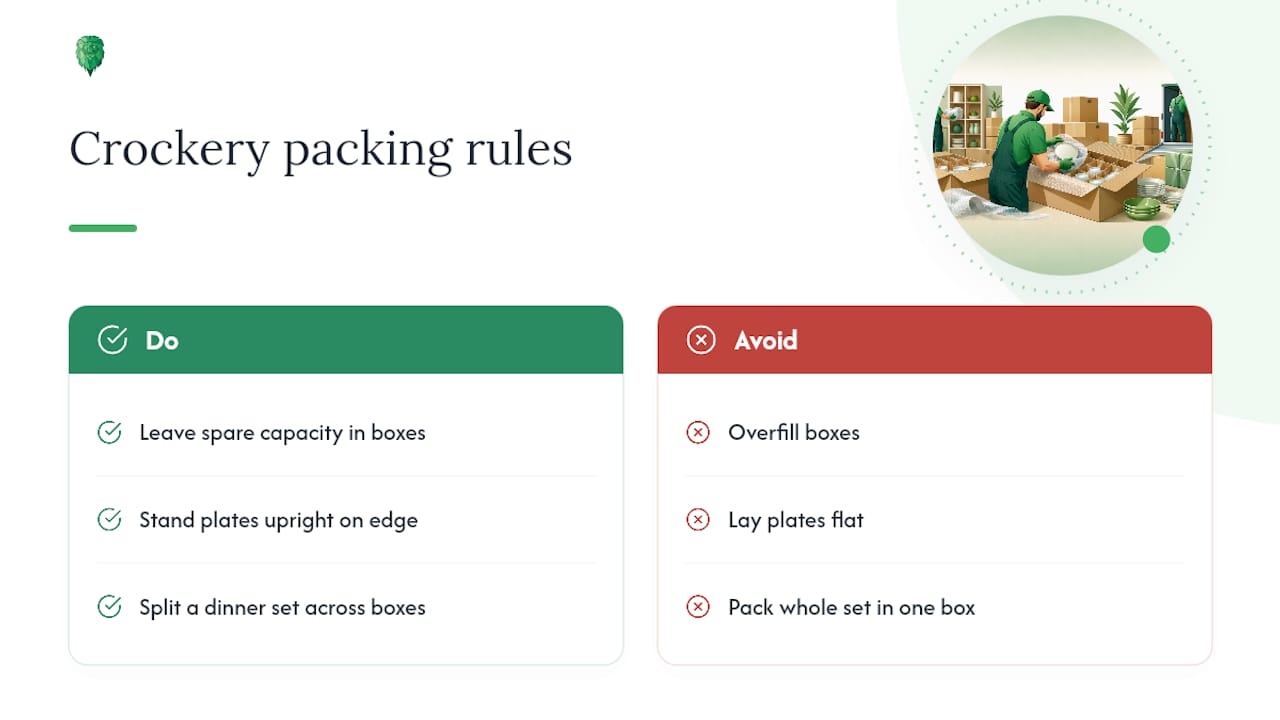
Experienced removal companies have spent many years handling this kind of job, and their teams routinely weigh up whether a customer’s own boxes will hold up against a full moving day or whether it’s safer to supply proper dish packs on the day. A booked packing service typically starts with a quick assessment of what needs protecting, followed by optional packing add-ons and fully insured handling from doorstep to doorstep, with an instant quote available before you commit to anything.
What the guides don’t tell you about packing dishes
Most packing advice treats every dish set the same, and that’s where it falls short. A set of everyday stoneware and a set of inherited bone china need different handling, yet the standard guidance gives them the same box and the same wrapping instructions. If a set matters to you beyond its replacement value, it’s worth packing it separately from your dishwasher-safe plates, even if that means buying one extra box.
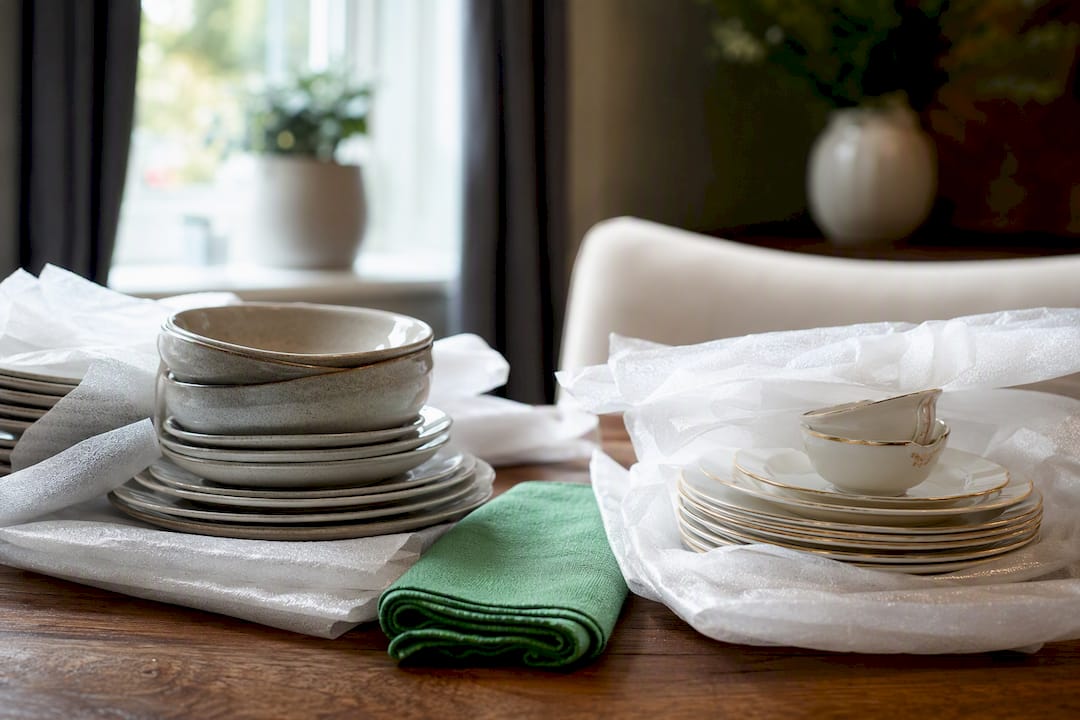
The other thing conventional advice underplays is how much damage happens after packing, not during it. A perfectly wrapped plate can still crack if the box it’s in gets tipped on its side in a van or has a wardrobe box dropped on top of it. Box choice and wrapping technique get most of the attention online, but loading order and handling on the day cause just as many breakages.
If there’s one thing to prioritise first, it’s this: buy slightly more boxes than you think you need and use fewer items per box. Under-filling a dish pack costs you a few extra pounds. Over-filling one costs you plates.
— Claudiu
Let Van-247delivery take the packing off your hands
Buying the right boxes solves half the problem, but fitting the packing in around work, kids, and everything else a move demands is a different challenge entirely. Van-247delivery offers a genuine alternative to spending your evenings wrapping plates: our packing service pairs with fully insured house removals, so your crockery, glassware, and everything else travels covered from your old kitchen to your new one.
If you’re dealing with a large dinner service, antique china, a tight moving date, or a long-distance move where damage risk climbs with every extra mile, that’s exactly when it’s worth getting a professional quote rather than gambling on DIY packing. Smaller jobs, like a single flat or a few rooms, are well suited to our man and van service instead. Either way, getting a price takes minutes: head to our house removals page for an instant quote and find out what a fully packed, fully insured move actually costs.
Sources
For exact dimensions and double-wall specs, the Pratt dish pack box listing shows the standard 18" x 18" x 28" format. Sierra Self Storage’s dish barrel box page details cell kit options and buy-back terms, while the U-Haul dish packing kit shows full kit contents including foam pouch counts. Always confirm current dimensions and pouch numbers directly with the supplier before ordering, as listings change.
FAQ
What are the best boxes for packing dishes?
A double-wall dish pack box, roughly 18" x 18" x 28" with a 51 ECT board rating, gives the strongest protection for a full crockery set. For smaller loads, a complete dish saver kit with a cell divider and foam pouches works just as well and is easier to assemble.
Can I get free boxes from supermarkets?
Some supermarkets do give away spare boxes on request, but these are usually single-wall and not designed to hold crockery safely under stacking pressure. They’re fine for lightweight items like books or linen, but dishes and glassware need proper double-wall construction to survive a move intact.
What are the best packing boxes for a house move generally?
Standard removal boxes suit clothes, books, and general household items, but dishes and glassware need specialist dish pack boxes or kits with dividers built in. For bulkier belongings like duvets or lampshades, our guide to large removal boxes covers sizing for that side of the move.
What’s the best way to pack dishes for moving?
Wrap each plate individually and stand it on edge in a cell divider rather than stacking flat, pad every gap with paper, and give cups and stemware their own foam pouch. Split larger sets across multiple boxes so one damaged box doesn’t put the whole collection at risk.
Does Van-247delivery offer a dish packing service?
Yes, packing is available as an add-on alongside house removals, with insured handling for fragile and high-value items. Pricing depends on the size of the job, so the fastest way to get a figure is through an instant online quote on the site.