Fish tank moving guide: move your tank empty, and keep the filter media wet and aerated at every stage: that’s the single most important rule in any fish tank moving guide. Fast your fish for about one to two days, bag them with water and air in appropriate proportions, and save some old tank water for chemistry continuity. Reassemble calmly, then test ammonia and nitrite daily for a fortnight.
TL;DR:
- Start planning two weeks ahead for tanks over 100 litres, check doorways and floor capacity, and test destination tap water for hardness, pH, and chloramine.
- Choose a dechlorinator rated for chloramine, since letting treated water stand will not remove it; chlorine only products are not enough.
- Save roughly 75% to 80% of tank water, and keep substrate in that water instead of rinsing it, because gravel also carries beneficial bacteria.
- At the destination, float sealed bags for 15 to 20 minutes, add tank water gradually for another half hour, and keep transport water out of the aquarium.
- Consider professional movers for tanks near or above 200 litres, reef systems, multiple tanks, or trips longer than about 65 kilometres.
Table of Contents
- Pre-move timeline and checklist
- Essential supplies and how to prepare them
- How to transport fish safely on moving day
- Moving the tank, substrate, plants and equipment
- A step-by-step sequence for moving day
- Reassembling your aquarium and settling fish in
- When to call in professional movers, and the rules that apply
- What years of removals work have taught us
- How we can help with your aquarium move
- FAQ
- Sources
Pre-move timeline and checklist, part of fish tank moving guide
A fish tank move goes far more smoothly when you treat it as a two-week project rather than a last-minute scramble. Larger setups, anything over around 100 litres, especially benefit from an early start, since there’s more livestock, more equipment and more water chemistry to manage carefully.
Here’s a simple way to break it down:
- Two weeks out: map your route, check doorway widths at both properties and confirm the new floor can bear the tank’s full weight once filled.
- One week out: service filters gently (rinse in old tank water, never tap water) but keep all media wet afterwards; begin sourcing buckets, bags and a test kit if you don’t already own one.
- Three to four days out: reduce feeding slightly and do a modest water change to lower nitrate levels before the move.
- 24 to 48 hours out: stop feeding fish entirely, collect a sample of the new address’s tap water if you can get there in advance, and label every container you’ll be using.
- The evening before: assemble all supplies in one place, charge any battery air pumps, and do a final visual health check on your fish.
Checking the route matters more than it sounds.
A tank move is not the moment to discover a staircase is too tight for your stand, or that a flight of steps outside the new property makes a careful, level carry impossible. If you’re booking a professional team, flagging these details in advance means they arrive prepared rather than improvising.
Testing the new-site tap water deserves its own line on the checklist. Hardness, pH and chloramine levels vary across the UK, and mismatched tap water is a common cause of post-move stress according to Aquacadabra’s moving guidance. Knowing the numbers before moving day lets you plan a gradual mixing strategy instead of reacting after the fact.
Essential supplies and how to prepare them, part of fish tank moving guide
Getting your supplies sorted early takes most of the stress out of moving day. The quantities scale with tank size, so it helps to think in terms of litres rather than guessing.
- Food-grade buckets with lids: plan for one bucket per 20 to 30 litres of tank water you intend to save.
- Polystyrene boxes: at least one per fish bag batch, ideally insulated, to buffer against temperature swings.
- Fish bags: doubled for every fish or small group, plus spares in case of splits.
- A reliable test kit: for ammonia, nitrite and pH, both before you leave and after you arrive.
- A dechlorinator rated for chloramine: most UK mains water is treated with chloramine rather than plain chlorine, so a basic chlorine-only product won’t fully neutralise it.
- Battery-powered air pumps: essential if your journey runs longer than an hour or so.
Chloramine matters because it’s more stable than chlorine and doesn’t dissipate by simply letting water stand, which is why a chloramine-rated dechlorinator is worth checking for specifically when you’re shopping, rather than assuming any bottle will do the job.
Filter media needs its own small operation. Keep it submerged in a bucket of old tank water with an air stone running, never sealed in a bag, since moving guidance from Peqaboo is clear that sealed bags turn anoxic quickly and kill off the nitrifying bacteria that keep your tank cycled. That bucket of media, more than anything else you pack, is what protects your tank from a full biological reset.
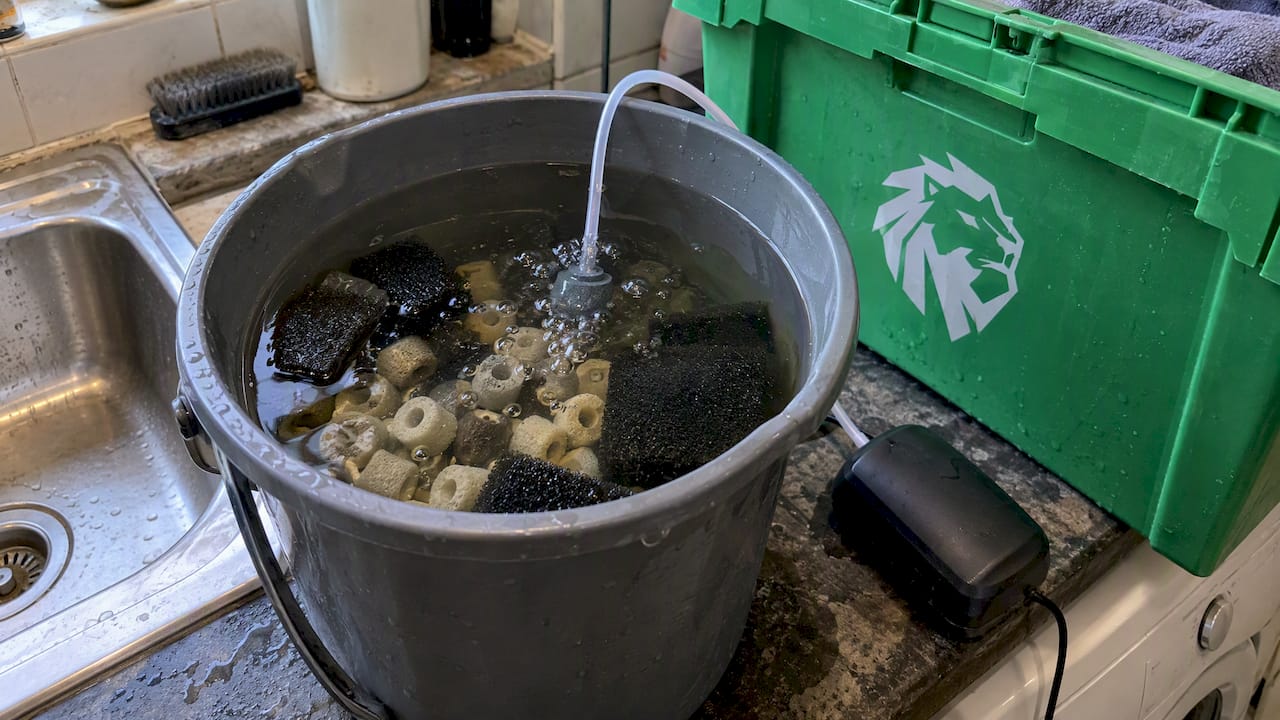
Pro Tip: Buy your battery air pump and test it a few days before the move, not on the morning itself.
How to transport fish safely on moving day, part of fish tank moving guide
Catching and bagging fish calmly reduces stress on both sides of the net. Work through the process in a fixed order so nothing gets rushed.
- Fast your fish for about one to two days before the move. Less food in their gut means less waste in the bag, and Aquacadabra notes this is standard practice among experienced movers.
- Group fish sensibly in bags. Keep aggressive or territorial species separate, and avoid overcrowding even compatible tankmates.
- Bag with roughly a third water to two-thirds air. That ratio gives enough oxygen headroom for the journey without so little water that fish are thrashed about.
- Double-bag every fish or group. One bag inside another guards against leaks and punctures from fins or sharp decor.
- Place bags inside a lidded, insulated box. Keep them upright, padded against each other, and away from direct light, since darkness has a calming effect.
- For journeys beyond an hour or two, add a battery air pump. A line into the box, even without direct contact with the bag water, helps maintain oxygen levels over a longer trip.
- Check on fish periodically without exposing them to cold draughts or bright light. Look for laboured gilling, colour loss or fish lying on their sides.
Temperature control runs through every one of these steps. Oxygen depletion and ammonia toxicity both worsen as water warms, so keeping the box in a temperature-stable part of the vehicle, not the boot in summer, not by a window in winter, is as important as the bagging itself.
Moving the tank, substrate, plants and equipment, part of fish tank moving guide
Always move the tank completely empty. A full or even partially filled aquarium under its own weight puts enormous strain on the seals and glass, and that’s true even over short distances.
- Drain most of the water into lidded containers, saving roughly 75 to 80% to bring with you, a method recommended in RemovalReviews’ UK guide to moving fish when moving home.
- Scoop substrate into a bucket of that saved tank water rather than rinsing it, since gravel carries its own share of beneficial bacteria.
- Wrap plants in damp newspaper or a sealed bag with a little tank water to keep roots and leaves from drying out in transit.
- Pad the empty tank thoroughly with towels or blankets, particularly at the corners, and always carry it supported from underneath rather than by the rim.
- Secure the tank upright in the vehicle, wedged so it cannot slide or tip during braking.
Filters, heaters and pumps split into two camps. Filter media stays wet, aerated and ideally in its own bucket, as covered above. Heaters, pump housings and empty filter canisters can travel dry, wrapped in towels to prevent cracked casings or dislodged internals. Keep cables coiled and taped rather than left loose, which avoids tangles and accidental strain on connectors when you’re unpacking in a hurry at the other end.
A step-by-step sequence for moving day, part of fish tank moving guide
Having a fixed running order on the day itself keeps everyone, including any helpers, working from the same plan rather than improvising under pressure.
- Switch off and unplug all equipment before touching anything else.
- Catch and bag fish first, while the tank is still full enough to net them without disturbing the substrate too much.
- Decant the saved water into lidded containers, then remove substrate into a separate bucket of that water.
- Transfer filter media into its aerated bucket, running the air pump continuously from this point on.
- Remove decor and plants, wrapping each as described above.
- Dry, pad and load the empty tank last, once everything else is packed and ready to travel.
- Load the vehicle with the tank secured upright, fish boxes kept level and stable, and media bucket positioned where it won’t tip.
- At the new address, set the tank down on a levelled, padded stand before anything else goes back in.
For a tank this complex, two people make the job considerably easier: one to manage fish and water, one to handle the tank and equipment. Agree a rough timing with your driver in advance, particularly for longer journeys, so stops are planned rather than improvised.
Pro Tip: Keep a small emergency kit in the car, spare bags, a battery pump and extra dechlorinator, in case a bag leaks or a journey runs longer than expected.
If a leak happens, transfer fish into a spare bagged container immediately rather than trying to patch the original. If a journey is delayed and oxygen looks low, gently agitate the bag water or add the battery pump line at the next safe stop.
Reassembling your aquarium and settling fish in, part of fish tank moving guide
Set the tank down on a level, padded stand before anything else happens, since an uneven base puts uneven pressure on the glass over time. Fill it, then run the filter and heater for several hours before any fish go back in, giving the water time to reach a stable temperature and the filter time to start circulating properly.
- Pour saved tank water in first, then top up with treated new tap water to reach normal levels.
- Float sealed fish bags in the tank for 15 to 20 minutes to equalise temperature gradually.
- Add small amounts of tank water into the bag every few minutes over the following half hour, rather than tipping fish straight in.
- Never pour transport water into the display tank, since it may carry ammonia built up during the journey.
- Reduce feeding for the first few days while the tank settles.
A mini-cycle after the move is normal, even when you’ve done everything right. A two-week daily testing window for ammonia and nitrite is a reliable rule of thumb, according to Peqaboo’s guidance on moving without losing the cycle, and acting quickly on any detectable rise, through a partial water change, usually prevents real harm. Watch for gasping at the surface, lethargy or loss of appetite beyond the first day or two, which are signs worth taking seriously rather than waiting out.
When to call in professional movers, and the rules that apply
Some moves are straightforward enough to handle yourself with a well-stocked boot and a careful plan. Others genuinely call for specialist help.
- Large tanks, generally anything approaching or exceeding 200 litres, are heavy, awkward and unforgiving of a dropped corner.
- Reef systems and multi-tank setups carry more livestock, more equipment and more that can go wrong without experienced hands.
- Journeys beyond around 65 kilometres raise genuine welfare questions around oxygen, temperature and timing that are worth planning for properly.
- Any move where you simply can’t dedicate enough hands or hours to doing each stage without rushing.
UK transport standards exist for good reason. The OATA Transport Code sets out packing standards, including the bag ratios and double-bagging covered earlier, clear “Live fish” labelling, and authorisation thresholds for transporters carrying livestock over longer distances. It’s worth asking any removal company directly whether they hold the relevant authorisation for a journey of this length before booking.
When you do bring in a professional team, provide all relevant details such as tank volume, number and type of fish, approximate journey distance and timing. This information helps the team plan the vehicle, padding and scheduling properly rather than working it out on the day.
What years of removals work have taught us
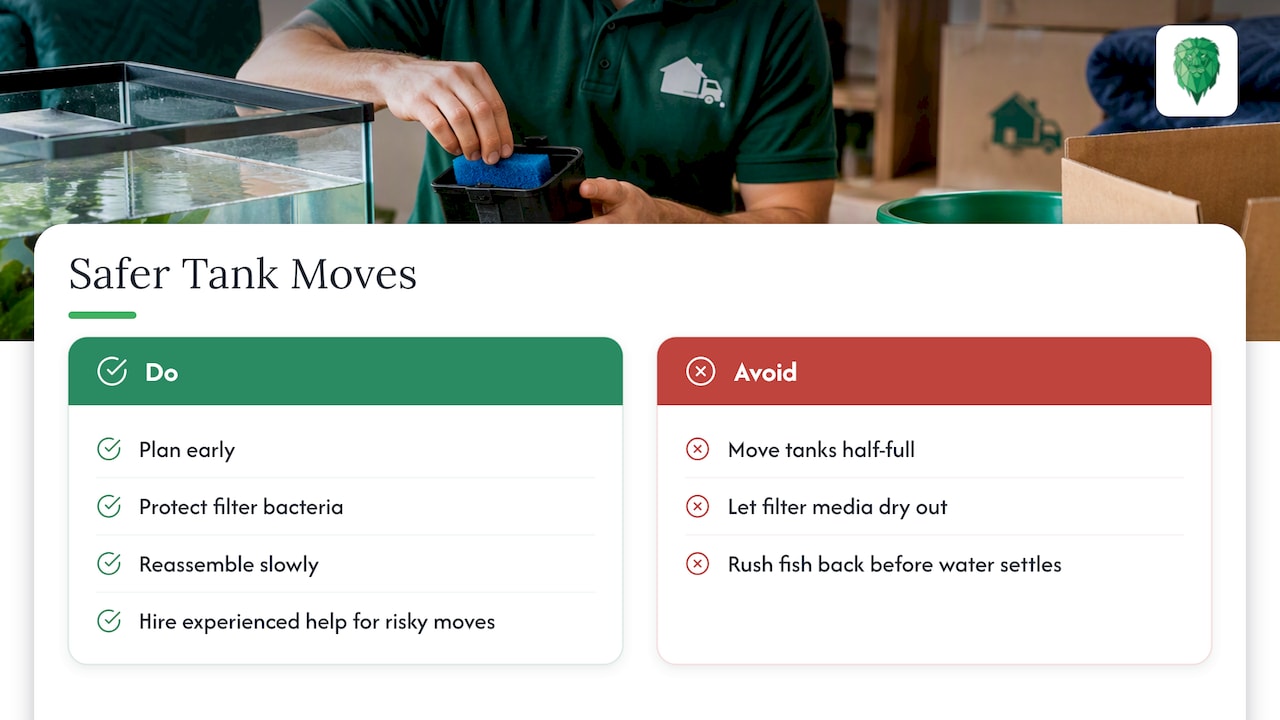
Media-first thinking is the one habit that separates a smooth tank move from a stressful one. We’ve seen the same mistakes repeat themselves: tanks moved half-full “just to save time,” filter media left to dry out in a forgotten bag, fish rushed back in before the water’s even settled. Every one of those shortcuts costs more time in the long run, usually in the form of a stressed or lost fish and a cloudy, mini-cycling tank for weeks afterwards.
Planning early, protecting the bacteria in your filter and moving slowly on reassembly will take you further than any amount of expensive equipment. For a large tank, a long journey or livestock you’d rather not risk, bringing in an experienced team is worth it, and we’re always glad to talk through the details with you.
— Claudiu
How we can help with your aquarium move
Moving a fish tank sits somewhere between fragile-item logistics and a genuine animal welfare job, which is exactly the overlap our house removals and furniture and large items services are built to cover. We handle padding, carrying and securing awkward, heavy or fragile pieces as a matter of course, and that includes aquariums, stands and the equipment that goes with them.
Alongside the tank itself, we offer packing, disassembly and insured transport, so the stand, cabinet and any glass canopy travel as safely as the tank does. When you request a quote, it helps to tell us the tank’s volume in litres, roughly how many fish or other livestock are involved, the distance between properties and your preferred moving date. We’ll factor in waiting time, currently £24 per hour per man, and talk through any storage or unpacking support you might need at the other end. Insurance and a clear plan for the day mean one less thing for you to worry about while your fish are in transit.
FAQ
How do I move house with a large fish tank?
For tanks over around 200 litres, drain the water into lidded containers, move the tank completely empty and keep filter media wet and aerated throughout. Given the weight and fragility involved, many owners choose a professional removals team for tanks this size, particularly over longer distances.
What is the fish tank rule for moving?
The core rule is to move the tank empty and never with water or substrate inside, since the weight puts serious strain on the seals and glass. Filter media should travel wet in a bucket of old tank water with aeration running, since the bacteria that keep your tank cycled live on the media, not in the water itself, according to Peqaboo’s guidance.
How do I know if my fish are settling into their new tank?
Fish that are adjusting well will swim normally, show interest in food within a day or two and display their usual colouring. Watch for warning signs over the following fortnight, such as gasping at the surface, lethargy or loss of appetite, and test ammonia and nitrite daily during that window, acting on any rise with a partial water change.
What should I do with an old fish tank I no longer need?
An empty tank in good condition can usually be sold, donated to a local aquarium club or given away through community listings rather than thrown out. If it’s cracked or beyond use, check with your local council on glass disposal rules, since most standard household recycling doesn’t accept aquarium glass.
How long does it take for a fish tank to re-cycle after a move?
Expect a mini-cycle rather than a full restart if filter media has been kept wet and aerated throughout the move. A two-week window of daily ammonia and nitrite testing is a reliable rule of thumb for catching and correcting any rise before it affects your fish, as outlined by Peqaboo.
Sources
- Peqaboo — Moving a tank without losing the cycle
- OATA — Transporting aquatic livestock: code and packing standards (Oct 2022)
- Aquacadabra — How to move a fish tank safely
- RemovalReviews — How to move fish when moving home (UK)