Kerbside delivery meaning : the driver brings your goods to the nearest safe, legal point outside your property and unloads them there. They do not carry the items into your home, garden, garage or any other spot on site. It sounds simple, but it catches out plenty of people, especially with heavy pallets and bulky furniture. Here is what it means in practice, what you need to arrange beforehand and what to do if you need more than a drop at the kerb.
TL;DR
- Kerbside delivery means the vehicle stops as close as it safely and legally can, and the goods are unloaded there, not carried inside.
- The “kerb” is not always right outside your door. It is the nearest accessible point, which depends on the road, parking rules and vehicle size.
- Have someone present, enough people to unload safely, a clear drop-off area, and tell the supplier about any access problems before dispatch.
- If access was not flagged or nobody can unload, the delivery may fail and you may pay for a redelivery.
- If you need items carried into a room, you need a different service from a standard kerbside drop.
Table of Contents
- What kerbside delivery actually means
- Where the goods actually end up
- What kerbside delivery does not include
- Why pallet deliveries are almost always kerbside
- How to prepare for a kerbside delivery
- What happens if the vehicle can’t reach you
- Safety: why drivers can say no
- Insurance and fragile items
- Kerbside, room of choice and white glove: the difference
- When you need more than a kerbside drop
- How we can help
- Common kerbside problems and simple fixes
- FAQ
- Sources
What kerbside delivery actually means
In the UK, “kerbside” is simply the spelling of curbside: the area where the road meets the raised pavement. Kerbside delivery is a delivery that ends there. One UK retailer’s help centre describes it as the driver stopping the vehicle as close as is safely and legally possible to the delivery address, without carrying goods into the home, building, garden, garage or a specific area on site.
Other suppliers say the same thing in slightly different words. One tile seller explains that the order goes to the nearest safe and accessible point, usually the pavement, and that the driver cannot move goods inside the home or garden. A wood fuel supplier says kerbside delivery involves unloading palletised goods onto a safe, stable spot at the kerb, without help getting items from the kerb into a building.
So the core idea is always the same: the vehicle stops, the goods come off, and the driver’s job ends at the vehicle’s nearest accessible point.
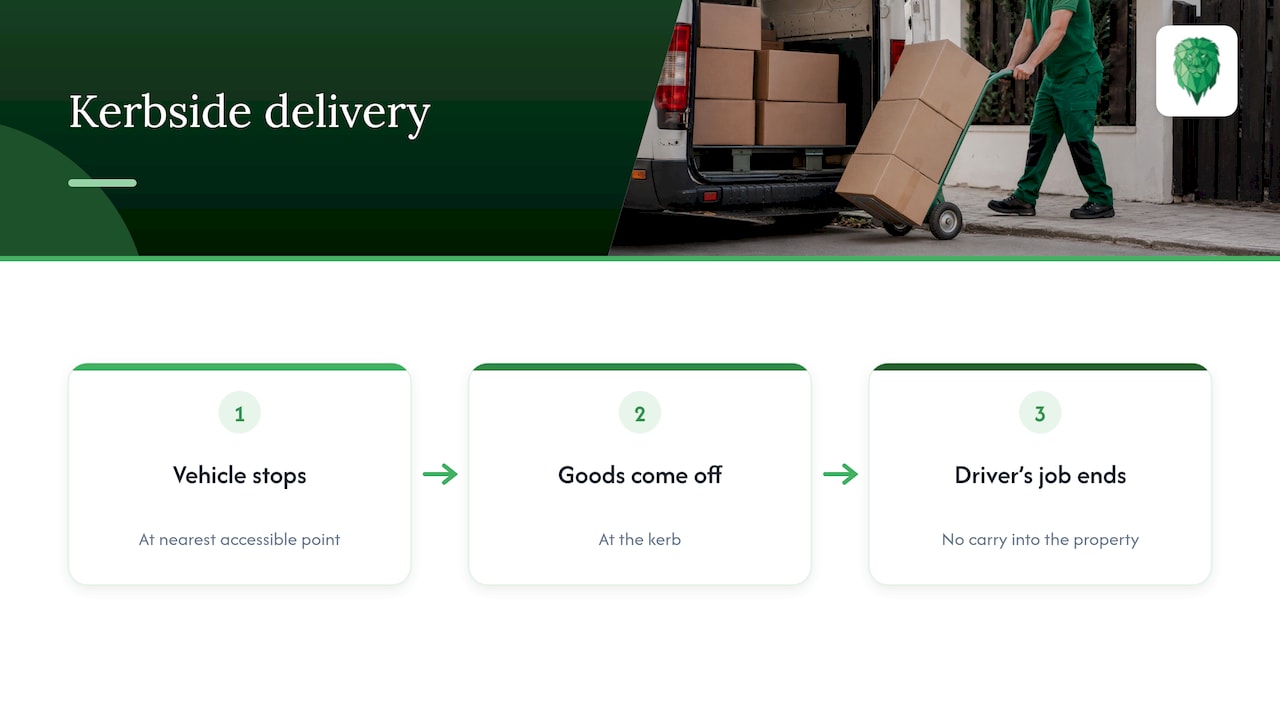
The short version in plain words for kerbside delivery meaning
Think of it as “delivered to the road”, not “delivered to your room”. If you order a pallet of paving slabs, a washing machine or a wardrobe on a kerbside service, you are the one who gets it from the pavement to where it lives.
Where the goods actually end up, part of kerbside delivery meaning
Many people picture the lorry pulling up at the front gate. Sometimes it does. Often it doesn’t. Where goods can be unloaded depends on the delivery location, vehicle access and whether it is safe and legal to stop, so drivers cannot always unload directly outside the property.
That means “the kerb” might be:
- Directly outside your front door, on a quiet residential street.
- A few doors down, because of parked cars or a narrow road.
- The end of a lane, if the lorry cannot turn or the surface is unsuitable.
- The nearest legal stopping point on a busy road with parking restrictions.
The driver decides what is safe on the day. That is not them being awkward. A large vehicle on a tight street, a low bridge or a steep hill can make the “obvious” spot unusable.
What kerbside delivery does not include, part of kerbside delivery meaning
This is the part that surprises people. A standard kerbside drop does not cover:
- Carrying goods through the front door or into a particular room.
- Moving items to a garden, garage, driveway or rear access area.
- Taking goods upstairs or into a lift.
- Unpacking, assembling or placing furniture.
- Removing packaging.
Suppliers spell this out in their delivery terms. One shipping policy says the driver is not required to move goods into the property, garden, garage, driveway, rear access area or an upstairs location. Another says drivers are not insured or permitted to move pallets beyond the kerbside.
That insurance point matters. If a driver does help you out of kindness, they may be going beyond what their cover allows, which is why many politely decline.
Why pallet deliveries are almost always kerbside, part of kerbside delivery meaning
If you are searching this phrase, there is a good chance you have ordered something on a pallet. Pallets are heavy, awkward and often arrive on a lorry with a tail-lift and a pallet truck. The driver lowers the pallet and wheels it to the nearest suitable point. Beyond that, it is down to you.
A pallet can weigh hundreds of kilos. Moving one across gravel, up a driveway slope or through a side gate needs the right kit and people who know how to use it. We go into this in more detail in our guide to kerbside pallet delivery, and if you are new to pallets generally, our explainer on what pallet delivery is is a good starting point.
How to prepare for a kerbside delivery, part of kerbside delivery meaning
Moving day is a marathon, not a sprint, and delivery day is no different: a little prep makes it far smoother. Based on what UK suppliers ask of their customers, here is a sensible checklist.
1. Make sure someone is there
Someone needs to be available to receive the order and check it. If nobody answers, the driver may not be able to leave it, and you could face a failed delivery.
2. Line up enough people to unload
Suppliers ask customers to arrange enough manual help to unload the goods safely, and not to assume the driver can assist. For heavy, bulky items, that means more than one pair of hands. For a pallet of loose items such as bags or boxes, you may need to break the load down and move it in stages.
3. Clear and check the drop-off area
The unloading area should be accessible and safe. Move parked cars if you can, clear the pavement and check the surface is stable. If you need a bay or cone placed, sort it before the day.
4. Tell the supplier about access problems early
One supplier asks you to flag access restrictions before dispatch, such as narrow roads, low bridges, weight restrictions, steep hills, gravel or uneven surfaces and parking restrictions. If you do not mention them and the delivery cannot be completed, you may be responsible for the charges.
5. Plan where the goods will go next
Decide in advance how you will get things from the kerb to their final spot. Do you need a sack truck, a pallet truck, ramps or extra people? Measure doorways and stairs too. It is far easier to solve this before the lorry arrives than while a pallet sits on the pavement.
6. Check the goods before the driver leaves
Look over the delivery while the driver is still there and note any visible damage on the paperwork. It is much easier to sort out at that moment than later.
What happens if the vehicle can’t reach you, part of kerbside delivery meaning
If access restrictions were not shared in advance, or there are not enough people to unload, the delivery may be unsuccessful and redelivery charges may apply. That is a frustrating and avoidable cost.
The fix is almost always communication. A quick note about a narrow lane or a steep drive at the time of booking lets the supplier choose a suitable vehicle or plan around it.
Safety: why drivers can say no. Part of kerbside delivery meaning
Unloading is not risk-free. The Health and Safety Executive notes that common causes of workplace transport accidents include people falling from or being struck by a vehicle, and objects falling from a vehicle. That is why drivers can refuse an unsafe unload.
The same HSE guidance says drivers should know they are authorised to refuse or stop loading or unloading for safety reasons, and that this should be confirmed with the recipient when the delivery is arranged. If the delivery is to a business site, it also advises agreeing safety arrangements, preferably in writing, before work starts.
In practice, this means:
- Keep children and pets away from the unloading area.
- Stay clear of the vehicle while the tail-lift is working.
- Do not push the driver to unload somewhere unsafe, such as a blind bend or a soft verge.
- Use proper lifting technique and enough people for heavy items.
If you are unsure about handling a heavy load, a professional mover is a sensible option rather than a risk to your back.
Insurance and fragile items, part of kerbside delivery meaning
Kerbside terms often put the responsibility for the offload on the customer. One retailer says customers must have enough labour and equipment ready at delivery, including a forklift if necessary, to offload bulky goods and bring them from the kerb into the property. It also says customers are responsible for arranging any necessary insurance for offloading.
So before you accept a kerbside delivery of anything fragile or valuable, ask yourself who is handling the item after the driver leaves. If the answer is “me and a friend”, think about whether that is wise for a marble worktop, a glass cabinet or a heavy appliance.
Kerbside, room of choice and white glove: the difference. Part of kerbside delivery meaning
Delivery terms vary between suppliers, but the usual levels look like this:
| Service level | Where the driver stops | Who carries the goods inside | Typical use |
|---|---|---|---|
| Kerbside | Nearest safe, accessible point outside | You | Pallets, building materials, bulky items |
| Doorstep | At your front door or entrance | You, beyond the door | Parcels, small furniture |
| Room of choice | Inside your property, in the room you pick | The delivery team | Furniture, appliances |
| Full service | Inside, with assembly and packaging removal | The delivery team | Larger furniture orders |
Names differ by supplier, so check what your order says. The point is that kerbside is the most basic option and the one that leaves the most work with you.
When you need more than a kerbside drop. Part of kerbside delivery meaning
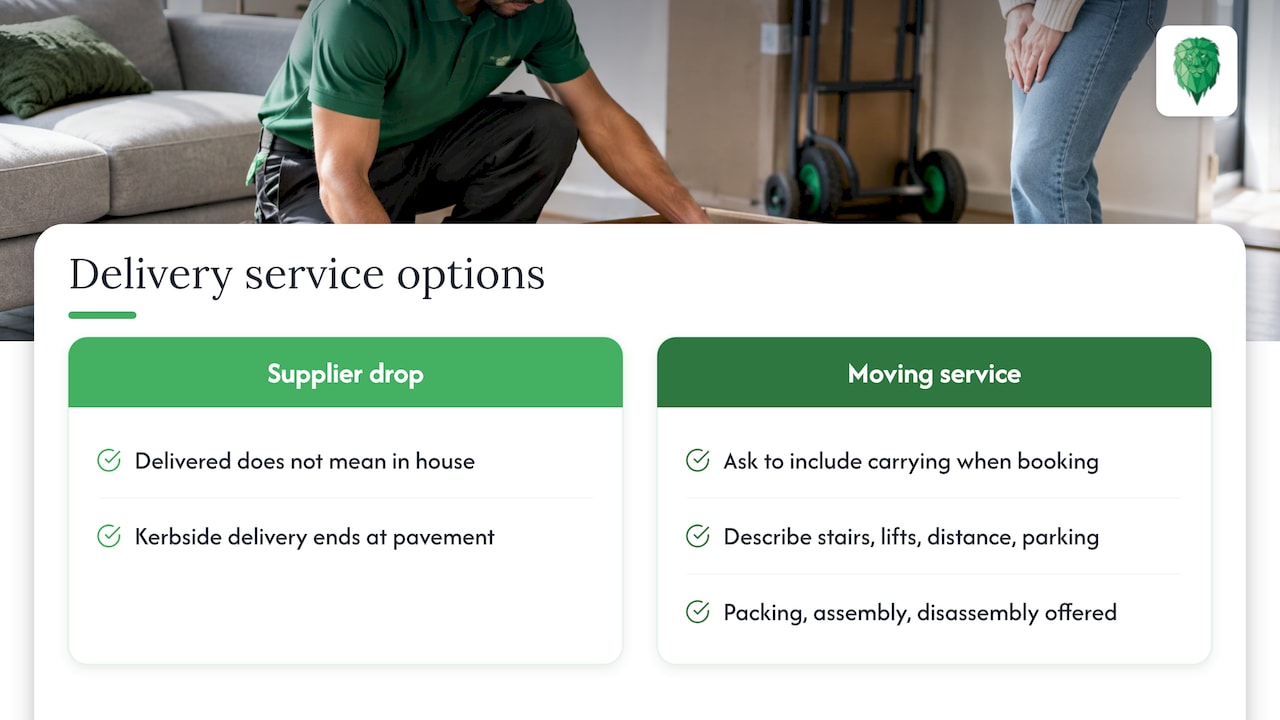
Sometimes the kerb is just not good enough. Maybe you live up three flights of stairs, down a long drive, or you are moving a piano that nobody should be lifting without training. Or you simply want the item inside, in the right room, without lifting a finger.
That is where a moving or courier service comes in, rather than a standard supplier delivery. Whether it is a sofa, a wardrobe, a pallet that needs taking beyond the pavement or a whole house, ask for the carrying to be included when you book, and say clearly what the route looks like: stairs, lifts, distance from the van, parking.
Our view: the kerb is where the planning starts
We have been moving things around the UK for over 15 years, and the most common surprise we hear about is the gap between “delivered” and “in the house”. Customers often assume the two are the same. With kerbside delivery they are not.
Our advice is simple: decide what “delivered” means to you before you book. If you want the goods in a room, say so and say where the room is. If you are expecting a pallet, tell whoever is sending it about the access, and look at how to prepare it properly. Our palletising guide and our piece on pallet delivery safety standards cover the practical side.
For large, fragile or valuable items, we think a team that handles them every day is the calmer choice. That is why we offer insured transport, and services such as packing, assembly and disassembly alongside the move itself, so the job does not stop at the pavement.
Claudiu
How we can help
If you want your items collected, moved and brought where they need to go, we can help. We offer pallet delivery across the UK, furniture and large item transport, piano removals, house removals and office relocations, plus extras like packing, storage, and furniture assembly and disassembly. Prices are quoted per job, and you can get an instant online quote.
When you ask for a quote, tell us about stairs, lifts, narrow roads and parking, and what you need carried and where. It helps us plan the right team and vehicle. If a job runs longer than planned because access was not as described, our published waiting time fee is £24 per hour per man, so a quick heads-up on the details can save you time and money.
Want to understand the wider picture first? Our guide to types of freight delivery explains the options, and our pallet delivery process article shows what happens from collection to drop-off.
Common kerbside problems and simple fixes, part of kerbside delivery meaning
| Problem | Why it happens | What helps |
|---|---|---|
| Driver stops down the road | Parked cars, narrow street, restrictions | Tell the supplier about access in advance; clear space if you can |
| Nobody to unload | Customer assumed the driver would help | Arrange helpers before the day |
| Delivery fails | Access issue not shared, or not enough help | Share details early to avoid redelivery charges |
| Goods stuck on the pavement | No plan for moving them on | Plan equipment, route and people ahead |
| Damage found later | Goods not checked at the time | Inspect and note issues before the driver leaves |
FAQ
What is meant by kerbside delivery?
It means the driver delivers to the nearest safe and legal point outside your property, usually the pavement or roadside, and unloads there. The driver does not carry the goods into your home, garden or garage. You are responsible for moving them from that point.
Does kerbside delivery mean right outside my front door?
Not always. The driver stops as close as is safe and legal, which may be a few doors away if the road is narrow or parking is restricted. If you know of access problems, tell the supplier before dispatch so they can plan for them.
Can the driver help me carry things inside?
Usually not. Many suppliers state that drivers are not required, and in some cases not insured or permitted, to move goods beyond the kerb. If you need items carried in, ask for a service that includes it, such as a furniture courier or removals team, when you book.
What happens if I can’t take the delivery at the kerb?
If nobody can receive or unload the goods, or the access issue was not flagged, the delivery may fail and redelivery charges may apply. Check your supplier’s terms and arrange help before the delivery day.