Kerbside pallet delivery means the driver brings your pallet to the edge of the road or the boundary of the property, lowers it to the ground and leaves it there. Moving it from the kerb to your door, garage or warehouse is down to you. It is the standard way pallets travel in the UK, and it works smoothly once you know who does what. Here is the plain-English version, plus a checklist so nothing catches you out on the day.
TL;DR
- Kerbside usually means the pallet is lowered to the ground at the kerb or the property entrance. The driver does not carry it inside.
- Have people, a pallet truck or a plan ready to move the load from the kerb, and be there to sign for it.
- Give the carrier the true size, weight, postcode type and access details when you book. Surprises on the day are what cost money.
- Wrap and secure the load as one unit, protect edges and photograph it before it leaves and again on arrival.
- Need a hand beyond the kerb? Ask for extra help when you book, not when the lorry arrives.
Table of Contents
- What kerbside pallet delivery actually means
- How the delivery works, step by step
- What you need to arrange at each end
- Pallet sizes, weights and access: what can change the delivery
- How to pack and secure a pallet
- What affects the cost of kerbside pallet delivery
- Checking the pallet on arrival
- A kerbside checklist for the day
- When kerbside is not enough
- Our view on kerbside pallet delivery
- Book your pallet delivery with us
- FAQ
- Sources
What kerbside pallet delivery actually means
Think of it as delivery to the pavement, not into the house. The vehicle pulls up as close as it safely and legally can. The driver uses a tail lift and a manual pallet truck to bring the pallet down to ground level, then hands over the paperwork. Palletise.co.uk’s buyer guide makes the same point: kerbside means kerbside, and moving the goods onwards is the recipient’s responsibility, so plan for it rather than assuming the driver will help.
A tail lift is a hydraulic platform on the back of the vehicle. Paving Slabs UK explains that the driver lowers the pallet to the ground and moves it with a manual pallet truck, which it describes as the most widely used method for pallet deliveries across the UK. That is exactly what most people picture when a booking says “kerbside”.
What the driver normally does:
- Arrives within the agreed day or time window.
- Lowers the pallet to the ground with the tail lift.
- Moves it a short distance off the vehicle with a pallet truck.
- Asks you to check the goods and sign.
What the driver normally does not do:
- Carry boxes or items off the pallet and into the building.
- Take the pallet up steps, along a long drive or through a narrow gate.
- Unwrap, unpack, assemble or remove packaging.
None of this is a problem. It simply means the last few metres need a plan, and we will get to that below.
How the delivery works, step by step, part of kerbside pallet delivery
A kerbside pallet delivery has the same rhythm whether you are sending a pallet of tools, boxed furniture or stock for a small shop.
- Collection. The driver collects from the sender, checks the pallet looks sound and loads it.
- Transit. Your pallet travels on its own or alongside others, depending on the service you choose.
- Delivery booking. You are told the delivery day, and often a time window, so you can be ready.
- Arrival. The driver parks as close as is safe, lowers the pallet and brings it to the kerb.
- Check and sign. You look the load over, note anything wrong on the paperwork and sign.
- Moving it on. The pallet is yours to move from the kerb to where it needs to be.
If you want the bigger picture of how a pallet journey fits together, our guides on the pallet delivery process and what pallet delivery is cover it from collection to signature.
What you need to arrange at each end, part of kerbside pallet delivery
A smooth delivery is mostly about preparation. Here is who needs to do what.
The sender
- Give accurate dimensions and weight. Measure the pallet with the load on it, including any overhang.
- Describe the goods honestly, especially if they are fragile, valuable or an awkward shape.
- Wrap and secure the load (more on that below).
- Label the pallet clearly with the delivery address and a contact number.
- Make sure someone is available at collection.
The recipient
- Be there, or have a named person there, to inspect and sign.
- Know where the pallet will go once it is off the vehicle.
- Have a pallet truck, a few helpers or a trolley and a plan for breaking down the load if needed.
- Check there is room for a large vehicle to stop. Parked cars, low branches and narrow roads are the usual culprits.
- Tell the carrier about anything unusual: a steep slope, a gated entrance, a shared yard, restricted delivery hours.
Moving the pallet from the kerb
This is the part people forget. A loaded pallet is heavy and does not roll on tarmac, grass or gravel. Your options are:
- A manual pallet truck on a flat, firm surface, which is the easiest option for a pallet that stays whole.
- Breaking the pallet down at the kerb and carrying items in by hand, with enough people to lift safely.
- Booking extra help so the goods are carried inside for you.
If the pallet holds household goods, furniture or something fragile and heavy, hand-carrying is not always sensible. This is where a team with the right kit is worth having.
Pallet sizes, weights and access: what can change the delivery, part of kerbside pallet delivery
Size and shape
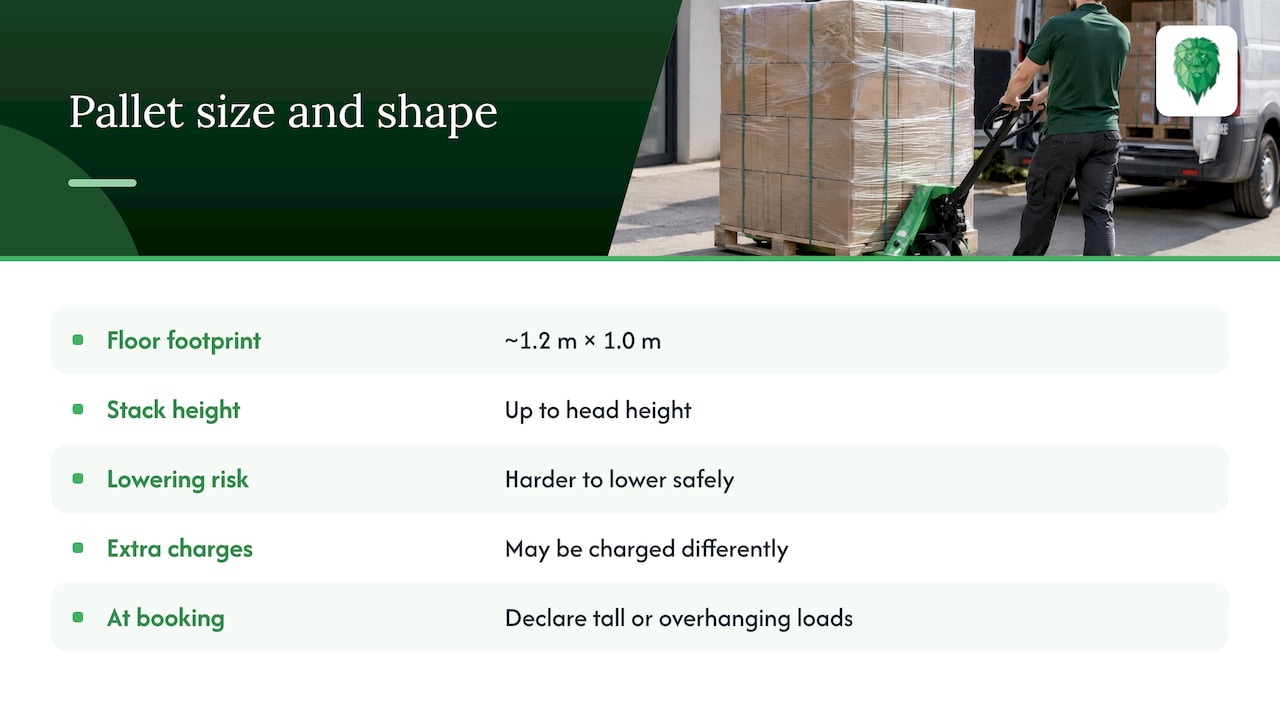
Palletise.co.uk’s guide describes a standard UK pallet as roughly 1.2m by 1.0m on the floor, which can be stacked to head height. A tall, top-heavy or overhanging load is harder to lower safely and may be charged differently, so say so at booking. If you are working with the Euro size instead, our Euro pallet dimensions guide has the measurements.
Weight
Weight decides how the pallet can be moved at both ends. A heavy pallet needs a proper pallet truck and a firm, level surface. Our guide to pallet weight limits in the UK explains the usual 1,000 to 1,200kg range and how to avoid reweighs.
Access to the property
Before you book, walk the route from the road to where the pallet will end up and ask yourself:
- Can a large vehicle reach the address, and is there a safe place to stop?
- Is the ground firm and level, or is it a soft verge, gravel or a slope?
- Are there steps, kerbs, gates or narrow gaps?
- Is it a residential street with parking pressure, a business park or a shared access?
- Are there time limits, such as school-run hours or a loading bay booking system?
If the vehicle cannot get close, say so at the quote stage. A different vehicle, a different time or a different drop point is far easier to arrange in advance than at the kerb with the engine running.
Type of goods
Building materials, boxed stock, machinery parts, furniture and household items all travel by pallet. Fragile, valuable or unusually shaped items deserve a mention when you book so they are loaded and handled with care.
How to pack and secure a pallet, part of kerbside pallet delivery
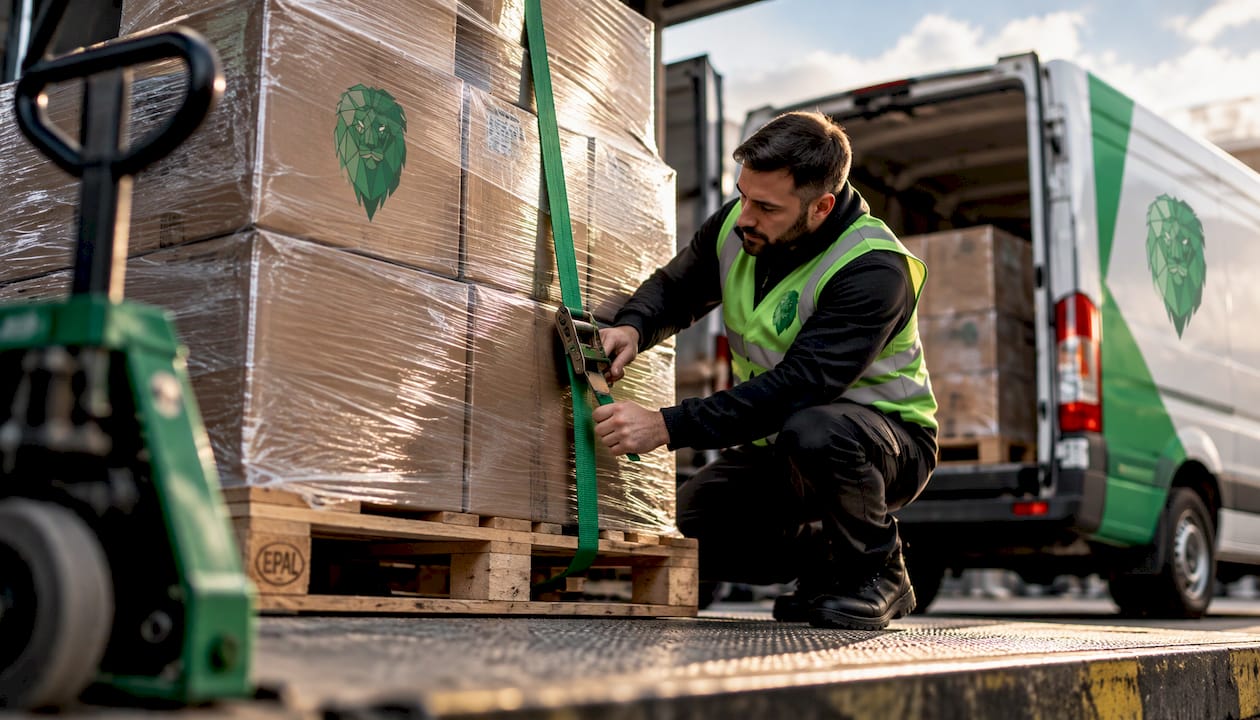
A well-built pallet behaves as one solid unit. The government’s guidance on securing loads on goods vehicles says to secure the load to the pallet so that it forms a single unit before it goes on the vehicle, using shrink wrap, banding or strapping. For fragile or crushable loads, it suggests a snug positive fit, a bungee sheet, or strapping over edge protectors.
In practice:
- Start with a sound pallet. No cracked boards or loose nails.
- Build a stable base. Heaviest items at the bottom, lighter ones above, with no overhang past the pallet edges.
- Fill the gaps. Empty space lets boxes shift. Use cardboard or padding to make the layers tight.
- Protect the edges and corners. Edge protectors stop strapping from cutting into cartons.
- Wrap it properly. Shrink wrap over the whole load and base, finishing with a few firm turns around the bottom to lock it to the pallet.
- Add a top sheet or cap if the load is going to sit outdoors for any time.
- Label two sides with the address and contact number.
For a step-by-step walk-through with photos in mind, see our palletising guide, and for the safety side of things, our pallet delivery safety standards.
What affects the cost of kerbside pallet delivery
We do not publish a fixed price for kerbside pallet delivery, because the right price depends on the job. What we can tell you is what usually moves a quote up or down:
- Distance and route. Longer journeys and remote postcodes cost more.
- Size and weight. A pallet that goes over standard dimensions or weight is priced differently.
- Speed. Same day and timed delivery are priced differently from a standard service.
- Access. Hard-to-reach addresses, restricted areas or the need for a different vehicle can change the price.
- Extras. Help beyond the kerb, packing or assembly are add-ons.
- Waiting time. If the driver has to wait because nobody is ready to receive the pallet, waiting time is charged at £24 per hour per man.
The most reliable way to keep a quote steady is to give complete details at booking. Accurate size, weight, access notes and a named contact are what stop a figure changing later.
Checking the pallet on arrival, part of kerbside pallet delivery
Even a well-packed pallet can take a knock. A few minutes at the kerb protects you.
- Photograph the pallet before the wrap comes off, with the driver still there.
- Look for visible damage: crushed corners, torn wrap, leaning stacks, wet patches.
- Write any damage on the delivery paperwork before you sign.
- Report problems the same day.
That order is the one Palletise.co.uk recommends: photographs first, a note on the paperwork, and a same-day report to the supplier. The guide also says transit damage is almost always something a supplier can help with when it is reported straight away with evidence, and almost never when it comes to light a fortnight later. If you want a practical example of what good photo evidence looks like, this advice on damaged items on delivery walks through the same habits.
If the driver cannot complete the delivery, for example because nobody is there or the vehicle cannot reach the address, the carrier will contact you to rearrange. Keep your phone nearby on the day and share a second contact number when you book.
A kerbside checklist for the day, part of kerbside pallet delivery
The day before
- Confirm the delivery window and the contact number the driver will call.
- Clear the space where the vehicle will stop and where the pallet will be placed.
- Move parked cars if you can.
On the day
- Have your pallet truck or helpers ready before the vehicle arrives.
- Keep children and pets away from the unloading area.
- Check, photograph, note and sign, in that order.
Afterwards
- Move the pallet to its final spot soon. Leaving it on the pavement is not a good idea, and an open pallet in the rain is not good for the goods.
- Keep the paperwork and photos until you are completely happy.
When kerbside is not enough, part of kerbside pallet delivery
Sometimes the goods are heavy, fragile or valuable enough that kerbside is not the best fit. Think of a piano, a large wardrobe, boxed appliances or office equipment. In those cases it makes sense to ask for a service that carries the items inside, instead of working out how to move a heavy pallet over a drive. That might be our furniture and large item delivery, or our specialist piano transport.
Our view on kerbside pallet delivery
Moving day is a marathon, not a sprint, and pallet deliveries are no different. Most of the stress comes from the last few metres, not from the motorway miles.
Our experience of more than 15 years in moving and logistics is that the easiest deliveries are the ones where everyone knew what “kerbside” meant before the vehicle turned up. So we encourage customers to tell us about the access, the weight and the people on site when they book. It takes two minutes and it saves everybody an awkward conversation on the pavement.
We also like to give you options. A pallet that goes to the kerb is fine for many jobs. If you would rather not lift, carry or push, tell us and we can talk through help with handling, packing, assembly and insured transport that suits the load. Our aim is a delivery that feels calm, not a puzzle you solve at the kerb.
Claudiu
Book your pallet delivery with us
We collect and deliver pallets across the UK, with flexible booking and insured transport. Tell us what you are sending, where it is going and how it can be accessed, and we will help you choose a service that fits.
Ready to go? Start with our pallet delivery service for an instant quote, or read more on UK pallet delivery and transport. If you also need packing, assembly or a man and van to carry things inside, you can arrange those through our main booking page.
FAQ
Does the driver carry my pallet into the house?
No, not on a standard kerbside service. The driver lowers the pallet to the ground at the kerb or the property entrance and you take it from there. If you want items carried inside, ask for extra help when you book.
Do I need to be in for a kerbside pallet delivery?
Yes, or a named person should be. Someone needs to check the goods, note any damage on the paperwork and sign. If nobody is there, the delivery may fail and waiting time can be charged at £24 per hour per man.
What should I do if my pallet arrives damaged?
Photograph it before the wrap comes off, with the driver present, and write the damage on the delivery paperwork before signing. Then report it the same day with your photos. Reporting quickly gives you the best chance of getting it sorted.
How should I pack a fragile pallet?
Build a tight, stable load with the heaviest items at the bottom and no overhang. Use edge protectors and fill gaps, then shrink wrap or strap everything into one unit. Tell us the load is fragile when you book so it is handled accordingly.
Can I get a pallet delivered if the vehicle cannot reach my address?
Often yes, but tell us at the quote stage. We can talk through a different drop point, timing or vehicle so the delivery still works on the day.