Narrow street access removals: the best approach to narrow street access removals is simple: survey the route first, sort out council parking permission early, and match your vehicle and equipment to what the street will actually allow. Measure and photograph every tight point, tell your building manager or council if you need a suspension, and brief your removals provider before moving day arrives. Skip these steps and you risk delays, damage or a Penalty Charge Notice instead of a smooth exit.
TL;DR:
- Survey the route carefully, measure doorways and stairwells, and photograph all potential pinch points to avoid delays and extra handling costs.
- Obtain necessary parking suspensions or dispensations at least 10 working days in advance to guarantee legal stopping points and avoid fines.
- Choose the appropriate handling strategy, such as dismantling or using mechanical aids, based on detailed measurements, and decide whether a relay or shuttle service is needed before move day.
- Book your removal service early, share measurements and permit confirmations, and prepare by labeling items, packing sturdily, and briefing the crew on route challenges.
- Avoid assumptions about parking; always verify access permissions, as unofficial signs do not guarantee space, and plan for extra time if using relays or shuttles to prevent cost overruns.
Table of Contents
- Why narrow-street removals need a different plan
- How professionals plan a narrow-access removal
- Your moving timeline: two weeks out to moving day itself
- Tricks that save time and stop damage
- Mistakes that delay the move or push up the cost
- Mechanical aids, protective kit and where to check permit rules
- UK permits, lead times and fees: what to expect
- Your pre-move checklist for tight-access properties
- How Van-247delivery handles narrow-access removals
- When to call in specialists and when DIY still works
- Book a move that’s planned around your street, not against it
- FAQ
- Sources
Why narrow street access removals need a different plan
A move through a wide driveway with easy parking is a different job to one down a terraced street with no loading bay in sight. Restricted access changes almost everything: how long the job takes, how many people you need, and how much can go wrong between the van and your front door.
When there’s nowhere obvious to park, crews end up carrying items much further than planned, which multiplies the risk of dropped boxes, scraped walls and sore backs. Every extra metre of carrying is extra time, and time on a moving day usually means extra cost too.
UK streets throw up a predictable set of obstacles:
- Resident parking bays that need a permit or suspension before a removal van can sit there legally.
- Double yellow lines and red routes, where stopping rules are stricter and enforcement is quicker.
- Narrow stairwells and communal doorways, especially in Victorian conversions and purpose-built flats.
- Lift limits, where a sofa or wardrobe simply won’t fit regardless of how carefully it’s angled.
This is exactly where following HSE manual handling guidance and your local council’s parking rules earns its keep. Both exist to stop two very avoidable outcomes: an injured crew member and an unexpected fine. Plan around them and the move day becomes predictable instead of a gamble.
How professionals plan a narrow street access removals
A removals team that deals with tight streets regularly doesn’t wing it on the day. They work through a sequence designed to catch problems while there’s still time to fix them.
-
Carry out a pre-move survey.
This means measuring every doorway, stair turn, gate and lift at both the old and new address, and photographing anything that looks borderline. Building contact details (concierge, managing agent, site manager) get noted at this stage too.
-
Decide whether a permit application is needed.
If there’s no guaranteed legal stopping point near either property, the next step is applying for a parking suspension or dispensation with the relevant council, or contacting Transport for London if the street is a red route.
-
Choose the right handling strategy.
Based on the survey, the planner decides whether mechanical aids will get furniture through safely, whether certain items need dismantling first, or whether a relay (unloading into a smaller vehicle or carrying over a longer distance in stages) is the only realistic option.
The survey is the part that’s easiest to skip and most expensive to skip. A missed measurement on a stair turn, discovered only when a wardrobe is wedged halfway up, turns a four-hour job into an eight-hour one.
Permit decisions depend heavily on location. According to the Royal Borough of Kensington and Chelsea’s suspension FAQ, a removal van may stop briefly in a resident bay or on a single yellow line if it’s genuinely loading or unloading continuously, but once that continuous loading stops, enforcement can follow. If you want a guaranteed space reserved for the whole job, you need a formal suspension, not a hopeful guess.
Mechanical aids versus dismantling versus a relay isn’t a free choice either. It follows from the measurements: if a sofa won’t go through a doorway at any angle, dismantling or a specialist hoist becomes the only route, and that decision needs to be made days before the van turns up, not on the pavement.
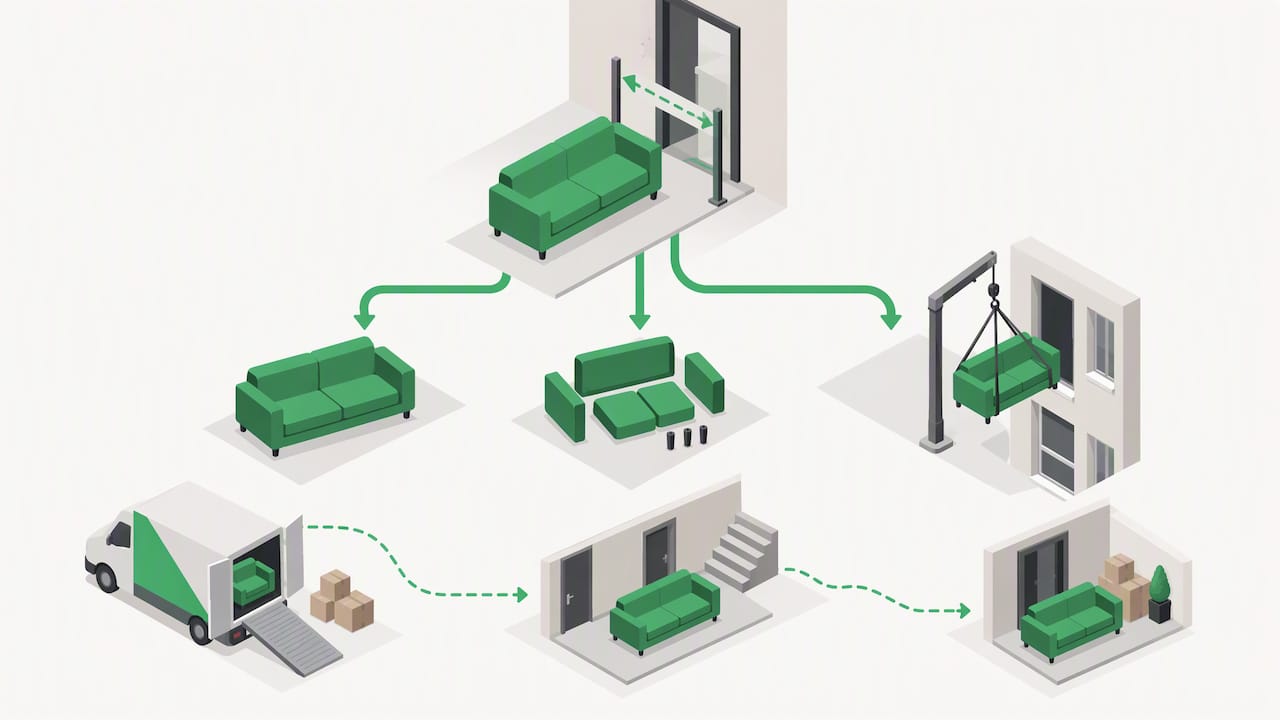
Your moving timeline: two weeks out to moving day itself, part of narrow street access removals
Breaking a narrow-access move into three windows keeps the big risks (parking enforcement, equipment mismatches, last-minute surprises) under control.
Two or more weeks before the move:
- Measure and photograph every pinch point at both properties: doorways, hallway corners, stairwells, gates and lift interiors.
- Check your council’s parking rules for both addresses and note whether a suspension or dispensation is likely to be needed.
- Decide on your vehicle plan, including whether a shuttle or relay will be necessary for either end of the move.
- Book your removals provider and share your measurements and photos with them so they can plan crew size and equipment.
48 to 72 hours before the move:
- Submit or confirm any parking suspension or dispensation application; most councils want notice well before this window, so this step should really be a confirmation rather than a first attempt.
- Confirm crew numbers, vehicle size and any mechanical aids (sack trucks, straps, slide boards) with your provider.
- Finalise your dismantling list: which furniture needs taking apart, and who is doing it.
On moving day:
- Make sure any official suspension signage or paperwork is visible and in place before the van arrives.
- Have someone supervise loading and unloading at both ends, keeping the route clear of bins, bikes and loose rugs.
- Protect the route itself: door frames, bannisters and wall corners are the most common casualties of a tight carry.
- If you’re using a relay or shuttle, agree a clear handover point and timing in advance so the smaller vehicle isn’t left waiting outside a resident bay without permission.
Lead times matter more than people expect. The RBKC suspensions FAQ asks for 10 working days’ notice for a resident-space suspension, with late applications sometimes accepted at a discretionary charge. Camden’s temporary traffic restriction application pack shows an even wider range depending on the category of restriction, with extra fees for anything affecting bus routes or roads managed by Transport for London.
Pro Tip: Book your parking suspension the same day you book your removals provider. Lead times for both tend to run in parallel, so treating them as separate tasks nearly always costs you time later.
Tricks that save time and stop damage, part of narrow street access removals
A few habits separate a smooth tight-access move from a stressful one, and most of them cost nothing but a bit of forethought.
- Dismantle in a logical order and label everything. Bag screws and small fittings with the piece of furniture they belong to, and photograph the assembled item before you take it apart so reassembly is quick rather than a guessing game.
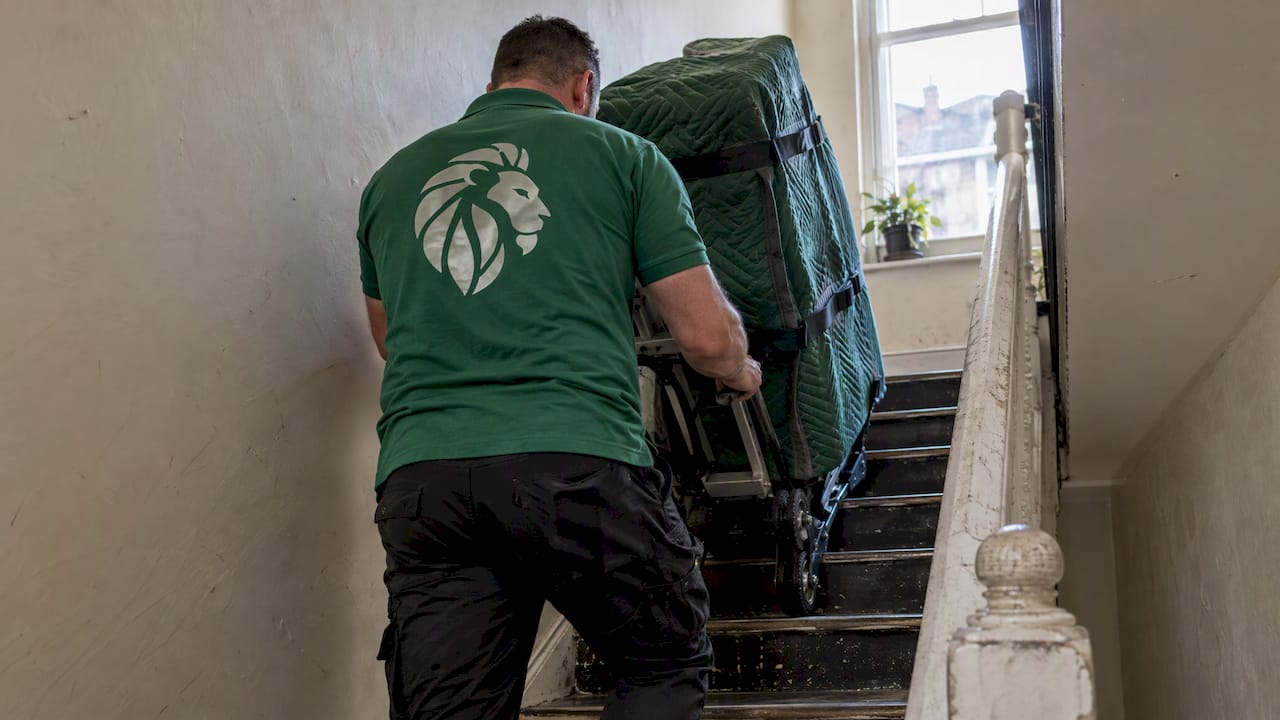
- Match the mechanical aid to the obstacle. A stair-climbing sack truck handles stairwells well, while a slide board or furniture skates suit tight turns where lifting isn’t practical.
- Pack for repeated handling. Items going through a narrow route often get carried further and handled more times than in a straightforward move, so sturdier boxes and extra padding around corners and edges earn their cost.
- Brief the crew properly before lifting anything. A two-minute walk-through of the route, pointing out the awkward turn or the low door frame, prevents far more damage than any amount of padding after the fact.
Pro Tip: Take a “before” photo of every room and hallway corner. It settles disputes about pre-existing scuffs and doubles as a reference if anything needs to go back exactly where it came from.
The HSE’s guidance on assessing manual handling backs this up directly: mechanical aids and route planning reduce risk far more reliably than simply adding extra pairs of hands to a badly planned lift.
Mistakes that delay the move or push up the cost, part of narrow street access removals
Most narrow-access problems trace back to a handful of avoidable errors, and each has a straightforward fix.
- Assuming you can just park outside. Informal confidence that “there’s usually space” isn’t the same as legal permission; check with your council rather than hoping for the best.
- Under-measuring the tricky bits. A lift that’s 2 centimetres too narrow or a stair turn that’s tighter than it looks on a quick glance causes far more delay than a missing parking space. Measure twice, at both ends of the move.
- Not budgeting for extra handling time. A relay or shuttle move takes longer than a single-vehicle job, and that time has a cost attached, whether it’s extra crew hours or a waiting charge.
- Putting out your own cones or signs. Unofficial cones have no legal standing and won’t stop a parking attendant issuing a ticket; only a proper council suspension or dispensation protects the space.
Mechanical aids, protective kit and where to check permit rules, part of narrow street access removals
A short kit list covers most narrow-access situations without overcomplicating the job.
- Stair-climbing sack trucks for moving heavy items up or down tight stairwells without lifting the full weight by hand.
- Slide boards or furniture skates for shifting bulky pieces across flat ground or around awkward corners.
- Removal blankets and corner protectors for door frames, bannisters and furniture edges along the carrying route.
- Webbing straps for securing loads during a relay or shuttle stage, where items get moved more than once.
For permissions, check your local council’s own parking or highways pages, such as the RBKC suspensions FAQ or Camden’s TTR application pack, since rules differ by borough. If a move involves a piano, a crane or an external hoist, bring in a specialist early and ask directly about insurance cover, access requirements and whether they need a separate permit of their own.
UK permits, lead times and fees: what to expect, part of narrow street access removals
Three different permissions get mixed up constantly, so it’s worth knowing which one you actually need.
- A parking suspension reserves a specific bay or section of road, typically arranged through your local council’s parking team.
- A dispensation is a shorter, more flexible permission, often used when a suspension isn’t strictly necessary but guaranteed access still matters.
- A temporary traffic restriction (TTR) covers larger-scale works, such as road closures or crane operations, and can involve Transport for London when the street in question is a red route.
Lead times vary considerably. RBKC’s own guidance asks for 10 working days’ notice for a resident-space suspension, while Camden’s TTR pack shows fee bands and lead times that climb further for anything touching a bus route or an SRN road. Inner-city boroughs generally need more notice than suburban ones, simply because more requests compete for the same road space.
Putting out your own cones or handwritten signs doesn’t carry any legal weight, and a parking attendant is entitled to ignore them entirely. The only way to guarantee a space is through the council’s own process, applied for with enough notice.
Your pre-move checklist for tight-access properties, part of narrow street access removals
Keep this close in the final run-up to moving day.
- Measure and photograph every doorway, stairwell, gate and lift at both addresses.
- Apply for any parking suspension or dispensation your council requires, allowing for their stated lead time.
- Decide which furniture needs dismantling and what protective packing the route demands.
- Confirm your vehicle plan, insurance cover and timeline directly with your removals provider.
- Share your measurements, photos and permit confirmations with your crew before they arrive.
How Van-247delivery handles narrow-access removals
Narrow streets call for services built around flexibility rather than a one-size-van and a hope. Our house removals cover packing, unpacking and storage for properties where the carrying route needs careful planning, and our furniture and large items service handles the specialist lifts, disassembly and insured transport that tight access often demands. For pianos and other awkward, heavy pieces, our piano removal service brings the extra care that a tricky staircase or narrow hallway needs.
We handle insured transport and specialist large-item moves regularly, alongside instant quotes and tracking so you always know where things stand.
Before requesting a quote, it helps to have ready:
- Photos of the tightest points along your carrying route, at both addresses.
- Measurements of doorways, stair turns, gates and lift interiors.
- Confirmation of any parking suspension or dispensation already arranged.
When to call in specialists and when DIY still works, part of narrow street access removals
In my view, pianos, antiques and anything needing a long carry through a narrow stairwell are jobs worth paying a specialist crew for. The margin for error is too small, and the cost of a damaged banister or a dropped instrument far outweighs a callout fee.
A careful man-and-van plan can still work well for lighter moves, as long as you’ve done the legwork: measured the route, checked the council’s parking rules, and briefed whoever’s helping you on the day. What I’d never recommend skipping, regardless of who does the lifting, is documenting the route and confirming permission with your council before van wheels touch the kerb.
— Claudiu
Book a move that’s planned around your street, not against it
If your street doesn’t leave much room to manoeuvre, we’d rather plan around that from the start than discover it on the day. Our team works with the measurements, photos and permit confirmations you’ve already gathered, and builds the vehicle, crew and equipment plan around what your route can actually take, whether that’s a full house removal, a man and van booking for a lighter job, or specialist handling through furniture and large items.
Send us your route details and we’ll give you an instant quote that reflects the access challenges, not a generic estimate that ignores them. Get in touch through our homepage to request a quote or arrange a pre-move survey before you commit to a date.
FAQ
What is the average cost of removals in the UK?
Removal costs in the UK vary widely depending on property size, distance and access difficulty, with narrow-access jobs often costing more due to extra handling time or shuttle requirements. For an accurate figure that reflects your specific route and property, request a quote directly rather than relying on a general estimate.
Is a removal company profitable?
Removal companies generate revenue per job, charging for the vehicle, crew, time and any add-ons such as packing, storage or specialist handling. Profitability depends on how efficiently jobs are planned, which is exactly why route surveys and permit checks matter: poor planning adds unplanned hours that eat into margins on both sides.
Which UK removal company is considered the best?
There’s no single official ranking of UK removal companies, so the right choice depends on what your move actually needs, such as specialist handling, insured transport or experience with tight-access properties. Checking a provider’s track record with narrow streets and awkward items, rather than general reputation alone, gives a clearer answer for your situation.
Do moving companies dismantle furniture?
Many removal companies, including ours, offer furniture disassembly and reassembly as part of a booking, which is often essential for getting large items through narrow doorways or tight stair turns. It’s worth confirming this service and discussing your specific furniture with your provider before moving day.
Sources
- Frequently Asked Questions about suspensions | Royal Borough of Kensington and Chelsea
- Assess manual handling | HSE