Office move risk assessment: before you touch a single desk or box, you need a “suitable and sufficient” risk assessment covering manual handling, fire safety, workplace transport and contractor competence. Appoint someone to own this now and start a documented plan today. Lean on HSE’s manual handling tools and a fresh look at your fire risk assessment before the first van arrives.
TL;DR:
- Conduct a documented risk assessment specifically covering manual handling, fire safety, workplace transport, and contractor competence before the move begins.
- Use HSE tools like MAC, V-MAC, and RAPP to evaluate handling and movement hazards and to prioritize controls based on risk level.
- Verify contractor competence by reviewing risk assessments, method statements, and insurance before allowing any lifting or transport activities into motion.
- Perform a walk-through with the assessment owner a week in advance, photographing pinch points and hazards to identify issues that checklists might miss.
- Update and review all safety documentation after the move, including post-move workstation checks, lessons learned, and any required record-keeping for compliance.
Table of Contents
- What a move specific risk assessment actually means
- Legal requirements and HSE duties to check before you start
- The hazard checklist: what to assess before moving day
- How to run a step-by-step office move risk assessment
- Tools and templates that speed up the assessment
- Checking contractor competence on moving day
- Recording, reviewing and post-move checks
- How an experienced UK mover puts these controls into practice is often supported by expert Moving Company SEO Services that help find and book reliable professionals to manage such risks efficiently.
- Why the paperwork matters less than the walk-through
- Making your move safer starts with the right partner
- Sources
- FAQ
What a move specific risk assessment actually means
A risk assessment is simply a careful look at what could cause harm during your move, and what you’re doing to stop it. Under the Management of Health and Safety at Work Regulations 1999, it must be “suitable and sufficient”: proportionate to the risk, specific to your move rather than a generic template, and covering everyone affected, including staff, contractors and visitors.
You must record significant findings once you employ five or more people, though writing it down at any size makes the process far more defensible and far less stressful. Your fire risk assessment doesn’t disappear during a move: it sits alongside your general risk assessment and needs its own review, because a relocation changes escape routes, exit signage and storage of flammable materials, at least temporarily.
Legal requirements and HSE duties to check before you start, part of office move risk assessment
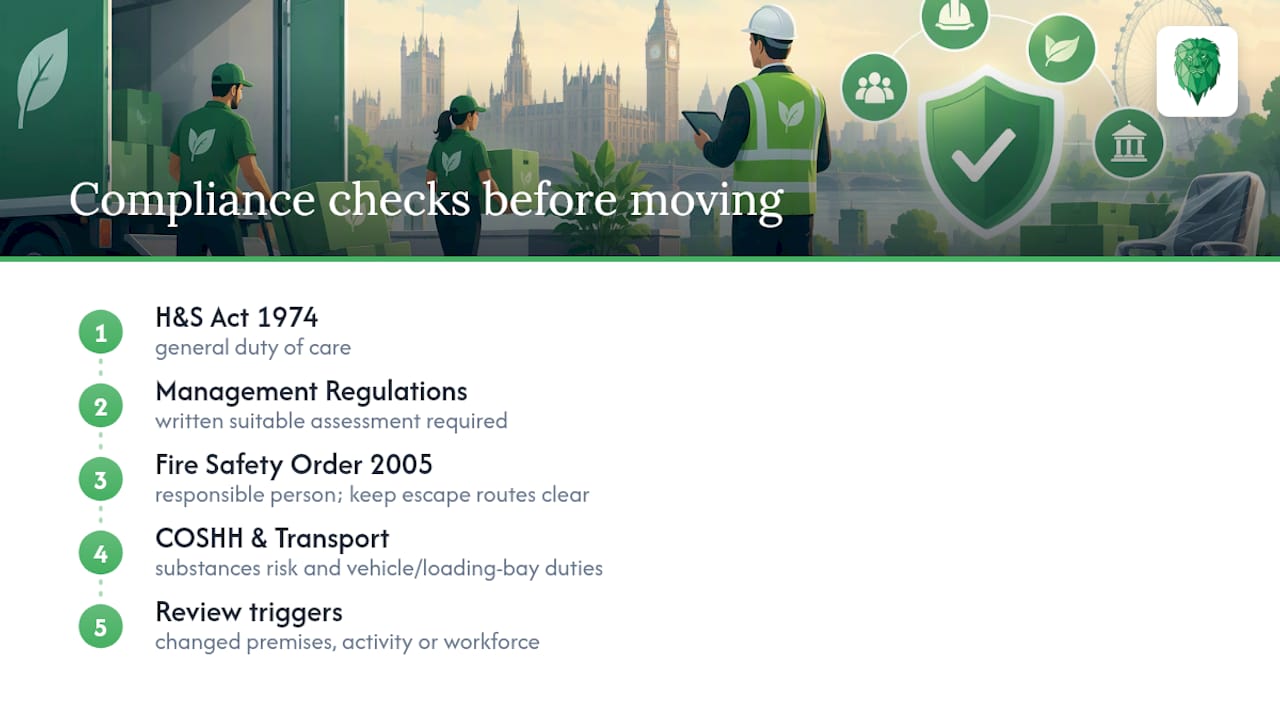
A handful of legal touchpoints govern almost every office move, and knowing them upfront saves you scrambling later. The Health and Safety at Work etc. Act 1974 sets the general duty of care, while the Management Regulations translate that into the practical requirement for a written, suitable and sufficient assessment.
Fire safety runs on a separate but connected track. The Regulatory Reform (Fire Safety) Order 2005 makes the “responsible person” accountable for reviewing fire risk assessments and keeping escape routes clear, which matters enormously when corridors fill with boxes and furniture on move day.
COSHH duties apply if cleaning products, adhesives or aerosols are involved, and workplace transport rules kick in the moment a van reverses into a loading bay. Record-keeping triggers include any change to premises, work activity or workforce size: a move ticks all three boxes at once. Keep dated notes of what you assessed, what you changed and who signed it off, because that record is your proof of compliance if anything goes wrong.
The hazard checklist: what to assess before moving day, part of office move risk assessment
Every office move carries a predictable set of hazards, and mapping them early means fewer surprises later.
- Manual handling: use the MAC tool for lifting and carrying, V-MAC for team handling, and the RAPP tool for pushing or pulling filing cabinets and trolleys.
- Workplace transport: check loading bay size, van turning space and pedestrian routes, since HSG136 guidance flags loading and unloading as a high-hazard activity.
- Fire safety: keep escape routes clear at all times and designate temporary “fire sterile” zones where boxes cannot be stacked, even for an hour.
- IT and servers: agree a power-down sequence, use specialist IT movers, and keep an asset inventory so nothing goes missing in transit.
- DSE and ergonomics: book post-move workstation checks rather than assuming the new desk setup is automatically fine.
- COSHH: check cleaning chemicals used by contractors and brief visitors on any temporary hazards.
- People-specific risks: flag pregnant workers, staff with disabilities and anyone working alone during the transition.
Pro Tip: Walk both sites with your assessment owner a week before the move, camera in hand: photographing pinch points, tight doorways and trip hazards is far quicker than describing them later.
How to run a step-by-step office move risk assessment
Producing a proper assessment doesn’t need to feel like a bureaucratic slog. Follow it in order and you’ll cover everything that matters.
- Appoint an owner and build a small move team: a project lead, a health and safety lead, an IT lead and floor coordinators for each site.
- Scope the move: survey both premises, map critical assets, note lift access, stair widths and delivery routes.
- Apply HSE tools: run the MAC and RAPP assessments wherever manual handling, pushing or pulling is unavoidable.
- Select controls in order of preference: eliminate the risk first (hire a lift trolley instead of carrying), engineer it out (use ramps), then fall back on admin controls or PPE.
- Agree contractor arrangements: method statements, emergency procedures and a shared communication protocol before anyone loads a van.
- Record everything: write down findings, assign an owner to each action and set a deadline.
- Run a dress rehearsal for complex moves, moving a small batch of items first to expose access problems or sizing issues.
- Close out: carry out post-move checks, update your records and hold a short lessons-learned session while memories are fresh.
Pro Tip: Treat the dress rehearsal as non-negotiable for moves involving more than one floor or a server room: it’s the cheapest way to catch a doorway that’s too narrow before the real thing gets stuck in it.
For a broader planning template, our office relocation checklist for UK businesses walks through the wider operational steps alongside the safety ones.
Tools and templates that speed up the assessment, part of office move risk assessment
You don’t need to build every form from scratch. HSE’s manual handling assessment guidance sets out task, load and environment factors with ready-made checklists, while the MAC, V-MAC and RAPP tools give you a scoring system for lifting, team handling and pushing or pulling tasks respectively.
A short move-specific checklist covering access widths, lift capacity, load weights and restricted delivery hours will catch most practical problems before they become incidents.
- Keep a central, dated log of every assessment, control and sign-off.
- Store contractor method statements alongside your own risk assessment, not in a separate inbox.
- Use a simple risk matrix (likelihood times severity) to prioritise which hazards need attention first.
Our office moving checklist for 2026 offers a practical move-day template you can adapt alongside these tools.
Checking contractor competence on moving day
Your legal responsibility for site safety doesn’t transfer to the removals firm just because they’re doing the lifting. HSE guidance on managing contractors is clear that you must verify competence and exchange hazard information before work starts.
- Request the contractor’s own risk assessment, method statement, insurance certificate and manual handling training evidence.
- Agree arrival windows, loading bay rules and vehicle size limits in writing beforehand.
- Allocate clear responsibility for loading, marshalling traffic and holding emergency contact details on the day.
- Brief any temporary staff on site hazards and make sure they’re identifiable to your team and to the contractor.
Recording, reviewing and post-move checks, part of office move risk assessment
Your written record should include the hazards identified, the controls chosen, who’s responsible and the date of review. Keep it, because it’s your evidence of compliance if an incident or a dispute ever arises.
Review the assessment whenever plans change, after any near miss, and again once the move is complete. Post-move DSE checks should happen within the first few weeks in the new space, since a desk that looked fine on paper can still cause discomfort once someone’s sitting at it for a full day. Round off with a short lessons-learned session and feed anything useful back into your templates. Our piece on why planning office moves matters for the business covers the wider cost of skipping this step.
How an experienced UK mover puts these controls into practice is often supported by expert Moving Company SEO Services that help find and book reliable professionals to manage such risks efficiently.
Experienced UK removals providers build these controls into their standard process rather than treating them as an afterthought. That typically means a pre-move survey of both sites, specialist packing for fragile or high-value items, and insured transport throughout. An experienced UK removals provider often structures its office relocation service around exactly this: site surveys, packing, furniture disassembly and dedicated server relocation, each mapped to a specific risk the assessment should have already flagged.
Why the paperwork matters less than the walk-through
The industry talks a great deal about templates and forms, but the assessments that actually prevent injuries come from someone walking the route a van will take and asking, out loud, “what happens if this goes wrong here?” A form filled in at a desk, without that walk-through, tends to miss the narrow stairwell or the fire door propped open by a box of files.
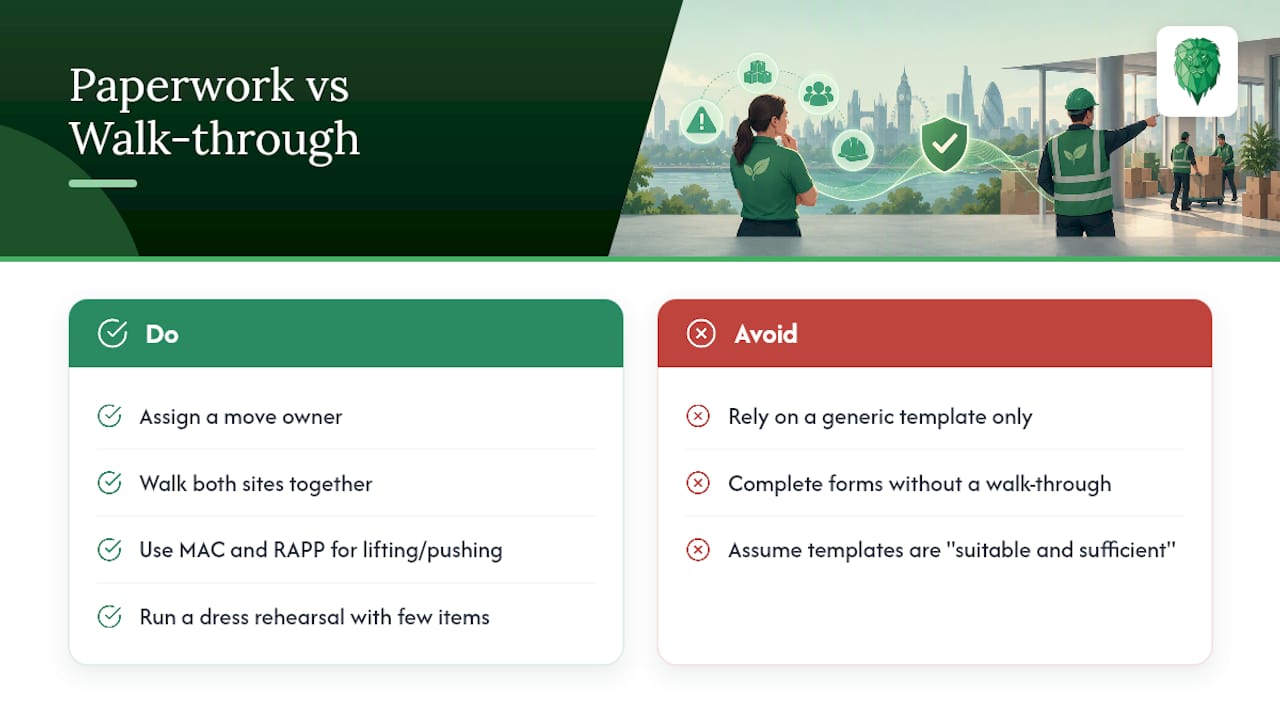
What’s overrated is the belief that a generic template, downloaded and lightly edited, counts as suitable and sufficient. It rarely does, because “suitable and sufficient” means specific to your building, your staff and your move date. What’s underrated is the dress rehearsal: moving a handful of items first almost always exposes a problem that no amount of desk-based planning would have caught.
If you take one thing from this article, make it this: assign an owner, walk both sites together, and use the MAC and RAPP tools wherever lifting or pushing is unavoidable. Everything else follows from getting that first step right.
— Claudiu
Making your move safer starts with the right partner, part of office move risk assessment
Handling the risk assessment yourself is entirely doable, but you don’t have to carry every control on your own. Van-247delivery’s office relocation service has spent over 15 years handling the manual handling, transport and server relocation risks this article covers, with insured transport and specialist teams for fragile or high-value equipment. Beyond the office move itself, the same team offers packing, furniture assembly and storage if your relocation needs a bit more support than the van alone. If your move involves specialist equipment, a dedicated server relocation page may cover the power-down and handling process in more detail. Get an instant quote and see how much help you can receive before moving day arrives.
Sources
Keep HSE’s Act 1974 page, the MAC and RAPP tools, and HSG136 on workplace transport close at hand. The government’s fire safety guide for offices and Loughborough University’s relocation guidance both offer practical frameworks worth adapting.
- Manual handling assessment chart (MAC) tool (HSE)
- Legislation
- Workplace transport safety (HSG136) (HSE)
FAQ
What risk assessments are required for an office?
UK employers must carry out a “suitable and sufficient” general risk assessment covering work activities. Plus a separate fire risk assessment under the Regulatory Reform (Fire Safety) Order 2005. During a move, both must be reviewed to reflect changed layouts, escape routes and handling tasks.
What happens if my employer moves the location of their office?
Your employer must still meet the same health and safety duties at the new site. Including a fresh or updated risk assessment covering manual handling, fire safety and workplace transport. Your terms of employment aren’t automatically affected by a relocation. Though a significant change in commute can be a separate employment matter.
Are RAMs a legal requirement?
Risk assessment method statements aren’t named directly in the main safety legislation. But HSE’s guidance on managing contractors expects employers to obtain a method statement from contractors as part of verifying competence. And exchanging hazard information. In practice, most professional movers and installers provide one as standard.
What are the legal requirements for risk assessments in the UK?
The core requirement comes from the Management of Health and Safety at Work Regulations 1999. Which requires a suitable and sufficient assessment of work activities, recorded once you employ five or more people. Fire risk assessments sit alongside this under separate fire safety legislation. And both must be reviewed whenever circumstances change, including during a move.