Palletising guide UK, palletising means loading your goods onto a pallet so they are stable, protected and easy to move with a forklift or pallet truck. Do it well and your freight arrives intact. Do it badly and it shifts, crushes or gets refused at the depot. The good news: it is a skill you can pick up in an afternoon. This guide walks you through choosing the pallet, stacking, wrapping, labelling and the rules for sending wooden pallets abroad.
TL;DR
- Choose a pallet that is sound and suits your load’s weight and size. A standard UK pallet is 1200 mm x 1000 mm.
- Stack in an interlocking “brick wall” pattern, heavy items at the bottom, with no overhang.
- Treat stretch wrap as the final security layer. It cannot fix a badly stacked load.
- Wrap the base first, spiral upwards with a 50% overlap, then give the top a few turns.
- Exporting? Solid wood pallets need an ISPM15 stamp.
Table of Contents
- What palletising actually involves
- Step 1: Choose the right pallet
- Step 2: Build a stable load
- Step 3: Wrap the pallet properly
- Step 4: Label it clearly
- Step 5: Handle it safely
- Sending pallets abroad: the ISPM15 rule
- Palletising by hand or with equipment?
- Our view: what we see on the road
- Need a hand getting your pallet there?
- A quick checklist before the driver arrives
- FAQ
- Sources
What palletising actually involves, part of Palletising guide UK
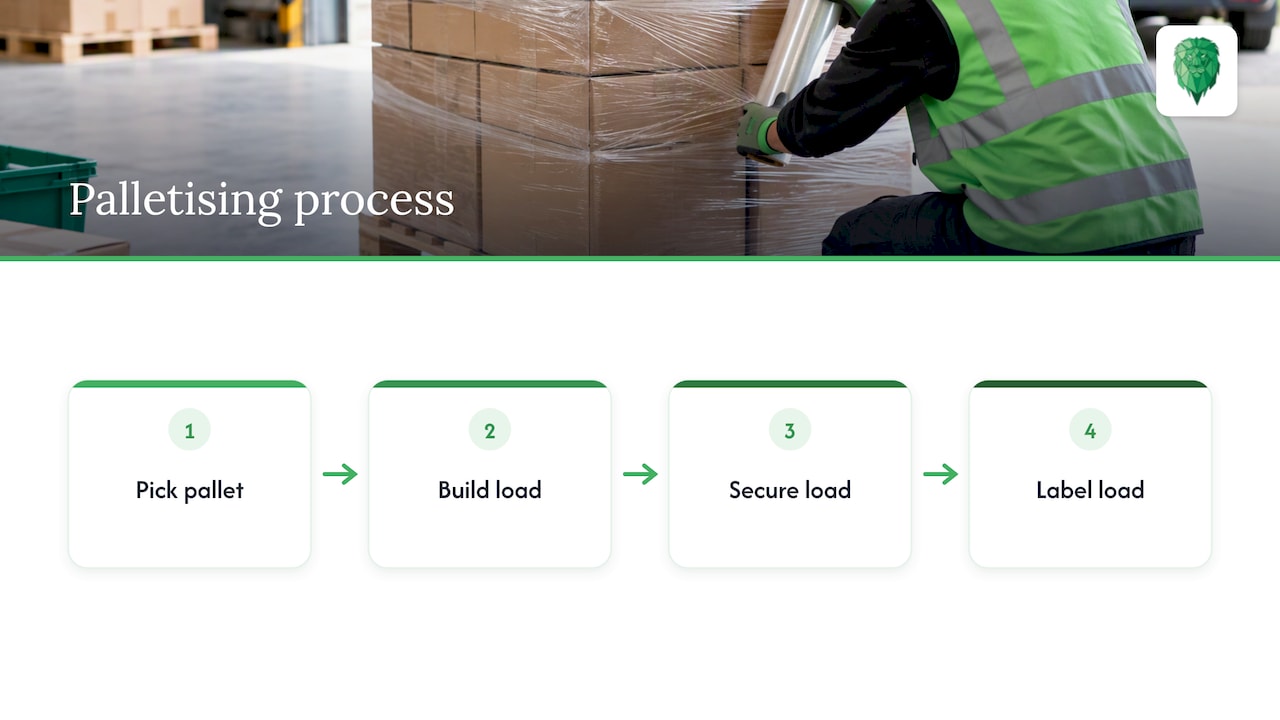
Palletising is every step between “a pile of boxes” and “a single unit a driver can pick up”. That covers picking the pallet, building the load, securing it and labelling it. The aim, as one UK materials-handling guide puts it, is a uniform, stable unit that is efficient and safe to handle.
If you search around, you will find a lot of material about palletising robots and automated end-of-line systems. That is for factories moving thousands of cartons an hour. This guide is for everyone else: small businesses, online sellers, workshops and households sending a few pallets by hand.
Step 1: Choose the right pallet, part of Palletising guide UK
It is tempting to grab whichever pallet is lying around. The Health and Safety Executive’s pallet safety guidance (PM15) points the other way: pallets should be chosen for the specific load and the way they will be stored and handled. A pallet that copes with a light load on the floor may not cope with a heavy one in racking.
Size
In the UK the most common pallet is the standard 1200 mm x 1000 mm. The Euro pallet is 1200 mm x 800 mm, and you will meet it more often in European freight. Half and quarter pallets exist for smaller consignments.
A simple rule: pick the size your boxes fill best. If your cartons fit the deck with little wasted space, you get a more stable load and often a cheaper delivery.
Condition
Before you load anything, look the pallet over:
- Are all the deck boards and bearers present and firmly attached?
- Any splits, protruding nails or crushed corners?
- Is it dry and free of oil or spills?
A damaged pallet can collapse under the load or snag on a forklift. If in doubt, swap it. Repairing a pallet with the wrong timber is also a problem if it is going overseas (more on that below).
Step 2: Build a stable load
This is where most pallets are won or lost. Experts at a UK packaging supplier warn that people lean on stretch film to fix poor stacking. It does not work. If the boxes are not stacked stably, no amount of plastic stops them shifting in transit.
The stacking rules
- Heavy at the bottom, light on top. Crushable items go last.
- Use an interlocking pattern. Lay each layer so the joints do not line up with the layer below, like bricks in a wall. A hand-wrapping guide recommends exactly this kind of pattern for stability.
- Keep boxes inside the pallet edge. Overhang weakens the cartons and makes the load snag.
- Fill gaps. Empty space lets cartons slide. Use corrugated card, void-fill or smaller boxes to pack the voids.
- Keep the top flat. A level top lets you stack safely, if the carrier allows it, and gives the wrap something to grip.
Awkward loads
Not everything is a neat carton. For machinery, bagged goods, tyres or tall items, think about the centre of gravity and how the load will be lifted. Corner boards on the edges add rigidity and protect against strapping and wrap cutting in. For heavy or sharp-edged items, add a layer of cardboard or a sheet between the load and the film.
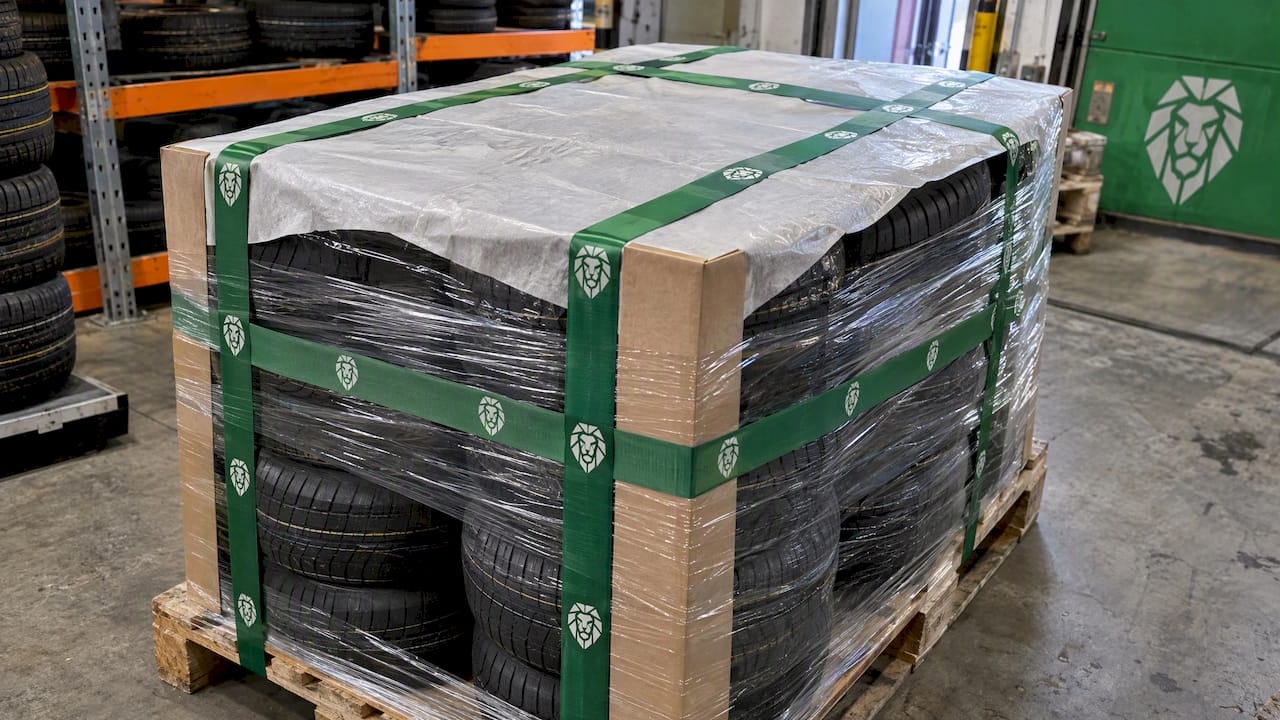
A word on height: carriers and pallet networks set their own limits for height and weight, and they differ. Check your carrier’s maximum before you build, not after. Our team can confirm details when you ask for a quote.
Step 3: Wrap the pallet properly, part of Palletising guide UK
Once the stack is solid, wrap it. Wrapping is the final security layer, not the structure.
The method
The Kwikpac hand-wrapping guide and similar UK suppliers describe the same basic technique:
- Start at the base. Secure the film to the pallet itself, or to a corner, so the load is tied to the pallet.
- Wrap the bottom layers tightly, going round a few times.
- Spiral upwards with about a 50% overlap on each turn.
- Finish with two or three turns at the top, then fold the tail under so it does not unravel.
- Test it. Gently push the top layer. If it shifts, the load is not secure.
Choosing the film
The same guide notes that around 17 micron is standard for medium-duty loads, while 20 to 23 micron suits heavy-duty or sharp-edged items. It also suggests avoiding black or coloured film unless you need it for security, because many carriers prefer clear film so they can see what is inside.
Common wrapping mistakes
| Mistake | What happens | Fix |
|---|---|---|
| Starting wrap halfway up the load | Load is not tied to the pallet and can slide off | Anchor at the base first |
| Too few turns at the top | Top layer shifts | Finish with two or three revolutions |
| Loose wrap | Film stretches in transit | Keep steady tension |
| Wrapping an unstable stack | Load shifts inside the film | Restack before wrapping |
| Dark or opaque film | Carrier cannot inspect it | Use clear film |
Step 4: Label it clearly, part of Palletising guide UK
A well-built pallet with a missing label is still a lost pallet. Good practice:
- Put the delivery address, postcode and a contact phone number on at least two sides of the pallet.
- Attach the label to the pallet or to the load where it will not be torn off by the film. A label under a clear window of wrap is protected from scuffs.
- Remove or cover old labels and barcodes from reused cartons, so nobody scans the wrong one.
- Mark fragile or “this way up” if it genuinely matters, and always tell the carrier about hazardous or unusually heavy items at the booking stage.
Take photos of the finished pallet before it leaves, from all four sides. If there is ever a dispute about damage, you will be glad you did.
Step 5: Handle it safely, part of Palletising guide UK
Safety does not stop at the wrap. A few points from the HSE’s PM15 guidance:
- Use the right equipment. A pallet truck or forklift, not an improvised tool. Wedging a sack truck between the deck boards damages the pallet and is a classic route to injury.
- Do not double-stack on the floor without a risk assessment. Toppling pallets are dangerous. The HSE reported a £600,000 fine for a manufacturer after a fatal incident at its Gargrave site in 2020; read the case for the details of what went wrong.
- Check the manufacturer’s safe loading information where it is available, especially if the pallet is going into racking.
If you are not sure how to move a heavy load safely at your premises, speak to your health and safety lead or a qualified forklift trainer before lifting it.
Sending pallets abroad: the ISPM15 rule, part of Palletising guide UK
Shipping to the EU or beyond adds one important rule. Under GOV.UK guidance on wood packaging, solid wood packaging, including pallets, crates and dunnage, must meet ISPM15 standards. That means the wood is debarked and heat-treated to 56°C for 30 continuous minutes, and the pallet carries a legible ISPM15 mark.
A few practical points from the same page:
- Reusing a pallet is fine, as long as the mark is clear and the pallet is undamaged.
- A pallet repaired with non-compliant timber must be re-treated and re-marked by an authorised repairer.
- Movements between Great Britain and Northern Ireland follow different rules. Check the official wood packaging material guidance for your route.
If you want to avoid the issue altogether, plastic or other non-wood pallets are not solid wood packaging in this sense, but check the destination country’s rules and your carrier’s requirements first.
Palletising by hand or with equipment? Part of Palletising guide UK
The easiest way to decide is to look at volume and weight.
| Situation | Sensible approach |
|---|---|
| A few pallets a week, lightweight cartons | Manual palletising with a hand wrap |
| Regular pallets, repeated heavy loads | Pallet truck, wrapping dispenser or a wrapping station |
| High daily volumes | Automated palletising and machine wrapping |
For most small firms and individuals, a pallet truck, a roll of film with a handle and some corner boards go a long way. A pallet optimisation guide from a UK packaging supplier is worth a read if you ship volume and want to squeeze more onto each pallet.
Our view: what we see on the road, part of Palletising guide UK
We have been moving things around the UK for over 15 years, and the pattern is very consistent. The pallets that cause trouble are rarely the heavy ones. They are the ones where someone trusted the film to do the stacking’s job, or where the label said one thing and the booking said another.
Here is what we would tell a friend:
- Build it as if there were no wrap. If the stack would survive a gentle shove without film, the film will finish the job.
- Tell us what is really on the pallet. Weight, height and whether it is fragile change how we plan the journey. A true description is cheaper than a surprise at the depot.
- Think about the end of the journey. Is there a loading bay, or will the pallet come off a van onto a pavement? Say so when you book.
- Think about value. Standard transit cover may not reflect what your goods are worth. Our guide to pallet insurance in the UK explains why it pays to check before you send something valuable.
Moving day, or delivery day, is a marathon, not a sprint. A few calm minutes with the pallet beforehand saves a lot of stress later.
— Claudiu
Need a hand getting your pallet there?
If you would rather not worry about the logistics once the pallet is ready, that is what we are here for. Our pallet delivery service covers the UK, and you can start with an instant online quote. We also run local pages for routes such as pallet delivery in London, Manchester and Sheffield. If you are not sure whether a pallet is the right format for your goods, our large parcel delivery page is a good place to look. And if the job is part of a bigger move, our man and van and packing services can sit alongside it.
A quick checklist before the driver arrives, part of Palletising guide UK
- Pallet is clean, dry and undamaged, with no loose boards.
- Load is stacked in an interlocking pattern, heavy items at the bottom.
- Nothing overhangs the edges.
- Gaps are filled and the top is level.
- Wrapped from the base, spiral up with 50% overlap, finished with a few turns on top.
- Gentle push test passed.
- Address and phone number on at least two sides.
- Photos taken.
- Weight, dimensions and any special handling told to the carrier.
- ISPM15 mark visible if the pallet is leaving the UK.
FAQ
What is the standard pallet size in the UK?
The standard UK pallet is 1200 mm x 1000 mm, according to UK pallet size guidance. The Euro pallet, at 1200 mm x 800 mm, is common in European freight. Check which one your carrier expects when you book.
How many times should I wrap a pallet?
There is no magic number, because it depends on the load. The usual method is to wrap the base tightly, spiral up with roughly 50% overlap, and finish with two or three turns at the top. Then give the load a gentle push: if the top layer moves, add more wrap or, better, restack it.
Does palletising and palletizing mean the same thing?
Yes. “Palletising” is the British spelling and “palletizing” the American one. The process and the equipment are the same, so any guide using either spelling will help you.
Do I need ISPM15 for pallets going within the UK?
The ISPM15 rules on GOV.UK apply to solid wood packaging moving between Great Britain and the EU, and Northern Ireland has its own arrangements. For purely domestic deliveries within Great Britain your carrier will mostly care that the pallet is sound. Ask them if you are unsure.
Can I reuse an old pallet?
Yes, if it is undamaged and clean. For exports, the ISPM15 mark must also still be clear. Anything with broken boards or exposed nails is better swapped for a good one.
Sources
- Pallet safety PM15, HSE
- Manufacturing company fined £600k after fatal workplace incident, HSE
- Wood packaging goods for import and export, GOV.UK
- Wood packaging material for import and export, GOV.UK
- How to Wrap a Pallet by Hand, Kwikpac
- How To Wrap A Pallet For Shipping, Schott Packaging
- UK Pallet Sizes Explained, Stack Industrial
- Palletising goods: Techniques, methods and equipment, Jungheinrich
- 6 essential pallet optimisation tips, GWP