Relocating a business feels straightforward until you realise how much sits beneath the surface. Most people picture lorries, boxes, and a new set of keys. But business relocation is the process of moving part or all of a company’s operations to a new location, whether that’s a domestic office move across town or shifting operations to a different country entirely.
The legal exposure, the HR implications, and the risk of operational downtime can each derail a move just as easily as a missing removal van. This guide cuts through the noise and gives you a clear, practical path forward.
Table of Contents
- What business relocation actually means for UK companies
- Legal and HR considerations during relocation
- Expert move management: How to plan and execute office relocation
- Minimising operational disruption: IT, downtime and productivity
- Why business relocation is more complex than most guides suggest
- Find reliable logistics support for your business relocation
- Frequently asked questions
Key Takeaways
| Point | Details |
|---|---|
| Relocation goes beyond moving | Business relocation covers legal, HR, and operational complexities—not just physical logistics. |
| Early HR consultation is vital | Consulting employees and reviewing contract terms avoids major legal risks in UK relocations. |
| Plan for IT disruption | Professional IT moves typically limit downtime to hours, not days, safeguarding productivity. |
| Move management is essential | Appointing a project manager and using phased checklists ensures a smooth relocation. |
| Professional help streamlines success | Expert logistics firms specialise in efficient, legally sound, and low-disruption business office moves. |
What business relocation actually means for UK companies
Having previewed the complex nature of business relocation, let’s clarify exactly what the term covers. The word “relocation” gets used loosely, and that vagueness causes real problems when businesses start planning without understanding which type of move they’re actually dealing with.
For UK businesses, business relocation can mean either international relocation of operations for corporate or market expansion, or domestic office relocations. The term is used very differently depending on whether you are moving your company’s operations to another country or simply moving premises within the UK.
“Business relocation covers everything from an SME moving to a larger office on the same trading estate, to a multinational restructuring its European headquarters. The physical logistics are just one layer.”
This distinction matters enormously for planning purposes. Here’s why the two types differ so significantly:
- Domestic office move: Focuses on logistics, lease agreements, staff commuting impact, and IT migration. The legal framework is primarily UK employment law.
- International relocation: Involves immigration, tax structuring, cross-border corporate law, and potentially establishing a new legal entity in the destination country.
- Partial relocation: Some businesses move only certain departments or functions, which creates its own coordination challenges across split sites.
- Operational relocation: A business might move its warehousing or manufacturing without moving its office staff at all.
Before you book a single removal van or sign a lease, you need to be clear on which category applies to you. Getting this wrong early means revisiting decisions under pressure later. A solid office move checklist can help you map out exactly what your specific type of move involves from day one.
The good news is that once you understand the scope, everything else becomes easier to sequence. Most UK domestic relocations are very manageable with the right team and timeline. International moves need specialist legal and financial advice before logistics even enter the picture.
Legal and HR considerations during relocation
Once the business relocation type is established, legal and HR issues become the next major consideration. This is the area most businesses underestimate, and it’s where the most expensive mistakes tend to happen.
UK employment law puts specific obligations on employers who relocate. It’s not simply a matter of telling your team the new address and expecting everyone to show up on day one. Employers should plan for employee impact and consult properly, because enforcing mobility or relocation clauses without following the right process can create serious legal risk, including unfair dismissal claims.
Here’s how to handle the HR and legal side in a structured way:
- Review all employment contracts early. Check whether contracts include a mobility clause allowing you to require staff to work from a different location. The presence of a clause doesn’t automatically make it enforceable. Reasonableness still applies.
- Begin consultation as early as possible. The earlier you bring employees into the conversation, the more time they have to raise concerns, arrange childcare adjustments, or consider their options. Early consultation reduces resentment and legal exposure simultaneously.
- Assess the impact on each role individually. A move that adds five minutes to one employee’s commute might add 90 minutes to another’s. Document these assessments and treat each situation on its own merits.
- Offer relocation assistance where appropriate. Many businesses offer a relocation allowance or contribution to moving costs to encourage staff to follow the company. This goodwill gesture often prevents resignations and tribunal claims.
- Take specific legal advice on redundancy risk. If some staff genuinely cannot relocate, you may need to consider whether a redundancy situation arises. Getting this wrong is costly. A specialist employment solicitor is worth every penny here.
- Update employment contracts before the move. Once the new location is agreed, update contracts to reflect the new place of work and have staff sign the revised versions before you move.
Pro Tip: Bring your HR team or an employment law adviser into the planning process at least six months before your target move date. Consultation periods take time, and rushing them creates exactly the legal risks you’re trying to avoid. Good planning practices applied early make the whole process far less stressful for everyone involved.
The HR element of a relocation isn’t a box-ticking exercise. Your people are your business. Handle this well and you carry your best talent with you to the new site. Handle it badly and you lose experienced staff, face grievances, and start your new chapter on the wrong foot.
Expert move management: How to plan and execute office relocation
With legal risks addressed, effective project management is what drives relocation success. Even a well-intentioned move falls apart without someone owning the process end to end.

Relocation projects should include practical move-management methodologies such as appointing a project or move manager, carrying out audits of furniture and equipment, planning IT and telecoms ahead of the physical move, sequencing each phase carefully, and setting a contingency plan such as continued working from home during the transition period.
Here’s a sequenced approach that actually works:
- Appoint a dedicated move manager. This person owns the relocation project and coordinates between facilities, IT, HR, finance, and the removal company. Without a single point of accountability, things fall through the gaps.
- Conduct a full asset audit. Walk every floor and document every desk, chair, monitor, server, printer, and piece of equipment. Decide what moves, what gets disposed of, and what needs replacing at the new site.
- Plan IT and telecoms first. Broadband installation, server migration, phone systems, and access control all need lead times. These cannot be left until the week before. Aim to have IT infrastructure operational at the new site before the first team member arrives.
- Create a phased move schedule. Rather than moving everyone at once, sequence departments by operational priority. Move teams that can tolerate a brief pause in activity first. Keep client-facing teams operational for as long as possible.
- Build in a contingency plan. What happens if the new premises aren’t ready on day one? Remote working protocols, temporary office space, or a delayed start date should all be considered before you need them.
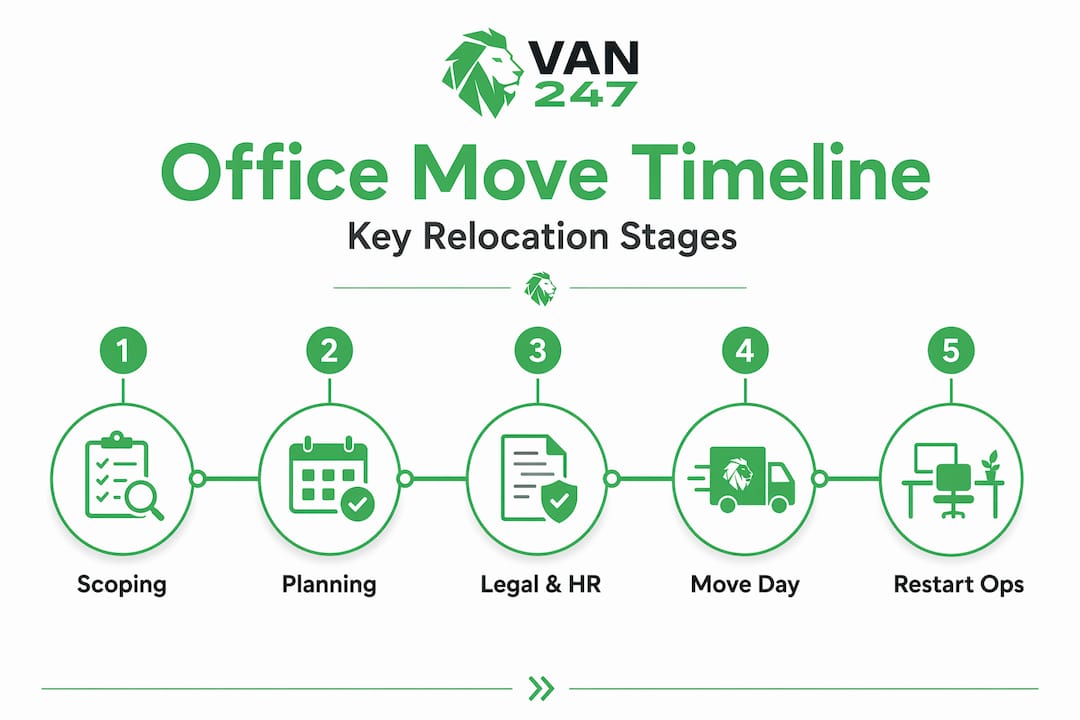
| Phase | Timeline before move | Key tasks |
|---|---|---|
| Scoping | 9 to 12 months | Define move type, appoint move manager, set budget |
| Audit | 6 to 9 months | Asset audit, IT assessment, HR consultation begins |
| Planning | 3 to 6 months | Book removals, plan IT migration, finalise schedule |
| Execution | 1 to 4 weeks | Physical move, IT cutover, staff briefings |
| Review | Post-move | Lessons learned, outstanding issues, productivity check |
This kind of structured approach is covered in detail in a step-by-step relocation checklist that walks you through every stage. For businesses worried about keeping revenue flowing during the move, there’s also specific guidance on how to minimise downtime which is worth reading alongside your planning documents.
Pro Tip: Schedule the physical move over a weekend or bank holiday if at all possible. Moving furniture and equipment outside of business hours means your team arrives Monday morning to a functioning office, rather than navigating removal teams and half-assembled desks mid-week.
Minimising operational disruption: IT, downtime and productivity
IT and operational disruption can be make-or-break during a business move. This is the area where well-managed relocations prove their worth most clearly, and where under-prepared ones lose real money.
Professionally managed IT moves aim to limit downtime to under four hours, while self-managed moves can average multiple days of disruption. That’s not a minor inconvenience. For many businesses, multiple days of IT downtime means lost orders, frustrated clients, and damaged reputation.
Here’s how to protect your operations during the transition:
- Migrate cloud-based systems before the physical move. If your business uses cloud tools for email, documents, or customer management, these can often be reconfigured remotely without any physical disruption.
- Run parallel systems during the transition. Where possible, keep old systems active for a short period while new ones bed in. This gives your team a safety net if something doesn’t connect as expected.
- Test everything before staff arrive. VPNs, printers, shared drives, phone systems. Run full connectivity tests at least 48 hours before the first employee sets foot in the new space.
- Have a clear escalation route for IT issues. If something breaks on day one, who does your team call? Make sure there’s a named contact and a priority response agreement in place.
- Brief all staff on the new setup in advance. Explain any changes to login procedures, new Wi-Fi credentials, updated phone extensions, and any new tools introduced during the move.
| Move type | Average IT downtime | Productivity impact |
|---|---|---|
| Professionally managed | Under 4 hours | Minimal, recovery same day |
| Self-managed | Multiple days | Significant, client-facing risk |
| Hybrid approach | 4 to 24 hours | Moderate, manageable with planning |
The minimising downtime guide goes deeper on specific tactics for IT-heavy businesses. If your operations run on servers, specialist equipment, or bespoke software, that guide will save you considerable stress.
The honest truth is that most businesses don’t fully appreciate how long it takes to restore full productivity after a move. Even when everything goes smoothly, staff need time to settle, find their rhythm, and learn the new environment. Build two to four weeks of reduced productivity expectations into your planning and you won’t be caught out.
Why business relocation is more complex than most guides suggest
Here’s a perspective that doesn’t often get said plainly: most UK office relocations don’t fail because the lorry was late or the boxes weren’t labelled. They fail because the legal and HR risks were treated as an afterthought, and the IT planning was squeezed into the final two weeks.
The guides that focus purely on logistics are selling you an incomplete picture. After handling relocations across the UK for over 15 years, what we consistently see is that businesses who struggle were those who treated the move as a facilities project rather than a cross-functional business programme.
Employment contract terms, including mobility clauses, reasonableness standards, and consultation practices, can materially affect legal risk. The relocation plan should include HR and employment law input early. Not as a final check. Early. This is not a formality; it’s a risk management decision.
The second thing most guides underplay is the compounding effect of IT downtime. Four hours of system downtime might feel manageable in isolation. But when you add staff orientation time, unpacking, re-establishing workflows, and chasing outstanding IT issues, the real productivity dip is almost always longer and steeper than expected. Businesses that invest in professional IT migration consistently recover faster and report fewer post-move complaints from clients.
The third overlooked factor is what we’d call “relocation fatigue” among your team. A move asks a lot of people. Longer commutes, unfamiliar environments, and process changes all create friction. Businesses that communicate well throughout the process, involve staff in decisions where possible, and acknowledge the disruption openly, tend to see staff settle in significantly faster.
Our genuine advice: build your relocation team as you’d build a project team for a major product launch. Clear roles, regular updates, a single decision-maker, and a realistic timeline. Look at move management strategies that work across different move scales and adapt them to your specific situation. The businesses that treat relocation as a business transformation project almost always come out the other side stronger.
Find reliable logistics support for your business relocation
With actionable steps and hard-won insights covered, here’s where you can find professional support for your UK business move. Getting the logistics right is the final piece of the puzzle, and it matters more than most people realise.
At Van-247 Delivery, we specialise in making the physical side of business relocation as smooth as possible. Our office removals service is designed specifically for businesses that need their equipment moved safely, efficiently, and with minimum disruption to the working day. From desks and filing cabinets to servers and specialist equipment, we handle it with care. We also offer practical office moves tips so you can plan every stage with confidence. Whether you’re moving a small team across town or coordinating a multi-floor relocation, our business logistics support team is ready to help you plan a move that keeps your business moving forward.
Frequently asked questions
Does business relocation always involve moving staff?
No, business relocation may involve only moving operations or assets, but relocating staff is often a central part of the process when new premises are involved.
What legal risks are linked to employee relocation in the UK?
If you don’t consult employees or handle mobility clauses properly, you risk claims from staff including unfair dismissal, particularly if the relocation is deemed unreasonable or poorly handled.
How can businesses minimise disruption during an office relocation?
Appointing a project manager and planning IT moves carefully can keep downtime under four hours, compared to multiple days of disruption that self-managed moves often experience.
When should UK businesses start planning their relocation?
Planning should ideally begin at least 6 to 12 months before the move date, covering audits and contingency measures to ensure nothing is left to the last minute.