Commercial moving is defined as the planned, professional relocation of a business’s physical assets, including office furniture, IT equipment, files, and fixtures, from one premises to another. Unlike a house move, a commercial relocation is built around one non-negotiable priority: keeping your business operational throughout the process.
The industry term you will hear most often is commercial relocation, and it covers everything from a small office shift across town to a full-scale corporate headquarters move. This guide explains what commercial moving involves, what it costs, and how to plan one without losing a working day.
What is commercial moving and how does it differ from residential?
Commercial moving is a project-based process with a defined scope, schedule, and risk plan, all designed to protect ongoing business functionality. Commercial moves differ from residential ones by involving complex building requirements, certificates of insurance (COIs), and coordination across multiple stakeholders. That last point matters more than most businesses expect.
When you move a home, you deal with one family and one removal van. When you move an office, you deal with building managers, IT teams, department heads, facilities staff, and the removal company, all at the same time. The coordination load is genuinely different in kind, not just in scale.

Here is a direct comparison to make the distinction clear:
| Factor | Residential Move | Commercial Move |
|---|---|---|
| Stakeholders | Household members | Staff, IT, facilities, management |
| Building access | Standard | Service lifts, loading bays, COIs required |
| Equipment handled | Household goods | Servers, workstations, specialist machinery |
| Downtime risk | Personal inconvenience | Revenue and operational loss |
| Insurance | Standard contents cover | Commercial liability and specialist cover |
| Planning horizon | Weeks | Months, with phased execution |
The building access point is one that catches businesses off guard. Securing COIs and pre-booking service elevators typically needs to happen weeks before the move date. Day-of arrangements rarely succeed in commercial properties, and a failed booking can delay your entire operation.
Pro Tip: Ask your building manager for a written list of access requirements on day one of your planning process. This single step prevents the most common commercial move delays.
What does the commercial relocation process actually involve?
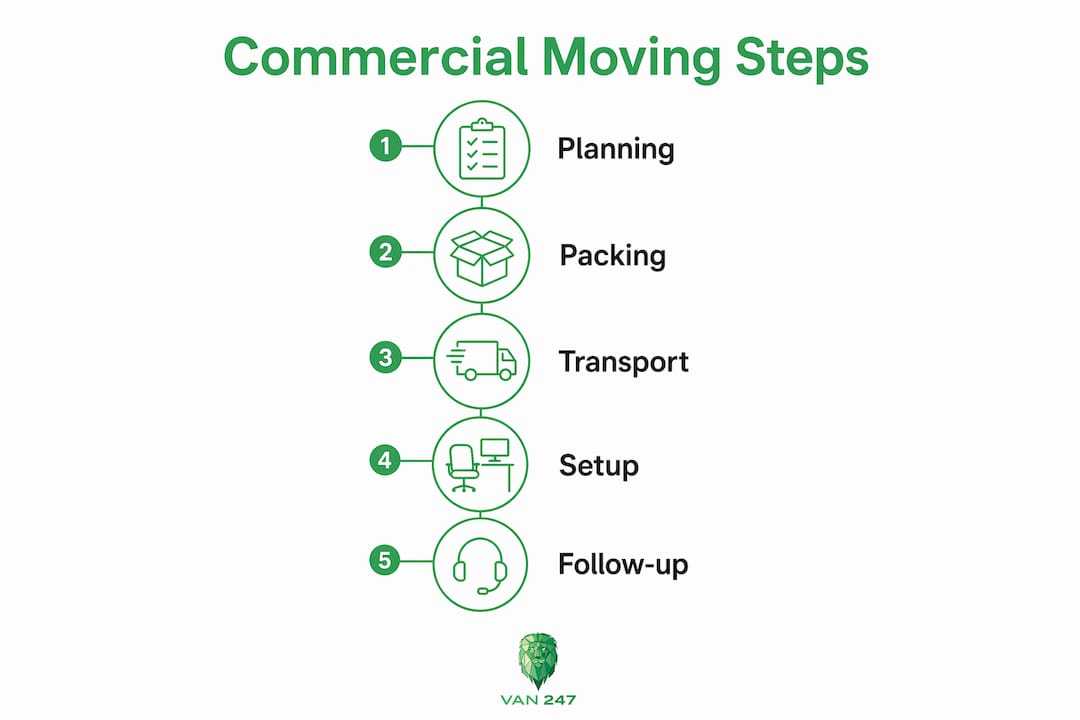
Commercial moving services commonly include planning, packing, furniture disassembly, loading, transporting, and placement based on floor plans. Each phase requires its own preparation, and skipping one creates problems in the next.
Here is how a well-managed commercial move typically unfolds:
- Pre-move survey and planning. A project manager assesses your current premises, inventories assets, and builds a move schedule. This stage produces the written risk plan that keeps the move compliant and on track.
- Floor plan mapping. Your new space is mapped in advance so every desk, cabinet, and server rack has a designated position before the first box arrives.
- Specialist packing. Electronics, fragile equipment, and confidential files require specific packing materials and labelling protocols. Standard cardboard boxes are not appropriate for server hardware or medical equipment.
- Furniture disassembly. Large workstations, modular shelving, and boardroom tables are dismantled on site and reassembled at the new location according to the floor plan.
- Coordinated transport. Vehicles are sized and scheduled to match your asset volume and move distance. For larger organisations, this often means multiple vehicles running in sequence.
- IT infrastructure cutover. Office moves can disrupt IT infrastructure, and maintaining network uptime requires careful cutover planning and specialist handling. This phase is typically scheduled last, or run in parallel by a dedicated IT team.
- Post-move placement and checks. Assets are placed according to the floor plan, furniture is reassembled, and a final walkthrough confirms everything is accounted for and undamaged.
Pro Tip: Label every cable, monitor, and peripheral with its user’s name before disconnection. Reconnection at the new site becomes a ten-minute job rather than a two-hour puzzle.
Phased execution mitigates risks by providing buffer time for technical setup, furniture assembly, and unexpected problems. Attempting the entire office move in a single weekend without phased planning often results in incomplete setups and operational disruption on Monday morning. That is a lesson most businesses only learn once.
How much does a commercial move cost?
Basic corporate relocations in 2025–2026 typically range from £1,500 to £30,000, with specialised or large-scale moves often costing considerably more. That wide range reflects how many variables feed into the final figure.
The main cost drivers are:
- Volume and weight of assets being moved
- Distance between old and new premises
- Specialist equipment such as server racks, safes, or laboratory hardware
- Building access complexity including lift bookings, parking permits, and out-of-hours access fees
- Timing of the move, with weekend and out-of-hours slots typically priced higher
- Insurance requirements specific to your industry or equipment value
One cost comparison that surprises many businesses is the DIY versus professional mover calculation. Hiring experienced commercial movers can prevent damage, save time, and reduce hidden costs compared to managing the move internally. When you factor in staff time, potential equipment damage, and the risk of extended downtime, the professional option frequently works out cheaper.
Watch out for these commonly overlooked additional costs:
- Parking suspensions or loading bay permits in city centres
- Storage fees if your new premises are not ready on move day
- Specialist disposal of old furniture or equipment
- Reinstallation fees for leased equipment such as photocopiers
Understanding what business relocation means in financial terms before you sign a contract with any provider is the single most effective way to avoid budget surprises.
How do you plan a successful commercial move?
The businesses that come through a commercial relocation without losing productivity share one habit: they start planning earlier than feels necessary. Six to twelve weeks of lead time is standard for a mid-sized office. Larger organisations often begin twelve months out.
Here are the practices that separate smooth moves from chaotic ones:
- Appoint a relocation manager. One person owns the project, communicates with the removal company, and is the single point of contact for staff queries. Without this role, decisions fall through the gaps.
- Communicate early with your team. Clear communication with employees about the move timeline and objectives reduces uncertainty and eases the transition. Tell people what is happening, when, and what is expected of them before rumours fill the silence.
- Book building services in advance. Booking loading docks, service elevators, and adhering to safety guidelines needs to happen weeks before the move. Do not assume availability.
- Plan your IT cutover separately. Treat the technology migration as its own sub-project with its own timeline, responsible person, and contingency plan.
- Run a phased move where possible. Move one department at a time rather than the whole business at once. This keeps part of your operation running and gives you a live test of the process before committing everything.
- Choose your provider carefully. Look for a commercial moving company with verifiable experience in your type of premises, appropriate insurance, and a clear written quote that itemises every service.
Pro Tip: Request references from businesses of a similar size that your chosen provider has moved before. A company experienced in moving ten-person offices may not be the right fit for a 200-person headquarters.
You can find practical office relocation strategies that cover the specific challenges logistics providers manage during business relocations, from access coordination to post-move checks.
Key takeaways
A well-planned commercial relocation protects business continuity, controls costs, and reduces staff disruption when it is treated as a structured project rather than a simple removal job.
| Point | Details |
|---|---|
| Commercial moving defined | It is the professional, planned relocation of business assets with continuity as the primary goal. |
| Key difference from residential | Commercial moves involve multiple stakeholders, building compliance, and specialist equipment handling. |
| Cost range | UK commercial relocations typically cost £1,500–£30,000 depending on scale and complexity. |
| Phased execution matters | Moving departments in stages prevents Monday morning operational failures and IT disruptions. |
| Early planning is non-negotiable | Book building access, appoint a relocation manager, and communicate with staff at least six weeks out. |
What i have learned after watching businesses move
By Claudiu
Most businesses treat a commercial move as a logistical inconvenience to get through as quickly as possible. That mindset is the root cause of most move-related disasters I have seen.
Treating business relocation as a strategic growth initiative rather than a mere logistical task genuinely improves outcomes. The businesses that approach a move with that framing ask better questions: Does this new location improve our access to clients? Does the floor plan support how our teams actually work? Those questions change the quality of every decision that follows.
The two most consistent mistakes I observe are underestimating the timeline and underestimating the IT complexity. A business that books removal vans for a Saturday and expects to be fully operational by Monday without a dedicated IT cutover plan is setting itself up for a painful week. Technology does not migrate itself, and network configurations that took months to build do not reassemble in an afternoon.
The other thing worth saying plainly: communication is not a soft skill in a commercial move. It is a project management tool. Staff who know what is happening, when, and what they need to do arrive at the new office ready to work. Staff who find out about the move through corridor gossip arrive anxious and unproductive. The difference in first-week output between those two groups is significant.
Treat your relocation as a project with a sponsor, a plan, and a risk register. The businesses that do this come out the other side stronger.
— Claudiu
How Van-247delivery can support your office relocation
Planning a commercial move and not sure where to start? Van-247delivery has over 15 years of experience helping UK businesses relocate offices of all sizes, from small professional suites to multi-floor corporate premises.
The team at Van-247delivery handles the full scope of a commercial office relocation, including specialist packing, furniture disassembly and reassembly, coordinated transport, and post-move placement. Every move is covered by appropriate insurance, and the team works around your schedule to minimise downtime. If you want practical guidance before you commit, the office move tips resource covers the key steps in plain language. Get an instant quote today and take the first step towards a move that does not cost you a working week.
FAQ
What is commercial moving in simple terms?
Commercial moving is the professional relocation of a business’s assets, including furniture, equipment, and files, from one premises to another. The process is planned to keep the business operational throughout.
How long does a commercial move typically take to plan?
Most mid-sized office moves require six to twelve weeks of planning. Larger organisations with complex IT infrastructure or specialist equipment often need twelve months or more.
What is the difference between commercial and residential moving?
Commercial moves involve multiple stakeholders, building compliance requirements such as COIs and lift bookings, and specialist handling for IT and business equipment. Residential moves are simpler in scope and coordination.
How much does a commercial relocation cost in the UK?
UK commercial relocations typically range from £1,500 to £30,000, depending on the volume of assets, distance, specialist equipment, and building access requirements.
Do i need specialist movers for an office relocation?
Yes. Professional commercial movers provide liability coverage, specialist packing, and project management that reduce the risk of damage and operational disruption compared to managing the move internally.