Express delivery is defined as the fastest tier of shipping, guaranteeing domestic transit within 1–3 business days compared to the 5–8 business days typical of standard ground shipping. That gap matters enormously when you are sending a legal contract, a medical supply, or a time-sensitive business order. The industry term you will also hear is expedited freight, though in UK logistics, “express delivery” is the standard phrase for this priority service.
Whether you are an individual sending an urgent parcel or a business managing critical stock, understanding how express shipping works will save you time, money, and a great deal of stress.
What is express delivery and how does it work?
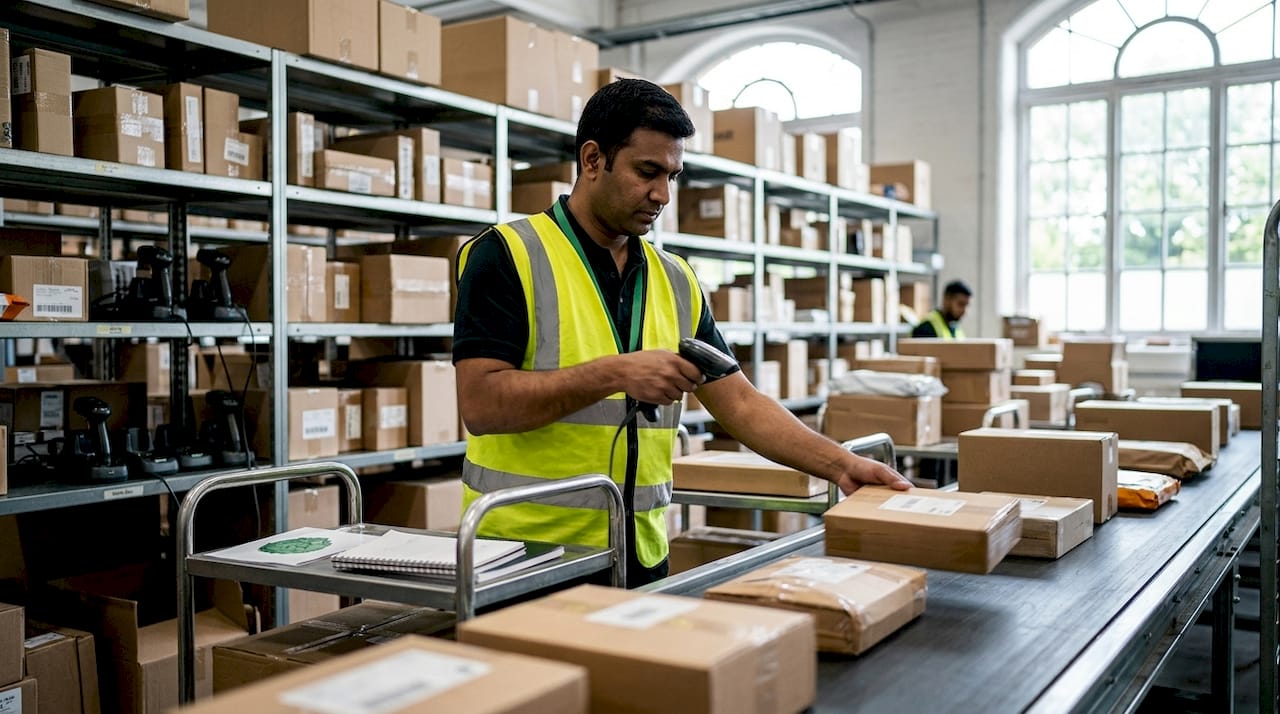
Express delivery is a priority shipping service that places your shipment at the front of the handling queue from the moment it is collected. Unlike standard shipping, where parcels pass through multiple sorting hubs and share transport with lower-priority freight, express shipments receive dedicated scanning at every touchpoint and travel via direct-to-destination routing that bypasses traditional sorting delays.
The operational process works like this:
- Collection and priority tagging: Your parcel is collected and immediately flagged as express, separating it from standard freight at the first scan.
- Dedicated transport: Express shipments use direct road networks or air freight rather than shared consolidation vehicles, cutting transit time significantly.
- Time-definite delivery windows: Carriers commit to a specific delivery window, often next morning or by a set hour the following day.
- Minimised intermediate stops: Standard parcels may pass through three or four sorting depots. Express parcels typically go direct or through one intermediate point only.
- Real-time tracking: Priority handling includes more frequent scan updates, so you can monitor progress at each stage.
The key difference from standard shipping is not just speed. It is the entire handling process that changes. Express shipments skip the queues that slow standard freight down.
Pro Tip: Always check your carrier’s cutoff time before booking. Missing the cutoff often means your express parcel enters the priority queue the next business day, delaying it by a full 24 hours despite the premium cost. Most carriers set cutoffs between 3 PM and 4 PM.
What does express delivery cost in the UK?
Express delivery costs significantly more than standard shipping, and that premium is intentional. Same-day express options can cost 300–500% more than standard overnight services, reflecting the dedicated resources required to guarantee speed. Carrier rates also increased by an average of 5.9% in january 2026, so budgeting accurately is more important than ever.
Several factors influence the final price:
- Package size and weight: Heavier or bulkier items cost more to move at speed, particularly when air freight is involved.
- Destination: Urban deliveries within a major city cost less than rural or remote UK addresses, where dedicated routing adds distance.
- Service window: A guaranteed pre-noon delivery costs more than a standard next-day window, because it requires tighter scheduling.
- Urgency: Same-day collection and delivery carries the highest premium, particularly outside metropolitan areas.
The cost premium is justified for certain shipment types. Medical supplies, legal documents, perishable goods, and high-value items all carry a cost of failure that far exceeds the express shipping fee. A business that loses a contract because a document arrived late pays far more than any courier surcharge.
Pro Tip: Compare the cost of express delivery against the cost of the delay itself. For urgent business shipments, the maths almost always favours paying the premium.
Express delivery vs standard and expedited shipping: what is the difference?
The three main shipping tiers are frequently confused, and the terminology varies between carriers. Here is how they actually differ in UK logistics.
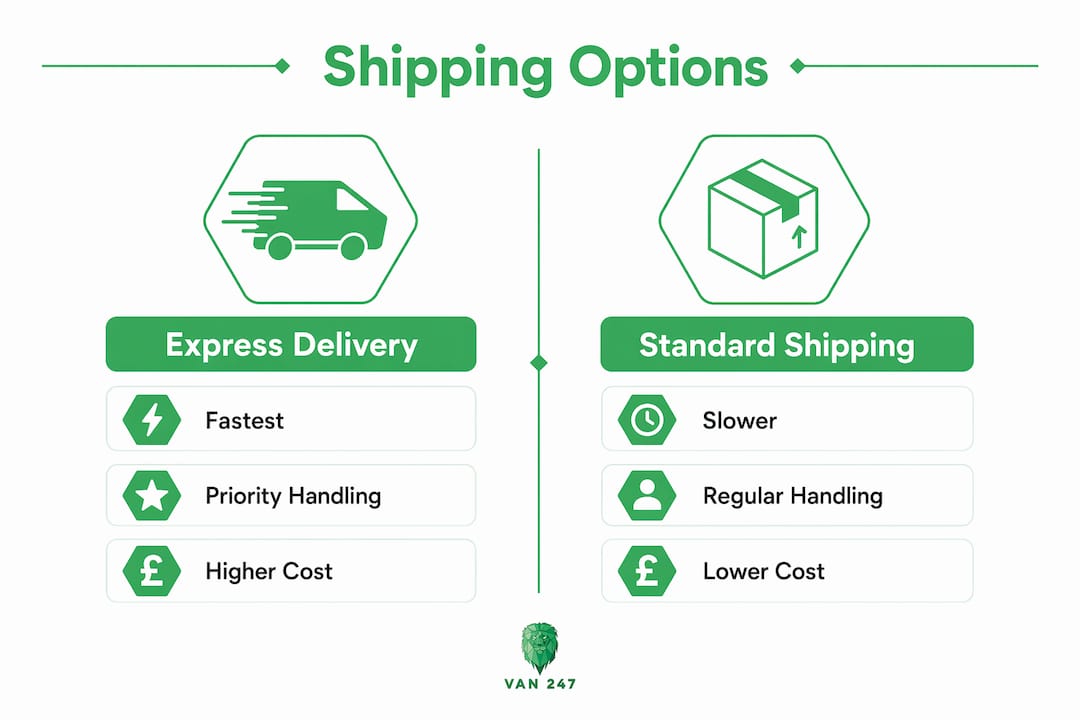
Express and expedited shipping sit in a clear hierarchy. Express is the fastest guaranteed option, typically next-day or same-day. Expedited is a middle tier, faster than standard ground but slower than express. Standard is the baseline, with no time-definite guarantee.
| Service tier | Typical delivery time | Cost level | Best for |
|---|---|---|---|
| Standard delivery | 5–8 business days | Lowest | Non-urgent parcels |
| Expedited shipping | 2–3 business days | Moderate | Time-sensitive but flexible |
| Express delivery | 1 business day or same day | Highest | Urgent, critical, or high-value items |
| Same-day delivery | Same day (metro areas) | Premium | Emergencies, last-minute needs |
Same-day delivery is a subset of express services, but it is usually limited to metropolitan areas such as London, Manchester, or Birmingham. Van-247delivery offers same-day delivery in London, which is particularly useful for businesses operating in the capital with urgent freight needs.
The terminology confusion arises because some carriers use “expedited” and “express” interchangeably. The practical rule is straightforward: if the carrier guarantees next-day or same-day delivery with a time-definite window, it is express. If it is simply faster than standard but without a firm guarantee, it is expedited.
What are the benefits of express delivery for individuals and businesses?
Speed is the obvious benefit, but the real value of express delivery runs deeper than fast transit times. 86% of consumers expect fast delivery within two days or less, and 63% treat this as a baseline expectation rather than a premium. That shift in consumer behaviour means businesses that cannot offer fast delivery risk losing customers to those that can.
The practical benefits of express delivery include:
- Reliability for critical shipments: Legal documents, medical supplies, and signed contracts cannot wait. Express delivery provides a guaranteed window, not just a target.
- Protection of perishable goods: Food, pharmaceuticals, and temperature-sensitive items deteriorate with time. Faster transit reduces spoilage risk and protects product quality.
- Customer satisfaction and trust: Businesses that deliver quickly build stronger customer relationships. Fast, reliable delivery is now a competitive differentiator, not a luxury.
- Reduced risk of lost contracts: A missed delivery deadline on a business tender or legal filing can have serious financial consequences. Express delivery removes that risk.
- Operational agility: When supply chains face disruption, express delivery gives businesses the flexibility to respond quickly, whether that means restocking urgently or fulfilling a last-minute order.
For individuals, the benefit is simpler. You get peace of mind. Knowing your parcel will arrive tomorrow morning, tracked at every stage, removes the anxiety that comes with standard shipping for anything that matters.
For time-sensitive small business deliveries, express shipping also reduces the need to hold large safety stock, because you can replenish quickly when needed.
Key takeaways
Express delivery is the fastest, most reliable shipping tier available in the UK, guaranteeing time-definite transit within 1–3 business days through priority handling, dedicated routing, and real-time tracking.
| Point | Details |
|---|---|
| Speed advantage | Express delivery completes transit in 1–3 business days versus 5–8 for standard shipping. |
| Cost premium | Express options can cost 300–500% more than standard services, justified for critical shipments. |
| Cutoff times matter | Missing a carrier’s 3–4 PM cutoff delays your express parcel by a full business day. |
| Service hierarchy | Express is fastest, expedited is middle-tier, and standard is the baseline with no time guarantee. |
| Consumer expectations | 86% of consumers expect delivery within two days, making express capability a business necessity. |
Why I think most businesses use express delivery the wrong way
Most businesses treat express delivery as a panic button. Something goes wrong, a deadline looms, and suddenly express shipping is the emergency fix. I have seen this pattern repeatedly, and it costs companies far more than it should.
The smarter approach is to treat express delivery as a planned capability, not a last resort. Businesses that build express shipping into their logistics strategy from the start, identifying in advance which shipment types always warrant the premium, spend less overall. They avoid the chaos surcharge that comes with booking urgent freight at the last minute.
The other mistake I see regularly is ignoring cutoff times. You book express delivery at 4 PM, the cutoff was 3 PM, and your “next-day” parcel actually arrives the day after. That is a preventable error that undermines the entire point of paying the premium.
My honest view is that express delivery is worth every penny for the right shipments. Legal documents, high-value goods, perishable items, and anything with a contractual deadline should always go express. For everything else, expedited or standard shipping is perfectly adequate. The discipline is knowing the difference before you book, not after.
— Claudiu
Van-247delivery: urgent UK shipping when it counts
When you need a shipment to arrive fast and in good condition, the carrier you choose matters as much as the service tier you select. Van-247delivery has over 15 years of experience handling urgent freight across the UK, from pallet transport with same-day collection to dedicated man with a van services for large or awkward items that standard couriers will not touch.
Van-247delivery covers the full range of urgent shipping needs, including furniture, heavy parcels, and business freight that requires careful handling alongside speed. If you need a fast quote for an urgent delivery, Van-247delivery provides instant pricing so you can make a decision without delay. The team specialises in priority collections across the UK, with flexible booking and full insurance cover included as standard.
FAQ
What is express delivery in simple terms?
Express delivery is a shipping service that guarantees your parcel arrives within 1–3 business days through priority handling and dedicated transport routes, faster than standard or expedited options.
How does express delivery differ from expedited shipping?
Express is the fastest tier, typically guaranteeing next-day or same-day delivery. Expedited shipping is a middle tier, faster than standard ground but without the same time-definite guarantee as express.
Why is express delivery more expensive?
Express delivery costs more because it uses dedicated transport, priority queue handling, and direct routing that bypasses standard sorting hubs, all of which require additional resources and scheduling.
What happens if I miss the carrier cut off time?
Missing a carrier’s cut off time, usually between 3 PM and 4 PM, means your parcel enters the express queue the following business day, delaying delivery by 24 hours despite the premium cost.
Is same-day delivery the same as express delivery?
Same-day delivery is a subset of express services and the fastest option available, but it is typically limited to metropolitan areas. Standard express delivery covers a broader geography with a next-day or 1–3 day window.