Moving house consistently ranks as one of life’s most stressful events, and it’s easy to see why. Between coordinating solicitors, booking removals, packing years’ worth of belongings, and managing unexpected delays, the whole process can feel overwhelming before you’ve even lifted a single box. Surveys confirm that a significant number of Brits find the experience so draining they vow never to do it again. But here’s the good news: with the right plan, the right help, and a clear understanding of what to expect, moving day can actually feel manageable. This guide walks you through every stage, from legal milestones to packing hacks, so you can focus on the exciting part: settling into your new home.
Table of Contents
- Understanding the UK home-moving process
- Planning and preparing: creating your moving checklist
- Packing strategies: materials, techniques and common mistakes
- Understanding removal services and moving costs
- Moving internationally: bringing personal belongings into the UK
- Our honest take on what makes a move genuinely stress-free
- Ready to make your move simpler?
- Frequently asked questions
Key Takeaways
| Point | Details |
|---|---|
| Plan with a checklist | Following an 8-week moving plan and checklist prevents common setbacks and reduces stress. |
| Book removals early | Securing removal services 6–8 weeks before your move helps you avoid last-minute stress and limited options. |
| Budget realistically | Moving costs in the UK can range from a few hundred to several thousand pounds, depending on service choices. |
| Pack an essentials box | Having key items easily accessible on moving day will make your move smoother and more comfortable. |
| Check legal deadlines | Stay aware of deadlines for insurance, taxes, and transfer relief when moving, especially for international relocations. |
Understanding the UK home-moving process
To lay a strong foundation, it’s essential to break down what actually happens during a UK house move. Unlike some countries where property transfers are relatively swift, the UK process involves several distinct legal and administrative stages, each with its own timeline.
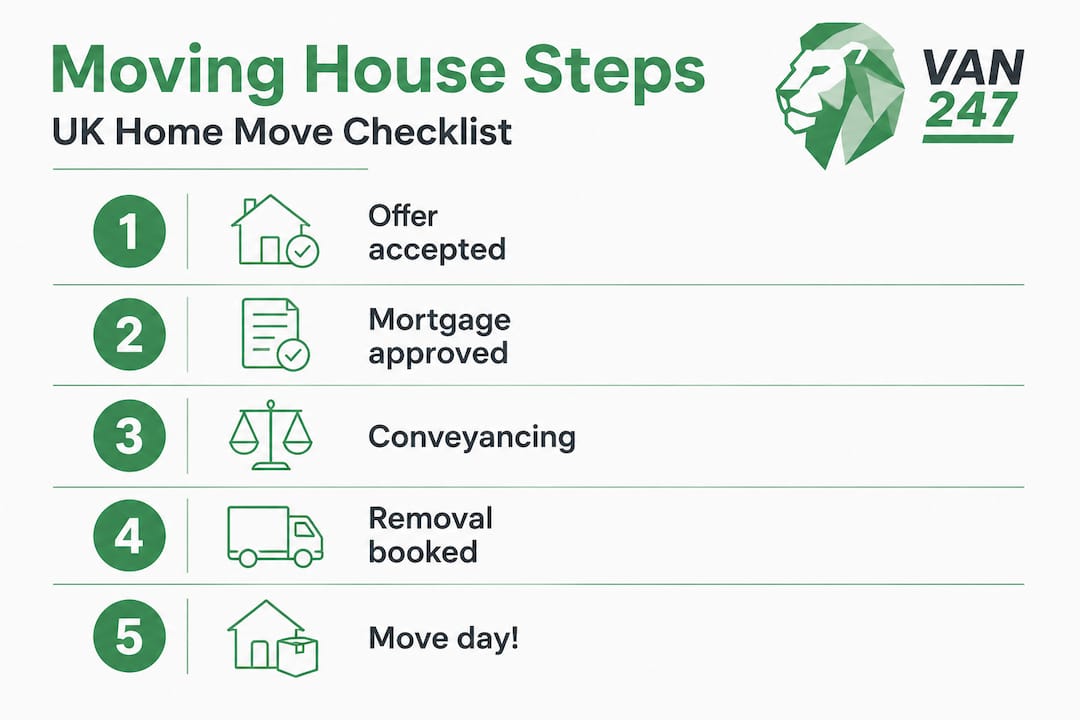
Here’s a simplified overview of the key milestones:
| Stage | Typical timeframe |
|---|---|
| Offer accepted | Day 0 |
| Mortgage in principle secured | Weeks 1–2 |
| Conveyancer instructed | Weeks 1–3 |
| Surveys and searches completed | Weeks 4–8 |
| Exchange of contracts | Weeks 8–12 |
| Completion (moving day) | Weeks 10–16 |
The move house timeline can stretch considerably depending on your chain. A property chain means your move is linked to other buyers and sellers, and if one person encounters a problem, everyone further along the chain feels the knock-on effect. This is one of the most common sources of delay in UK moves.
According to guidance from Uswitch, you should treat your move as a structured timeline: secure a mortgage in principle first, then instruct a conveyancer, arrange your removals, and finally set key dates around exchange and completion. Doing these steps out of order is one of the biggest mistakes first-time movers make.
A few other factors that affect timing in the UK:
- Stamp Duty Land Tax (SDLT) deadlines: If you’re purchasing during a relief period, missing the completion deadline can cost thousands.
- Buildings insurance: Most mortgage lenders require you to have buildings insurance in place from the date of exchange, not completion.
- School term dates: Many families plan completions around school holidays, which creates peak demand in summer months.
Understanding these dependencies early means you can build realistic expectations and avoid nasty surprises.
Planning and preparing: creating your moving checklist
With the stages set out, next comes assembling a personalised checklist to ensure nothing gets missed. Think of this as your moving day survival bible. The earlier you start, the calmer you’ll feel.
A practical approach is to work backwards from your expected completion date. Property Passport recommends breaking the process into an 8-week checklist, with specific tasks assigned to each week. Here’s a condensed version:
- Eight weeks out: Book your removal company, start decluttering, and notify your employer of your new address.
- Six weeks out: Order packaging materials and start packing non-essential rooms like spare bedrooms and storage areas.
- Four weeks out: Redirect your post with Royal Mail, notify utility providers, and confirm your removal booking.
- Two weeks out: Pack the majority of your belongings, label all boxes clearly, and confirm your completion date with your solicitor.
- One week out: Defrost the freezer, disassemble large furniture where possible, and prepare your essentials box.
- Moving day: Do a final walkthrough, take meter readings, hand over keys, and check nothing has been left behind.
Your moving home checklist should also include admin tasks that are easy to forget: updating your driving licence, registering with a new GP, and informing your bank and insurance providers.
| Task | Who to notify |
|---|---|
| Address change | DVLA, HMRC, bank, GP |
| Utilities | Gas, electricity, water, broadband |
| Post redirection | Royal Mail (set up 3–6 months) |
| Council Tax | Current and new local authority |
Pro Tip: Don’t wait until exchange to book your removal company. Popular firms fill up quickly, especially in summer. Provisionally book as soon as you have a likely completion window, and confirm once contracts are exchanged.
Packing strategies: materials, techniques and common mistakes
Once your checklist is underway, it’s time to tackle the practicalities of packing your belongings safely. Packing is one of those tasks that sounds simple but can go badly wrong without a clear approach.
Essential packing supplies to gather:
- Double-walled cardboard boxes in various sizes
- Heavy-duty packing tape and a dispenser
- Bubble wrap and packing paper for fragile items
- Permanent markers for labelling
- Wardrobe boxes for hanging clothes
- Mattress covers and furniture blankets
As highlighted in moving guidance, ordering your packing materials several weeks in advance prevents last-minute scrambling and gives you time to pack methodically rather than frantically.
How to pack different items safely:
- Breakables: Wrap each item individually in bubble wrap, fill gaps in boxes with packing paper, and mark the box “fragile” on multiple sides.
- Books: Use small boxes only. Books are deceptively heavy and large boxes will become impossible to lift safely.
- Clothing: Wardrobe boxes keep hanging clothes wrinkle-free. For folded items, vacuum storage bags save significant space.
- Valuables and documents: Keep these with you personally on moving day. Do not put passports, jewellery, or important paperwork in the removal van.
“The most common packing mistake isn’t poor wrapping. It’s unclear labelling. A box marked ‘kitchen’ tells the removal team nothing. A box marked ‘kitchen: mugs and glasses, fragile, this way up’ tells them everything.”
Using your packing checklist room by room keeps things organised and means unpacking at the other end is far less chaotic. Pack one room at a time and seal each box completely before moving on.
Common mistakes to avoid:
- Overpacking boxes until they bulge or break
- Mixing items from different rooms in the same box
- Forgetting to photograph meter readings at both properties on moving day
- Leaving packing until the final week and rushing through fragile items
- Not preparing a clearly labelled essentials box for moving day itself
If the thought of packing your entire home feels genuinely overwhelming, professional packing services are a worthwhile investment. Experienced packers can often complete in hours what takes most people several stressful days.

Understanding removal services and moving costs
Good packing prepares you for the next big question: choosing the right removal service and planning your moving budget. Removal costs are one of the most searched topics for anyone planning a move, and for good reason. Prices vary enormously.
Average moving costs in the UK depend on several key factors: the size of your property, the distance between your old and new home, the level of service you choose, and any additional extras like packing, storage, or specialist item handling.
| Property size | Local move (est.) | Long-distance move (est.) |
|---|---|---|
| 1-bedroom flat | £300–£600 | £600–£1,200 |
| 3-bedroom house | £700–£1,200 | £1,200–£2,500 |
| 5-bedroom house | £1,500–£3,000+ | £2,500–£5,000+ |
These are estimates only. Always get at least three quotes from reputable companies before committing.
Types of removal service available:
- Self-pack, van-only hire: You pack everything yourself and the company provides the vehicle and driver. Most affordable option.
- Part-service: You pack, but the removal team loads, transports, and unloads. A good middle ground.
- Full-service: The company handles packing, loading, transport, and unpacking. Most expensive but least stressful.
- Specialist services: For pianos, antiques, or large furniture, specialist handling is essential. Don’t cut corners here.
Tips for reducing costs without compromising quality:
- Move mid-week or mid-month when demand is lower
- Declutter before getting quotes so you’re not paying to move items you no longer want
- Ask whether the company offers insurance cover for your belongings in transit
- Check reviews on independent platforms before booking
Exploring your removal company options is worth doing early. If you need temporary storage solutions between properties, factor that cost in too. A gap between completion dates is more common than people expect, and having a reliable storage option lined up takes the pressure off.
Moving internationally: bringing personal belongings into the UK
While most moves occur within the UK, many people face the additional hurdle of moving from overseas. Here’s how to handle it smoothly.
If you’re relocating to the UK from abroad, you may be eligible to bring your personal belongings in free of customs duty and VAT under what’s known as Transfer of Residence (ToR) relief. According to HMRC guidance, there are strict eligibility criteria and time limits that must be met.
Key eligibility requirements:
- You must have been living outside the UK for a continuous period of at least 12 months.
- The goods must have been owned and used by you for at least six months before moving.
- You must intend to use the goods for the same purpose in the UK.
- You must not sell or loan the goods within 12 months of importation.
How to apply: step by step
- Complete the ToR1 form (available from HMRC) before your goods arrive in the UK.
- Gather supporting documents: proof of overseas residence (utility bills, rental agreements), proof of ownership of goods, and your passport.
- Submit your application to HMRC and await approval before shipping your belongings.
- Ensure your removal company or freight forwarder is aware of your ToR status, as they will need to reference it during customs clearance.
| Document required | Purpose |
|---|---|
| ToR1 form | Official application for relief |
| Proof of overseas residence | Confirms 12-month residency abroad |
| Proof of ownership | Shows goods were owned before the move |
| Passport or ID | Identity verification |
“Timing is everything with ToR relief. Your application should be submitted before your goods arrive in the UK. Applying retrospectively is possible in some cases but significantly more complicated.”
Missing the deadlines or submitting incomplete paperwork can result in unexpected import duties, which can run into thousands of pounds for a full household of belongings. If you’re unsure, a customs broker or your removal company can often assist with the paperwork.
Our honest take on what makes a move genuinely stress-free
After more than 15 years in the removals industry, we’ve seen every kind of move: the perfectly planned, the last-minute scramble, and everything in between. And here’s something that might surprise you: the moves that go smoothest are rarely the ones with the biggest budgets.
The real difference is almost always communication. Customers who stay in close contact with their removal team, who flag access issues at the new property in advance, who let us know about that awkward corner sofa or the piano in the front room, consistently have better experiences. It’s not about spending more. It’s about sharing information early.
We’d also push back gently on the idea that DIY moves save money. When you factor in van hire, fuel, the physical toll, and the genuine risk of damage to your belongings, the gap between a DIY move and a professional one is often smaller than people assume. And the stress gap is enormous. Moving day is a marathon, not a sprint, and having a professional team who have done it hundreds of times makes a real difference when things don’t go to plan.
Our honest advice: invest in a good removal company, start your checklist earlier than feels necessary, and give yourself permission to ask for help. Moving house is a big deal. You don’t have to do it alone.
Ready to make your move simpler?
Planning a move and feeling the weight of it all? We understand. At Van 247 Delivery, we’ve been helping people across the UK move their homes and offices for over 15 years. Whether you need a full-service removal, a man with a van, specialist furniture transport, or professional packing support, we’ve got you covered.
Our team offers flexible booking, comprehensive insurance, and instant quotes so you can plan with confidence. We handle everything from fragile antiques to bulky furniture, and we’re with you every step of the way. Get your free, no-obligation quote today and take the first step towards a genuinely stress-free move.
Frequently asked questions
How far in advance should I book a removal company for a UK move?
Book your removal company at least 6 to 8 weeks before your planned moving date. As part of an 8-week moving checklist, booking removals early is one of the first recommended steps, particularly during busy summer months when availability fills up fast.
What essentials should I pack for moving day?
Prepare a dedicated essentials box containing toiletries, phone chargers, a kettle, tea and coffee, snacks, important documents, and basic cleaning supplies. This moving-day essentials box means you won’t be hunting through dozens of boxes for the things you need most on your first night.
How much does moving house typically cost in the UK?
Costs range from a few hundred pounds for a small local move to several thousand for a large property over a long distance. UK removal pricing varies significantly based on property size, distance travelled, and the level of service you choose, so always compare at least three quotes.
What documents do I need for transferring goods into the UK from abroad?
You will need to complete the ToR1 form and provide proof of overseas residence, proof of ownership of your goods, and valid identification. HMRC requires approval before your belongings arrive in the UK, so start the process well in advance of your shipping date.