Moving a piano feels deceptively straightforward until you’re staring at 300 kilograms of finely tuned instrument wedged in a narrow stairwell. Most people assume that a strong group of friends and a borrowed van will do the job. They’re wrong. Pianos are among the most complex objects to relocate safely, combining extreme weight, mechanical fragility, and dimensional awkwardness in a single instrument. This article breaks down the real risks involved, explains what genuine expertise looks like, and shows you why trusting a specialist is the smartest decision you can make for your piano and your safety.
Table of Contents
- The anatomy of a piano: not just heavy, but fragile
- Why DIY piano moving is risky: common pitfalls and real consequences
- Specialist piano carriers: tools, techniques, and training
- What happens if things go wrong? Cost and consequences explained
- The uncomfortable truth about moving pianos: why expert experience is irreplaceable
- Looking for specialist piano carriers in the UK?
- Frequently asked questions
Key Takeaways
| Point | Details |
|---|---|
| Unique piano fragility | Pianos combine heavy weight with delicate internal parts, making moving them uniquely risky. |
| DIY risks | Attempting a piano move without specialists often leads to costly repairs or injuries. |
| Specialist expertise matters | Professional carriers use proper tools and proven techniques for safe piano transport. |
| Financial protection | Specialist movers carry insurance, giving peace of mind and risk coverage. |
| Choosing experience saves | Hiring skilled carriers prevents hidden damage and saves money in the long run. |
The anatomy of a piano: not just heavy, but fragile
Before you can appreciate why moving a piano is so difficult, it helps to understand what’s actually inside one.
A standard upright piano weighs between 150kg and 250kg. A baby grand sits between 180kg and 300kg. A full concert grand can exceed 500kg. That alone would make moving one challenging. But weight is only part of the story.
Inside the casing, you’ll find:
- Thousands of strings under enormous tension, each tuned to a precise pitch
- A cast iron frame that holds those strings and adds significant weight
- A soundboard made from thin, resonant spruce, which cracks easily under pressure or sudden temperature change
- The action mechanism, a system of over 7,500 moving parts in a typical upright, including hammers, dampers, and key components
- Pedal linkages running from the foot pedals up into the body of the instrument
Even small shocks during transit can knock strings out of tune or, worse, crack the soundboard. The soundboard is particularly vulnerable because it acts like a giant speaker, designed for acoustic sensitivity rather than structural resilience. One sharp bump against a door frame can cause damage that costs hundreds of pounds to repair.
| Piano type | Approximate weight | Key risk areas |
|---|---|---|
| Upright (small) | 150 to 200kg | Stability on stairs, doorway clearance |
| Upright (large) | 200 to 250kg | Floor loading, narrow hallways |
| Baby grand | 180 to 300kg | Leg removal, tilting safely |
| Full grand | 300 to 500kg+ | Access routes, floor strength |
Following piano moving best practices from the outset makes a real difference to outcomes. And as experienced piano movers will tell you, stairways are where a large proportion of incidents occur. Uneven surfaces, tight turns, and limited working space all multiply the chances of something going wrong.
Some DIY discussions online suggest moving a piano yourself is possible with enough helpers and basic equipment. The risk remains high, particularly when stairs, awkward angles, and internal damage that may not be immediately obvious are involved.
Why DIY piano moving is risky: common pitfalls and real consequences
Now we turn to what actually happens when people try to go it alone, and the results are rarely pleasant.
The most immediate danger is physical injury. A piano that shifts unexpectedly during a move can cause serious back injuries, crushed fingers, and even fractured bones. This isn’t a risk reserved for amateurs. It happens to experienced tradespeople who underestimate a particular staircase or a difficult door frame.
Common pitfalls in DIY piano moves include:
- No proper lifting equipment: Standard furniture dollies are not built for the weight distribution of a piano
- Inadequate padding: Blankets and packing tape are a poor substitute for specialist protective wrapping
- Misjudging the route: Not measuring doorways, stairwells, or lift dimensions before attempting the move
- Uneven team coordination: Four people lifting without clear communication leads to uneven load distribution
- Ignoring the legs: Grand piano legs must be removed in the correct sequence, or the instrument can tip without warning
What makes this more troubling is that damage is often invisible at first. A cracked soundboard or a damaged action mechanism may not reveal itself until weeks after the move, by which point it’s impossible to attribute it to a specific incident. Your home insurance policy is very unlikely to cover a self-inflicted piano accident. General removal insurance rarely applies to DIY moves either.
“The issue with moving a piano yourself isn’t just the weight. It’s the fact that the damage often doesn’t show up until you next sit down to play. By then, proving what happened and who is responsible is almost impossible.”
As noted in various DIY forum discussions, some people do manage piano moves without specialists. But the consensus among professionals is consistent: risk remains high, especially for stairs, tipping, and internal damage.
Pro Tip: Never attempt to move a piano up or down stairs without specialist help. Stairs are responsible for a disproportionate number of piano move injuries and instrument write-offs. The forces involved when a piano starts to tip on a staircase are enormous and very difficult to control.
If you are planning a move and want to understand what can go wrong, reading about grand piano moving tips is a good starting point. For a broader view of keeping pianos safe during relocation, you will also find useful guidance on what questions to ask. When you are ready to act, you can find piano moving services near you, and if you want to understand the pricing side, piano mover price explained gives you an honest breakdown of what you are paying for.
Specialist piano carriers: tools, techniques, and training
We’ve seen why the risks are real. Now let’s explore what makes professionals genuinely different from a team of well-meaning volunteers.
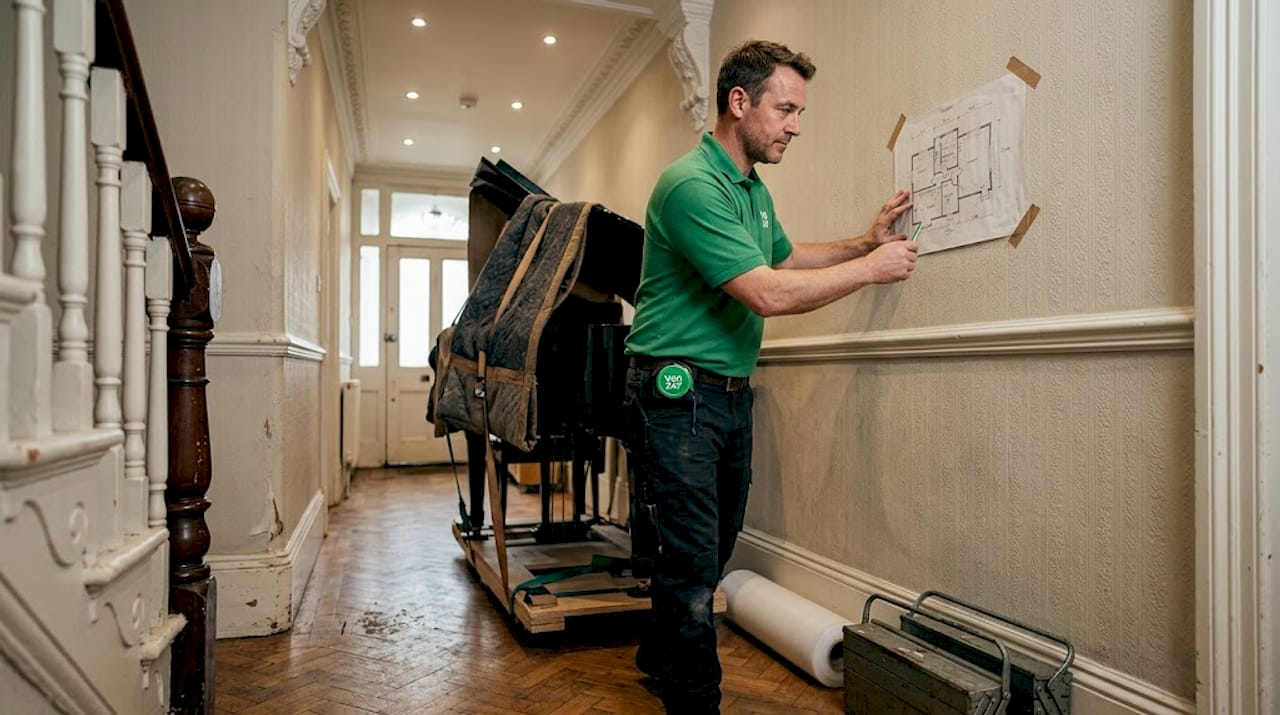
Specialist carriers don’t just bring more muscle. They bring the right equipment, trained technique, and accumulated experience that no amount of enthusiasm can replace.
Equipment used by professional piano carriers:
- Padded piano boards and skid boards designed for the instrument’s specific shape
- Heavy-duty dollies with rubber wheels rated for the correct load
- Ratchet straps and specialist harnesses to secure the piano during transit
- Foam padding and blanket wrapping to protect the exterior
- Stair climbing equipment and ramps rated for extreme weight
- Enclosed vans with air-ride suspension or padded interiors to reduce vibration in transit
Training and technique:
Professional movers follow a careful stepwise process for every move. Here’s what a typical professional piano move looks like:
- Assessment: Survey the route including all doorways, staircases, and potential obstacles, taking precise measurements
- Preparation: Remove lid, music desk, and any detachable parts, wrapping each piece individually
- Leg removal (for grands): Carried out in a specific sequence to keep the instrument balanced throughout
- Loading onto skid board: Done carefully with the instrument correctly positioned for its weight distribution
- Securing for transit: Ratchet straps applied at designated points to prevent any movement in the vehicle
- Unloading and reassembly: Reversed process carried out with the same precision, followed by a position check once in the new room
| Approach | Equipment | Injury risk | Damage risk | Insurance cover |
|---|---|---|---|---|
| DIY move | Basic dollies, blankets | High | High | Rarely covered |
| Specialist carrier | Rated equipment, padding | Low | Very low | Included or available |
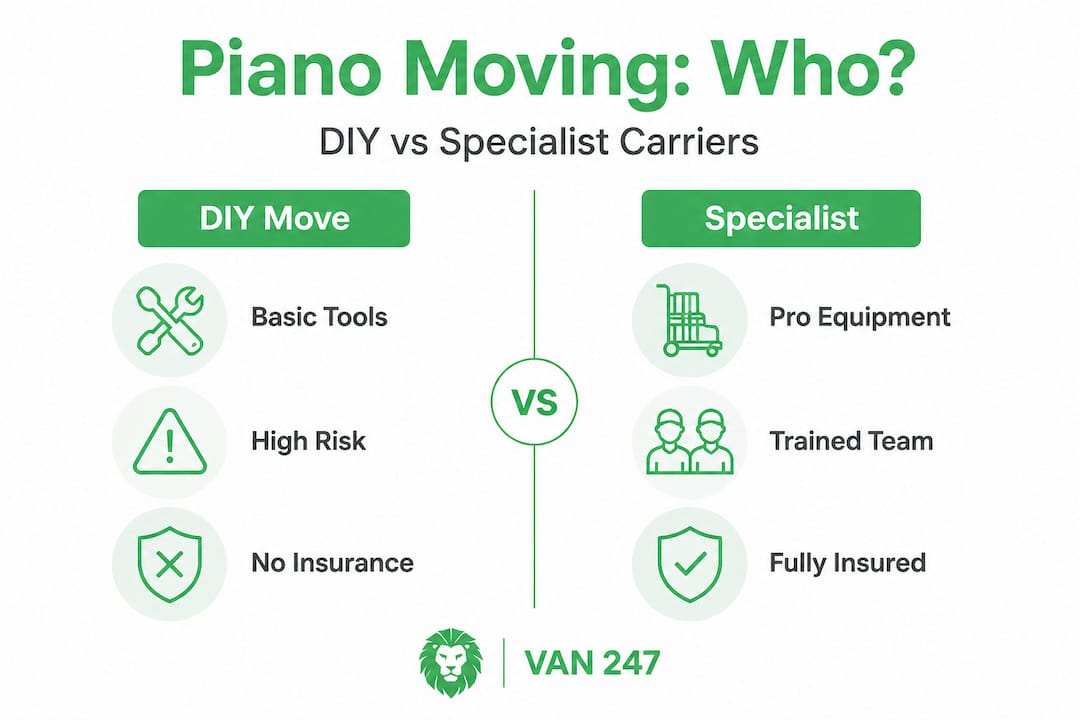
As some online discussions highlight, DIY piano moving with adequate help is technically possible in some scenarios. But the gap in outcomes between amateur and professional approaches is significant, particularly over longer distances or through challenging access routes.
For those needing fast piano transport, specialists can accommodate same-day or urgent moves while maintaining the same careful standards.
Pro Tip: Before booking any carrier, measure every doorway, hallway, and staircase on the route. Include the height, width, and any turn radius. Share these measurements with your carrier in advance. This single step prevents most last-minute complications on moving day.
What happens if things go wrong? Cost and consequences explained
Having understood the expertise involved, we need to consider what’s genuinely at stake if something goes wrong during a piano move.
The financial consequences of a failed piano move can be severe. Piano repairs are expensive, and some damage is simply irreparable.
Common repair costs following a poorly managed piano move:
- Soundboard crack repair: £500 to £2,000, depending on severity
- String replacement (full set): £800 to £3,000 for a quality upright
- Action mechanism overhaul after impact damage: £300 to £1,200
- Repolishing and exterior damage repair: £200 to £800
- Full piano replacement (if damage is beyond repair): £1,500 to £20,000+
Some damage cannot be fixed at any price. A severely cracked cast iron frame or a buckled soundboard may render the instrument unplayable permanently. This is particularly painful when the piano in question has sentimental value, perhaps a family heirloom or a first instrument.
Here are the key financial risks to be aware of:
- Your home insurance may not apply: Most home insurance policies exclude damage caused by moving, and this exclusion is often buried in the small print
- The people helping you aren’t insured either: If a friend injures themselves helping you move a piano, their medical costs could become your liability
- Replacement costs far outweigh moving costs: A specialist move might cost £150 to £400. Replacing a damaged piano could cost ten times more
- Tuning alone isn’t enough after a bad move: A piano that has been dropped or jolted severely may need far more than a tuning appointment to restore it to playing condition
According to various amateur move discussions, people often underestimate how much internal damage can go undetected until the instrument is played. The risk of hidden damage is a strong argument for choosing professionals every time.
For long-distance relocations, the risks multiply further. Nationwide piano transport services manage the additional challenges of extended road travel, temperature variation, and multiple handling points with specialist care built into every stage.
The uncomfortable truth about moving pianos: why expert experience is irreplaceable
After going through all of this, there’s one honest observation worth making.
The most common mistake people make is treating piano moving as a heavy lifting problem rather than a specialist skill. You wouldn’t rewire your home because you’ve watched a YouTube video. The same logic applies here. Pianos are precision instruments that happen to be very large and very heavy. Both of those things matter equally.
We’ve spoken to people who tried DIY piano moves and said the same thing afterwards: it looked manageable until it wasn’t. The tipping point, literally and figuratively, usually comes mid-staircase or at an awkward turn, when someone loses their grip, communication breaks down, or the weight distribution shifts unexpectedly.
What professional carriers bring to the job isn’t just equipment. It’s the ability to anticipate problems before they happen. They look at a staircase and immediately see the three things that could go wrong. They look at a doorway and know whether the piano will clear it without needing to try. This kind of experience is built up over hundreds of moves, and it simply cannot be replicated on your first attempt.
As various online conversations acknowledge, some DIY moves succeed. But success in those cases is often luck rather than skill. Relying on luck with a £5,000 instrument is a gamble most people would rather not take once they understand what’s actually at risk.
Local piano movers who have genuine experience will also carry the right insurance and be able to show you their credentials without hesitation. If a carrier can’t tell you exactly what their insurance covers or how many piano moves they’ve completed, that’s a clear sign to look elsewhere.
Pro Tip: When booking a carrier, ask specifically how many piano moves they carry out per month. A firm handling pianos regularly will have refined processes and appropriate equipment. A general removal company that does piano moves occasionally is a different proposition entirely.
Looking for specialist piano carriers in the UK?
Knowing the risks and understanding what expertise looks like is the first step. The next step is finding the right people for the job.

At Van 247 Delivery, we’ve been handling specialist piano moves across the UK for over 15 years. Our UK piano removal experts bring the right equipment, training, and insurance to every job, whether you’re moving a small upright around the corner or arranging nationwide piano transport solutions for a concert grand. We take the time to assess your route, communicate clearly at every stage, and ensure your instrument arrives safely. For a full picture of what our team needs to plan your move effectively, take a look at our guide to understanding piano transport jobs. Get an instant quote today and let us take the stress off your hands.
Frequently asked questions
Can I move a piano myself if I have enough friends and equipment?
While it may be technically possible in straightforward ground-floor scenarios, the risk of hidden damage and physical injury remains high, particularly on stairs or through tight access points.
What equipment do specialist piano carriers use?
Specialist carriers use padded dollies, rated ratchet straps, piano skid boards, protective foam wrapping, and enclosed vehicles with suspension designed to minimise vibration during transit.
Are specialist piano carriers insured for any accidental damage?
Yes, reputable specialist piano carriers offer insurance that covers accidental damage during transit, which is something most DIY moves cannot provide, leaving you exposed to significant repair costs.
How much does professional piano moving typically cost in the UK?
Professional piano moving in the UK usually costs between £100 and £400 depending on the piano type, distance travelled, and the complexity of the access route at both ends of the move.