Relocating a business is nothing like moving home. You might think the same principles apply, but the reality is far more complex, and the stakes are significantly higher. From protecting sensitive equipment and maintaining data security to navigating health and safety regulations and keeping your team productive, commercial removals demand a completely different level of planning.
Get it wrong and you risk costly downtime, damaged assets, and even legal exposure. This guide breaks down everything you actually need to know, so your next office move goes smoothly, safely, and without nasty surprises.
Table of Contents
- What makes commercial removals different?
- The commercial removals process: key steps explained
- Choosing your approach: full-service vs self-managed moves
- Insurance and compliance: how to avoid costly mistakes
- Our view: why most commercial removals go wrong (and how to get it right)
- How Van-247 can support your next business move
- Frequently asked questions
Key Takeaways
| Point | Details |
|---|---|
| Plan for compliance | Risk assessments and health and safety compliance are non-negotiable for commercial removals. |
| Choose your service level | Decide between full-service or self-managed moves based on risk, accountability, and cost trade-offs. |
| Insure your move completely | Goods in Transit and Public Liability insurance protect your business assets during relocation. |
| Professional support reduces risk | Using experience removal specialists minimises downtime and compliance headaches. |
What makes commercial removals different?
Most people picture a removal lorry, some boxes, and a few strong arms. That mental image works reasonably well for a house move. For a business relocation, it falls dangerously short.
Commercial removals involve a far greater scale of assets. Think server racks, specialist machinery, confidential filing systems, branded furniture, and dozens of individual workstations, all of which need to arrive in the right place, in the right condition, at exactly the right time.
Unlike domestic moves, there is no flexibility to “sort it out later.” Every hour your business is offline costs money.
Here is what separates commercial removals from domestic ones:
- Scale and complexity: Offices often contain hundreds of individual items, many of which require specialist handling or disassembly.
- Business continuity: Operations cannot simply pause. Clients, suppliers, and staff all depend on minimal disruption.
- Confidentiality: Personnel files, financial records, and client data must be handled securely throughout the move.
- Regulatory compliance: You have legal obligations that simply do not exist in a home move.
- Multiple stakeholders: Facilities managers, IT teams, department heads, and removal crews all need to be coordinated.
That last point about regulation is worth pausing on. UK health and safety regulations require risk assessments for manual handling, using tools like the Manual Handling Assessment Charts (MAC), ensuring safe vehicle movements, clear responsibilities between drivers and site workers, and full compliance with the Health and Safety at Work Act during moves.
This is not optional guidance. It is a legal requirement, and ignoring it exposes your organisation to serious liability.
“Underestimating the regulatory side of a commercial move is one of the most common and most costly mistakes businesses make.”
The good news is that experienced providers of removals services in the UK understand these obligations inside out. Working with a professional team means these compliance boxes are ticked before the first box is packed.
When you compare commercial and house removals, the difference in complexity becomes immediately clear, and so does the value of specialist support.
With the unique business risks in mind, it is essential to look at the step-by-step process commercial removals require.
The commercial removals process: key steps explained
A well-executed commercial move does not happen by accident. It is the result of careful planning, clear communication, and a structured process that leaves nothing to chance. Here is what a professional approach looks like from start to finish.
- Pre-move audit and inventory: Before anything is packed, carry out a full audit of everything your business owns. Catalogue every item, note its condition, and flag anything that requires specialist handling. This inventory becomes your master document throughout the move.
- Risk assessment and method statement: As required by UK health and safety law, a formal risk assessment must be completed before the move begins. This covers manual handling risks, vehicle access at both sites, and the responsibilities of everyone involved. A method statement outlines exactly how the move will be carried out safely.
- Packing and labelling: Every item should be packed professionally and labelled clearly, including the destination room or workstation. Colour-coded labelling systems work brilliantly for larger offices. Sensitive equipment like servers and monitors needs anti-static packaging and custom crating.
- On-move coordination: On the day itself, you need a single point of contact at each site. This person liaises with the removal crew, manages access, and resolves any issues in real time. Vehicle movements should be scheduled to avoid congestion, and all documentation, including inventory sheets and delivery notes, should travel with the load.
- Post-move set-up and compliance checks: Once everything arrives, the job is not done. IT systems need reconnecting and testing, furniture needs positioning, and a final check against the inventory confirms nothing has been lost or damaged. Any compliance-related documentation should be filed and retained.
You can find a more detailed step-by-step office move guide to help you map out your timeline. It is also worth using an office removal planning tool to keep every task, deadline, and responsibility in one place.
Pro Tip: Many businesses try to save money by delegating the move to in-house staff. This sounds sensible until you realise that untrained employees handling heavy or sensitive equipment creates a real liability. If someone is injured, or a server is dropped, your business bears the cost, both financially and legally. Leave the heavy lifting to the professionals.
Understanding the stages sets the scene, but businesses face a crucial choice of how to deliver their move: end-to-end service or a more hands-on approach.
Choosing your approach: full-service vs self-managed moves
There is no single right answer here, but there are clear trade-offs that every business should understand before committing to an approach.
| Factor | Full-service move | Self-managed move |
|---|---|---|
| Cost | Higher upfront | Lower upfront |
| Accountability | Single provider responsible | Shared or unclear |
| Downtime risk | Lower | Higher |
| Insurance coverage | Typically included | Often gaps exist |
| Stress level | Lower | Significantly higher |
| Compliance handling | Managed by provider | Your responsibility |
| Flexibility | Structured | More ad hoc |
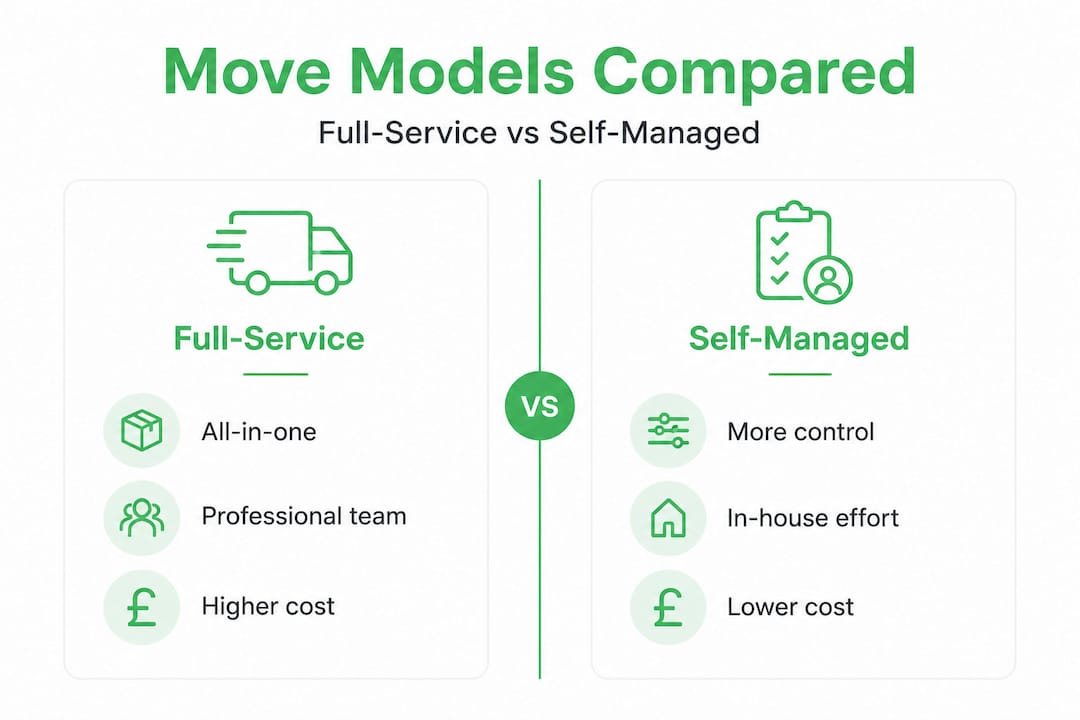
A full-service approach means one provider handles everything: planning, packing, transport, and set-up. You pay more, but you gain a single point of accountability and a team that is professionally trained and insured. If something goes wrong, there is a clear process for resolution.
A self-managed or bundled approach gives you more control and can reduce costs. You might hire a van, coordinate your own staff, and use a removal company only for the heavy items. The risk is that responsibilities become blurred. Who is liable if a monitor is cracked? Who ensures the risk assessment is completed? These questions often go unanswered until something goes wrong.
Comparing commercial move models shows that while some businesses advocate for full-service end-to-end arrangements for accountability, others prefer self-pack or bundled options for cost savings. However, the consensus is clear: DIY approaches carry a significantly higher risk of downtime and insurance gaps. Even global logistics providers recognise that the hidden costs of a poorly managed move almost always outweigh the apparent savings.
Guidance on how to select the right move service can help you weigh up your specific needs, budget, and risk tolerance before making a decision.
Pro Tip: Whatever approach you choose, always get written confirmation of what is and is not covered by your removal provider’s insurance. Many businesses assume they are fully covered, only to discover significant gaps when they need to make a claim. Ask specifically about full replacement value, not just depreciated value.
Once you know your preferred approach, you need to make sure the basics, insurance and compliance, are fully covered.
Insurance and compliance: how to avoid costly mistakes
This is the part of commercial removals that most businesses overlook until it is too late. Insurance and compliance are not exciting topics, but they are absolutely critical to protecting your organisation during a move.
The two most important insurance types to understand are:
- Goods in Transit insurance: This covers your equipment, furniture, and assets while they are being transported. If items are lost, stolen, or damaged during the move, this policy pays out. Without it, you are personally liable for replacing everything.
- Public Liability insurance: This covers third-party damage or injury caused during the move. If a removal crew member accidentally damages the lift in your new building, or a member of the public is injured, Public Liability insurance steps in. Removal company insurance should always include both of these as a minimum, along with full value protection for high-value items.
Here is a quick reference table to help you ask the right questions:
| Insurance type | What it covers | Key questions to ask |
|---|---|---|
| Goods in Transit | Assets during transport | Is it full replacement value or depreciated? |
| Public Liability | Third-party injury or damage | What is the coverage limit? |
| Employer’s Liability | Staff injuries during the move | Is the removal crew employed or subcontracted? |
| Professional Indemnity | Errors in planning or advice | Does your provider carry this? |
Beyond insurance, you should also check for industry accreditations. FORS Silver (Fleet Operator Recognition Scheme) is a recognised standard for commercial vehicle operators, covering safety, efficiency, and environmental performance. A removal company holding FORS Silver accreditation has been independently audited, which gives you greater confidence in their professionalism.
Common compliance mistakes to avoid:
- Failing to carry out a formal risk assessment before the move begins
- Not confirming that the removal company holds valid insurance certificates
- Assuming your existing business insurance covers assets during a move (it often does not)
- Neglecting to check vehicle access restrictions at either site, particularly in city centres
- Overlooking data protection obligations when moving physical files or IT equipment
You can find reputable removal companies that hold the right credentials, and it is always worth understanding removal van costs upfront so you can budget accurately without cutting corners on coverage.
Putting these essentials together, businesses can secure a smooth and safe move, if they avoid common pitfalls and approach planning with a clear strategy.
Our view: why most commercial removals go wrong (and how to get it right)
After more than 15 years supporting businesses through commercial relocations, we have seen the same mistakes repeated time and again. And the frustrating thing is that most of them are entirely avoidable.
The biggest pitfall is not a lack of budget or a bad removal company. It is a breakdown in the chain of accountability. When multiple teams are involved, such as facilities, IT, HR, and external contractors, and no single person owns the process end to end, things fall through the gaps. A risk assessment gets delayed. A labelling system is inconsistent. The IT team arrives before the furniture, or vice versa. These are not catastrophic failures individually, but together they create chaos.
We also see businesses focus almost entirely on cost when choosing a removal provider. Going cheap rarely pays off. A lower quote often means less experienced staff, thinner insurance coverage, and no formal method statement. When something goes wrong, and in a poorly planned move something usually does, the savings evaporate instantly. The cost of even one day of unplanned downtime for a mid-sized business can easily exceed the difference between a budget provider and a professional one.
What actually works? Here is what the most successful commercial moves have in common:
- A single in-house champion: One person with the authority and time to own the move from planning to completion.
- Documented responsibilities: Every task, from packing a desk to reconnecting a server, is assigned to a named individual.
- Proof of compliance: Method statements and risk assessments are requested and reviewed before the move begins, not assumed.
- Insurance verification: Certificates are checked, not just promised.
- A realistic timeline: Rushed moves cut corners. Build in contingency time at every stage.
The myth that a commercial removal is just a bigger version of a home move is genuinely dangerous. It leads businesses to underplan, underinsure, and underestimate the expertise required. Treat your office move as the significant operational project it is, and the results will reflect that.
How Van-247 can support your next business move
Planning a commercial removal is a serious undertaking, and you do not have to navigate it alone.
At Van-247, we have been supporting businesses across the UK with professional, insured, and fully coordinated removal services for over 15 years. Whether you need same-day pallet transport for urgent equipment, flexible local man and van solutions for smaller office relocations, or last minute removals when timelines shift unexpectedly, we have the resources and experience to keep your move on track. Our team understands the compliance requirements, insurance essentials, and coordination challenges that commercial moves involve. Get in touch today for a tailored quote and find out how straightforward your next business relocation can be.
Frequently asked questions
What legal requirements must be considered for a commercial removal in the UK?
Risk assessments and compliance with the Health and Safety at Work Act are mandatory for any business removal, covering manual handling, vehicle movements. And clearly defined responsibilities between all parties involved.
Why is Goods in Transit insurance essential for office moves?
Goods in Transit insurance covers your equipment and assets if they are lost, stolen, or damaged during transport, protecting your business from potentially significant replacement costs.
How can businesses minimise downtime during a removal?
Use a detailed move schedule with clear milestones, assign a dedicated move coordinator to own the process. And partner with experienced removal specialists who can work efficiently around your operational hours.
What are the main risks of DIY commercial moves?
DIY commercial moves consistently result in higher downtime, uninsured losses, and compliance oversights compared to professionally managed services. Often costing more in the long run than the initial savings suggest.