Understanding piano transport regulations, piano transport regulations in the UK are defined by the Manual Handling Operations Regulations 1992 (MHOR). A risk-based legal framework that applies to all workplace manual handling, including moving pianos.
There is no dedicated piano transport statute in UK law. Instead, compliance depends on applying MHOR correctly, alongside international rules like CITES and the ATA Carnet system when instruments cross borders.
Whether you are moving a grand piano across town or shipping a vintage upright to Europe, understanding piano transport regulations means knowing which rules apply, when they apply, and how to meet them without putting people or instruments at risk.
What do UK piano transport regulations actually require?
UK piano transport law has no fixed weight limit for moving a piano. MHOR 1992, amended in 2002, does not say “a piano weighing over X kilograms requires Y people.” It says employers must avoid hazardous manual handling wherever practicable, and where that is not possible, they must assess and reduce the risk. That distinction matters enormously in practice.
The assessment tool built into MHOR is the TILE framework. TILE stands for Task, Individual, Load, and Environment. Each element shapes the risk profile of a piano move:
- Task: What physical actions are involved? Lifting, carrying, lowering, pushing, or pulling a piano up stairs all carry different risk levels.
- Individual: Is the worker trained and physically capable? Are there health conditions that affect their ability to handle heavy loads safely?
- Load: How heavy is the piano, and is it awkward to grip? A baby grand and a concert grand present very different load challenges.
- Environment: What are the floor surfaces, staircase widths, doorway clearances, and lighting conditions at both the collection and delivery address?
Around 35% of workplace injuries relate to manual handling. That figure explains why MHOR places the burden on employers and transport businesses to eliminate risk first, then manage what remains. For piano movers, this means the compliance mindset should always start with mechanical aids, not muscle.
Employers must provide written risk assessments, evidence of worker training, and appropriate mechanical aids such as piano trolleys, skate boards, and loading ramps. Workers have a corresponding duty to follow safe systems of work and use the equipment provided. A compliant piano move typically requires documented TILE-based assessment, proof of training, and mechanical aids matched to the specific piano weight and access conditions.
Pro Tip: Keep a copy of your TILE risk assessment on site during every piano move. If an injury occurs or an HSE inspector visits, that document is your primary evidence of compliance.
Do you need a CITES certificate for piano transport?
Moving a piano internationally gets more complex when the instrument contains materials derived from protected species. The Convention on International Trade in Endangered Species (CITES) governs the cross-border movement of instruments made with materials such as Brazilian rosewood or elephant ivory, both listed under CITES Appendix I.
If your piano contains these materials, a Musical Instrument Certificate is required to cross international borders legally. Without it, customs authorities can seize the instrument at the border. That is not a theoretical risk. It happens to touring musicians and private owners who assume their piano is exempt.
Here is what you need to know about CITES compliance before any international move:
- Identify the materials first. Check the piano’s provenance documents, manufacturer records, or have a specialist assess the instrument. Brazilian rosewood was commonly used in piano keys and cases before international restrictions tightened.
- Apply for the Musical Instrument Certificate in advance. The certificate is issued for non-commercial use only, covering performances, personal use, and similar activities.
- Understand the limits of the certificate. CITES travel exemptions do not cover commercial sales or transfers abroad. If you are selling a piano internationally, you need a separate export permit, not a Musical Instrument Certificate.
- Carry the certificate with the instrument at all times. Border officials need to see it alongside the piano, not stored separately in a different bag or vehicle.
- Do not leave documentation to the last minute. Proactive material verification and documentation assembly is the single most effective way to avoid border delays.
Pro Tip: If you are unsure whether your piano contains protected materials, contact the manufacturer or a specialist restorer before booking international transport. Discovering the issue at the border is far more costly than checking in advance.
How does the ATA Carnet system work for piano export?
The ATA Carnet is the standard system for temporarily exporting and re-importing goods, including pianos, without paying customs duties. It is widely used by touring musicians, orchestras, and music businesses moving instruments across borders for performances, recordings, or temporary exhibitions.
The carnet works through a voucher system. Yellow Export and Re-import vouchers must be physically stamped at designated customs points when the piano leaves and re-enters the UK. Getting this wrong does not just cause paperwork headaches. Missing physical stamping at designated IBFs invalidates customs clearance and risks fines or seizure of the instrument.
| Crossing point | IBF facility | Notes |
|---|---|---|
| Dover / Eurotunnel | Sevington IBF | Primary facility for Channel crossings |
| Holyhead | Holyhead IBF | Covers Irish Sea routes |
| Other ports | Check HMRC guidance | Not all ports have IBF facilities |
Key operational requirements for ATA Carnet stamping include:
- Physical presence at the IBF. The carnet holder or their authorised representative must be present at the facility during stamping.
- Hi-vis clothing. Carnet holders and drivers must wear hi-vis jackets or tabards during stamping operations at IBF sites. This is an operational requirement, not optional.
- Correct routing. Follow designated routes within the IBF. Deviating from the approved route can invalidate the process.
- Stamping schedules. Operational success with ATA Carnet depends on strict adherence to stamping schedules. Arriving outside operating hours means the piano cannot legally cross the border that day.
Working with a customs agent or specialist transport company that understands carnet logistics removes much of this operational pressure. They know the facilities, the schedules, and the paperwork requirements in detail.
Best practices for transporting pianos safely and compliantly
Safe piano transport is not just about following the law. It is about protecting a fragile, expensive instrument and the people moving it. These two goals align closely when you apply the right approach from the start.
| Approach | What it involves | Why it matters |
|---|---|---|
| Mechanical aids | Piano trolleys, skate boards, loading ramps | Reduces manual handling risk under MHOR |
| Pre-move risk assessment | TILE framework applied to specific move | Legal requirement and practical safety tool |
| Proper wrapping and securing | Blankets, straps, custom crating | Prevents damage to keys, lid, and casework |
| Team training | Handling techniques, equipment use | Reduces injury risk and ensures compliance |
| Insurance | Specialist piano transport cover | Protects against damage claims |
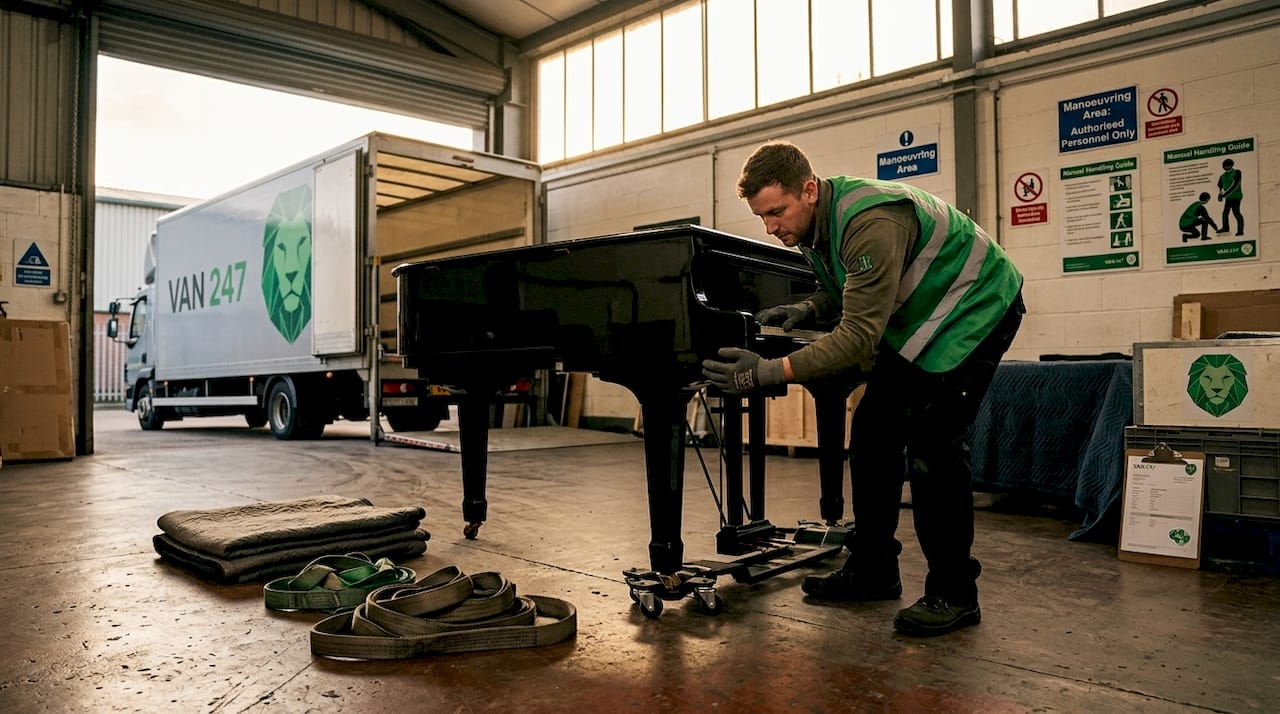
Professional piano movers use specialist equipment including dollies, climate-controlled vehicles, and custom crating to protect delicate instruments. Improper moves frequently cause damage to piano components that is expensive and sometimes irreversible.
Before any move, communicate the piano’s weight and dimensions clearly to everyone involved. A standard upright piano weighs between 100 and 200 kilograms. A concert grand can exceed 500 kilograms. These are not figures you discover on the day. They shape every decision about team size, equipment, and vehicle choice.
Wrapping matters more than most people expect. The piano lid, keyboard cover, and pedal assembly are all vulnerable during loading and transit. Use moving blankets secured with straps, and consider moving tools like ratchet strapping to keep the instrument stable in the vehicle. Avoid stacking anything on top of the piano during transport.
Pro Tip: Always confirm doorway widths and staircase dimensions at both the collection and delivery address before the move day. A piano that cannot fit through a door is a problem that no amount of skill or equipment can solve on the spot.
Key takeaways
Compliant piano transport in the UK requires a documented TILE risk assessment under MHOR, CITES certification for instruments containing protected materials, and correct ATA Carnet stamping at designated IBFs for temporary international movements.
| Point | Details |
|---|---|
| No piano-specific UK law | MHOR 1992 governs piano transport through a risk-based TILE framework, not fixed weight limits. |
| CITES certificate required | Pianos containing Brazilian rosewood or ivory need a Musical Instrument Certificate for international travel. |
| ATA Carnet stamping is critical | Yellow vouchers must be physically stamped at Sevington or Holyhead IBFs; missing this step risks seizure. |
| Mechanical aids are legally required | Employers must provide trolleys, ramps, and training as part of MHOR compliance, not just as good practice. |
| Insurance and documentation | Specialist cover and written risk assessments protect both the instrument and the people moving it. |
Why piano transport compliance is simpler than it looks
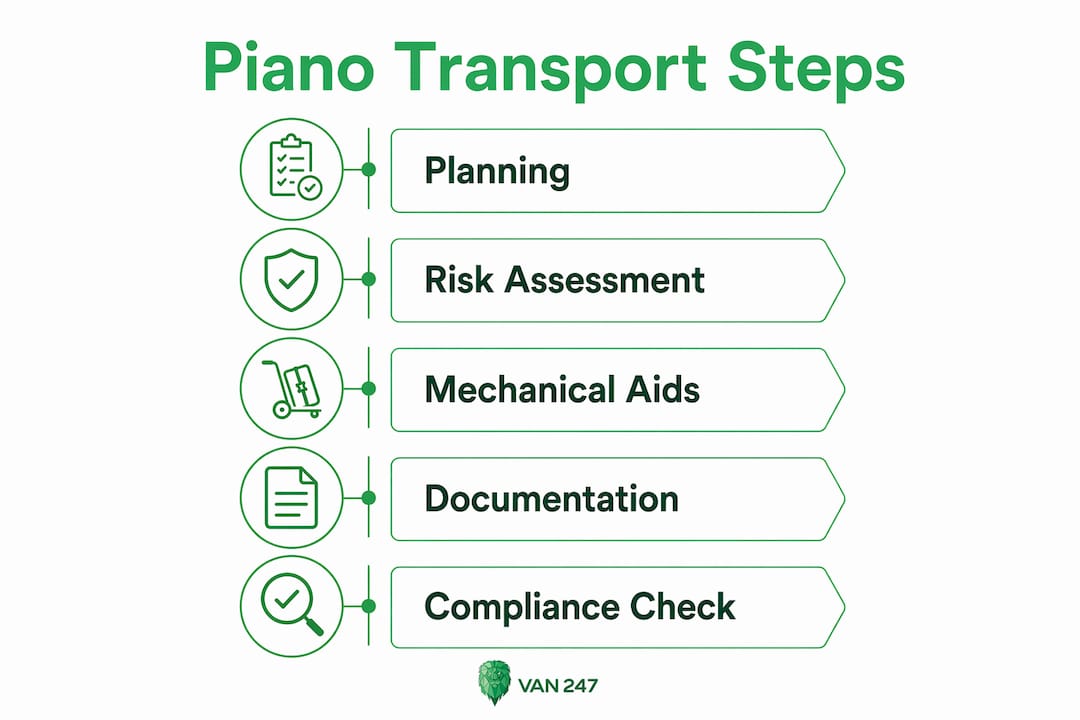
People often assume there must be a specific set of piano moving regulations buried somewhere in UK law. There is not. Once you understand that MHOR is the governing framework and that it focuses on risk assessment rather than rigid rules, the whole picture becomes much clearer.
The most common misunderstanding I see is around weight limits. People ask: “Is there a legal limit for how heavy a load one person can carry?” The honest answer is no. MHOR requires you to assess whether the task is hazardous and reduce that risk. For a piano, the answer is almost always to use mechanical aids and a trained team rather than relying on individual strength.
On the international side, CITES compliance trips people up not because the rules are complicated, but because they do not check the instrument’s materials until it is too late. The Musical Instrument Certificate process is straightforward if you start it early. The ATA Carnet system is similarly manageable once you understand the IBF stamping requirements and plan your route accordingly.
My honest view is that most piano transport problems are planning problems. The regulations themselves are reasonable and workable. What causes issues is leaving compliance checks to the last minute, underestimating the physical demands of the move, or assuming that general removal experience translates directly to piano handling. It does not. Pianos require specific knowledge, specific equipment, and specific documentation. Get those three things right, and the move goes smoothly.
— Claudiu
Move your piano with confidence using Van-247delivery
Van-247delivery has over 15 years of experience handling specialist piano transport across the UK, with a team that understands both the MHOR requirements and the practical demands of moving delicate instruments safely. Whether you need a local move or a more complex relocation, Van-247delivery’s specialist piano transport service covers everything from pre-move risk assessment to proper wrapping, loading, and insured delivery. For larger moves or office relocations involving pianos, the house removals service provides a fully managed solution with compliance built in. Get an instant quote online and book with confidence, knowing your instrument is in experienced hands.
FAQ
Is there a specific piano transport law in the UK?
No specific piano transport law exists in the UK. The Manual Handling Operations Regulations 1992 (MHOR) govern all workplace manual handling, including piano moves, through a risk-based TILE framework.
When do I need a CITES certificate for my piano?
You need a CITES Musical Instrument Certificate when transporting a piano internationally if it contains materials from protected species, such as Brazilian rosewood or elephant ivory. Without it, the instrument risks seizure at the border.
What is an ATA Carnet and do I need one?
An ATA Carnet is a customs document for temporarily exporting and re-importing goods, including pianos, without paying duties. You need one if you are taking a piano abroad temporarily, for example for a tour or performance, and intend to bring it back to the UK.
Where do I get my ATA Carnet stamped in the UK?
ATA Carnet vouchers must be physically stamped at designated Inland Border Facilities. For Channel crossings, use Sevington IBF near Dover. For Irish Sea routes, use Holyhead IBF. Stamping outside these facilities does not satisfy customs requirements.
Do I need insurance for piano transport?
Insurance is not a legal requirement under MHOR, but specialist piano transport insurance is strongly recommended. Professional piano movers carry cover for damage to the instrument and third-party liability, protecting you if something goes wrong during the move.