Scheduling a van delivery is the process of securing a confirmed time slot, providing precise shipment details, and coordinating route logistics to guarantee your items arrive on time. Whether you are moving house, transporting furniture, or sending pallets across the country, knowing how to schedule van delivery correctly saves you time, money, and considerable stress.
This guide covers everything from the operational details you must gather upfront, to selecting the right time window, planning your route, and troubleshooting problems on the day. Services like Rapid Despatch, EasyRoutes, and Van-247delivery each approach the booking process differently, so understanding the fundamentals puts you firmly in control.
What information do you need to schedule van delivery?
Successful scheduling requires collecting exact operational details before you even open a booking form. Missing a single piece of information can result in the wrong vehicle being assigned, an inaccurate arrival time, or a failed delivery attempt.
The details you need fall into four clear categories:
| Category | What to Provide |
|---|---|
| Location details | Pickup and delivery postcodes, floor level, lift availability |
| Item details | Count, dimensions, weight, stackability, fragility |
| Site constraints | Loading bays, parking restrictions, timed access windows |
| Contact details | Name and phone number at both collection and delivery points |
Getting these right matters more than most people realise. A van booked for a ground-floor flat will not carry a piano to a third-floor office without prior notice. Similarly, a driver arriving at a loading bay that closes at 10:00 will miss the slot entirely if nobody flagged the restriction at booking stage.
Pro Tip: Always confirm whether any item requires special handling, such as antiques, electrical equipment, or items over 100kg. Flagging this upfront prevents last-minute vehicle swaps and protects your goods.
When you arrange a van delivery for a business, add the recipient’s site instructions and any security sign-in requirements. Residential moves need the same rigour. Note whether there is a dropped kerb, a narrow access road, or a parking permit zone. These details affect vehicle choice and arrival time equally.
How do you choose the right delivery time window?
Time-window services require choosing specific defined delivery windows that are often narrow and harder to guarantee due to route planning complexity. The three most common options in the UK are 1-hour slots, AM windows (08:00–12:00), and pre-noon guarantees. Each comes with a different price point and a different level of certainty.
Narrower windows cost more because they demand precise per-stop timing and realistic buffers built into the route. A 1-hour slot at 09:00 on a Monday morning in central London is a very different proposition to a 1-hour slot at 14:00 in a rural postcode. Traffic density, parking availability, and driver hours all affect whether the window holds.
Before confirming any timed window, work through this checklist:
- Confirm the window is guaranteed to your specific postcode, not just available in theory
- Check the latest collection cut-off time for your chosen service
- Verify whether the window carries a money-back guarantee or simply a best-effort promise
- Build in at least 15 minutes of buffer at the delivery end for access delays
- Ask what happens if the window is missed and whether a retry is included
Amazon Shipping recommends specific cut-offs for peak season, such as 21 December for two-day delivery before 24 December. Missing a cut-off means delays or the need for alternative arrangements. The same principle applies to any timed van delivery: confirm cut-offs before locking in your slot.
Pro Tip: When you are close to a cut-off time, consider booking a dedicated same-day vehicle rather than a network timed service. Dedicated vehicles carry only your load, so the window is far more reliable.
Postcode eligibility is a genuine issue in the UK. Some timed windows are only available in major urban centres. If your delivery address is in a rural area or a remote Scottish postcode, always check eligibility before paying for a premium window. You can read more about choosing a reliable courier to understand which services cover your area.
Route planning and loading order for multi-stop deliveries
Efficient multi-drop deliveries group stops by postcode clusters and sequence them within clusters, loaded in reverse drop order to save time at stops. This single principle is the biggest efficiency gain available to anyone running more than two drops in a day.
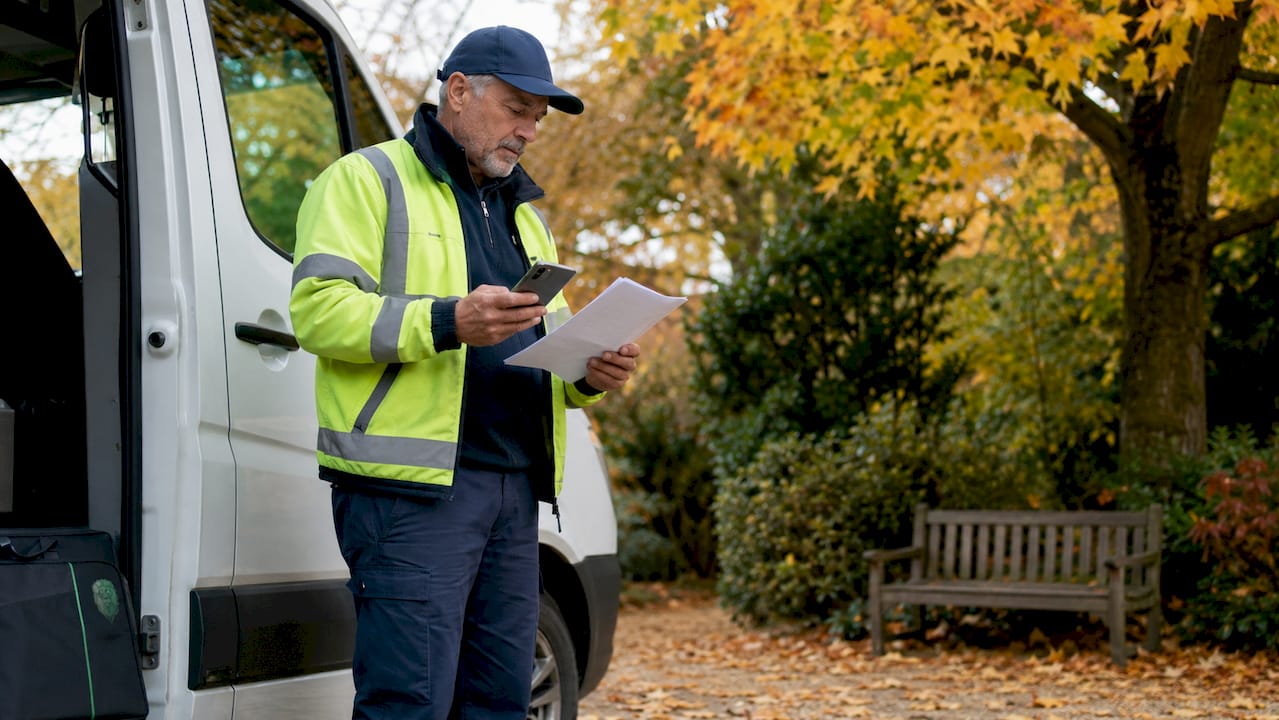
The logic is straightforward. If your first drop is at the back of the van, you spend time unloading and reloading at every stop. Load in reverse order and the first drop is always at the door. Loading in reverse drop order can save up to 90 minutes over a 30-stop route by eliminating repeated searching at stops. That is not a marginal gain. It is the difference between finishing on time and running two hours late.
Here is how manual planning compares to using a route optimisation tool:
| Approach | Pros | Cons |
|---|---|---|
| Manual mapping | No software cost, full control | Time-consuming, prone to human error |
| Route optimisation tools (e.g. EasyRoutes, MapTools.uk) | Fast, accounts for traffic and clusters | Requires accurate input data |
Drivers commonly err by delivering in manifest or alphabetical order rather than geographical sequence, wasting time and fuel. Resequencing by geography is standard advice for any driver running multiple drops. If you are planning manually, print a map and draw your clusters before you sequence the stops.
Adding a 10–15% buffer to your total route time accounts for real-world delays including traffic, parking searches, and longer-than-expected dwell times at each stop. A route that looks like four hours on paper often takes five in practice.
Pro Tip: Never plan your drop sequence from a manifest list. Sort by postcode district first, then sequence within each district. This one change removes most of the backtracking from any multi-stop route.
How to book and confirm your van delivery step by step
Delivery scheduling is a structured workflow linking order visibility, route planning, and driver and time slot assignment before dispatch. Software solutions automate slot setting and driver assignments, enabling live tracking and adaptability. Understanding this workflow helps you ask the right questions when booking.
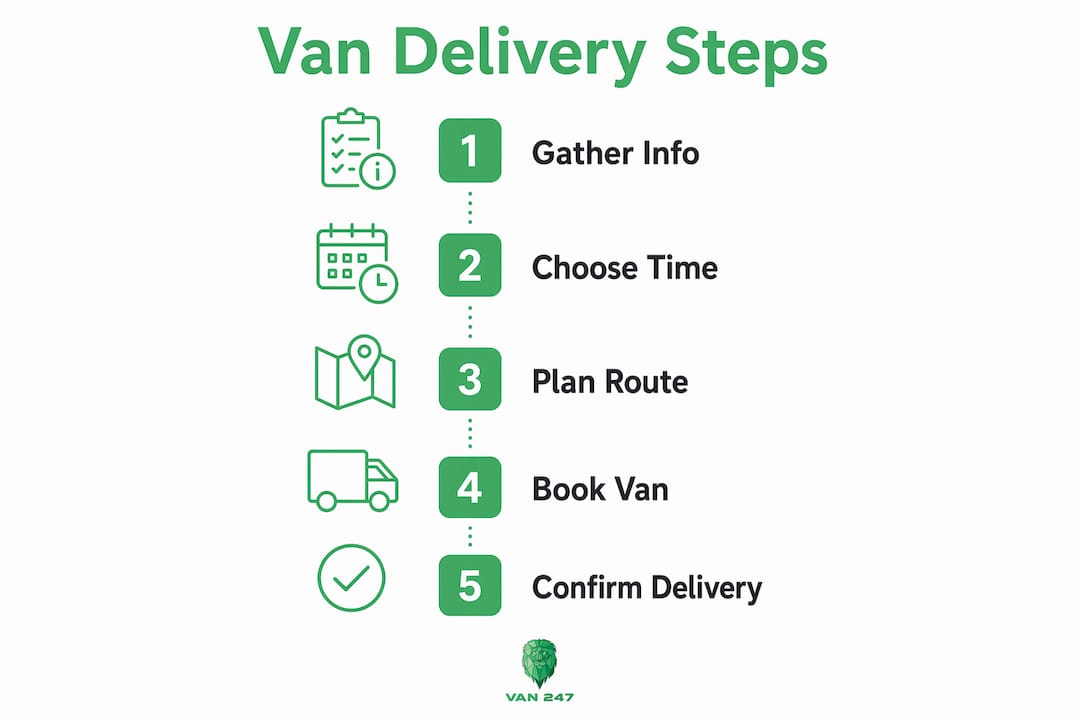
The typical booking process follows these steps:
- Gather your data. Collect all location, item, and site details before opening any booking platform.
- Select your service and time window. Choose between same-day, next-day, or timed window options based on urgency and budget.
- Complete the booking and receive confirmation. A reliable service sends written confirmation with a booking reference, driver details, and the confirmed window.
- Driver assignment and dispatch. The platform assigns a driver and generates the route. You should receive a tracking link at this stage.
- Communicate with both ends. Notify the collection contact and the delivery recipient of the confirmed window before the day.
Common mistakes to avoid when booking:
- Assuming a timed window is available without checking postcode eligibility
- Providing approximate dimensions instead of measured ones
- Forgetting to mention stairs, lifts, or restricted access
- Not confirming the cut-off time for same-day or next-day collection
- Leaving the recipient uninformed about the delivery window
Scheduling is more than slot selection. It requires end-to-end planning including driver hours management, site dwell time, and escalation contacts for guaranteed timed deliveries. If you are booking a business delivery, include a named contact at the delivery site who can authorise receipt and handle any access issues on the day.
For larger moves, Van-247delivery offers man and van services with flexible scheduling and GPS tracking, which removes much of the coordination burden from your side.
How do you handle problems on the day of delivery?
The biggest scheduling failures stem from plans breaking under real-world conditions. Live tracking and dynamic rerouting are key to maintaining schedules. Static timetables without flexibility tend to fail against traffic or access issues.
The most common causes of delivery failure on the day are:
- Traffic delays on motorways or in urban centres
- Driver hours restrictions under UK Working Time Regulations
- Site access problems such as locked gates or unavailable contacts
- Items not ready for collection at the agreed time
If your delivery is running late, the first step is to contact the driver or the dispatch team directly. A good service provides a live tracking link so you can see exactly where the vehicle is. Live tracking integrated with scheduling software enables real-time adjustments, which is critical for meeting promised delivery windows in practice.
When a window cannot be met, ask immediately whether a retry is possible the same day or whether it rolls to the next available slot. For time-critical deliveries, switching to a dedicated same-day vehicle is the most reliable contingency. A dedicated vehicle carries only your load and is not subject to network routing constraints.
Pro Tip: Keep a short escalation list ready before delivery day: the driver’s number, the dispatch team’s number, and the delivery site contact. Three numbers is all you need to resolve most issues within minutes.
Key takeaways
Scheduling a van delivery successfully requires accurate operational data, a realistic time window, a geographically sequenced route, and a clear escalation plan for the day.
| Point | Details |
|---|---|
| Gather complete details upfront | Provide postcodes, dimensions, weight, site constraints, and contact names before booking. |
| Verify your time window | Confirm postcode eligibility, collection cut-offs, and whether the window is guaranteed. |
| Load in reverse drop order | Sequence items so the first drop is at the van door, saving up to 90 minutes on multi-stop routes. |
| Use live tracking | Choose a service with real-time GPS tracking to catch and resolve delays before they become failures. |
| Prepare an escalation plan | Keep driver, dispatch, and site contact numbers ready before delivery day begins. |
What i have learned after years of watching deliveries go wrong
People treat van delivery scheduling as a series of isolated tasks: book the van, give the address, wait for arrival. That mental model is the root cause of most delivery failures I have seen.
The details that get skipped at booking stage are the ones that cause problems at 08:30 on a Tuesday morning. A driver who does not know there is a height barrier at the delivery site cannot phone ahead to warn anyone. A recipient who was not told the window would be 07:00–09:00 is still asleep when the van arrives.
What actually works is treating the whole process as a single connected workflow. The booking form is not a formality. It is the document that determines whether the delivery succeeds. Every field you leave blank or approximate is a risk you are accepting.
Route optimisation tools like EasyRoutes and MapTools.uk have made the planning side genuinely accessible, even for one-off moves. You do not need to be a logistics manager to use them. You just need to input accurate data and trust the output.
The other thing I would say is this: communication is free. Sending a message to the delivery recipient the evening before, confirming the window and asking them to keep their phone on, takes 30 seconds. It prevents more failed deliveries than any piece of software.
Treat scheduling as an integrated workflow, not a checklist. The difference in outcomes is significant.
— Claudiu
Plan your next van delivery with Van-247delivery
Van-247delivery has been handling UK moves and deliveries for over 15 years, and the team understands exactly how much rides on getting the timing right. Whether you need a house removal service with a confirmed time window, or a same-day pallet collection and delivery for your business, Van-247delivery offers flexible scheduling, GPS tracking, and insured transport across the UK. You get an instant quote, a confirmed booking reference, and a driver who knows the route. No guesswork, no vague arrival windows. If you are ready to book or just want to compare your options, the Van-247delivery team is ready to help.
FAQ
What details do i need to book a van delivery?
You need pickup and delivery postcodes, item dimensions and weight, site access details such as stairs or loading bays, and contact names at both ends. Missing details lead to wrong vehicle assignments or failed deliveries.
How do i choose between a 1-hour slot and an AM window?
A 1-hour slot offers greater precision but costs more and is harder to guarantee on complex routes. An AM window (08:00–12:00) is more flexible and more reliably met, making it the better choice when exact timing is not critical.
What should i do if my delivery window is missed?
Contact the dispatch team immediately using the tracking link or escalation number. For time-critical loads, ask about switching to a dedicated same-day vehicle, which carries only your items and is not subject to network routing delays.
How do i plan a multi-stop van delivery efficiently?
Group stops by postcode cluster, sequence them geographically within each cluster, and load items in reverse drop order so the first delivery is always at the van door. Add a 10–15% time buffer for traffic and parking.
Is live tracking available for scheduled van deliveries?
Most professional UK delivery services, including Van-247delivery, provide GPS tracking links once a driver is assigned. Live tracking lets you monitor progress and flag delays before they affect the delivery window.