Full-service removal is defined as a moving solution where a professional crew manages every step of your relocation, from packing your belongings to placing them in your new home. The industry term you will also hear is “comprehensive removal service,” and both phrases describe the same thing: you hand over the physical and logistical work entirely.
If you are weighing up your options ahead of a house or office move in the UK, understanding exactly what full-service relocation covers will help you spend wisely and move with far less stress.
What does full-service removal mean in practice?
A full-service move transfers 100% of the physical and logistical labour to the moving crew, so you do not need to source packing materials, rent a van, or lift a single box. The removal company arrives with everything required and works through a structured process from start to finish. Think of it as handing over the keys to a trusted team and collecting them again at your new address.
The typical scope of a full-service removal covers:
- Packing materials and packing: The crew supplies boxes, bubble wrap, packing paper, and tape. They pack every room, labelling boxes clearly for easy unpacking.
- Furniture disassembly and reassembly: Beds, wardrobes, flat-pack units, and large desks are taken apart before loading and rebuilt at your new property.
- Loading and transportation: The team loads the van safely, securing items to prevent damage in transit. They drive to your new address and unload everything.
- Unpacking (optional add-on): Many full-service removal companies offer unpacking as an extra, placing items in designated rooms and removing packing materials.
- Specialist item handling: Pianos, artwork, antiques, and fragile electronics receive tailored protection. You can read more about this in Van-247delivery’s guide to moving heavy furniture.
- Debris removal: Some companies remove packing waste as standard; others only gather it on site. Always confirm this detail in advance.
The standard full-service scope is modular, meaning you can often select only the elements you need. That flexibility is genuinely useful if you want professionals to handle packing but prefer to manage unpacking yourself.
Pro Tip: Ask your removal company for a written list of every service included before you sign anything. “Full-service” is not a legally regulated term in the UK, so two companies can use the same phrase to describe very different offerings.

How does full-service compare with self-service or partial moves?
The clearest way to understand the benefits of full-service movers is to set them against the alternatives side by side.
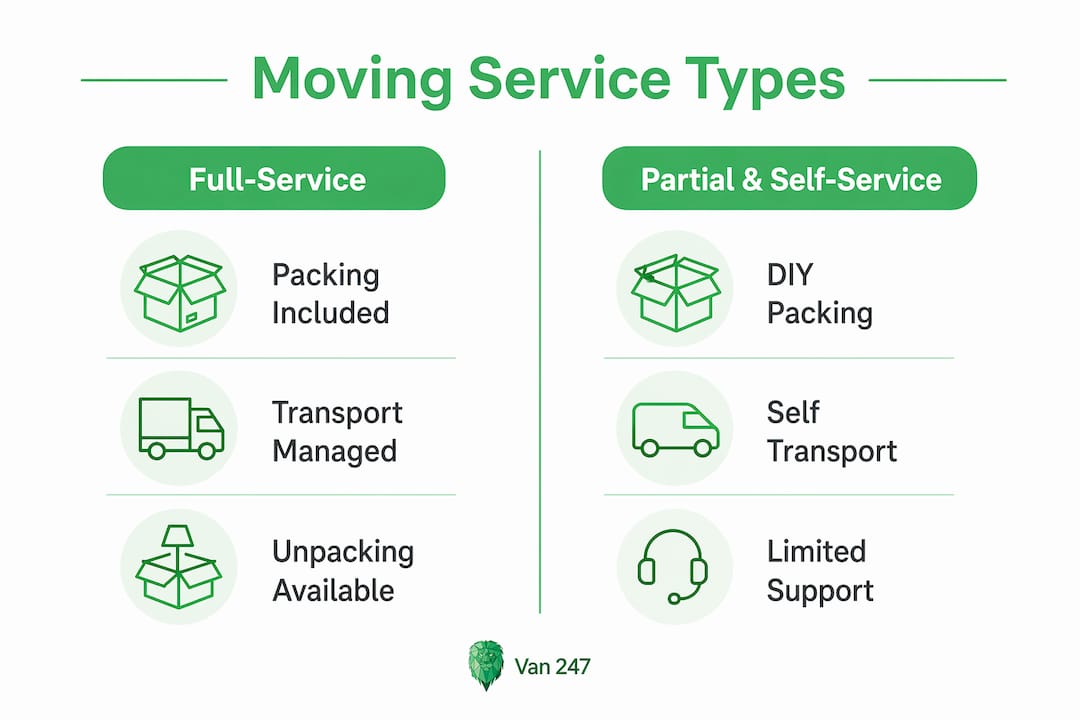
| Feature | Full-service removal | Partial service | Self-service (DIY) |
|---|---|---|---|
| Packing | Done by the crew | You pack; crew transports | You pack and transport |
| Furniture disassembly | Included | Usually not included | Your responsibility |
| Transport | Managed by company | Managed by company | You hire a van |
| Physical labour | Crew handles all | Shared | Entirely yours |
| Time investment | Very low | Moderate | Very high |
| Stress level | Low | Moderate | High |
| Typical cost | Highest | Mid-range | Lowest upfront |
A self-service move looks cheaper on paper, but the real cost includes van hire, fuel, packing materials, and the physical toll on you and anyone helping. Industry experts advise weighing the financial cost of a full-service move against the physical health risks and personal time value involved. Back injuries from lifting heavy furniture are common during DIY moves, and a single GP visit or lost day of work quickly erodes any saving.
A partial service sits in the middle. You handle packing, and the crew manages transport and loading. This works well for smaller homes or when budget is tight, but it still leaves you with the most time-consuming task. For a deeper look at how these options compare, Van-247delivery’s article on removals vs relocations breaks down the decision clearly.
Pro Tip: If you are moving a business, the time saved by a full-service crew is almost always worth the extra cost. Every hour your staff spend packing is an hour not spent on revenue-generating work.
What factors influence the cost of full-service removals in the UK?
Full-service removal costs vary considerably depending on several key variables. Understanding these factors helps you get accurate quotes and avoid surprises.
| Cost factor | Why it matters |
|---|---|
| Home size and volume | More rooms mean more packing time, more boxes, and a larger vehicle |
| Distance of the move | Longer journeys increase fuel costs and crew time |
| Specialist items | Pianos, safes, and large antiques require extra equipment and expertise |
| Add-on services | Unpacking, debris disposal, and storage add to the base price |
| Regional variation | Costs in London and the South East tend to be higher than in other UK regions |
| Access at either property | Narrow streets, stairs, or no parking can increase the time and cost |
Full-service moving costs vary widely depending on volume, distance, and packing needs, with prices in the industry ranging from modest local moves to substantial long-distance relocations. That range reflects just how much the scope can differ between a one-bedroom flat move across town and a five-bedroom house move from London to Edinburgh.
The value question is worth thinking about honestly. A full-service removal frees you to focus on other vital relocation tasks such as legal documentation, school transfers, and utility switchovers. When you add up the hours saved and the reduced risk of damage to your belongings, the price difference between full-service and DIY often narrows considerably.
What should you ask removal companies before booking?
Booking a full-service removal without asking the right questions is one of the most common mistakes UK movers make. Full-service is not a standardised term, so the scope varies greatly between companies. Here is what to confirm before you commit:
- Get a written service list. Ask for an itemised breakdown of every task included. Do not accept a vague summary.
- Check credentials. Look for membership of the British Association of Removers (BAR) or the National Guild of Removers and Storers (NGRS). These bodies require members to meet quality and conduct standards, and they help ensure the company handles your move directly rather than subcontracting to unknown parties.
- Clarify packing materials. Are boxes, bubble wrap, and tape included in the quoted price, or charged separately?
- Confirm debris removal. Debris removal is often an add-on; some movers only gather packing materials without disposing of them. Ask whether waste is taken away or left for you to deal with.
- Discuss specialist items. Tell the company about any pianos, large mirrors, gym equipment, or valuable antiques. Confirm how these will be handled and whether specialist insurance applies.
- Request a detailed written estimate. A reputable company will survey your home, either in person or via video call, before quoting. Avoid firms that quote blind over the phone.
- Understand cancellation and liability terms. Ask what happens if your completion date changes, and check what the company’s liability covers if items are damaged in transit.
Pro Tip: Get at least three written quotes and compare them line by line, not just on total price. A lower headline figure sometimes means fewer services are included.
The scope of full-service packages varies greatly and should be confirmed before contracts are signed. That single step protects you from the most common post-move disputes.
Key takeaways
Full-service removal means a professional crew handles every physical and logistical task of your move, but the exact scope varies between companies and must always be confirmed in writing before booking.
| Point | Details |
|---|---|
| Definition is clear, scope is not | “Full-service” is unregulated; always request an itemised written service list. |
| Core services are consistent | Packing, disassembly, transport, and unloading are standard; unpacking and debris removal may cost extra. |
| Cost reflects multiple variables | Home size, distance, specialist items, and add-ons all affect the final price. |
| Credentials matter | Check for BAR or NGRS membership to confirm quality and direct service delivery. |
| Value goes beyond price | Time saved and physical risk avoided often justify the higher cost of full-service over DIY. |
My honest view on full-service removal after years in the industry
I have spoken with hundreds of people who chose a DIY move to save money and regretted it by lunchtime on moving day. Moving day is a marathon, not a sprint, and underestimating the physical and mental load is extremely easy to do from the comfort of your sofa three weeks before the event.
The biggest misunderstanding I see is that people treat “full-service” as a single, fixed product. It is not. One company’s full-service includes unpacking and debris collection; another’s stops at the front door of your new property. Neither is wrong, but you need to know which one you are buying. The term is not legally regulated, which means the responsibility for clarifying scope sits entirely with you as the customer.
My advice is to think of full-service removal as a menu rather than a set meal. Start with the core services you genuinely need, add the extras that will save you real time or stress, and skip the ones that do not apply to your situation. A good removal company will help you build that package honestly. If a company pushes you towards their most expensive option without asking about your specific circumstances, that tells you something important about how they operate.
For businesses, the calculation is even clearer. The logistics involved in a commercial relocation are complex, and every hour of downtime has a direct cost. Full-service removal for an office move is not a luxury. It is a practical decision that protects productivity and reduces the risk of damage to expensive equipment.
— Claudiu
How Van-247delivery can help with your removal
Whether you are moving a family home or relocating an entire office, Van-247delivery offers tailored removal packages built around what you actually need. The team has over 15 years of experience handling everything from fragile antiques to full office fit-outs across the UK.
Van-247delivery’s house removal service covers packing, disassembly, transport, and optional unpacking, with insured transit and flexible booking to fit around your completion date. For businesses, the office removal service minimises downtime with experienced crews who work efficiently and carefully. Get an instant quote online and speak directly with the team to build a package that suits your timeline and budget.
FAQ
What does full-service removal include as standard?
Standard full-service removal includes professional packing with supplied materials, furniture disassembly and reassembly, loading, transportation, and unloading at your new property. Unpacking and debris removal are often available as add-ons but are not always included in the base price.
Is full-service removal worth the cost for a small flat?
For a one or two-bedroom flat, full-service removal can still be worth the cost if you have limited time, no help available, or fragile and valuable items. The price is lower than for larger homes, and the time and stress saved are the same regardless of property size.
How do I know if a UK removal company is reputable?
Check for membership of the British Association of Removers (BAR) or the National Guild of Removers and Storers (NGRS). These memberships indicate the company meets professional standards and is less likely to subcontract your move to unknown third parties.
Does full-service removal cover debris disposal?
Not always. Debris removal varies between companies; some include it as standard while others only collect packing materials on site without taking them away. Always confirm this detail before signing your contract.
How far in advance should I book a full-service removal in the UK?
Booking four to eight weeks ahead is advisable for most UK moves, particularly if you are moving at the end of the month or during summer, when removal companies are busiest. Last-minute bookings are possible but may limit your choice of company and increase cost.