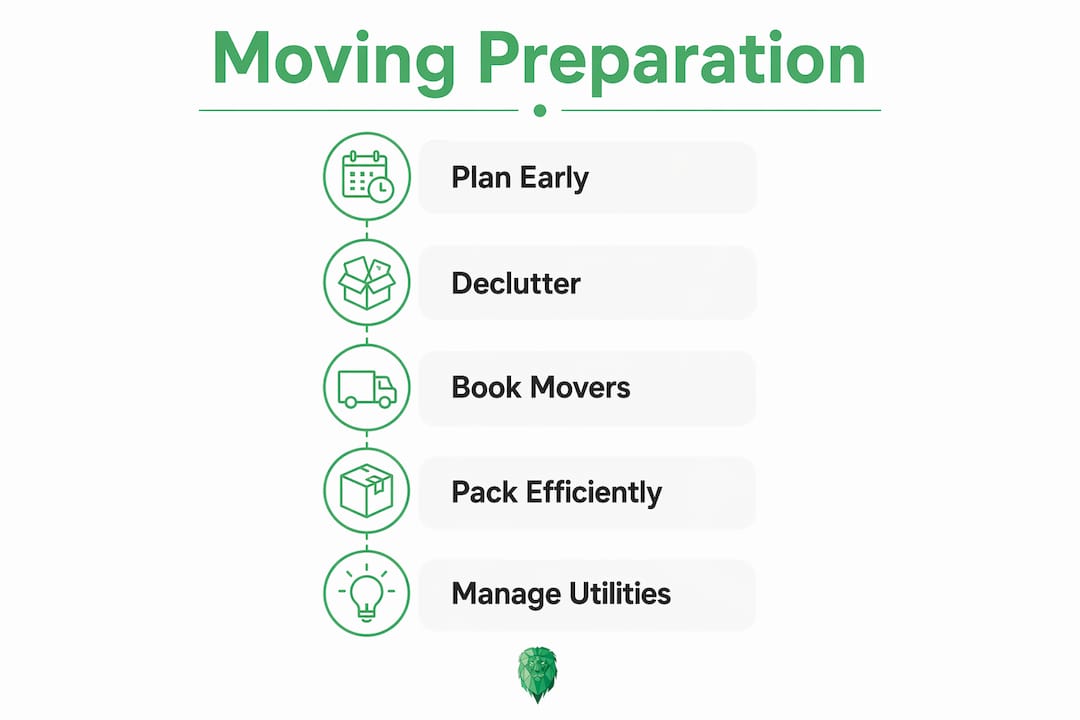
How to prepare for a move? Preparing for a move is defined as the process of planning, packing, and coordinating logistics well in advance to avoid last-minute chaos and protect your belongings. Done well, relocation planning turns what feels like an impossible task into a series of manageable steps. This guide covers everything from building your moving checklist eight weeks out to handling utilities and surviving moving day itself.
Whether you are moving a family home or a studio flat, the same principles apply: start early, pack with purpose, and keep the essentials close.
How to prepare for a move: when should you start?
The best time to start planning is at least eight weeks before your move date. WikiHow’s week-by-week checklist recommends beginning two months ahead to allow time for booking transport, gathering packing supplies, and notifying relevant parties. Starting early means you pack gradually rather than in a frantic final weekend.
Your first actions in weeks eight and seven should be practical and administrative:
- Book your removal company or van hire. Availability fills quickly, especially at weekends and at the end of the month.
- Notify your landlord or estate agent in writing, giving the required notice period.
- Inform your employer of your new address and any time off needed on moving day.
- Create a moving binder or digital checklist. Apps like Google Keep or a simple spreadsheet work well.
- Contact your energy, broadband, and water providers to flag your moving date.
- Begin decluttering room by room. Fewer items mean fewer boxes and lower removal costs.
Decluttering early is one of the most underrated tips for moving. Charity shops such as British Heart Foundation and Oxfam accept furniture, clothing, and kitchenware. Selling items on Facebook Marketplace or Vinted before the move puts money back in your pocket and cuts the volume you need to transport.
Pro Tip: Book your removal company before you start packing. Knowing the exact date locks in your timeline and prevents the common mistake of packing too early or too late.
How to pack efficiently: organising, labelling, and your essentials box
Packing efficiently is the single biggest factor in a smooth unpacking experience. The golden rule is to pack low-use items first and leave daily essentials until the final day or two. Start with books, seasonal clothing, decorative items, and spare bedding. Leave out your kettle, phone charger, and toiletries until the very end.

National Van Lines advises labelling every box by room and adding a brief description of contents. This speeds up unpacking and tells your movers exactly where each box belongs without you having to supervise every single one. Clear labelling reduces handling time and the risk of boxes ending up in the wrong room.
A colour-coded system works particularly well for families. Assign each room a colour and use matching coloured tape or stickers on every box destined for that room. Add “FRAGILE” stickers to anything breakable, and write “THIS WAY UP” on boxes containing lamps or glassware.
Your essentials box deserves special attention. WikiHow and National Van Lines both stress the importance of a dedicated first-night box containing:
- Toiletries: toothbrush, toothpaste, soap, and shower gel
- Medications and any prescription items
- Phone, laptop, and device chargers
- A change of clothes for each family member
- Snacks, tea bags, and a travel kettle
- Bedding for the first night
- Important documents: tenancy agreement, passports, and insurance papers
Pro Tip: Keep your essentials box in your car or with you personally. Do not load it onto the removal van. You need it the moment you arrive, not after you have unloaded forty boxes.
Here is a quick comparison of packing approaches to help you choose the right method:
| Approach | Best for | Key advantage |
|---|---|---|
| Room-by-room packing | Most households | Keeps items grouped for easy unpacking |
| Category packing | Minimalists and small flats | Reduces duplicate items across rooms |
| Colour-coded labelling | Families with children | Movers and kids can both follow the system |
| Professional packing service | Fragile or high-value items | Insured handling and specialist materials |
For detailed guidance on labelling your moving boxes, Van-247delivery has a practical room-by-room breakdown worth bookmarking before you start.
What to do before moving: managing utilities and mail forwarding
Utility management is one of the most overlooked parts of relocation planning, and getting it wrong costs money. The Energy Saving Trust, citing Citizens Advice, recommends giving your energy supplier at least 48 hours’ notice before you move out. That notice period gives your supplier time to close your account correctly and prevents billing disputes later.
Follow these steps in order:
- Take a final meter reading on the day you leave. Photograph the meter with the date visible on your phone.
- Take an initial meter reading at your new property on the day you move in. Photograph that too.
- Contact your new energy supplier to register as the account holder. Do not assume the previous tenant’s account will transfer.
- Schedule utility disconnection and reconnection to overlap by at least one day. Disconnect your old supply the day after you leave and activate the new supply the day before you arrive. This avoids any gap in service.
- Arrange broadband installation at your new address at least two weeks in advance. Engineer appointments book up quickly.
- Update your address with your bank, HMRC, your GP, and your car insurance provider.
Photographed meter readings are your strongest defence against an incorrect final bill. Store the images in a dedicated folder on your phone and email them to your supplier the same day.
Mail forwarding through Royal Mail acts as a safety net, but it does not replace updating your address directly with senders. USPS forwarding guidelines note that forwarding typically lasts 12 months. The same principle applies in the UK: use Royal Mail’s redirection service as a temporary buffer while you work through your list of contacts. For a full change of address checklist, Van-247delivery covers every sender category you need to notify.
For renters, taking dated photographs of every room at both your old and new property protects your deposit. A structured photographic inventory that includes meter readings, key handover, and condition notes can decisively resolve tenancy deposit disputes. Do not skip this step.
Van-247delivery’s guide on moving house electricity and gas covers the full utility handover process in detail, including what to do if you cannot reach your supplier on moving day.
How to prepare for moving day: logistics and stress reduction
Moving day is a marathon, not a sprint. Preparation the night before makes the day itself far calmer. Confirm your removal team’s arrival time and check that parking is available outside both properties. If you live on a restricted street, contact your local council in advance about a temporary parking suspension.
On the day itself, keep these actions front of mind:
- Have your essentials box ready by the front door before the movers arrive.
- Use an inventory list to tick off items as they are loaded. National Van Lines recommends creating a room-by-room tally before loading begins. This record also supports any insurance claim if an item goes missing.
- Direct movers to place boxes in the correct rooms using your colour-coded labels. You will save hours of shifting boxes later.
- Keep cleaning supplies accessible. You will need them to clean your old property before handing over the keys.
- Have cash or a card ready for any last-minute costs, such as parking fees or a tip for the removal team.
- Do a final walk-through of your old property. Check every cupboard, loft hatch, and outdoor space before you leave.
Pro Tip: Pack an “open-first” box for your new home containing a torch, a multi-tool, bin bags, toilet roll, and a phone charger. These are the items you will reach for within the first hour of arrival.
The emotional side of moving day catches many people off guard. If you are moving with children, keep a small bag of their favourite toys and snacks with you in the car. Familiar comforts help children settle into a new environment far more quickly than you might expect.
Key takeaways
Preparing for a move successfully requires starting at least eight weeks ahead, packing systematically with clear labels, and managing utilities and mail forwarding before you leave.
| Point | Details |
|---|---|
| Start eight weeks out | Book transport, notify landlords, and begin decluttering at least two months before moving day. |
| Pack in stages | Begin with low-use items and leave daily essentials until the final day or two. |
| Label every box clearly | Use room names, content descriptions, and colour-coded tape to guide movers and speed unpacking. |
| Handle utilities early | Give energy suppliers 48 hours’ notice and photograph meter readings on both move-out and move-in days. |
| Protect your essentials | Keep your first-night box and important documents with you, not on the removal van. |
The part of moving most people get wrong
People talk a lot about packing and booking vans. What they rarely talk about is the gap between leaving one home and feeling settled in the next. I have seen well-organised moves fall apart not because of logistics, but because the person moving had no plan for the first 48 hours in the new property.
The essentials box is not just a convenience. It is the thing that lets you make a cup of tea, find your phone charger, and sleep in a made bed on night one. When those basics are sorted, the rest of the unpacking feels manageable rather than crushing. Skipping this step is the single most common mistake I see, and it is entirely avoidable.
The other thing worth saying plainly: do not underestimate the emotional weight of a move. Even a positive move to a better home involves leaving behind a space that held your routines. Give yourself permission to feel that. Small comforts matter. A familiar mug, your own pillow, a playlist you love. These things help you settle far faster than getting every box unpacked on day one.
Start earlier than you think you need to. Label more thoroughly than feels necessary. And keep your essentials close.
— Claudiu
Van-247delivery: professional support for your house move
Moving house is a big undertaking, and having the right team behind you makes a real difference.
Van-247delivery offers house removal services across the UK, with professional teams experienced in handling everything from studio flats to large family homes. If you need something more flexible, the man with a van service is a cost-effective option for smaller moves or single-room relocations. Van-247delivery has over 15 years of experience in UK removals, with insured transport, flexible scheduling, and the option to add packing assistance. Book early to align with the eight-week planning timeline and secure your preferred date.
FAQ
How far in advance should I start planning a move?
Start planning at least eight weeks before your moving date. This gives you time to book transport, notify landlords and utility providers, and pack gradually without a last-minute rush.
What should go in a first-night essentials box?
Your essentials box should include toiletries, medications, phone chargers, a change of clothes, snacks, bedding, and key documents. Keep it with you rather than loading it onto the removal van.
How do I avoid energy billing disputes when moving?
Give your energy supplier at least 48 hours’ notice before moving out. Take a dated photograph of your final meter reading and send it to your supplier on the day you leave.
Do I need to set up mail forwarding when I move?
Royal Mail’s redirection service acts as a useful safety net, but it does not replace updating your address directly with banks, HMRC, your GP, and other key contacts. Set up forwarding and work through your address update list at the same time.
How do I keep track of my belongings on moving day?
Create a room-by-room inventory list and tick off items as they are loaded and unloaded. National Van Lines recommends this approach as it also supports any insurance claim if something goes missing during the move.