Freight shipping is the commercial transport of goods by road, sea, or air, and getting it right in the UK requires more than just booking a van. Sea freight carries approximately 95% of UK import and export volume, with Felixstowe alone handling 36% of all container traffic. That single statistic tells you how much of British trade depends on getting logistics decisions right from the start. This guide to freight shipping UK covers the main transport modes, documentation requirements, packaging best practices, and practical tips to help you move goods safely, legally, and cost-effectively.
What are the main freight shipping methods in the UK?
Choosing the right transport mode is the single most important decision in any shipment. Get it wrong and you pay too much, wait too long, or both. The three core options are road, sea, and air freight, and each suits a different type of cargo and timeline.
Sea freight
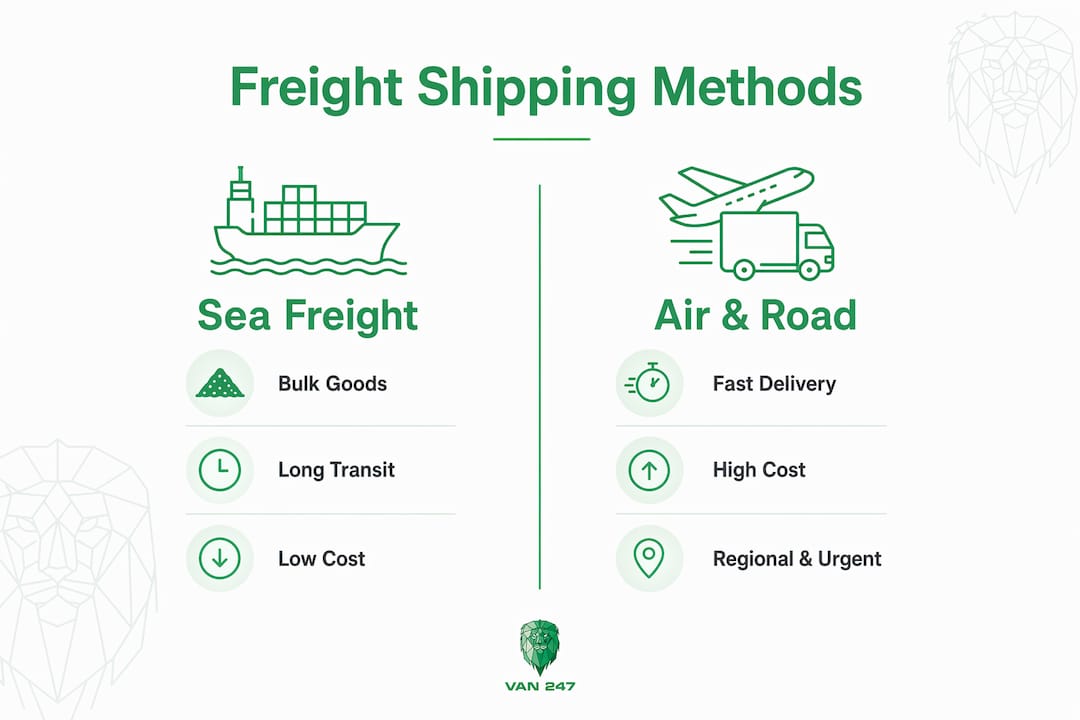
Sea freight is the backbone of UK international trade. It suits bulk goods, heavy machinery, and large retail orders where speed is less critical than cost. Transit times run 10–45 days at a cost of roughly £0.50–£2 per kilogram. That low cost per unit makes sea freight the default choice for importers bringing in large volumes from Asia, the Americas, or the Middle East.

Road freight
Road freight covers most domestic UK deliveries and many European routes. Transit times typically sit at 1–5 working days, making it the go-to option for time-sensitive regional shipments. You can book a full truckload (FTL) for a dedicated vehicle, or a less-than-truckload (LTL) service where your goods share space with other shippers’ cargo. Road freight offers flexibility that sea and air cannot match for short to medium distances.
Air freight
Air freight delivers in 1–5 days at a cost of approximately £2–£6 per kilogram. That premium price is worth paying for high-value electronics, pharmaceuticals, or perishables where every day of delay costs money. Air freight is rarely the right choice for heavy or low-margin goods, but for urgent shipments it is the only realistic option.
| Mode | Typical transit time | Approximate cost per kg | Best for |
|---|---|---|---|
| Sea freight | 10–45 days | £0.50–£2 | Bulk, heavy, low-margin goods |
| Road freight | 1–5 working days | Varies by distance | UK and European deliveries |
| Air freight | 1–5 days | £2–£6 | Urgent, high-value, or perishable cargo |
You can read a deeper breakdown of each option in this guide to types of freight delivery across the UK.
Pro Tip: If your cargo fills more than half a trailer, FTL almost always works out cheaper and faster than LTL. Fewer handling points mean less damage risk and more predictable delivery windows.
What documentation do UK shippers need to comply with?
Paperwork is where most freight problems start. Missing or incorrect documents cause border delays, fines, and held shipments. Getting your documentation right before the goods leave the warehouse saves a significant amount of stress later.
The core documents required for UK import and export include:
- Commercial invoice: Must include HS commodity codes, the value of goods, country of origin, and buyer and seller details.
- Packing list: Details the contents, weight, and dimensions of each package or pallet.
- EORI number: Your Economic Operators Registration and Identification number is mandatory for any business trading goods across UK borders.
- Bill of lading or airway bill: The carrier’s receipt and contract of carriage for sea and air shipments respectively.
- Customs declaration: Required for all imports and exports post-Brexit.
VAT is charged at 20% on imports valued over £135. Below that threshold, VAT is collected at the point of sale rather than at the border. Customs duty rates vary by commodity code, so using the correct HS code is not optional. An incorrect code can trigger a reassessment and a penalty.
Post-Brexit rules also affect wooden packaging. Wooden pallets moving between the UK and EU must comply with ISPM 15 and carry the IPPC mark. Failure to comply leads to rejection at the border and potential destruction of the pallet. This catches many smaller shippers off guard, particularly those who are new to cross-border trade.
Incoterms also matter. They define who is responsible for costs, risk, and insurance at each stage of the journey. DDP (Delivered Duty Paid) and EXW (Ex Works) sit at opposite ends of the responsibility spectrum. Agreeing Incoterms in writing before shipment prevents disputes later.
Pro Tip: Check your documentation at least 48 hours before the planned collection date. Border agencies do not accept last-minute corrections, and a missing EORI number can ground a shipment entirely.
How to prepare and package freight shipments properly
Good packaging is not just about protecting your goods. It is about presenting a shipment that carriers will accept, customs will clear, and recipients will receive in one piece. The preparation stage is where many shippers lose money through avoidable damage.
Follow these steps to prepare freight correctly:
- Choose the right pallet. Standard UK pallets measure 1,200mm x 1,000mm. Euro pallets measure 1,200mm x 800mm. Match your pallet size to the carrier’s vehicle specifications before booking.
- Build a stable load. Place the heaviest items at the base and work upward. Avoid overhanging the pallet edges, as this creates instability and increases the risk of collapse during transit.
- Anchor the stretch wrap. Anchoring stretch wrap to the pallet base rather than just the goods prevents load sliding during transit. This step is frequently skipped and is one of the most common causes of in-transit damage.
- Label on at least two sides. Labels on pallets must appear on at least two sides because shrink wrap glare and warehouse stacking can obscure a single label. Use waterproof labels and include the consignee’s full address, contact number, and any handling instructions.
- Photograph everything. Take clear photos of the loaded pallet from all four sides before collection. This documentation is your primary evidence if you need to make an insurance claim.
- Check weight limits. Most standard pallets have a maximum load of 1,000kg. Exceeding this risks carrier rejection and potential liability for any resulting damage.
Wooden versus plastic pallets is a genuine choice worth making deliberately. Wooden pallets are cheaper and widely available, but they require ISPM 15 treatment for cross-border EU shipments. Plastic pallets are reusable, hygienic, and ISPM-exempt, making them the better option for food-grade or pharmaceutical cargo.
Pro Tip: Document the condition of your goods with photos before packing and after palletising. If a claim arises, timestamped photos are far more persuasive than a written description alone.
For more detail on getting pallet preparation right, the guide to pallet distribution covers load stability and risk reduction in depth.
What are the best practices for managing UK freight shipments?
Efficient freight management comes down to planning, carrier selection, and knowing what to do when things go wrong. Most delays and cost overruns are preventable with the right habits in place.
- Choose FTL for time-sensitive cargo. FTL reduces handling and damage risk and supports faster direct movements. LTL suits smaller loads where cost matters more than speed, but your goods will pass through multiple handling points.
- Select carriers with strong recovery capability. A carrier’s response when something goes wrong matters as much as their performance when everything goes right. Ask about their exception handling process before you book.
- Arrange separate freight insurance. Carrier liability limits are often insufficient to cover the actual invoice value of your goods. Arrange dedicated freight insurance for any shipment where the carrier’s standard liability would leave you out of pocket.
- Pre-book for out-of-hours collections. Weekend and early-morning collections often carry a surcharge, but pre-booking avoids the premium rates charged for same-day requests.
- Verify paperwork before collection. A single missing document can hold a shipment at the border for days. Build a pre-shipment checklist and run through it every time.
- Communicate proactively. Keep your recipient informed of expected delivery windows. Missed deliveries cost money in redelivery fees and can damage commercial relationships.
Choosing the right carrier is a decision that deserves proper research. The guide on how to choose a courier in the UK covers the key evaluation criteria clearly.
Pro Tip: For high-value shipments, separate freight insurance beyond the carrier’s standard liability is not optional. Document the shipment’s condition with photos before handover so any claim is straightforward to process.
Key takeaways
Successful freight shipping in the UK requires the right transport mode, complete documentation, stable packaging, and adequate insurance coverage before goods leave your hands.
| Point | Details |
|---|---|
| Match mode to cargo | Sea suits bulk goods, road suits regional speed, and air suits urgent high-value shipments. |
| Documentation is non-negotiable | EORI numbers, HS codes, and ISPM 15 compliance prevent costly border delays. |
| Packaging prevents losses | Anchor stretch wrap to the pallet base and label on at least two sides for every shipment. |
| FTL reduces damage risk | Choosing full truckload over shared loads cuts handling points and speeds up delivery. |
| Insurance covers the gap | Carrier liability rarely matches invoice value, so arrange separate freight insurance. |
What I have learned from years in UK freight logistics
Freight shipping looks straightforward on paper. In practice, the problems almost always come from the same three places: wrong documentation, poor packaging, and underestimating insurance gaps.
The documentation issue surprises people. Shippers who have been trading domestically for years suddenly face EORI numbers, commodity codes, and ISPM 15 compliance when they expand into cross-border trade. The paperwork is not complicated once you know it, but the first time you get it wrong at a border crossing is an expensive lesson. My advice is always to build a pre-shipment checklist and treat it as seriously as the goods themselves.
Packaging is the other area where I see consistent underinvestment. A pallet that looks fine in a warehouse can arrive at its destination in pieces if the stretch wrap was not anchored properly or the load was built without weight distribution in mind. Photographs before collection are not paranoia. They are the difference between a successful insurance claim and an argument you cannot win.
The insurance gap is the one that genuinely concerns me. Most shippers assume the carrier covers them. The carrier’s standard liability is almost never enough for goods of real value. Arranging a separate policy takes an hour and costs a fraction of what a single uninsured loss would set you back.
The shippers who manage freight well are not necessarily the ones with the biggest budgets. They are the ones who treat preparation as part of the job rather than an afterthought.
— Claudiu
How Van-247delivery can support your freight needs
Freight shipping does not have to feel like a puzzle you solve alone. Van-247delivery has been supporting UK businesses and individuals with transport solutions for over 15 years, covering everything from single pallet collections to full household removals.
Whether you need same-day pallet transport with tracked collection, a full house removal service across the UK, or a flexible man and van for smaller moves, Van-247delivery offers insured, professional transport with instant quotes and real support. The team understands the practical realities of UK freight, from weight limits and pallet specifications to out-of-hours collections and fragile goods handling. Get an instant quote today and move your goods with confidence.
FAQ
What is freight shipping in the UK?
Freight shipping is the commercial transport of goods by road, sea, or air. In the UK, sea freight carries approximately 95% of import and export volume, while road freight handles most domestic and European deliveries.
What documents do I need to ship freight from the UK?
You need a commercial invoice with HS codes, a packing list, an EORI number, and a customs declaration. For imports over £135, VAT at 20% also applies.
Do wooden pallets need special treatment for EU shipments?
Yes. Wooden pallets moving between the UK and EU must comply with ISPM 15 and carry the IPPC mark. Non-compliant pallets risk rejection or destruction at the border.
When should I choose FTL over LTL?
Choose full truckload when your cargo fills more than half a trailer, when speed matters, or when you need to minimise handling. LTL suits smaller loads where cost is the priority.
Is carrier liability enough to cover my goods?
Carrier liability limits are rarely sufficient to cover the full invoice value of goods. Arrange separate freight insurance for any shipment where a loss would affect your cash flow.