For large transfers for furniture, Booking a professional on-site or video survey, then requesting a written, itemised quote, is the single best first step when you need to move large furniture in the UK. Which? Trusted Traders confirms that an accurate professional assessment of items and access points is the most critical step to avoid delivery failures and unexpected charges. Do those two things before anything else and you are already ahead of most people who book a mover.
Your two fastest next actions:
- Take photos and measure every item (height, width, depth) plus every internal doorway, staircase width, and lift interior on both the collection and delivery sides.
- Ask any mover you contact for proof of BAR membership or equivalent credentials, and request their transit insurance details and payment-guarantee scheme in writing before you confirm.
Pro Tip: If an on-site visit is not possible immediately, a five-minute video call walking the mover through your rooms and access points gives them enough to issue a reliable preliminary quote.
Key takeaways
Booking a professional survey and insisting on a written, itemised quote are the two steps that protect you most when arranging large furniture transfers in the UK.
| Point | Details |
|---|---|
| Survey before anything else | An on-site or video survey prevents access surprises and ensures accurate pricing. |
| Written, itemised quote | Insist on a fixed price with a full service specification and exclusions listed clearly. |
| Check insurance and BAR status | Confirm goods-in-transit cover and BAR membership for payment protection and dispute resolution. |
| Prepare your home and access | Clear pathways, arrange parking, and supply measurements at booking to avoid delays and extra charges. |
| Call specialists early | Pianos, crane lifts, and antiques need specialist teams booked well in advance of moving day. |
| Van-247delivery | Offers UK-wide insured large furniture transfers, from single items to full removals, with instant online quotes. |
Table of Contents
- What should you prepare before calling a mover?
- How do professional movers plan and execute large-item moves?
- What must appear in your written quote?
- What drives the cost of moving large furniture?
- What happens on moving day, step by step?
- What cover do you have if something goes wrong?
- When do you need a specialist rather than a standard team?
- A note from the Van-247delivery team on what makes a move go well
- Van-247delivery: get a quote for your large furniture move
- Sources
- FAQ
What should you prepare before calling a mover part of large transfers for furniture?
Getting your information together before you pick up the phone saves time and gets you more accurate quotes. Movers price on specifics, not guesses.
Measurements and photos to gather:
- Item dimensions: height, width, and depth for every large piece
- Internal doorway widths at both addresses (standard UK doors are often narrower than people expect)
- Staircase width, ceiling height on landings, and any tight corners or half-landings
- Lift interior dimensions if either property has one
- Photos of each item, including any existing damage or fragile areas
Access and site details to note:
- Parking availability: is there a loading bay, a yellow line, or a residents’ permit zone?
- Narrow lanes or low bridges on the approach
- Permitted delivery hours (some blocks and streets restrict these)
- Whether the building requires a booking for the service lift
Inventory notes: list each item, note its condition, flag anything that needs partial disassembly, and mark antiques or fragile pieces separately. Which? Trusted Traders recommends checking that any company you contact is endorsed or holds recognised credentials before sharing your details.
Pro Tip: A short video filmed on your phone, walking from the street through to the room where the item sits, is often more useful to a mover than a written description. Send it alongside your measurements.
How do professional movers plan and execute large-item moves part of large transfers for furniture?
A good removal company does not just turn up with a van. The process starts well before moving day, with a structured survey that shapes every decision that follows.
Survey methods used by professionals:
- In-person measurement with a checklist covering item dimensions, access routes, floor protection needs, and parking
- Video survey via phone or tablet when distance or timing makes a site visit impractical
- Written risk assessment noting stairs, tight corners, fragile flooring, and any items requiring disassembly
Once the survey is complete, the team selects the right equipment. For most large furniture transfers, that means a tail-lift van and a trained two-person crew. Heavier or bulkier pieces may need a hoist, a stair-climbing trolley, or, for items that cannot pass through a building’s interior, an external crane lift through a window or balcony. Protective blankets, furniture straps, and door-frame padding are standard on professional jobs.
For bulk furniture delivery, businesses should think in freight terms: weight and volume determine whether a load suits a less-than-truckload or full-truckload vehicle, and real-time tracking with synchronised assembly teams reduces the gap between delivery and use. Inventory tagging and scheduled delivery windows matter just as much as the vehicle choice.
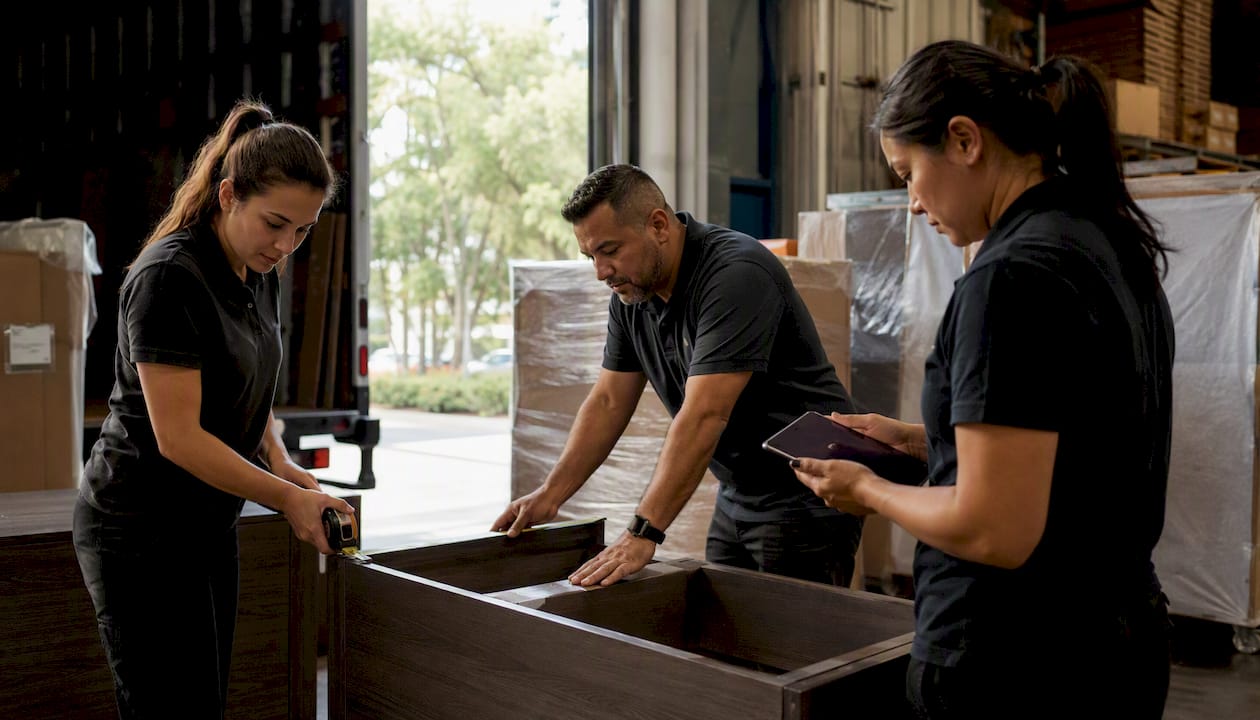
White-glove delivery goes further still: room-of-choice placement, assembly, packaging removal, and advance timed communication. For fragile or high-value pieces, the reduced damage risk frequently justifies the extra cost.
Pro Tip: Document every access constraint in writing and share it with the mover before the survey. A photo of a tight staircase landing sent in advance can prevent a crane-lift surprise on moving day.
What must appear in your written quote part of large transfers for furniture?
A verbal agreement is not enough. The BAR Code of Practice requires Members to provide fixed-price written quotations that describe services included and identify excluded services clearly. Insist on all of the following before you sign anything.
Core items the quote must contain:
- A fixed price (not an open-ended hourly estimate without a cap)
- A full service specification: what is included (dismantling, reassembly, packing, floor protection) and what is explicitly excluded
- Access assumptions the price is based on (e.g. ground-floor access, no parking restrictions)
- Insurance and liability terms: declared-value cover, goods-in-transit insurance, any excesses
- Delivery window, cancellation terms, and rescheduling policy
- Details of the payment-guarantee scheme and independent dispute resolution process
BAR membership is one of the clearest signals that a company operates under an externally audited Code of Practice. Members undergo annual audits and must offer payment protection and independent dispute resolution, which matters enormously if something goes wrong.
Red flags to watch for: vague scope lines such as “move furniture as required,” open-ended hourly rates with no cap, and any refusal to visit or video-survey the items before quoting.
Pro Tip: Ask specifically: “Is this a fixed price or an estimate?” If the answer is “estimate,” ask what triggers additional charges and get those triggers listed in writing.
What drives the cost of moving large furniture part of large transfers for furniture?
Price varies more than most people expect, and knowing the levers helps you compare quotes fairly.
Primary cost drivers:
- Distance between collection and delivery addresses
- Item size, weight, and the number of operatives required
- Access difficulty: stairs, narrow corridors, no parking, permit zones
- Time on site, including waiting time for lifts or restricted-access buildings
- Specialist equipment: hoists, crane hire, piano skids
Add-ons that raise the price: white-glove in-home placement (typically an additional fee but reduces risk for valuable pieces), assembly and disassembly, packing materials, waste removal, storage, and same-day or expedited delivery.
For business moves, inventory management, palletisation, and scheduled delivery windows add to the base cost but reduce the risk of delays and damage claims.
Practical ways to reduce costs:
- Consolidate multiple items into a single job rather than booking separately
- Be flexible on delivery windows (off-peak slots are usually cheaper)
- Prepare items for easier handling: remove drawers, dismantle legs where possible
- Get at least three itemised written quotes before committing
Pro Tip: For known unknowns like parking permits, ask the mover to include a capped allowance in the fixed price rather than leaving it as an open variable. A fixed quote with a named cap is almost always preferable to an hourly rate.
What happens on moving day, step by step?
Moving day runs smoothly when everyone knows what to expect. Here is the typical sequence for a professional large-item move.
- Crew arrival and pre-check. The team confirms access, reviews the job sheet, and walks the route from vehicle to room before touching anything.
- Protective measures. Door frames, banisters, and floor surfaces are padded or covered. Pathways are cleared of obstacles.
- Loading sequence. Heaviest and largest items go first. Each piece is wrapped, strapped, and positioned in the vehicle to prevent movement in transit.
- Transit. For longer moves, the driver confirms the route and estimated arrival time. Live tracking or an SMS update window keeps you informed.
- Unloading and placement. Items are brought in following the agreed room plan. Protective coverings are removed only once the piece is in position.
- Final inspection and sign-off. You and the crew check each item against the job sheet. Any damage is noted before you sign.
Be present throughout, or have a trusted contact there in your place. Confirm the crew’s arrival window the evening before, have keys ready, and walk the route with the lead operative on arrival. Inspecting goods before signing is standard practice and your best protection if a claim arises later.
Pro Tip: Keep a simple item-by-item sign-off sheet during unloading. Tick each piece as it arrives and note its condition. If a dispute arises later, that sheet is your clearest evidence.
What cover do you have if something goes wrong for large transfers for furniture?
Insurance is not a nice extra. It is the difference between a straightforward claim and a costly argument.
Types of cover to understand:
- Basic carrier liability: covers loss or damage caused by the mover’s negligence, but often at a low per-item limit
- Declared-value cover: you state the replacement value of each item; the mover’s liability is capped at that figure
- Goods-in-transit insurance: broader cover for damage during loading, transit, and unloading; ask for the insurer’s name and policy number
BAR Members must offer payment protection and independent dispute resolution under their Trading Standards-approved Code of Practice. If a BAR Member fails to resolve a complaint, you can escalate to BAR’s independent Alternative Dispute Resolution scheme without going to court.
If damage occurs:
- Photograph the damage immediately, before anything is moved or repaired
- Note serial numbers or identifying marks on damaged items
- Notify the mover in writing the same day and follow their stated claims procedure
- Obtain written repair or replacement estimates and keep all receipts
If the mover does not respond adequately, Trading Standards and the Consumer Ombudsman are the next escalation routes. The BAR Code of Practice gives consumers a clear framework for exactly this situation.
Pro Tip: Ask for written confirmation of insurance limits within the quote itself, and keep a signed copy of the completed job sheet. Those two documents are your strongest position in any dispute.
When do you need a specialist rather than a standard team for large transfers for furniture?
Some jobs are beyond what a standard two-person removal team can safely handle. Recognising these early saves you from a last-minute scramble.
Scenarios that require specialist handling:
- Pianos: upright and grand pianos need specialist skids, straps, and often a dedicated piano-moving team with experience in weight distribution
- Marble or stone-topped furniture: extreme weight concentrated in a small area; standard trolleys and straps are usually inadequate
- Very narrow staircases: some Victorian and period properties have staircases that rule out standard carrying; a stair-climbing machine or external hoist may be the only safe option. Transporting furniture on stairs requires specific planning
- External crane lifts: when an item cannot pass through the building interior, a crane lift through a window or balcony is the answer; this requires permits, road closures in some cases, and significant lead time
- Listed buildings: any work affecting the structure (removing a window frame for a crane lift, for example) may need listed-building consent
- Antiques and climate-sensitive pieces: require bespoke packing, possibly climate-controlled transit, and handlers with specific experience
Identify specialist needs during the survey, not on moving day. Crane hire, scaffold, and permit applications can take days or weeks to arrange.
Pro Tip: Book specialist equipment, particularly crane hire, as early as possible. Permit applications for road closures or parking suspensions in many UK councils require at least five working days’ notice.
A note from the Van-247delivery team on what makes a move go well
The jobs that run without a hitch share one thing: the client gave us accurate information upfront. Exact measurements, clear photos of the access route, and a note about any fragile or specialist items mean we arrive with the right vehicle, the right team size, and the right equipment. No surprises for you, no delays for us.
Transparent quoting matters just as much. Every job we price includes a written scope, insurance details, and a clear statement of what is and is not included. Our trained two-person teams handle everything from single-item large item delivery to full house removals, with insured transport throughout the UK.
The smoothest moves we handle are the ones where the client has cleared the pathways, confirmed parking, and supplied measurements at the booking stage. That preparation alone cuts the average job time and eliminates the most common cause of extra charges.
Pro Tip: Supply your measurements and access photos at the point of booking, not after. It lets us confirm the right vehicle and team size immediately, which means a faster, more accurate quote and a smoother moving day.
Van-247delivery: get a quote for your large transfers for furniture
Moving large furniture is one of those jobs where the right team makes all the difference. Van-247delivery offers house removals, man-with-a-van, pallet transport, piano moving, assembly and disassembly, and fully insured transport across the UK. Whether you need a single sofa moved across town or a full household relocated, the process starts with an instant online quote or a quick survey call.
Every job comes with insured transport, a written scope, and a team trained to handle oversized and fragile pieces safely. For businesses, palletised and bulk furniture shipping with scheduled delivery windows is available alongside standard removal services.
Ready to get started? Visit the furniture and large items page to request an on-site or video survey, or get an instant quote online today.
Sources
- Removal companies: what you can expect from our endorsed Which? Trusted Traders
- British Association of Removers – The trade association for removal companies in the UK
- What to Expect from White-Glove Sofa Delivery Services in the UK – Couchery
- White glove furniture delivery UK: what it is and why it matters – Nicholas John Interiors
- 10 Key Logistics Considerations for Efficient Bulk Furniture Delivery | Artisan Furniture UK
FAQ
What is the first step when arranging large furniture transfers?
Book an on-site or video survey with your mover before anything else. This confirms access, vehicle requirements, and any specialist equipment needed, and it is the basis for an accurate fixed-price quote.
Does a BAR member offer better consumer protection?
Yes. BAR Members are subject to annual external audits, must provide fixed-price written quotations under a Trading Standards-approved Code of Practice, and offer payment guarantees and independent dispute resolution if a complaint cannot be resolved directly.
How much does moving large furniture cost in the UK?
Cost depends on distance, item size, access difficulty, number of operatives, and any specialist equipment required. White-glove services carry an additional fee on top of standard removal rates, typically ranging from £75–£200 depending on complexity. Get at least three itemised written quotes to compare fairly.
When do I need a specialist removal team rather than a standard mover?
Pianos, marble-topped furniture, items requiring external crane lifts, antiques needing climate-controlled transit, and moves in listed buildings all require specialist teams and equipment beyond a standard two-person crew.
Can Van-247delivery handle both single-item and full-house large furniture moves?
Yes. Van-247delivery offers man-with-a-van services for single large items and full house removals, with insured transport, assembly and disassembly, and pallet delivery available across the UK.