Bank holiday moving cost: yes, you can move on a UK bank holiday. Most professional removal companies do operate on those dates, and so do man-and-van services. The catch? You should expect to pay 10%–30% more than you would on a standard weekday, and available slots fill up faster than you might think.
Here is what to expect at a glance:
- Higher prices: Bank holiday and weekend moves typically carry a 10%–30% premium over weekday rates, driven by overtime and statutory holiday pay for crews.
- Limited availability: Fewer teams work on bank holidays, so popular dates (Easter Monday, August bank holiday) book out weeks or even months in advance.
- Self-hire quirks: If you plan to hire a van yourself, rental return desks are often closed on bank holidays, which can mean paying for an extra day’s hire.
- Insurance and terms: Most firms carry the same liability cover on bank holidays as any other day, but always confirm this when you request a quote.
Start getting quotes at least eight to twelve weeks before a bank holiday move date. Slots are genuinely scarce, and early booking is the single most effective way to keep costs down.
Key takeaways
Bank holiday moves cost 10%–30% more than weekday moves. Booking at least eight to twelve weeks ahead is the most effective way to secure a slot; however, premiums depend on local demand and firm policy, so budget for the higher end of the range to avoid surprises.
| Point | Details |
|---|---|
| Expect a cost uplift | Bank holiday moves typically cost 10%–30% more than a standard weekday move. |
| Book well in advance | Aim for eight to twelve weeks ahead; popular bank holiday slots fill quickly. |
| Get itemised written quotes | Ask for the holiday surcharge, minimum-hire period, and add-ons shown separately. |
| Self-hire van extra day | Return desks may be closed on the holiday, adding an unplanned extra hire day to your cost. |
| Van-247delivery | Offers transparent bank holiday pricing with instant online quotes and no hidden surcharges. |
Table of Contents
- How does availability change on bank holidays and Sundays?
- How does a bank holiday affect your moving costs?
- What extra charges appear on bank holiday quotes?
- What should you tell a removal company to get an accurate quote?
- How can you reduce the cost of a bank holiday move?
- Worked examples: what will your bank holiday move actually cost?
- What are the alternatives to moving on a bank holiday?
- A practical word from someone who sees this every week
- Van-247delivery can handle your bank holiday move
- Sources
- FAQ
How does availability change on bank holidays and Sundays part of bank holiday moving cost?
Many movers do operate on bank holidays, but the picture varies considerably depending on the type of service you need.
Full-service removal companies tend to run a reduced crew on bank holidays. Some firms only take on jobs booked well in advance; others close entirely on certain dates (Christmas and Boxing Day being the most common exceptions). Ring ahead and do not assume a company is available just because its website shows no blackout dates.

Man-and-van operators are often more flexible. Many are sole traders or small teams who choose their own working days, so you may find more willingness to work on a bank holiday, sometimes at a negotiated rate.
Self-hire van rental is where availability gets complicated. Depot opening hours are frequently reduced or suspended on bank holidays, which affects both collection and return. As noted above, if the return desk is shut on the holiday, you will typically be charged for the extra day.
Practical constraints worth knowing:
- Local councils sometimes suspend parking suspensions or permit schemes on bank holidays, which can actually help with access, but check your specific area.
- Traffic patterns are unpredictable: bank holidays can mean quieter roads in some areas and heavy leisure traffic in others.
- Shops and storage facilities may have reduced hours, which matters if you need packing materials or a storage unit on the day.
Pro Tip: Call removal companies on a Tuesday or Wednesday morning to discuss bank-holiday availability. Mondays are their busiest admin day, and you will get a more considered conversation mid-week when staff have more time to check rotas and give you an accurate answer.
How does a bank holiday affect your moving costs part of bank holiday moving cost?
The 10%–30% uplift is the industry rule of thumb, and it is a useful planning anchor. The actual figure depends on the firm, the date, and how much demand there is in your local area.
The main cost drivers are:
- Labour and overtime: Holiday premiums exist primarily because crews require overtime or statutory holiday pay. This is the biggest single contributor to a higher quote.
- Minimum-hire rules: Some companies enforce a minimum number of charged hours or a full-day minimum on bank holidays, even for a small job that would normally take three hours.
- Surge pricing: On the most popular bank holidays, basic supply-and-demand pushes prices up independently of any formal surcharge policy.
Baseline removal costs before any uplift
Typical local move costs give you a starting point for calculating what a bank holiday premium will actually mean in pounds:
| Property size | Baseline (weekday) | +10% uplift | +30% uplift |
|---|---|---|---|
| 1-bed flat | £250–£450 | £275–£495 | £325–£585 |
| 2-bed home | £400–£700 | £440–£770 | £520–£910 |
| 3-bed home | £600–£1,000 | £660–£1,100 | £780–£1,300 |
| 4-bed home | £800–£1,400 | £880–£1,540 | £1,040–£1,820 |
| 5-bed home | £1,200–£2,000 | £1,320–£2,200 | £1,560–£2,600 |
For shorter local moves quoted on an hourly basis, a two-person team with a van typically runs at around £50–£80 per hour on a standard day. On a bank holiday, expect that hourly rate to sit at the higher end of the range or above it, with a minimum-hours clause applied on top.
Budget for the 30% end of the range, not the 10% end. If your quote comes in lower, that is a pleasant surprise. If you have only budgeted for 10% and the quote reflects 25%, you are under pressure at exactly the wrong moment.
What extra charges appear on bank holiday quotes part of bank holiday moving cost?
Beyond the headline holiday premium, several line items commonly appear on bank holiday quotes that you would not necessarily see on a standard weekday job. The Association of Independent Movers flags these as the most frequent sources of surprise charges:
- Holiday premium or overtime surcharge: A flat percentage or fixed fee added to the base quote. Always ask for this to be shown as a separate line item so you can compare quotes fairly.
- Minimum-hire day charge: If the job takes four hours but the company charges a full-day minimum on bank holidays, you pay for eight.
- Waiting time: Delays at either property (solicitor chains, key handover issues) are charged per hour. On a bank holiday, when crews are working overtime, this rate is higher.
- Long carry: If the removal van cannot park close to your front door, a charge per metre of carry applies. Parking restrictions vary on bank holidays, so confirm access in advance.
- Parking permits: In controlled parking zones, you may need a suspension permit from the council. Some councils do not process these on bank holidays, so apply early.
- Fuel and congestion/ULEZ charges: Relevant if your move passes through London’s ULEZ or a congestion zone. These apply on bank holidays just as on any other day.
- Packing materials and add-ons: Charged separately from the removal fee regardless of the day, but worth confirming the rate upfront.
On insurance: most removal companies carry the same goods-in-transit cover on bank holidays as on weekdays. Confirm the valuation limit and excess when you book, and ask whether the policy changes if the move runs into the following day.
Ask every firm to send you a written, itemised quote. A verbal “it’ll be about £X” is not a quote. A written breakdown showing the base rate, holiday surcharge, minimum hours, and any add-ons is the only document you can compare fairly across companies.
What should you tell a removal company to get an accurate quote?
Getting a precise quote for a bank holiday move means giving the company everything it needs upfront. Clear, early communication is the most reliable way to avoid surprise charges.
Information to provide:
- The exact date, stated explicitly as a bank holiday (e.g., “Easter Monday, 21 April”).
- Full inventory: number of rooms, large items (sofas, wardrobes, white goods), and anything fragile or specialist (piano, artwork, gym equipment).
- Both addresses, including floor levels, whether there is a lift, and approximate distance from the front door to where the van will park.
- Parking situation at both ends: is there a controlled zone, a narrow street, or a loading bay?
- Whether you need packing, disassembly, or storage as part of the job.
- Your preferred time window and how flexible you are on start time.
Questions to ask the company:
- Does your quote include a bank holiday surcharge, and can you show it as a separate line?
- Is there a minimum-hire period on this date?
- What is your cancellation or rescheduling policy if completion is delayed?
- Does your goods-in-transit insurance apply in full on a bank holiday?
- What is your expected arrival window, and how do you handle delays?
- Are there any additional charges for waiting time, long carry, or parking permits?
Pro Tip: Send your quote request by email rather than phone. A written request forces the company to respond in writing, which gives you a document to compare and refer back to if charges appear on the final invoice that were not discussed.
How can you reduce the cost of a bank holiday move?
The most reliable way to cut your bank holiday moving cost is simply to move on a different day. Midweek moves (Tuesday, Wednesday, Thursday) on non-holiday weeks are consistently the cheapest option. If you have any flexibility at all, moving the day after a bank holiday often costs significantly less and still gives you the long weekend to settle in.
If the bank holiday date is fixed, here are the tactics that genuinely help:
- Book early. Booking two to three months ahead gives you access to more firms and more competitive pricing. Last-minute bank holiday slots, when you can find them, carry the highest premiums.
- Do your own packing. Labour is the main cost driver on bank holidays. Packing everything yourself before the crew arrives reduces the hours they need to charge.
- Partial self-move. Move smaller items, boxes, and clothes in your own car over the days before. The removal team then handles only the large furniture, cutting the job duration.
- Be flexible on start time. An early-morning start often costs less than an afternoon slot and reduces the risk of running into overtime charges.
- Get three written quotes. Prices vary more than you might expect between firms on bank holidays. A few hours of comparison can save a meaningful amount.
- Check removal cost saving tips for additional tactics that apply year-round.
What typically increases costs unexpectedly:
- Leaving packing until the crew arrives (adds hours at the holiday rate).
- Not confirming parking in advance (waiting time charges mount quickly).
- Booking a self-hire van without checking return desk hours.
- Assuming a verbal quote covers everything.
Pro Tip: Ask the removal company whether they have any cancellations on the day before or after the bank holiday. Firms sometimes offer those slots at a reduced rate to fill gaps in their schedule.
Worked examples: what will your bank holiday move actually cost?
These examples use the baseline cost bands from MovingCost.co.uk and apply the 10%–30% uplift range to give you a realistic budget range for a bank holiday job.
| Move type | Weekday baseline | Bank holiday (10%) | Bank holiday (30%) |
|---|---|---|---|
| 1-bed flat, local | £350 | £385 | £455 |
| 3-bed home, local | £800 | £880 | £1,040 |
| 3-bed home, long distance | £1,400 | £1,540 | £1,820 |
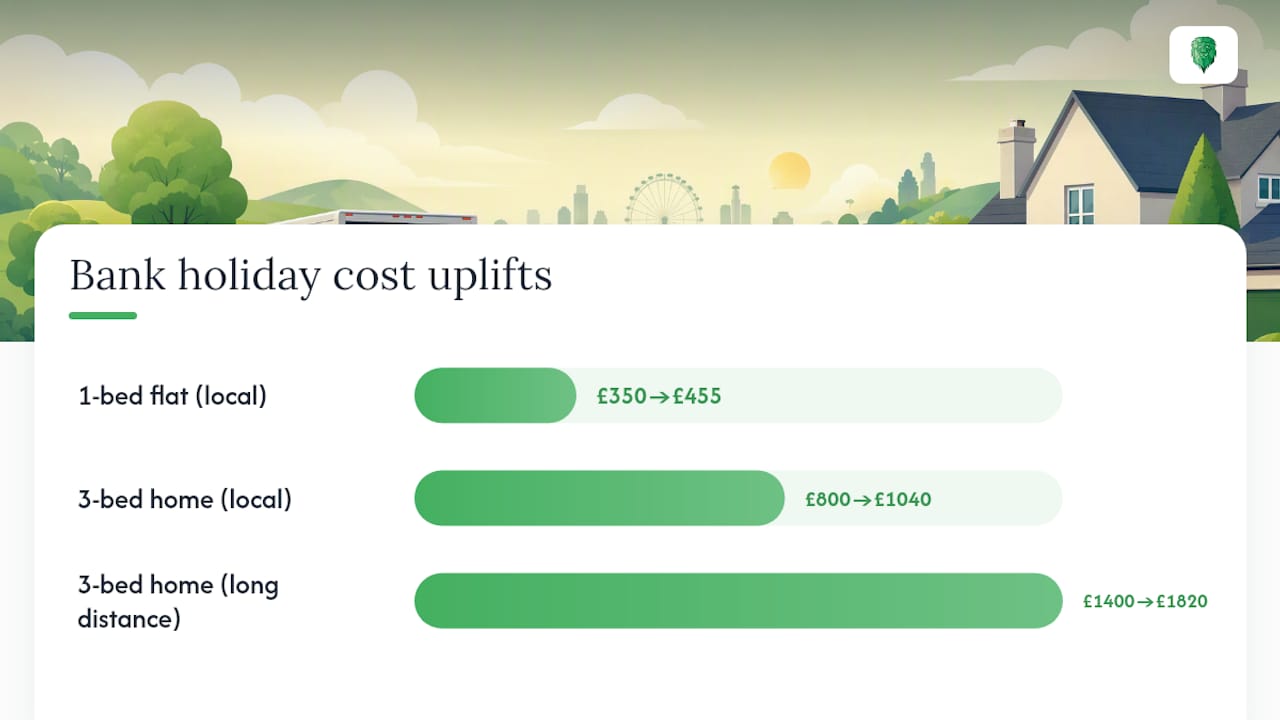
For the 1-bed flat example on an hourly rate: at £65 per hour for a two-person team, a four-hour job costs £260 on a weekday. On a bank holiday with a 20% premium and a four-hour minimum enforced, that becomes £312 before any add-ons.
Long-distance moves are worth separate consideration. Cross-country moves involve more variables: fuel, overnight stops if the move spans two days, and the fact that the crew may be working across a bank holiday and the following day. Always ask explicitly how multi-day jobs are priced when a bank holiday falls within the window.
When using an online quote calculator, the fields that matter most for bank holiday pricing are: the exact date, property size, distance, and any specialist items. The calculator gives you a useful ballpark, but the final quote will reflect the specific holiday surcharge policy of the firm you choose.
Use the worked examples as a budget stress-test, not a firm price. Local market conditions, the specific bank holiday, and the firm’s own policy all affect the final number.
What are the alternatives to moving on a bank holiday?
Sometimes the bank holiday date is genuinely fixed. Other times, there is more flexibility than you initially think. Here are the realistic options and when each one makes sense:
- Move the day before the bank holiday. You get the long weekend to unpack and settle in, and you pay standard weekday rates. The main risk is that completion day is fixed by your solicitor, not by you.
- Move the day after the bank holiday. Often the cheapest option if you have flexibility. Removal companies are back to full staffing and standard pricing, and you still benefit from the extended weekend.
- Partial DIY with a hired van. Works well for smaller moves or students. The cost is lower, but factor in the extra hire day if the return desk is closed on the holiday itself. Check return hours before you book.
- Man-and-van for a smaller move. A man-and-van service is often more flexible on bank holidays than a full removal company and can be a practical choice for a 1-bed flat or a studio. Rates vary, but the smaller scale means the absolute cost is lower even with a premium applied.
- Storage bridge. Move your belongings into storage before the bank holiday at standard rates, then complete the move into your new home on a normal working day. Adds cost and effort but removes the bank holiday premium from the largest part of the job.
When is the premium worth paying? If your completion date is legally fixed, if you have taken annual leave around the bank holiday, or if the convenience of a long weekend to unpack genuinely matters to you, the extra cost can be justified. The 10%–30% uplift on a 2-bed local move adds £40–£210 to the bill, but the final premium depends on firm policy and demand, so expect higher quotes during peak holidays. For many people, that is a reasonable price for the flexibility.
For help choosing between full-service, man-and-van, and self-hire options, the decision usually comes down to volume, distance, and how much you want to do yourself.
A practical word from someone who sees this every week
The most common mistake people make when planning a bank holiday move is treating the date as a minor detail rather than the most important piece of information on the quote request. Crews need to be confirmed, vehicles allocated, and overtime authorised well in advance. When a customer calls two weeks before Easter Monday hoping to book a three-bed removal, the honest answer is often that the good slots are already gone.
The second most common mistake is accepting a verbal quote and then being surprised by the written invoice. Holiday surcharges, minimum-hire periods, and waiting-time charges are all legitimate, but they should appear in writing before you confirm the booking, not after the van has left your old address.
Book early, get everything in writing, and flag the bank holiday date explicitly in your first message to any removal company. Those three habits will save you more stress than any other piece of advice in this article.
Van-247delivery can handle your bank holiday move
Bank holiday moves need a firm that is upfront about costs from the start, not one that adds surcharges after you have already committed.

Van-247delivery offers house removals, man-and-van services, packing, storage, and insured transport across the UK, including on bank holidays. Surcharges are shown transparently in your instant online quote, so you see the full bank holiday cost before you confirm anything. There are no hidden overtime lines appearing on the final invoice.
For smaller bank holiday moves, the man-and-van service offers a flexible, lower-cost alternative to a full removal team. For larger homes or long-distance jobs, the full removal service covers packing, disassembly, and goods-in-transit insurance as standard.

Get your instant quote now at Van-247delivery and see exactly what your bank holiday move will cost before you decide.
Sources
Before you finalise your plans, these are the most reliable places to check facts and verify dates:
- Association of Independent Movers — extra charges on removals
- FreightWaves — cost to move holidays/weekends
- Movingcost
- Checkatrade — cost of moving house guide
- RemovalReviews — Is it possible to move home on a bank holiday?
- JustMoveIn — Moving home on a bank holiday
FAQ
How much more does a bank holiday move cost in the UK?
Bank holiday moves typically cost 10%–30% more than a comparable weekday move, driven mainly by overtime and statutory holiday pay for removal crews. On a 3-bed local move with a £800 weekday baseline, that means budgeting an extra 10% to 30% of that baseline amount.
What is the average cost of moving house in the UK?
Baseline local move costs range from roughly £250–£450 for a 1-bed flat up to £1,200–£2,000 for a 5-bed home; a 3-bed local move typically falls in the £600–£1,000 range before any bank holiday uplift is applied.
Do removal companies work on bank holidays?
Most do, but with reduced availability and higher prices. Early booking and clear communication are the most reliable ways to secure a slot and avoid surprise charges on a bank holiday date.
Is it cheaper to move the day after a bank holiday?
Yes, in most cases. Moving the day after a bank holiday means standard weekday rates, full crew availability, and no minimum-hire surcharges, while you still benefit from having the long weekend to prepare or begin unpacking.
How far ahead should I book a bank holiday removal?
Book at least eight to twelve weeks ahead for popular bank holidays such as Easter or the August bank holiday. The earlier you book, the more firms you can compare and the better your chance of securing a competitive rate.