Antique furniture insurance is cover written around the real value of old and irreplaceable pieces, and for most owners it means going beyond a standard home contents policy. Standard policies often cap what they pay for a single item, or leave antiques out altogether. The fix is simple in principle: get each valuable piece valued, tell your insurer about it, and check that the cover still applies when the piece leaves the house. That last part matters most if you are moving, because transit is where antiques are most at risk. If you are planning a move, we handle large and delicate items every week as part of our furniture and large items service, and we would rather you arrive with the paperwork sorted than find the gaps after a scratch.
TL;DR
- Many insurers do not cover antique furniture under a standard contents policy, and some apply a single article limit, so one valuable piece may be only partly covered.
- Specialist or high-value home policies can cover antiques at an agreed value, including accidental damage and theft, and often pieces away from home.
- A professional valuation and good photographs make a claim far smoother, and values should be rechecked when the market moves.
- Before a move, ask your insurer in writing whether antiques are covered in transit by professional removers, and how they must be packed.
- If something goes wrong, report it quickly, keep the evidence, and do not authorise repairs before your insurer agrees.
Table of Contents
- Why standard contents insurance often falls short
- What specialist antique furniture cover usually includes
- Valuing antique furniture for insurance
- Moving day: the moment antiques are most exposed
- Promo: moving antiques with people who do it daily
- Perspective
- If something is damaged or lost
- FAQ
- Sources
Why standard contents insurance often falls short
Most of us buy contents insurance for the sofa, the television and the kitchen gadgets. An oak chest of drawers from 1780 is a different animal. Hiscox says many insurers do not cover antique furniture, art or statues under standard home contents policies, and that some policies carry a Single Article Limit. The British Antique Dealers’ Association (BADA) likewise says standard house and contents insurance typically gives only limited cover for antiques and works of art.
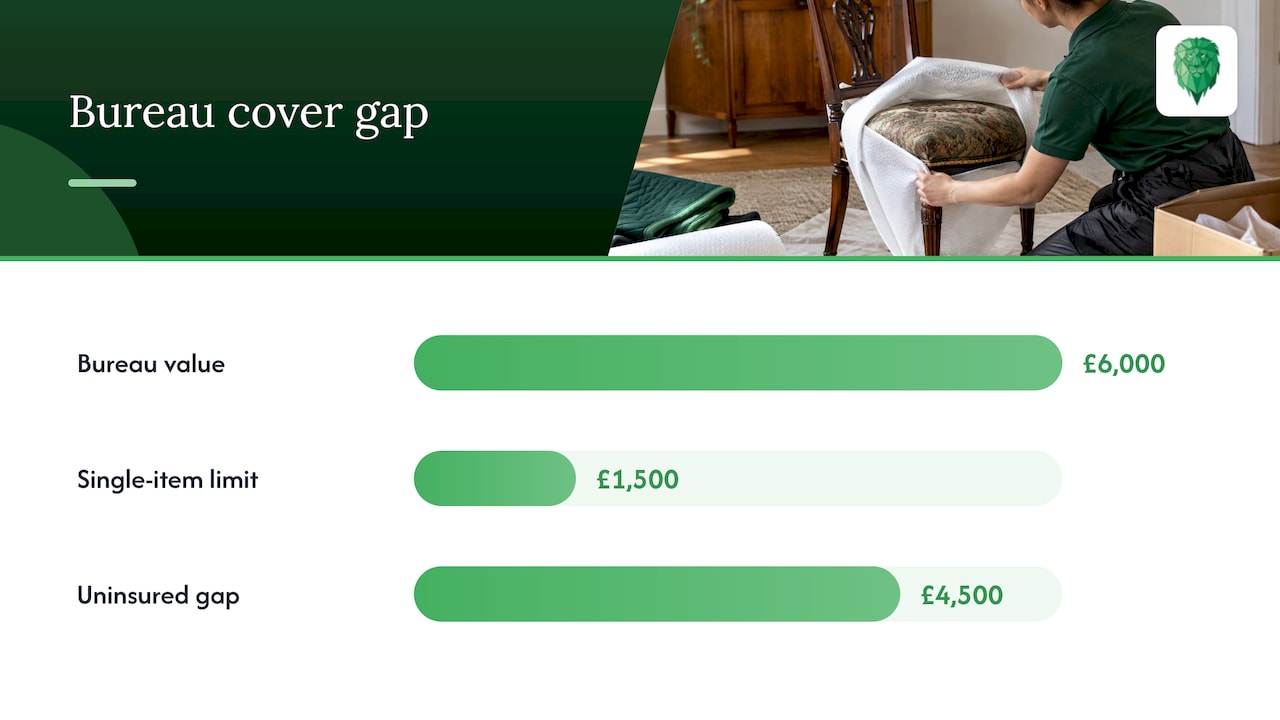
What is a single article limit? It is the most the insurer will pay for any one item, however much it is worth. AXA’s contents policy, for example, has a single article limit of £1,500 across its Home, Plus and Premier levels. If you own a Georgian bureau worth £6,000, a limit like that leaves a large gap, even if the rest of your contents are insured for tens of thousands.
A second trap is how claims are settled. Which? explains that insurers pay either on a new-for-old basis or an indemnity basis, and indemnity deducts for wear and tear. For an antique that is already two centuries old, that kind of deduction can be painful, and a modern replacement is not what you lost anyway. The same Which? piece also notes that policies differ in what they leave out, so the terms and conditions are worth reading before you buy.
A quick check of your own policy
Before anything else, find your policy documents and look for:
- the single article limit and the total limit for valuables;
- any wording that excludes or restricts antiques, art or collections;
- the level above which items must be listed separately. Culvertons notes that home policies generally require items worth roughly £1,000 to £1,500 and above to be separately listed;
- whether accidental damage is included, since AXA notes not all contents policies cover it;
- what the policy says about items in transit or in storage.
If any of that is unclear, your insurer or broker can confirm it in writing. It is a ten-minute call that can save a very bad day.
What specialist antique furniture cover usually includes
Specialist and high-value home policies are built for exactly this situation. The detail varies by insurer, so treat the examples below as a guide to what to look for, not a promise of what every policy does.
| Feature | What it means for you | Example from published policy information |
|---|---|---|
| Agreed value | The insurer accepts a valuation in advance, so there is less argument at claim time | BADA notes insurers will agree to pay the amount stated on a valuation |
| Accidental damage and theft | Covers the knocks and the burglary, not just fire and flood | Highworth’s stand-alone antique policy includes both |
| Cover away from home | Useful if a piece is out for restoration, on loan or in transit | Highworth lists cover elsewhere for up to 90 consecutive days |
| New acquisitions | Pieces you buy at auction or from a dealer are covered straight away | Rivr covers new purchases automatically for 60 days |
| Loss in value after repair | Pays for the drop in worth even when a repair is good | Assetsure’s antique policy covers depreciation following repair, up to the insured amount |
| Pairs and sets | If one chair of a set of six is damaged, the lost value of the set is recognised | Assetsure includes pairs-and-sets cover |
| Unlisted pieces | Lower-value antiques are covered without itemising each one | Stanhope provides £15,000 of cover for antiques and art as standard, with no need to specify pieces valued below £15,000 |
Notice how each row solves a problem a standard policy leaves open. The loss-in-value point deserves a closer look. A skilfully repaired walnut table may look perfect, yet collectors will pay less for it. Hiscox’s policy wording (February 2026) says it will pay for any loss in value after repair, which the policyholder must prove, and that when it decides to pay the full value it takes possession of the item. That is why a good valuation on file matters.
When to talk to a broker
If your contents are worth £100,000 or more, BADA says a tailored policy can be arranged, often with a broker’s help, with benefits such as worldwide cover, automatic cover for new acquisitions and agreed values. For a collection of that size, a broker or insurer is the right person to speak to, and we would always encourage you to do so before a move rather than during it.
Valuing antique furniture for insurance
The number on the policy has to be right. Too low and you are underinsured. Too high and you may pay for cover you cannot claim.
An insurance valuation is not the same as what you paid, and it is not the same as what a piece might fetch at auction. Culvertons explains that an insurance value estimates the cost of sourcing a ready replacement from a recognised dealer. It is worked out by adding an uplift, based on condition, rarity and commercial appeal, to the open-market auction value. That is why a valuer’s figure is often higher than the auction price you remember.
Two valuation approaches show up in policy wordings:
- Market value: the insurer pays what the item was worth on the day before the loss. Stanhope’s wording (November 2024) insures antiques at current market value unless there is an approved valuation.
- Agreed value: with an approved valuation sent to the insurer, the item is insured at the agreed replacement value in that document.
What evidence to keep
You do not need a filing cabinet, just a tidy folder, digital or paper:
- Photographs of each piece from several angles, plus close-ups of maker’s marks, labels, carving and any existing damage.
- Measurements and a short written description: timber, period, maker if known.
- The receipt, auction invoice or dealer’s paperwork showing provenance.
- The valuation certificate for anything of real value.
BADA advises that detailed descriptions and photographs help substantiate a claim and aid police recovery if a piece is stolen. It also advises treating insurance as a back-up to security, not a replacement for it, so good locks and alarms still matter.
When to update a valuation
Markets move in both directions. Culvertons says a re-appraisal only needs doing if the market has changed enough to warrant it, and that values for many traditional antiques have sat at a long-term low, while pieces that suit contemporary homes have risen quickly. Practical triggers for a recheck: you inherit or buy a new piece, the policy renews and you have not looked at the schedule for years, or you hear that your type of furniture has changed noticeably in price. Tell your insurer about any new valuation so the figure on the policy matches it.
Moving day: the moment antiques are most exposed
If you take one thing from this article, take this: an antique can be perfectly insured at home and not insured on the way to your new one. Stanhope says antiques are most commonly damaged in transit, for example on the way home from a dealer or between homes.
Policy wordings show how differently insurers treat this:
- BSPoke’s Platinum Home wording (January 2025) includes an extension for contents, fine art and antiques during removal, transit and storage to a new permanent UK residence by professional removal contractors, but not while in storage for more than 15 days. The same wording excludes items in transit that are not suitably packed and secured.
- Howden’s Private Client Elite Home wording (August 2025) also excludes loss or damage to an item in transit that is not adequately packed and secured.
- Rivr says antiques are covered during a home move when transported and temporarily stored by professional removal companies, subject to terms.
Two lessons stand out. First, cover during a move often depends on a professional removal firm being used. Second, packing and securing is frequently a condition, not a nicety. Both are good reasons to hand delicate furniture to people who do this daily.
Your pre-move checklist
- Ask your insurer in writing whether antiques are covered during a house move, and under what conditions: professional movers, packing standard, storage limits.
- Check whether cover is UK-only or worldwide if any piece is travelling abroad. Highworth’s buyer checklist lists this, along with whether new purchases get instant cover.
- Update your photos the week before the move, so condition is recorded on the day the pieces leave.
- Confirm the carrier’s own insurance and what it covers. Our guides on how to insure transported items and what furniture courier insurance covers walk through the questions to ask.
- Plan the packing. Our guide to moving fragile items safely covers wrapping and loading, and our piece on moving a grandfather clock shows how much care a single tall piece needs.
- Watch the storage clock. If there is a gap between homes, check how many days of storage your policy tolerates.
Promo: moving antiques with people who do it daily
We have been moving homes, offices and large items across the UK for over 15 years, and our transport is insured. For antiques that means packing and securing pieces properly, which, as the policy wordings above show, is exactly what insurers look for. We can also disassemble and reassemble furniture, so a four-poster or a large dresser travels in manageable parts, and we offer storage if your dates do not line up.
For a single special piece, see our furniture and large items service. For a whole-house move, our house removals include packing, unpacking and storage options. Piano owners can look at our piano removal service.
An instant online quote takes a few minutes, and you pay before the job, so you know where you stand ahead of moving day. If a job overruns because of waiting time, it is charged at £24 per hour per man.
Perspective
Insurance is the part of a move people leave until last, and it deserves to come first. When you sit down with the policy wording, you will often find that the cover has two conditions hiding in it: the piece must be valued, and it must be properly packed and secured when it travels.
That second condition is where we come in. Our approach to antique and delicate furniture is to treat the packing as part of the protection, not an extra. We have more than 15 years of experience with large, fragile and valuable items, and we offer packing, disassembly and reassembly so that pieces travel in a state that suits both the furniture and the paperwork.
Our advice is simple. Get your valuations done, tell your insurer you are moving, ask the questions in the checklist above, and then give us the list of pieces, the access details at both ends and any quirks, such as a narrow staircase or a fragile veneer. A calm move is mostly preparation, and moving day is a marathon, not a sprint.
Claudiu
If something is damaged or lost
Even with careful planning, accidents happen. The claim process is easier when you know the shape of it. Stanhope’s policy wording gives a clear example of what many insurers expect:
- Act quickly. For loss, theft or malicious damage, report to the police within 24 hours of discovering it and obtain a crime reference number.
- Limit further damage. Take reasonable steps to stop things getting worse.
- Contact your insurer as soon as possible with a completed claim form, proof of purchase and ownership, and evidence of value. In that wording the insurer will not consider the claim until a valuation or receipt is provided.
- Do not authorise repair or restoration without the insurer’s written agreement.
- Expect a choice of outcomes. The insurer may replace, repair or restore the item, or pay the market value or agreed amount.
Your own policy may set different timescales, so read its claims section now, not on the day. This is why the photos and valuation folder from earlier are worth the effort: they are your evidence.
FAQ
Does home contents insurance cover antique furniture?
Sometimes, but often only in part. Hiscox says many insurers do not cover antique furniture under standard contents policies, and some policies limit what they pay for any single article. Check your policy for its single article limit and any exclusions, then ask your insurer how it treats antiques.
How much does an antique furniture valuation cost, and do I need one?
Fees vary by valuer and by the number of pieces, so ask for a quote before booking. A valuation is worth having for anything above your policy’s listing threshold, which Culvertons puts at roughly £1,000 to £1,500 for home policies in general. BADA notes insurers will pay the amount on a valuation, which avoids disputes at claim time.
Is my antique furniture insured while it is being moved?
That depends entirely on your policy. Some policies extend cover to a home move by professional removal contractors, with conditions on packing and storage length. Others exclude items that are not suitably packed and secured. Ask your insurer in writing before the move.
How often should I update an insurance valuation?
There is no fixed rule. Culvertons advises re-appraising when the market has changed enough to warrant it. Sensible moments are when you acquire a piece, when your policy renews and you have not reviewed the figures for several years, or when prices for your kind of furniture shift noticeably.
Sources
- Antiques insurance, Hiscox UK
- Hiscox Home Insurance policy wording, February 2026
- Insuring antiques, BADA
- Contents insurance explained, Which?
- Home contents insurance, AXA UK
- Antiques and collectables insurance, Highworth Insurance
- Antique insurance, Rivr
- Insurance for antiques and collectables, Assetsure
- Antiques insurance, Stanhope Insurance
- Stanhope policy wording, November 2024
- Insurance valuation services, Culvertons
- BSPoke Platinum Home policy wording, January 2025
- Howden Private Client Elite Home policy wording, August 2025