Artwork transport guide: photograph and document every piece before you touch a roll of tape. Use archival-safe, medium-appropriate barriers rather than whatever’s in the cupboard, crate anything travelling long distance, and book climate-controlled, insured transport for anything of real value. Everything else in this guide simply expands on those four moves. If you need the stepwise version, jump to the checklist below.
TL;DR:
- Proper documentation involves photographing each artwork from multiple angles and creating a signed condition report before packing begins.
- Use acid-free interleaving materials like glassine or tissue tissue, avoiding bubble wrap or newspaper directly on the artwork to prevent damage.
- Crates for long-distance transport should float the piece in a shock-absorbing foam cavity, with humidity buffers like silica gel packs and phase-change gels.
- Load artwork last into the vehicle, transport upright on its long edge, and secure it away from other cargo to prevent shifts or impacts during transit.
- Insurance coverage must be explicitly declared and is often limited by standard carriers; consider a dedicated fine-art policy for valuable pieces.
Table of Contents
- Quick checklist for artwork transport: what to do first
- How should you pack different artwork mediums for transport?
- What makes a good crate for shipping artwork?
- How should artwork be loaded and monitored during transit?
- What documentation and insurance do you need for artwork shipping?
- How do you choose the right artwork transport service?
- What experienced art handlers know that checklists miss
- Booking Van-247delivery for your artwork move
- Where this guide’s advice comes from
- Sources
- FAQ
Quick checklist for artwork transport guide: what to do first
Before anyone reaches for bubble wrap, work through these steps in order. Rushing straight to packing is how corners get knocked and provenance details get lost.
- Create a condition report. Photograph every piece from multiple angles, including close-ups of existing damage, signatures and frame joints, and note exact dimensions.
- Measure everything. Record height, width, depth and frame profile so you know whether you need a standard box, a custom crate or a flat portfolio case.
- Sort by medium and fragility. Oil paintings, works on paper, glass-framed prints and sculpture all need different handling, so group them before you start buying materials.
- Check your staging space. Don’t leave artwork sitting in a garage, van, or unheated hallway overnight, since temperature swings do more damage than most transit does.
- Decide who’s doing the lifting. A single canvas across town is a different job to twelve crated pieces going cross-country. Match the artwork to personal transport, a general mover, or a specialist art logistics provider.
Getting this sequence right at the start saves far more time than it costs, and it’s the difference between a smooth artwork transport guide checklist and a stressful morning of improvising.
How should you pack different artwork mediums for transport? Part of artwork transport guide
There’s no single correct way to wrap art. Wrapping artwork for moving depends almost entirely on what the piece is made from, and treating every medium the same way is where most preventable damage happens.
Start with the layer that touches the surface. Whatever the medium, the first material against the artwork should be archival-safe, acid-free glassine or interleaving tissue, never bubble wrap, cling film or newspaper directly on the surface. Standard bubble wrap can imprint its texture onto soft or varnished paint over time and trap moisture against the surface, which is a slow, quiet way to ruin a painting that looked fine when it was packed. The NMS handling guidelines are blunt about this: newspaper, polystyrene peanuts and wax paper can mark or chemically degrade both artwork and frames, so none of them belong anywhere near a valuable piece.
Framed and glazed works
If the glazing is glass, a painter’s-tape X across the pane helps contain shards should it crack, then build a “sandwich” using two pieces of cardboard slightly larger than the frame, taped together at the edges with the artwork protected inside, and add foam corner protectors before boxing. If the glazing is acrylic, skip the tape entirely. Museums Galleries Scotland notes that adhesives which are fine on glass can damage or discolour acrylic glazing, so this is one of the easiest and most common mistakes to make on moving day.
Unglazed canvases
For an unframed or unglazed canvas, the float-mount method is worth learning: the painting sits suspended within a rigid outer frame or box, touching nothing but soft padding at the very edges, so the painted surface itself never makes contact with any material. Use board thicknesses that won’t flex under light pressure, and always carry and store canvases upright on their long edge rather than flat, which spreads stress unevenly across the stretcher bars.
Works on paper and pastels
Flat is almost always safer than rolled for anything with texture. Use a rigid, acid-free portfolio case with glassine interleaving between every sheet. When rolling is unavoidable, use tubes with a minimum diameter of around 75mm, and interleave the paper with tissue as you roll to stop pastel or charcoal transferring onto itself.
Sculptures and textiles
Sculptures need blocking, palletising and foam cavities cut to the exact shape of the piece, with any lifting done from load-bearing points identified in advance, never from an arm, a plinth edge or a decorative element. Textiles should be folded with acid-free tissue placed inside every fold to stop creasing and colour transfer.
- Avoid: newspaper, polystyrene peanuts, wax paper, direct-contact bubble wrap, painter’s tape on acrylic
- Use instead: glassine, acid-free tissue, Ethafoam or Plastazote padding, rigid portfolio cases, custom foam cavities
Pro Tip: Handle every framed piece with two hands and clean, dry gloves, one supporting the base and one steadying the top. A single hand gripping the frame edge is how corners get dented before the artwork’s even left the wall.
What makes a good crate for shipping artwork? Part of artwork transport guide
A crate becomes necessary the moment a piece is travelling long distance, changing hands multiple times, or is valuable enough that a dented corner would be a genuine financial loss rather than an inconvenience. Museum courier manuals draw a clear line between simple protective boxes and true shipping crates, and the Art in Transit handbook from the Smithsonian’s Museum Conservation Institute is the reference most professional packers still build against.
Inside a proper crate, the artwork should float within a cavity rather than sit flush against the walls. That gap, filled with shock-absorbing foam, is what actually stops vibration and sudden impacts reaching the piece. Ethafoam and Plastazote are the two materials that come up again and again in professional specifications, and for float-mounts specifically, Ethafoam blocks of at least 50mm depth that recover around 90% of their shape after sustained compression give reliable, repeatable shock isolation.
Humidity matters as much as impact. Silica gel packs, conditioned to a target relative humidity before the crate is sealed, buffer against swings during transit, and phase-change gels can hold a stable temperature within a narrow band for several hours, which is often a cheaper fix than booking a fully chilled vehicle for a short journey.
When you’re specifying or approving a crate, ask for:
- Skids underneath, so the crate can be moved by pallet truck without touching the contents
- A sealed, weatherproof lid with tamper-evident buckles or latches
- Built-in handling frames or handles that keep hands off the artwork itself
- Clear “This Way Up” and face-orientation labelling on every side
If the artwork is crossing a border inside a wooden crate, check that the timber meets ISPM-15 international standards for treated wood packaging. Customs officers can and do hold shipments at the border over untreated pallets and crating timber, which is an entirely avoidable delay.
How should artwork be loaded and monitored during transit? Part of artwork transport guide
Loading order matters more than most people expect: art should go into the vehicle last and come out first, so it spends the least possible time wedged behind other cargo. Every piece travels upright on its long edge, never flat, and never stacked under anything else, however light.
Inside the van or truck, artwork needs to be strapped into a dedicated rack or secured against a padded bulkhead with anti-slip decking underneath, physically separated from furniture, boxes or anything with sharp edges. A crate that can shift six inches on a motorway bend has failed before it’s even reached the destination.
Temperature control is where a surprising number of moves go wrong. Oil paint becomes brittle below 10°C, while acrylic paint softens above 30°C, according to the NMS handling guidelines, so anything travelling in an uninsulated van through a UK winter or a heatwave is at real risk regardless of how well it’s crated. For valuable or climate-sensitive pieces, ask specifically for a climate-controlled vehicle, or a crate fitted with phase-change buffers if a full chilled van isn’t available or affordable for the distance involved.
On longer journeys, sustained road vibration is a slower but real threat, which is exactly why foam density and float-mount design matter more the further the piece is travelling. For genuinely high-value shipments, ask your provider whether they offer GPS tracking and in-transit data-loggers that record temperature, humidity and shock events throughout the journey, giving you a verifiable record rather than just a hope that everything went smoothly.
- Load art last, unload it first
- Always transport upright, on the long edge
- Strap into dedicated racks, separated from other cargo
- Request climate control for anything sensitive to temperature or humidity
- Ask about GPS tracking and data-logger monitoring on higher-value moves
What documentation and insurance do you need for artwork shipping? Part of artwork transport guide
Documentation is what turns “it looked fine when it left” into something you can actually prove. A thorough condition report, photographed front, back and at every corner before the piece leaves your hands, is the single most useful document you’ll create, and a signed copy should travel with the crate itself.
Before you book anything, check what “insured” actually means with your carrier. Many general carriers cap liability at a fraction of an artwork’s real value, so anything above a modest sum needs a specific declared value agreed in writing, or a standalone fine-art insurance policy arranged separately. Chubb’s guide for collectors is worth reading in full if you’re moving anything with real financial value.
- Before packing: complete and photograph the condition report, get it signed by whoever is present.
- During transit: keep a packing build-sheet noting who handled the piece and when, with timestamps at every hand-off.
- On arrival: re-inspect against the original report before anyone signs the waybill.
- If damage appears: photograph it immediately, keep every scrap of the original packing material, note it on the waybill before signing, and contact your insurer or broker straight away with the photographs attached.
That last step matters more than people expect. Insurers repeatedly flag delayed reporting and discarded packaging as the two things that most complicate a claim.
How do you choose the right artwork transport service? Part of artwork transport guide
The right choice usually comes down to three factors multiplied together: how valuable or fragile the piece is, how far it’s travelling, and how much time you have. A modestly framed print going across town doesn’t need the same treatment as a fragile eighteenth-century canvas going to another country, and pretending otherwise either wastes money or risks the piece.
At minimum, any handler you hire should offer custom crating for anything travelling long distance, a signed condition report before and after the move, and climate-controlled transport as an option, not an afterthought they seem surprised you asked about.
Be wary of vague reassurances. “We’re very careful” isn’t a process. A provider with genuine art-handling experience should be able to describe their crating method, name the materials they use, and explain exactly what happens if something goes wrong.
- Ask what materials they use for facing and cushioning, and why
- Ask whether crating is custom-built or off-the-shelf
- Ask how their insurance and claims process actually works, step by step
- Ask for references from previous fine-art moves, not just general removals
Pro Tip: If a provider can’t answer a specific question about their claims process within thirty seconds, that hesitation tells you more than their sales pitch does.
What experienced art handlers know that checklists miss, part of artwork transport guide
The biggest hidden risk in most artwork moves isn’t the journey itself. It’s what happens in the hours before the wrapping starts. Taking a piece straight off a warm wall and into a cold van, or the reverse, without letting it sit and acclimatise for a day or two first, puts real stress on joints, canvas tension and varnish that no amount of careful crating afterwards can undo.
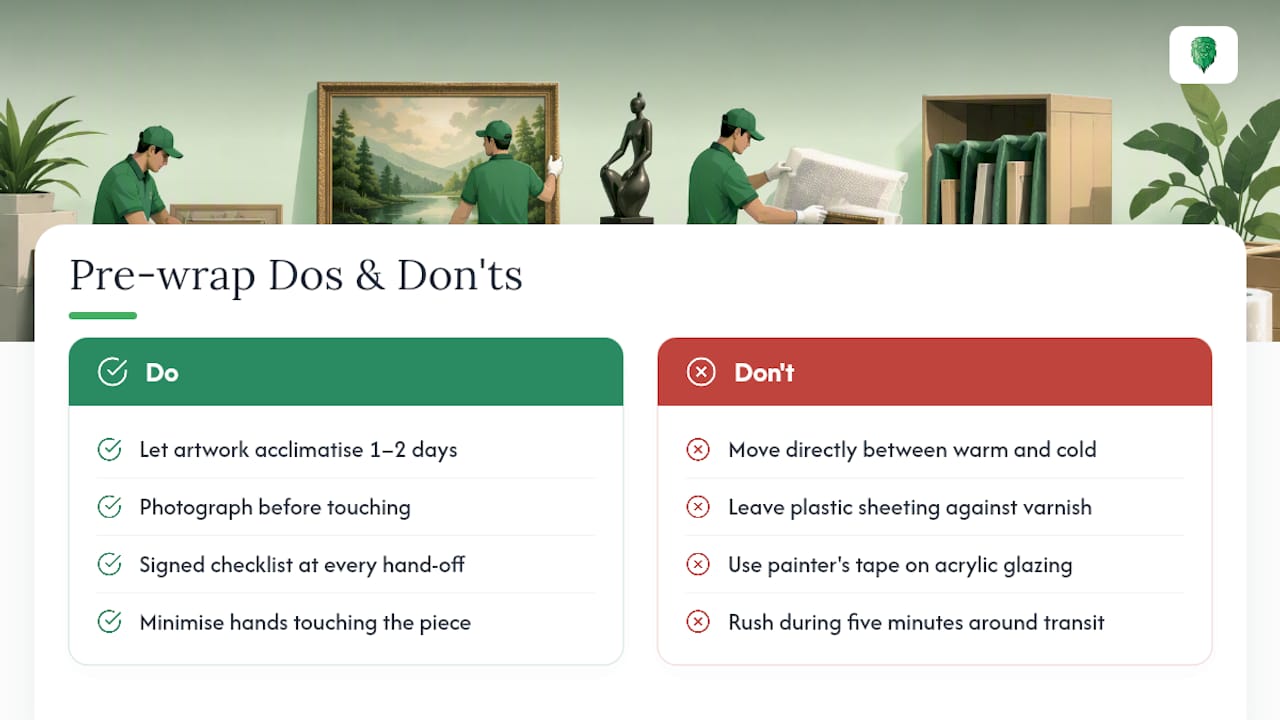
Some mistakes, once made, can’t be reversed. Plastic sheeting trapped against a varnished surface for even a few hours can leave a permanent texture mark. Painter’s tape on acrylic glazing can lift a haze off the surface the moment you peel it away. Neither shows up until it’s too late to fix.
What actually reduces claims isn’t more equipment. It’s discipline: a photograph before anyone touches the piece, a signed checklist at every hand-off, and the fewest possible hands making contact along the way. Most damage happens not in transit but in the five minutes either side of it, when people are moving fast and nobody’s watching closely enough.
— Claudiu
Booking Van-247delivery for your artwork move
If you’d rather hand the packing and driving to someone else, professional moving services cover most of what this guide describes, matched to the size of the job rather than a one-size-fits-all price. A single framed painting or a small sculpture crossing town suits our man with a van service, where one vehicle and one driver handle everything from loading to final placement. Crated pieces or multiple works travelling further afield fit better with pallet delivery, while a full collection move alongside the rest of a house or office is exactly what our house removals service, including professional packing, is built for.

Before booking, ask directly about insurance cover for the specific piece, experience with fragile or high-value goods, and whether a signed condition report is part of the process. If you already have a sense of your artwork’s dimensions and value, contact the provider for an instant quote and a suitable service level for the job.
Where this guide’s advice comes from
This guide draws on museum and insurer manuals rather than general moving tips. The NMS handling guidelines cover materials and climate thresholds, the Smithsonian’s Art in Transit handbook sets the standard for crating and float-mounts, and Chubb’s collector guide informs the insurance and claims steps. Anyone specifying a crate or a policy should read the relevant manual in full.
Sources
- NMS handling guidelines
- Art in Transit: Handbook for Packing and Transporting Paintings (Smithsonian / MCI)
- Smart about moving (Chubb) — guide for collectors
- Museums Galleries Scotland — caring for paintings and frames
FAQ
What is the best way to transport artwork?
Document condition with photographs first, pack with medium-appropriate archival materials, crate anything travelling long distance. And use climate-controlled, insured transport for valuable pieces.
What is the 70/30 rule in art?
That’s a compositional guideline used in creating artwork, balancing dominant and secondary elements on the canvas. It has no established meaning in packing or transport, so it isn’t relevant to shipping decisions.
What is the 2/3 rule for art?
This refers to visual composition and framing within a piece, not to transport or handling. Definitions vary by source, so treat it as a design principle rather than a packing standard.
How do you ship artwork safely?
Use archival glassine or tissue against the surface, never bubble wrap or newspaper directly on the artwork. Choose a proper crate with float-mount cavities for long-distance moves, and keep a signed condition report with the crate throughout transit.
Do I need special insurance for shipping artwork?
Standard carrier liability rarely covers a piece’s real value, so anything above a modest sum needs a declared value agreement. Or a dedicated fine-art insurance policy arranged before the move.