Commercial move insurance is a time limited goods in transit policy for your office relocation. Confirm whether your mover provides it and get the policy schedule in writing before anything leaves your building. If the cover on offer is not enough to replace your desks, servers or stock at full value, you can arrange a separate goods in transit policy instead. Some moving companies handle insured office relocations themselves, and the one habit that saves everyone a headache later is sorting the paperwork before the van arrives.
TL;DR:
- Check whether the payout uses new for old, invoice value, or depreciated market value; older equipment may be worth less under invoice valuation.
- Confirm limits per vehicle, consignment, and event, plus the excess and rules for goods split across vans, before accepting the mover’s cover.
- Storage periods vary; 60 days is commonly used in practice, so verify the policy’s exact window if your relocation includes a long gap between sites.
- For claims, notify the mover and insurer in writing the same day, preserve items, and submit photos bearing timestamps, the delivery note, and your inventory.
- Consider separate cover or a broker when high value equipment, unusual assets, multiple sites, or declared values exceed the mover’s consignment limit.
Table of Contents
- What commercial move insurance actually covers
- Arranging cover: your mover’s policy or a separate one
- The policy terms that decide whether a claim pays out
- What a commercial move typically costs to insure
- Making a claim: evidence that actually gets accepted
- How we support insured office relocations
- What procurement and facilities teams should prioritise
- Book an insured office move with us
- FAQ
- Sources
What commercial move insurance actually covers
Goods in transit cover for an office move is built around one simple idea: your equipment is protected from the moment it is lifted to the moment it is placed down at the new site. That includes loading, the journey itself, unloading, and often a short period of temporary storage in transit, which GOV.UK guidance confirms sits within the scope of relocation costs, alongside packing and unpacking.
Most policies respond to the perils you would expect: accidental damage, collision, fire and theft. What they will not usually touch is wear and tear, damage that existed before the move, or anything of high value that was not declared up front. Acts of war or terrorism are typically excluded too, though this rarely affects an office relocation in practice.
The detail that catches people out is the valuation basis, because it decides what you actually get paid:
- Invoice value: you are reimbursed what the item cost, which can undervalue older equipment.
- New for old: replacement at current prices, usually the better option for IT kit.
- Market value less depreciation: a reduced payout reflecting the item’s age and condition.
Know which basis applies before you need it, not after a server cabinet goes over on a ramp.
Arranging cover: your mover’s policy or a separate one, part of commercial move insurance
Most movers offer some form of transit cover as part of the job, but understanding exactly how moving insurance works is essential, and “some form” is doing a lot of work in that sentence. Before you book, ask these questions:
- Do you provide goods in transit insurance, and is it included or an add-on?
- Is the cover “open cover” that applies automatically, or does it need activating per job?
- What is the consignment limit, per vehicle and in total?
- Does the policy explicitly include loading, unloading and any temporary storage?
- Can I see the policy schedule or a certificate before the move date?
If your business is moving high-value items such as servers, specialist printing equipment or designer furniture, or if the consignment limit falls short of what you are carrying, separate cover is worth arranging. Declare high-value items in writing, request the mover’s trading conditions alongside their insurance certificate, and bring in a broker if the move spans multiple sites or involves unusual assets.
Pro Tip: Ask for the policy schedule before the move, not after something breaks. A verbal “yes, we’re insured” is not evidence anyone can claim against.
The policy terms that decide whether a claim pays out
The difference between a smooth claim and a drawn-out argument usually comes down to five lines in the policy document, so read them before you sign anything.
- Limit of indemnity: check whether it applies per vehicle, per consignment or per event, and whether it covers full replacement value.
- Excess: confirm how much you pay per claim and whether it applies per consignment when several vehicles are involved.
- Valuation basis: invoice value, new for old, or depreciated market value, each produces a very different payout.
- Consignment limits and aggregation: understand how limits stack when goods are split across multiple vans.
- Geographical scope and storage duration: verify the move is covered for the full route and that any storage in transit falls within the permitted window.
On that last point, HMRC’s own guidance for insurance premium tax treats storage as part of transit only within set time limits, with 60 days commonly used in practice. If your relocation involves a gap between sites longer than that, check explicitly whether your policy still applies, because tax treatment and cover periods tend to follow the same logic. GOV.UK’s guidance on managing risk in freight forwarding is equally clear that trading conditions must be agreed in writing, since these are what a mover’s liability actually rests on if something goes wrong.
What a commercial move typically costs to insure
Premiums move with the value you are declaring, the distance travelled, how much specialist packing is needed, and whether the site has access challenges like narrow stairwells or restricted loading bays. Storage in transit and high-value items such as servers, pianos or artwork push the cost up further, simply because the potential claim is bigger.
Movers charge for cover in different ways: a flat fee, a percentage of declared value, or fixed cover bands tied to consignment size. For complex or high-value moves, getting a separate quote from an insurer or broker can work out better value than accepting whatever band the mover defaults to. Treat a suspiciously low premium paired with a low consignment limit as a red flag rather than a bargain, since it may mean your real exposure is far higher than what you would recover.
Making a claim: evidence that actually gets accepted
Preparation does most of the work here. Before the move, photograph everything of value, keep an inventory with declared values, and get the mover’s trading conditions in writing so there is no ambiguity about what was agreed.
If something is damaged or goes missing, move fast:
- Notify the mover and insurer the same day, in writing where possible.
- Preserve the damaged item rather than disposing of it, insurers often want to inspect it.
- Get a written statement from the driver or crew if the incident happened in front of them.
- Take time-stamped photos of the damage and keep the delivery note.
- Submit your inventory and declared-value list alongside the claim.
Settlements are typically calculated on repair cost, replacement, invoice value, or new for old less an allowance for wear, depending on what the policy specifies. The British Association of Removers sets out that member firms must discuss insurance options with customers before the job, which gives you a reference point if a dispute arises. Where the trading conditions are unclear or a limit is being disputed, bring in a broker or seek legal advice rather than accepting a lowball settlement.
How we support insured office relocations
An office move carries more insurance risk than a house move, mostly because of IT equipment, and some movers build their processes around reducing that risk rather than just insuring against it. Our office relocation service covers specialist packing, storage in transit, server relocation, and reinstallation of Wi-Fi and video conference systems, each of which reduces the chance of something going wrong before it ever reaches a claims form.
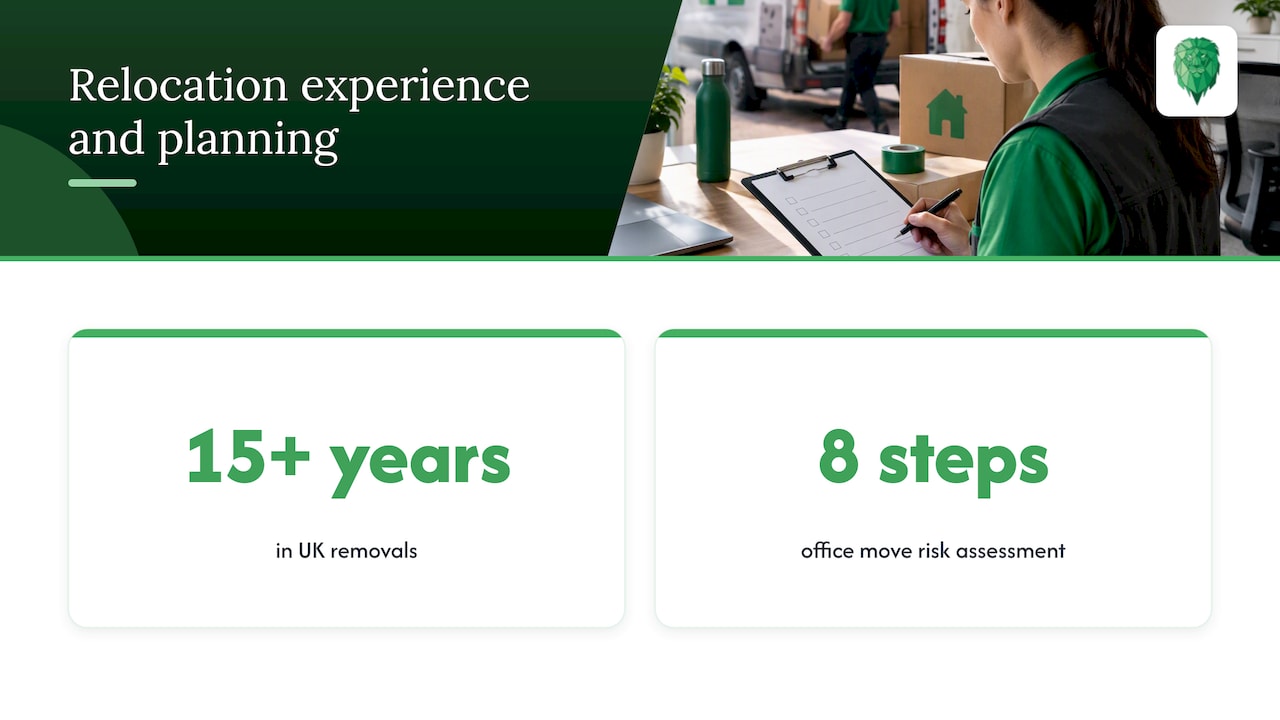
With over 15 years in UK removals, we have built practical resources alongside the service itself, including our 8 Step Office Move Risk Assessment, which walks through the preparation most claims disputes could have avoided. Moving companies often issue written trading conditions, provide consignment declarations for anything high-value, and supply a certificate or policy schedule on request before the move date, so clients have the paperwork in hand rather than chasing it afterwards.
What procurement and facilities teams should prioritise
If you take one thing from this guide, make it this: choose adequate indemnity limits and clear written terms over the cheapest premium on offer. A low-cost policy with a weak consignment limit is not a saving, it is a deferred cost waiting for the wrong afternoon.
Mover-arranged cover is convenient and usually fine for a standard office move, but check the valuation basis and storage-in-transit limits yourself rather than assuming they match your needs. For complex or high-value relocations, a broker earns their fee quickly. Above all, document everything and insist on seeing the policy schedule before a single box leaves the building.
— Claudiu
Book an insured office move with us
We arrange office relocations with insurance built into the process, not bolted on as an afterthought. Our office relocation service covers packing, storage in transit, server relocation, and reinstallation of IT and conferencing systems, alongside insured transport for everything in between. If you are also shipping palletised stock as part of the move, our pallet delivery service can run alongside the main job.
Before booking, confirm:
- What your consignment limit covers and whether it matches your declared values.
- Which valuation basis applies to your equipment.
- How long storage in transit is covered for, if your move needs it.
| What you get | Detail |
|---|---|
| Office relocation service | Packing, server relocation, Wi-Fi and conferencing reinstallation |
| Insurance evidence | Certificate or policy schedule provided on request before the move |
| Experience | Handling UK removals and office relocations |
Request a quote through our office relocation page and ask for your policy schedule before the move date is confirmed.
FAQ
What does commercial move insurance cover during an office relocation?
It covers physical loss or damage to your goods from loading through transit to unloading. And usually a limited period of storage in transit. Exclusions typically include wear and tear, pre-existing damage and undeclared high-value items.
Is my mover automatically insured for a commercial move?
Not always. British Association of Removers members must discuss insurance options before the job. But cover varies by firm, so always ask to see the policy schedule or certificate before booking.
How much does commercial move insurance cost?
Cost depends on declared value, distance, specialist packing needs. And whether high-value items like servers are involved, so there is no single fixed rate. Movers may charge a flat fee, a percentage of declared value. Or a fixed cover band, and a broker quote can be worthwhile for complex moves.
How long does storage in transit stay covered?
HMRC guidance on insurance premium tax treats storage as part of transit. Only within set time limits, with 60 days commonly used in practice. Always confirm the exact period with your mover or insurer rather than assuming a standard duration applies.
What evidence do I need to make a successful claim?
Insurers typically expect a pre-move inventory, declared values. Time-stamped photos of damage, a delivery note and, where relevant, a driver’s statement. Notify your mover and insurer the same day damage is discovered and keep the damaged item for inspection.
Sources