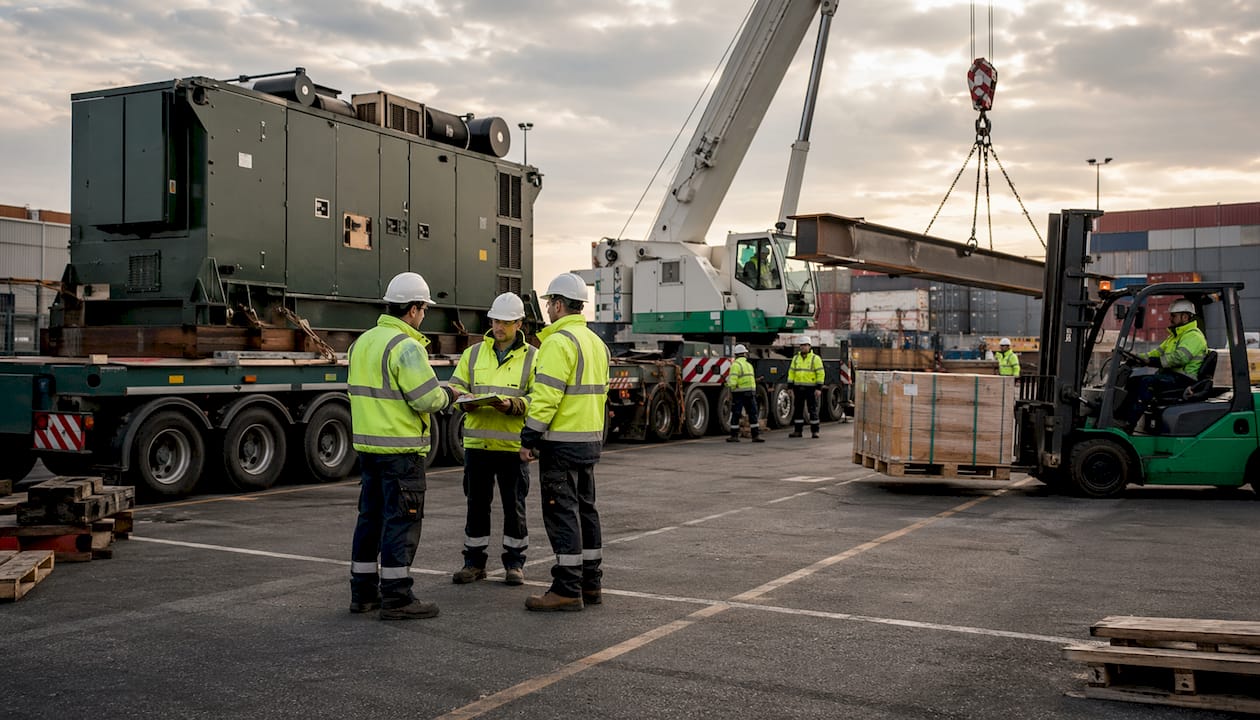
Explaining oversized item transport. Oversized item transport is defined as the movement of goods that exceed standard size or weight limits set by road, rail, or maritime authorities. In the UK, this typically means loads wider than 2.55 metres, taller than 3 metres, or heavier than 44 tonnes on a standard articulated lorry.
Whether you are moving a grand piano across London or shipping industrial machinery to a port, large item transport follows a completely different rulebook from standard freight.
The industry term is “project cargo” or “out of gauge” (OOG) freight, and understanding it saves you from costly mistakes. Van-247delivery has handled oversized and heavy loads across the UK for over 15 years, and the lessons from that experience shape every section of this guide.
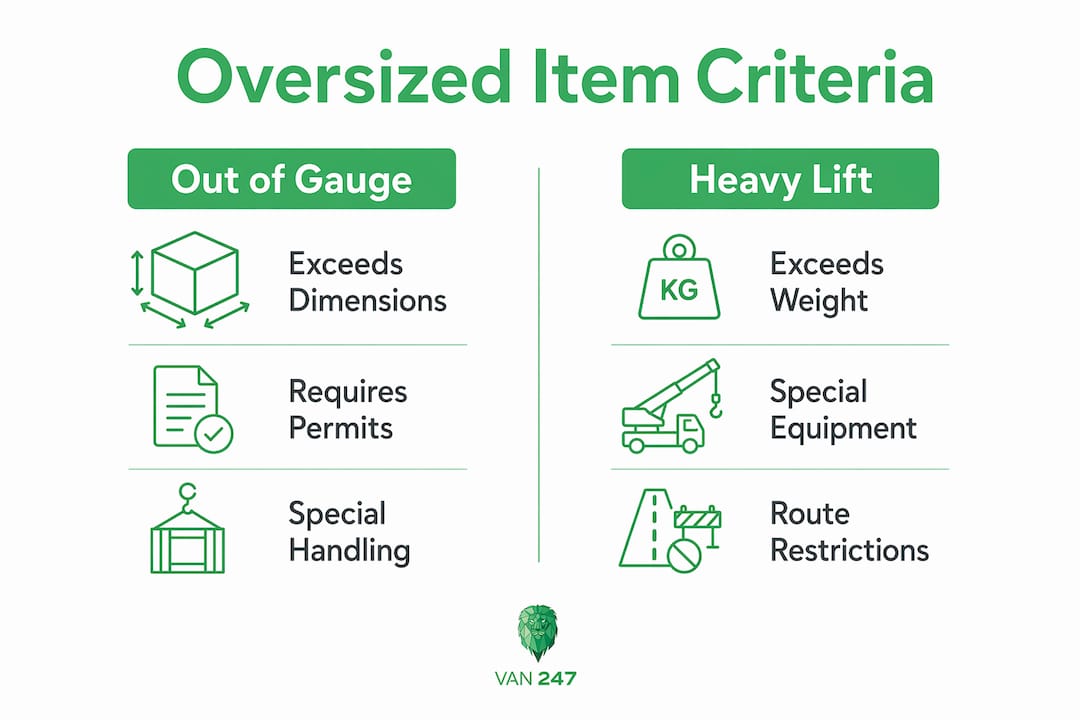
What are the defining criteria for oversized items in transport?
Oversized freight is classified by dimensions and weight, not by how awkward something looks. The thresholds matter because they determine which permits, equipment, and routes apply to your shipment.
Standard classification thresholds in the UK:
- Width: over 2.55 metres triggers an abnormal load classification
- Height: over 3.0 metres requires route assessment for bridge and overhead clearance
- Length: over 18.75 metres for a standard articulated vehicle
- Weight: over 44 tonnes gross vehicle weight on public roads
The industry separates two distinct categories. “Out of gauge” (OOG) cargo exceeds the physical dimensions of a standard container or vehicle. “Heavy lift” cargo stays within dimensional limits but exceeds safe weight thresholds for standard equipment. A large sculpture might be OOG but light. A compact industrial press might be within size limits but far too heavy for a standard flatbed.
Incorrect cargo measurements can cause permit rejections, route restrictions, cost overruns, and delays at ports or borders. That single fact explains why professional measurement and documentation come before any booking is made.
| Classification | Trigger | Typical requirement |
|---|---|---|
| Abnormal width | Over 2.55 m | Permit, possible escort |
| Abnormal height | Over 3.0 m | Route survey, clearance check |
| Abnormal length | Over 18.75 m | Permit, rear marker boards |
| Heavy lift | Over 44 t GVW | Specialist trailer, axle spread |
| Out of gauge (OOG) | Exceeds container envelope | Flat rack, open top, or breakbulk |
Getting the classification right at the start protects you from expensive surprises mid-transit.
What specialised equipment is used for oversized freight shipping?
The equipment choice is driven entirely by the cargo’s dimensions, weight, and fragility. There is no single solution for all oversized loads.
Road transport options
- Flatbed trailers suit wide, flat loads like steel beams or prefabricated panels. They offer easy crane access from any angle.
- Step-deck trailers lower the deck height by roughly 50 centimetres, giving extra vertical clearance for tall machinery without needing a special height permit in many cases.
- Lowboy trailers drop the deck even further, making them the standard choice for construction equipment such as excavators and bulldozers.
- Multi-axle trailers spread weight across more wheels, allowing very heavy loads to stay within road surface pressure limits. Some configurations carry loads exceeding 500 tonnes.
Ocean freight options
Non-containerisable cargo requires breakbulk, Ro-Ro, or flat-rack shipping, each with different insurance, handling, and coordination needs compared to standard containerised freight. Breakbulk ships carry individual pieces secured directly to the vessel’s deck or hold. Ro-Ro (roll-on, roll-off) vessels accept wheeled cargo driven directly aboard. Flat-rack containers have collapsible ends and no roof, allowing wide or tall items to be loaded from above or the side.
Flat rack containers make up less than 3% of the global container fleet, which makes them a scarce resource. That scarcity is why booking early is not optional.
Once the cargo is loaded, proper blocking, bracing, and tarping prevent damage during transit. Blocking stops lateral movement. Bracing prevents vertical shift. Tarping protects exposed surfaces from weather and debris.
Pro Tip: Always photograph your cargo before loading, showing all securing points and protective wrapping. This documentation is your first line of defence in any insurance or damage dispute.
How does route planning work for oversized cargo transport?
Route planning for oversized loads is an engineering exercise, not a sat-nav search. Complex oversize project cargo requires 8–16 weeks of advance planning to align cranes, terminals, permits, escorts, and delivery windows. That timeline surprises most first-time shippers.
The planning process follows a clear sequence:
- Measure and classify the cargo accurately. Confirm exact dimensions, weight, centre of gravity, and lifting points before anything else.
- Assess the origin and destination sites. Check gate widths, turning radii, overhead cables, and floor load ratings at both ends.
- Survey the route. Identify low bridges, weight-restricted roads, roundabouts with tight geometry, and any sections requiring temporary traffic management.
- Apply for permits. In the UK, abnormal load permits are issued by local highway authorities and, for motorways, by National Highways. Processing times vary by jurisdiction.
- Arrange escorts if required. Loads over certain widths legally require police notification or physical escort vehicles. Permit processing and pilot car coordination vary by jurisdiction and require experienced management to avoid transit disruptions.
- Confirm time restrictions. Many local authorities ban abnormal loads during peak hours, school run times, or major events.
For international ocean freight, submit exact dimensions 3–4 weeks before the cargo-ready date so the shipping line can calculate stowage positions and surcharges accurately.
Pro Tip: Book a physical site visit before the move date. Photographs and Google Maps miss overhead cables, soft verges, and low-hanging trees that can stop a lorry in its tracks.
Site-access constraints often cause more delay than the transport leg itself, especially in residential moves. A sofa that fits on the lorry but cannot turn the corner of a narrow hallway is a logistics failure, not a transport one.
What are the main risks in moving big items, and how do you manage them?
Risk in oversized transport clusters around five areas. Knowing them lets you plan around them rather than react to them.
- Equipment availability. Specialist trailers and flat-rack containers are scarce. Booking late means you accept whatever is available, often at a premium price and on a delayed schedule.
- Weather and port congestion. Heavy haul road moves are suspended in high winds. Port congestion delays vessel loading windows. Build buffer time into every schedule.
- Customs and documentation. Incorrect paperwork stops cargo at borders. For international moves, prepare commercial invoices, packing lists, certificates of origin, and any commodity-specific permits well in advance.
- Damage during transit. Oversized items are exposed to more handling touchpoints than standard freight. Each lift, transfer, and lashing adjustment is a damage opportunity.
- Insurance gaps. Specialised insurance is often necessary to cover risks unique to transporting oversized, fragile, or high-value freight. Standard goods-in-transit policies frequently exclude OOG cargo or cap payouts well below replacement value.
Treating oversized transport as a standard shipment results in failure. The cargo requires an engineered, cargo-centric plan that accounts for its specific centre of gravity, lifting points, and route constraints. That is not a philosophy. It is a practical requirement that separates successful moves from expensive ones.
Real-time tracking technology reduces anxiety and improves response times when something does go wrong. GPS-enabled load tracking lets you and your logistics coordinator see exactly where the cargo is and flag deviations from the planned route immediately.
For a broader look at how different freight types are classified and handled, the UK freight shipping guide covers the regulatory landscape in plain language.
Key takeaways
Oversized item transport requires engineered planning, specialist equipment, and permit compliance from the very first measurement to the final placement.
| Point | Details |
|---|---|
| Classify before you book | Confirm exact dimensions and weight to determine OOG or heavy-lift status before any booking. |
| Plan 8–16 weeks ahead | Complex oversized moves need this lead time to align permits, escorts, and equipment. |
| Choose equipment by cargo | Flatbed, lowboy, flat-rack, and Ro-Ro each suit different size and weight profiles. |
| Secure specialist insurance | Standard policies often exclude OOG cargo; confirm coverage before the move date. |
| Assess site access early | Origin and destination constraints cause more delays than the transport leg itself. |
What I have learned from years of oversized transport coordination
A perspective from Claudiu
The single biggest mistake I see is people treating an oversized move like a big version of a normal delivery. It is not. The moment a load exceeds standard dimensions, you enter a different world of permits, engineering assessments, and site-specific problem-solving. I have seen moves delayed for days because nobody checked whether a crane could reach the unloading point, or because a permit application listed the wrong axle configuration.
The detail that catches people out most often is site access at the destination. You can have the perfect trailer, the correct permits, and a flawless route survey, and then the lorry cannot get within 30 metres of the front door because of a low wall or a parked car. That is not a transport problem. It is a planning problem that shows up at the worst possible moment.
My honest advice is this: spend as much time planning the first and last 50 metres of the move as you do planning the entire route in between. Walk the site. Measure the gate. Check for overhead cables. Ask whether the floor inside can take the weight of the item being placed on it. These questions feel tedious before the move. They feel catastrophic if you skip them.
Experienced coordination across road, sea, and final-mile delivery is what separates a smooth project from a stressful one. The logistics are manageable when you treat them with the respect they deserve from day one.
— Claudiu
How Van-247delivery handles oversized item transport
Moving something large does not have to mean moving something stressful. Van-247delivery has over 15 years of experience matching the right vehicle, equipment, and crew to oversized loads across the UK.
Whether you need a man and van service for a bulky piece of furniture or a fully managed pallet transport solution for heavy commercial freight, Van-247delivery handles the logistics from first measurement to final placement. The team manages permit applications, vehicle selection, and load securing so you do not have to. Every booking includes insurance coverage and real-time tracking, giving you full visibility from collection to delivery. Get an instant quote at van-247delivery.com and let the team take the weight off your hands.
FAQ
What counts as an oversized item for transport?
An oversized item exceeds standard road or container limits, typically wider than 2.55 metres, taller than 3.0 metres, or heavier than 44 tonnes gross vehicle weight in the UK. These thresholds trigger permit requirements and specialist vehicle needs.
How far in advance should I book oversized freight shipping?
Book at least 3–4 weeks ahead for international ocean freight and 8–16 weeks ahead for complex project cargo moves. Specialist equipment like flat-rack containers is scarce, so late bookings often face delays and higher costs.
Do I need a permit to move an oversized load on UK roads?
Yes. Loads classified as abnormal require permits from local highway authorities, and motorway moves need approval from National Highways. Some widths also legally require escort vehicles or police notification.
What is the difference between OOG and heavy-lift cargo?
Out of gauge (OOG) cargo exceeds the physical dimensions of a standard container or vehicle. Heavy-lift cargo stays within size limits but exceeds safe weight thresholds. Both require specialist handling, but the equipment and permits differ significantly.
Is standard insurance enough for oversized item transport?
Standard goods-in-transit insurance frequently excludes OOG or high-value freight, or caps payouts below replacement value. Specialist insurance tailored to the cargo type and value is the safer choice for any oversized or fragile load.