Furniture courier insurance is, in practice, goods-in-transit insurance: cover for the items on the van against loss, damage or theft while they travel. If you are booking a courier, ask to see that cover, ask what the limits and excess are, and ask how to report damage. If you run a courier or removals business, you need goods in transit, van insurance and public liability, because each one covers something different.
Moving a sofa, wardrobe or dining table is stressful enough without wondering what happens if it arrives with a gouge in it. This guide walks you through it calmly, step by step, so you know what to ask before you book.
TL;DR
- Goods-in-transit insurance covers the furniture itself while it is being transported. Van insurance and public liability cover different risks.
- If you buy from a retailer, the goods generally stay at the trader’s risk until they reach you, under the Consumer Rights Act 2015.
- Check the limit, the excess, the exclusions (such as poor packing and delay) and whether loading, unloading and subcontractors are included.
- Inspect on delivery, photograph any damage and report it straight away. Policies can set short notification windows.
- Ask your courier for the cover details in writing before the job, not after something goes wrong.
Table of Contents
- Who is responsible for your furniture in transit?
- The three covers people mix up
- What goods-in-transit cover usually includes
- Limits, excesses and exclusions to check
- Before collection: set yourself up for a smooth claim
- On delivery: inspect before the crew leaves
- How claims work and why deadlines matter
- Our perspective
- If you run a courier or removals business
- Moving furniture with us
- FAQ
- Sources
Who is responsible for your furniture in transit? Part of furniture courier insurance
The answer depends on how the furniture is travelling. There are two common situations.
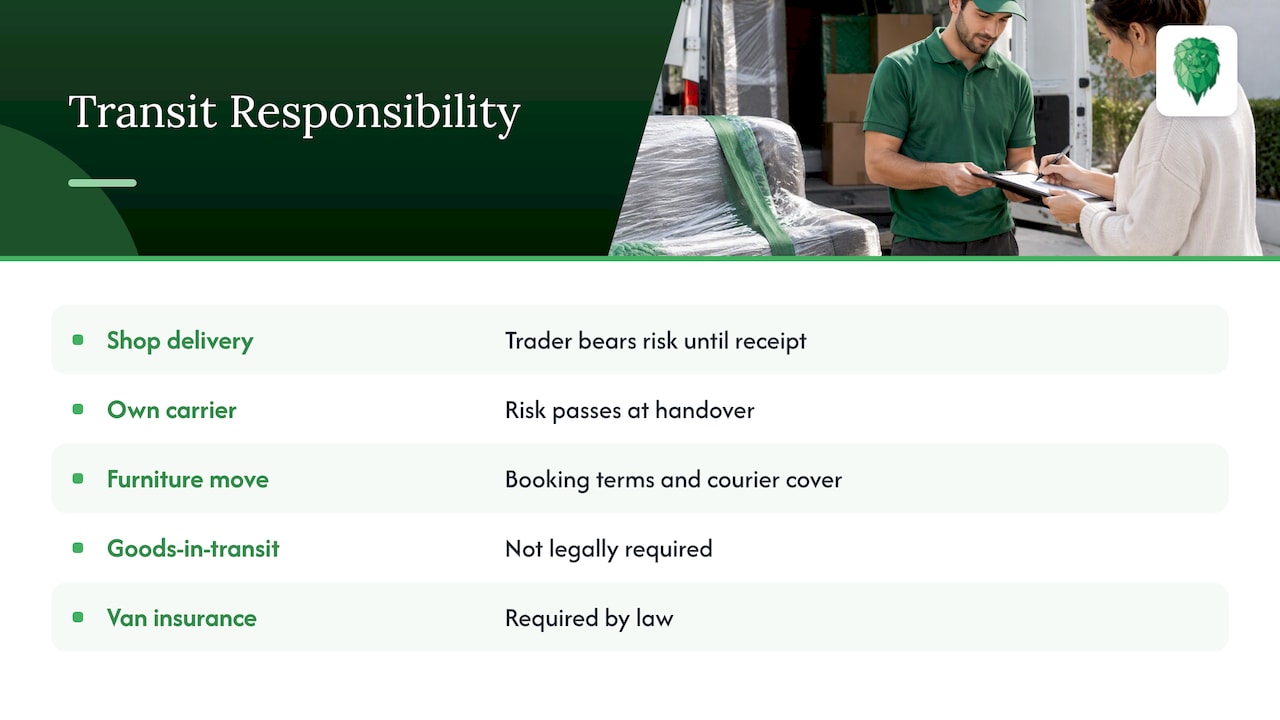
You bought the furniture from a shop and it is being delivered. Under section 29 of the Consumer Rights Act 2015, goods stay at the trader’s risk until they physically reach you or a person you name. The exception is when you arrange your own carrier, one the trader did not offer as an option. In that case, risk passes to you once the goods are handed to that carrier. So if you hire your own courier to collect a sofa from a shop, the insurance question becomes very much yours.
You hire a courier or removals company to move your own furniture. The Consumer Rights Act rule is about sales, so it does not settle this one. Here, what protects you is the courier’s insurance and the terms of your booking. Which is why it pays to ask the right questions first.
One more point worth knowing: goods-in-transit insurance is not a legal requirement, although customers may insist on it, whereas van insurance is required by law. A courier can be fully legal on the road and still have nothing protecting your wardrobe. Never assume the two come together.
The three covers people mix up, part of furniture courier insurance
When you search for furniture courier insurance, you will see three terms again and again. They sound similar. They are not.
| Cover | What it protects | Example |
|---|---|---|
| Goods in transit | The items being carried | A table top is cracked when the van brakes hard |
| Courier or van insurance | The vehicle, the driver, and third parties on the road | A collision damages another car |
| Public liability | Third-party injury or property damage caused by the business’s activities | A carried wardrobe scrapes a customer’s door frame |
This split follows the explanation from Compare the Market: goods-in-transit covers the items, courier insurance typically covers vehicle damage, courier injury and third-party damage, and public liability can cover third-party injury or property damage during loading and unloading.
The law treats them as separate classes too. The Regulated Activities Order lists insurance for loss of or damage to land vehicles, goods in transit, motor vehicle liability and general liability as distinct categories.
Why does this matter to you as a customer? Because a reassuring “yes, we are insured” can mean any one of them. Public liability would not pay for your scratched dining table. Goods-in-transit would not pay for a gouge in your landlord’s hallway. A good courier has the right mix, and a good customer asks which ones.
A useful rule of thumb from one insurance knowledge hub: delivery businesses usually face both goods-in-transit and public-liability risks, and the policies cover different things. If you want a deeper look at how these two compare, our own piece on goods in transit versus liability goes through it.
What goods-in-transit cover usually includes, part of furniture courier insurance
Policies are not identical, so read the wording. But looking at real policy documents gives you a good sense of what to expect.
Loading, unloading and short stops
Furniture often gets damaged at the doorstep rather than on the road: a tight stairwell, a turn in the hallway, a lift that is smaller than expected. It is reassuring that some wordings count this as part of the journey. AXA’s goods-in-transit wording defines transit as movement while the goods are in the insured’s custody or control, including loading, unloading and temporary storage during the movement, on or off the vehicle. A removers’ wording from Novas describes transit in a similar way.
Storage is a different matter
The same AXA wording excludes goods held at a rental location or under a storage contract. In plain English: a quick overnight stop mid-journey may be treated as part of transit, while furniture sitting in a storage unit for weeks is a separate question. If your move includes storage, ask what protects the furniture while it is there, and do not assume transit cover stretches that far.
Subcontractors
Many courier jobs are passed between drivers or partner firms. Cover for this is not automatic. The AXA wording lists several possible bases of cover, including all-risks physical loss or damage, liability under carriage conditions and liability for goods in the custody of subcontractors, and the policy schedule must show which ones are actually operative. AXA’s own advice is to check that subcontractors accept responsibility and carry adequate insurance.
The Novas removers wording also provides contingent liability cover for goods in a subcontractor’s custody or control. So the cover exists in the market. What you want to know is whether your courier has it.
A simple question to put to any provider: “If another driver or partner firm carries my furniture for part of the journey, who is responsible and how is it insured?”
Limits, excesses and exclusions to check, part of furniture courier insurance
This is the part most people skip, and it is where most disappointment comes from. Before you book, ask about five things.
- The limit. What is the most the policy pays for a single item, a single vehicle or a single job? Large contracts can ask for a lot: one public sector tender set GIT cover of £850,000 per vehicle for crane lorry and low-loader transport, for example. Your sofa move is far smaller, but the principle is the same: the limit should fit the value of what is on board.
- The basis of the limit. Some cover is calculated by weight rather than by value. That can leave light but valuable items, such as a glass-topped table or an antique cabinet, underinsured. Compare the Market advises checking any cost-by-weight limit and whether cover meets the full responsibility of the carrier.
- The excess. How much of any claim do you or the carrier absorb? Our article on transit insurance excess explains why this matters.
- The exclusions. Common exclusions across many transit policies include delay, insufficient packing, radioactive contamination and cyber risks. The two that matter for furniture are delay and insufficient packing. If a piece is poorly wrapped and gets scuffed, a claim can be refused.
- Special items. Pianos, mirrors, marble tops, antiques and anything unusually valuable may need to be declared in advance. Do it in writing.
A quick tip on packing: since inadequate packing is a common exclusion, it is worth having furniture wrapped properly, either by you or by the courier. Padding, corner protectors and blankets are not an extra for the sake of it. They can be the difference between a covered claim and a declined one.
The same logic applies to pallets. If you are sending boxed or palletised goods, our guide to pallet insurance in the UK looks at why standard limits may fall short.
Before collection: set yourself up for a smooth claim, part of furniture courier insurance
The best claim is the one you never need. The second best is the one that is easy to prove. A little preparation helps with both.
- Photograph everything. Take clear photos of each item before it leaves, from several angles, in good light. Capture existing marks too, so there is no debate later.
- Make a simple list. Note what is being moved, roughly what it is worth and any pieces that are fragile or high value.
- Disassemble sensibly. Large wardrobes and beds often travel better in pieces. Keep screws and fittings in labelled bags taped to the item.
- Get the cover in writing. Ask for the insurance details in your booking confirmation: what is covered, up to what amount and with what excess.
- Tell the courier about access. Narrow stairs, no lift, parking restrictions and long carries are the cause of many dents. Telling the crew in advance lets them plan.
If you collect an item yourself from a retailer, check it there and then. IKEA UK, for example, advises customers collecting goods to check that everything has been received, inspect packaging for damage and report anything missing or damaged as soon as possible.
On delivery: inspect before the crew leaves, part of furniture courier insurance
It is tempting to sign and get on with your day. Try to resist. A few minutes at the door can save weeks of back and forth.
- Check each item against your list while the delivery team is still there.
- Look at the furniture in normal light, not in a dim hallway.
- Point out any damage and ask the team to record it on the delivery paperwork.
- If you notice a problem later, take photographs and contact the courier straight away with the order number and details.
This mirrors what retailers advise. DFS asks customers to inspect all furniture before the delivery team leaves and report missing or damaged items immediately, and, if the problem is noticed later, to provide the order number, details and clear photographs. An insurance broker’s knowledge base suggests reporting visible delivery concerns within 48 hours to help protect the transit insurance position.
If you are moving boxes as well as furniture, it is fine to say “unchecked” for sealed boxes and open them within a day or two. Just do not leave it for weeks.
How claims work and why deadlines matter, part of furniture courier insurance
Every insurer has its own process, but most follow the same pattern: tell the courier or insurer, supply evidence, let them assess the damage and receive either a repair or a payment.
The detail that trips people up is timing. In a 2022 decision, the Financial Ombudsman Service stressed that time limits for notifying claims, in that case within 7 days of delivery, are critical policy terms and that failing to meet them can lead to a claim being declined. The same decision shows that the policy’s terms, including the basis of settlement (repair or replacement), are the main basis for resolving disputes.
So here is a sensible routine:
- Report the damage on the day you find it, in writing.
- Send photos of the damage and of the packaging.
- Give the order or booking number, the date and a short description.
- Keep all the paperwork and any repair quotes.
- Ask what the settlement basis is: repair, replacement or a cash sum.
If you are unhappy with how a claim is handled, you can take it further, and the Financial Ombudsman Service is the route for eligible complaints about insurers.
Our perspective
We have been moving homes, offices, pianos and pallets across the UK for over 15 years, and one thing stays true: customers rarely ask about insurance until something goes wrong. We would much rather you ask first.
Our view is simple. A courier job is only as good as the cover behind it. That is why insured transport sits at the heart of what we offer, and why we encourage you to ask for the details of any cover in writing, from us or from anyone else.
We also believe in the small things that stop claims from happening: proper packing, careful disassembly and reassembly of larger furniture, a crew that plans the route through your property and the habit of walking through the delivery with you before we leave. Insurance is the safety net. Good handling is the reason you should rarely need it.
If you have a big or delicate item, a piano or a full house of furniture, tell us at the start. It helps us plan the right crew, the right wrapping and the right approach.
Claudiu
If you run a courier or removals business, part of furniture courier insurance
You are reading this from the other side of the counter? Good. The same questions apply, just in reverse.
Compare the Market suggests businesses assess what they carry, their contractual liabilities and their routes. Then they should check any cost-by-weight limit, whether the cover meets their full responsibility, and whether they need public liability, storage or overseas transport cover on top.
A practical checklist:
- Match the limit to the biggest load you carry, not the average one.
- Read the schedule, not just the headline. The AXA wording makes clear that the schedule has to show which bases of cover are operative.
- Cover your subcontractors or make sure they have their own adequate insurance, and keep proof.
- Separate transit from storage. If you hold customers’ furniture, check that storage is covered, because transit wording may exclude it.
- Keep a record. Photos at collection and delivery, signed notes and timestamps make claims faster and disputes rarer.
Our article on courier van deliveries gives a feel for how a day on the road looks, and our guide to furniture delivery services covers the customer side in more detail.
Moving furniture with us
If you need a sofa, wardrobe, table or a whole houseful moved, we can help. Our furniture and large items service covers collection and delivery of bulky pieces, and we can add packing, furniture assembly and disassembly when you need it. Moving a whole home? See our house removals service, which can include unpacking and storage. We offer insured transport and you can get an instant online quote.

Tell us what you are moving, any access challenges and anything particularly valuable or fragile. If you are unsure what to ask about insurance, ask us and we will explain. If a job runs over because of delays on site, waiting time is charged at 24 GBP per hour per man, and we will always tell you how that works up front.
Ready to go? Get your quote and book on our site.
FAQ
Is furniture courier insurance a legal requirement?
No. Goods-in-transit insurance is not legally required, although customers may insist on it, whereas van insurance is required by law. That is why you should ask any courier directly whether your furniture is covered while it travels.
Does public liability insurance cover my furniture?
Not usually. Public liability covers a business’s legal liability for injury or damage to third parties, such as damaging a customer’s door during delivery. Damage to the goods being carried is the job of goods-in-transit cover.
Am I covered while the furniture is being loaded and unloaded?
Often yes, but check the wording. Some goods-in-transit policies define transit to include loading, unloading and temporary storage during the journey. Storage under a storage contract may be excluded, so ask about it separately if your move includes it.
How quickly should I report damaged furniture?
As soon as you see it, ideally before the delivery crew leaves. Policies can set strict windows: one Financial Ombudsman decision involved a 7-day notification limit. Send photos and your booking number in writing, and check your own policy or booking terms for the exact deadline.
What can cause an insurance claim to be declined?
Common reasons include missed notification deadlines and policy exclusions such as delay or insufficient packing. Preparing the furniture properly, photographing it and reporting problems promptly all help protect your claim.
Sources
- Consumer Rights Act 2015, section 29
- Goods In Transit Insurance, Compare the Market
- Financial Services and Markets Act 2000 (Regulated Activities) Order 2001, Schedule 1
- Goods in Transit vs Public Liability Insurance, Cover Buddies
- AXA goods in transit policy wording
- Novas removers goods in transit booklet
- Torpoint Town Council insurance document
- Contracts Finder notice attachment
- IKEA UK, How does Click & Collect work?
- DFS Help Centre, Checking your order upon delivery
- Fleming Howland, Checking goods on delivery
- Financial Ombudsman Service, decision DRN-3670344