Glass table transport: the safest way to transport a glass table is to separate the glass top from the base, wrap the glass in padding with protected edges and corners, and carry and load it on its edge, never flat. Then you secure it so nothing can slide or press against it. Done in that order, a glass table travels well. Done in a rush with a blanket and a roll of tape, it often doesn’t.
Moving a glass table is stressful, because one wrong step can end in a very expensive crunch. This guide takes you through it calmly, one step at a time, so you can decide what you can do yourself and what is better left to people who do it every day.
TL;DR
- Take the glass top off the base if you can, and move the two parts separately.
- Carry and transport large glass on its edge, not flat: museum handling guidance warns that big sheets may snap under their own weight when laid horizontally.
- Pad the whole top, protect the edges and corners, and never put tape directly on the glass.
- Clear the route first, use both hands, and take a second person for anything bigger than a small coffee table.
- If the top is fixed to the base, very large or tempered and heavy, book a removals team rather than risk it.
Table of Contents
- Why glass tables break in transit
- What you need before you start
- Step 1: Clear the route and the destination
- Step 2: Separate the glass from the base
- Step 3: Wrap the glass top
- Step 4: Wrap the base and chairs
- Step 5: Lift and carry it the right way
- Flat or on its edge: which is safer?
- Step 6: Load and secure it in the van
- Special cases
- How to reduce the risk even further
- Our perspective: what we see on the job
- When to let professionals handle it
- Quick checklist for moving day
- FAQ
- Sources
Why glass tables break in transit, part of glass table transport
Glass rarely breaks because of one dramatic event. It breaks because of small stresses that add up: a corner that knocks a door frame, a top that flexes while being carried flat, a hard object pressing on it in the van, or vibration that rubs a surface against something rough.
National Museums Scotland, which looks after fragile objects for a living, says good packing should protect against vibration and surface abrasion while giving support and stability. It also says the materials should be chosen after you assess the object’s material, condition, size, shape and weight. That is a good checklist for a dining table: how thick is the glass, are the edges chipped already, how heavy is it, and what shape is it?
Three things cause most of the damage in home moves:
- Carrying it flat. The glass bends slightly under its own weight and any twist can finish it.
- Exposed edges and corners. These are the weakest points and the first thing to hit a wall or doorframe.
- Loose loading. A top that can shift in the van will eventually meet something hard.
The good news: all three are easy to prevent.
What you need before you start, part of glass table transport
Gather everything first. Stopping halfway to hunt for tape is how accidents happen.
- Moving blankets or thick furniture pads
- Bubble wrap
- Flat cardboard sheets or corrugated board, cut slightly larger than the glass
- Corner and edge protectors (a U-shaped profile is designed for exactly this: a three-sided protector for exposed edges and corners, including glass panels)
- Packing tape or stretch wrap, for use on the padding only
- Soft cloth gloves for a better grip
- Moving straps or ratchet straps for the van
- Screwdriver or Allen keys for the base
- Small bags and a marker for screws and fittings
If the table is a big one, you will also want a trolley or dolly with a soft surface and a second pair of hands.
Step 1: Clear the route and the destination, part of glass table transport
Before you touch the glass, walk the whole route from the table to the van. National Museums Scotland’s guidance says the route should be clear and the destination uncluttered before you move glass, because breakage is the main risk.
In a normal home that means:
- Moving shoes, boxes and toys out of the hallway
- Propping doors open so nobody has to juggle a handle
- Checking the turn on the stairs or the tight corner by the front door
- Making sure the van parking is as close as possible
- Measuring the glass against the narrowest doorway so you know it will fit on its edge
Do the same at the other end. Pick the room and the wall where the glass will rest on arrival, and clear that space too.
Step 2: Separate the glass from the base, part of glass table transport
Taking things apart makes everything easier. Europcar’s van-loading guide says items that can be disassembled should generally be taken apart before loading, as it saves space and helps prevent damage in transit.
For most glass-top tables:
- Clear the table and wipe the glass so no grit is trapped under your padding.
- Have someone hold the top steady while you work. Never leave it unsupported.
- Look underneath. Tops are held by rubber or plastic pads, brackets, clips, or screws through fittings.
- Release the fixings, then lift the top off with two people, one on each side, using both hands.
- Put the top somewhere safe, standing on its edge against a wall on a folded blanket, not leaning on a hard floor edge.
- Unscrew the legs from the frame if they come off, and bag the screws. Tape the bag to the underside of the frame, not to the glass.
Take a quick photo before you start. It makes reassembly far less of a puzzle.
If the glass can’t be removed
Some tables have a top that is bonded or glued, or set into a frame, or that simply won’t release without tools you don’t have. Don’t force it. Levering can chip the edge, and a chipped edge is a weak edge.
In that case, treat the whole table as one fragile piece:
- Turn nothing upside down unless the maker says so.
- Cover the top completely with padding and cardboard, then wrap the frame separately.
- Carry it with two people and keep the glass vertical or close to it if the design allows.
- Think seriously about professional help. Our team deals with fixed-top tables regularly, and we can take them apart on site if it is safe to do so.
Step 3: Wrap the glass top, part of glass table transport
This is the step that matters most, so take your time.
- Start with a clean layer. If the glass has a hard surface that might scratch, a sheet of soft paper or a clean cloth against the glass helps.
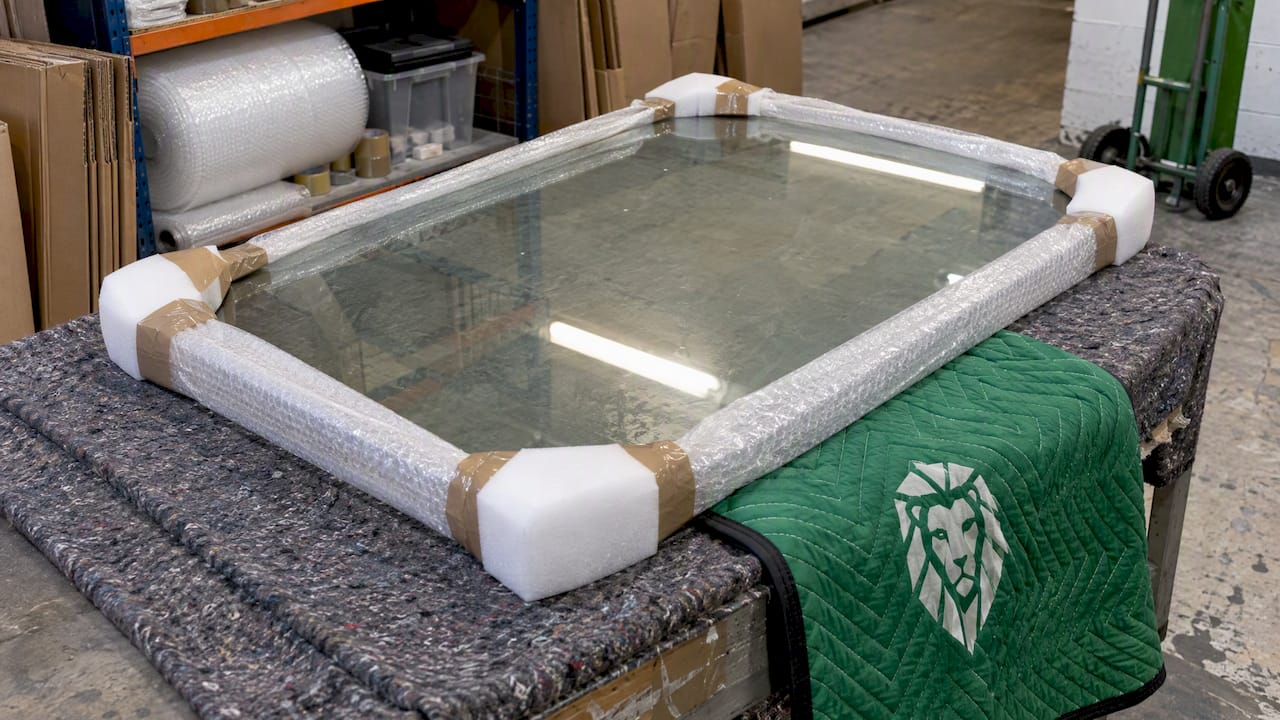
- Add bubble wrap. Cover both faces, and wrap right around the edges.
- Protect the edges and corners. Fit U-shaped edge protectors or folded cardboard along every edge, and double up on corners.
- Add rigid sheets. Place a cardboard sheet over each face so the glass is sandwiched between boards.
- Finish with a blanket. Wrap the whole thing in a moving blanket for cushioning.
- Secure the outer layers only. Use tape or stretch wrap over the blanket and board, not on the glass.
That last point is important. National Museums Scotland says never to put tape or sticky labels directly on glass objects. Adhesive can leave residue and, when you peel it, it can pull at the surface. A common mistake is taping a big “X” straight across the glass. It does not make it stronger, and the tape leaves a mess.
Label the outside clearly: “Glass, this way up, carry on edge”. Anyone helping on the day will thank you.
If you would like to see how professionals approach padding across a whole house, our guide to how movers wrap furniture walks through the method step by step.
Step 4: Wrap the base and chairs, part of glass table transport
The base is easier but still needs care, particularly if it is metal, polished wood or chrome. Wrap legs separately, pad the corners of the frame, and keep any fixings with it. If the chairs come with the table, stack them securely and pad the legs so they can’t scratch each other or poke at the wrapped glass.
Step 5: Lift and carry it the right way, part of glass table transport
Carrying is where most breakages happen, so slow down.
- Wear gloves and take off watches or rings that might catch.
- Use both hands, always. National Museums Scotland recommends using both hands and cradling glassware carefully.
- Carry the top on its edge, with the longer side down. The Metropolitan Museum of Art’s handling guidance says larger glass panels should be stored vertically, preferably on the longer side, with support to reduce the risk of buckling.
- Agree your signals in advance: who walks backwards, who calls “stop”, who opens doors.
- Don’t carry it while holding a phone, a coffee or a box.
The same Met guidance notes that transport equipment such as rubber-wheeled carts, padded baskets and dollies can be appropriate depending on the object’s size, weight and shape. At home, a padded sack truck for a large top can save your back and the glass.
Flat or on its edge: which is safer? Part of glass table transport
This is the question most people search for, and the answer is clear: on its edge.
National Museums Scotland advises carrying large sheets of glass vertically because they may snap under their own weight when laid horizontally. Europcar’s guide gives the practical version for a van: place a disassembled large tabletop on its side, flat against the side of the truck, with nearby chairs stacked securely.
A quick comparison:
| Position | Risk | When it makes sense |
|---|---|---|
| On its long edge, against the van wall | Lowest risk when padded and strapped | Almost every glass top |
| Flat on the van floor | Bends under its own weight, easily crushed by other items | Only for small, thick pieces with nothing on top, and with extra care |
| Leaning loose at an angle | Slides, tips and can slip at the bottom edge | Never |
One more point: even when vertical, the glass needs support. The Met guidance stresses that vertical support matters for larger panels, and that the support system must prevent movement without damaging surfaces. In a van, that means soft padding at the bottom edge, a firm wall of the van or boxes on one side, and a strap holding it all in place.
Step 6: Load and secure it in the van, part of glass table transport
The glass should be among the last things in, and the last things out at the other end if you are moving a full house. Think of loading as building a safe corner.
- Lay a folded blanket on the floor against the van’s side wall.
- Stand the wrapped glass on its long edge on that blanket, with the side wall behind it.
- Place soft items such as duvets or cushions on the open side, so nothing hard touches it.
- Use straps to hold the glass snugly to the wall. Europcar recommends moving pads and packing straps for heavy furniture and suggests checking the finished load so items are secured and delicate things covered.
- Put the base and chairs in separate spots. Heavy items go on the floor, never leaning on the glass.
- Give the load a gentle shove. If anything moves, add padding or tighten the straps.
Drive smoothly. Take roundabouts and speed bumps slowly, and brake early. A wrapped top that has been strapped well can handle a long trip. One that has been squeezed in at the last minute usually can’t.
What about pickup trucks and open loads?
If you’re thinking of using a pickup or open trailer, be honest about the weather and the vibration. Rain, wind and bouncing are hard on glass. A closed van with a wall to lean against is a much safer choice.
Special cases
Very large or heavy tops. Thick glass on a six-seater or eight-seater table can weigh a lot. If two people can’t lift it comfortably, don’t lift it. A third pair of hands, or a professional team, is a better answer than a heroic attempt.
Round tables. Round glass has no flat edge to rest on, so the carrying position needs more padding and support. Pack it in a rigid sandwich of boards and keep it upright with firm support at two points.
Shipping abroad or in a container. Container shipping adds weeks of vibration, stacking and humidity. For overseas moves, glass needs rigid crating or a custom case rather than a blanket. Ask a specialist to pack it.
Already chipped or cracked. Don’t move it. A weakened edge or crack can spread without warning. Consider replacing the top at the other end.
Side tables and coffee tables. Smaller tops follow the same rules. The only difference is that one person can often manage them, though a second pair of hands is still smart.
How to reduce the risk even further, part of glass table transport
A few small habits make the difference between a stressful day and a calm one:
- Plan the order. Tackle the glass early on a quiet morning, not at the end of an exhausting day.
- Measure first. Know the glass size and the narrowest doorway before the van arrives.
- Keep the area clear. Children and pets should be elsewhere while the glass is on the move.
- Check your insurance. Ask what your own policy covers, and what any removals company’s insured transport covers, before moving day.
- Take photos. Pictures of the table before wrapping help if you ever need to show its condition.
- Stay patient. Moving day is a marathon, not a sprint. Rushing is the real enemy of glass.
Our perspective: what we see on the job
We have been moving homes and offices across the UK for over 15 years, and glass tables come up all the time. Our advice is simple: if the top comes off, take it off, and keep it on its edge from the first lift to the last. Most of the problems we are called in to prevent come from people trying to save ten minutes.
We also think it is fine to ask for help. A glass top is often one of the most valuable things in a room, and a good team brings the padding, the straps and the practice. Because we also offer packing, furniture disassembly and assembly, we can take the table apart, wrap it, load it, and put it back together at the other end, so you don’t have to worry about missing screws.
If you’re not sure whether your table is a DIY job, describe it to us: the size, the type of fixing, and the stairs. We would rather talk it through honestly than watch you take a risk.
— Claudiu
When to let professionals handle it, part of glass table transport
DIY works well for a small coffee table and a calm afternoon. Think about booking help when:
- The top is large, thick or heavy
- It can’t be taken off the base
- You have stairs, narrow turns or a long carry
- You have no second person, or no suitable vehicle
- The table is valuable or sentimental
- You’re moving the whole house on the same day and glass is just one of many worries
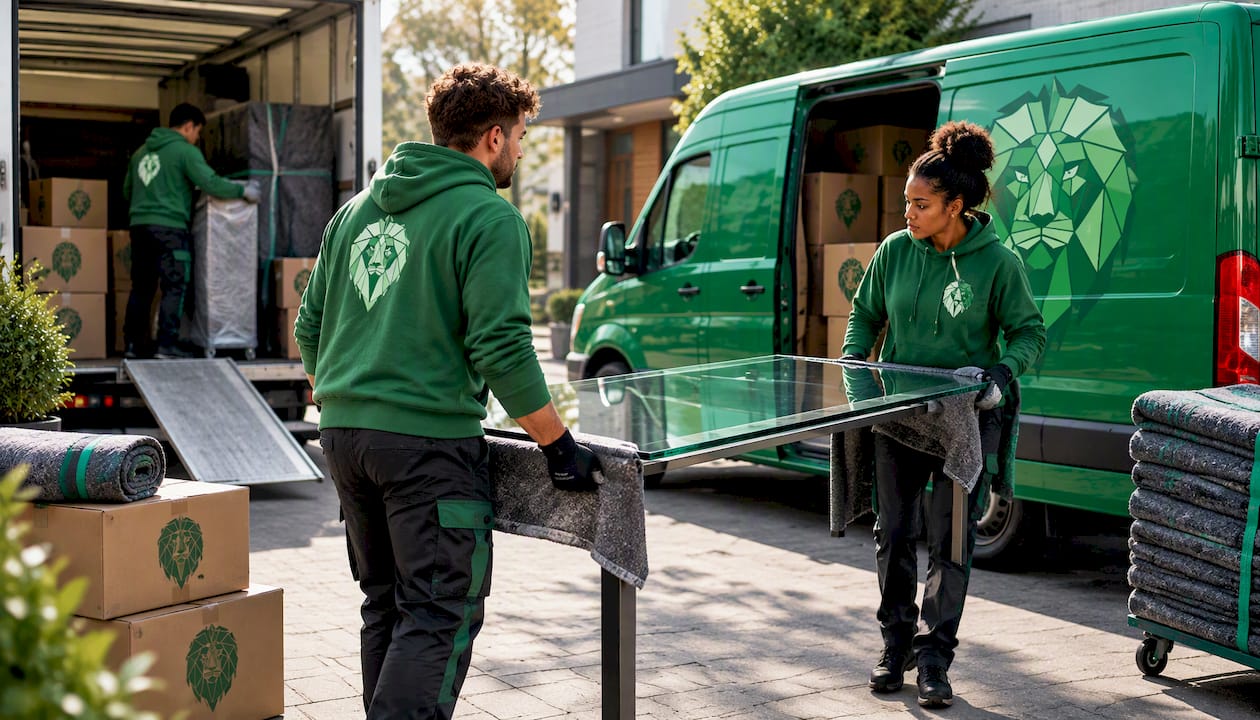
Our furniture and large items service covers exactly this kind of job, from a single glass table to a full dining set, and our man and van service suits one-off deliveries when you only have a few items to move. If the table is part of a bigger move, our house removals team can handle the whole thing, including packing and disassembly. You can get an instant quote online on our website, and your items travel with insured transport.
If you want to compare options for a single piece, our guide to furniture delivery services explains what to look for. And if a job runs longer than planned, waiting time is charged at £24 per hour per man, so having the route clear and the table ready for loading helps keep things smooth.
Quick checklist for moving day
- [ ] Route and destination cleared
- [ ] Table photographed and measured
- [ ] Glass removed and standing on its edge on a blanket
- [ ] Screws bagged and labelled
- [ ] Glass padded on both faces, with edges and corners protected
- [ ] Tape only on outer layers, never on glass
- [ ] Two people for the carry
- [ ] Glass loaded on its long edge against the van wall
- [ ] Straps tight, soft padding on the open side
- [ ] Base and chairs loaded separately
FAQ
How do you transport a glass tabletop?
Remove it from the base, wrap both faces in padding with cardboard boards, protect the edges and corners, and carry it on its edge with two people. In the vehicle, stand it on its long edge against the side wall and strap it so it cannot move.
Can you transport glass lying down?
It is best avoided for large pieces. Museum guidance says large sheets of glass may snap under their own weight if laid horizontally. If you have no choice with a small, thick piece, support it fully across its whole surface and put nothing on top.
What is the best way to transport a heavy glass table?
Split it into parts, use at least two people, and use a padded trolley for the top. Keep it vertical and strapped in a closed van. For very heavy tops, a professional team with the right equipment is the safest choice.
Can I use bubble wrap and tape alone?
Bubble wrap helps, but it is not enough on its own. Add rigid boards on both faces, protect the edges and corners, and add a blanket on the outside. Keep tape off the glass itself and use it only on the outer layers.
Sources
- National Museums Scotland: Advice for Museums, handling guidelines
- The Metropolitan Museum of Art: The Care and Handling of Art Objects, 2019
- Europcar: How to pack and load a van or truck
- Impakt Packaging: U-Profile Edge Protector