Goods in transit insurance protects your stock, tools, or a client’s belongings against theft, loss, or damage while they’re being moved by road in the UK. If you’re a courier, remover, pallet operator, or tradesperson carrying anyone else’s property in your van, you almost certainly need it, whether or not the law technically demands it.
Before you request a quote, here’s your immediate checklist:
- Check whether your client contracts or courier network already specify a minimum cover level
- Note your typical load value per job, not just your annual turnover
- Have your vehicle and driver details ready, insurers ask for these upfront
Get that sorted first, and the rest of this guide will make a lot more sense.
Key Takeaways
Goods in transit insurance protects UK operators against theft, loss, and damage in transit, but the basis of cover, not the price, determines whether a claim actually pays what you need.
| Point | Details |
|---|---|
| Check the basis of cover | Confirm whether your policy pays declared value (All Risks) or a weight-based limit (RHA/CMR) before you buy. |
| Meet overnight security conditions | Keep vehicles garaged, locked, and goods out of sight, or overnight theft claims are commonly excluded. |
| Prepare quote details in advance | Have vehicle, driver, route, and typical load value information ready to get an accurate quote. |
| Document every job | Photographed driver condition reports at load and delivery are decisive evidence in disputed claims. |
| Confirm contract requirements | Check whether client contracts or courier networks specify a minimum cover level before you commit. |
Table of Contents
- What does goods in transit cover in the UK?
- What exclusions catch out UK transport operators?
- All Risks vs RHA and CMR: which basis of cover suits you?
- How much does goods in transit insurance cost for UK businesses?
- Is goods in transit insurance a legal requirement in the UK?
- How do you buy goods in transit insurance and get accurate quotes?
- How do you make a claim and avoid common rejections?
- What operational habits actually reduce claims?
- Why the basis of cover matters more than the price tag
- Sources
- FAQ
What does goods in transit cover in the UK?
Goods in transit insurance pays out when items are stolen, lost, or accidentally damaged while they’re moving between two points, and pricing varies significantly between providers depending on what you carry and how you carry it. Most policies extend beyond the moment wheels are turning.
Cover typically applies to:
- In-transit theft or damage to items on your vehicle, whether that’s a sofa, a pallet of stock, or a customer’s parcel
- Loading and unloading incidents, when goods are most often dropped, scraped, or knocked
- Temporary storage, if your policy includes it, covering overnight stops between collection and delivery
- Goods carried for reward, meaning customer property you’re paid to transport, as distinct from your own business equipment
That last distinction matters more than most operators realise. A tool bag full of your own kit sits under different cover to a client’s three-piece suite on the back of your van. House removals, pallet deliveries, courier parcels, and tradespeople hauling parts between sites all fall into that “goods carried for reward” category, and it’s the one insurers scrutinise most closely when a claim lands on their desk.
What exclusions catch out UK transport operators?
Every policy has limits, and the ones that catch people out are rarely hidden in small print. They’re usually just unread.
Common exclusions include:
- Wear and tear, or gradual deterioration rather than a single incident
- Damage from insects, mould, or condensation, particularly on longer routes or delayed deliveries
- Losses caused by defective or inadequate packing, this one alone accounts for a huge share of rejected claims
- Cash, money, and certain named valuables, which usually need separate cover
Theft from an unattended vehicle is where most disputes start. Standard insurer guidance commonly excludes overnight theft from an unattended vehicle unless you meet strict security conditions: the vehicle garaged, doors locked, and goods kept out of sight. Leave a load visible on a driveway overnight and you may find your claim goes nowhere.
Pro Tip: Photograph your vehicle parked up each night for a week and check it genuinely meets your policy’s security wording. Insurers will ask for proof, not promises, if theft ever happens.
All Risks vs RHA and CMR: which basis of cover suits you?
The basis of cover you choose decides how much you actually get paid, and this is the single biggest factor separating a policy that protects you from one that leaves you exposed.
All Risks cover pays out against the declared value of the goods themselves. If you’re carrying a client’s antique dining table worth £3,000, a genuine All Risks policy aims to compensate close to that figure, subject to policy terms.
RHA and CMR bases work differently. These liability limits are typically expressed per kilo or per tonne rather than against declared value, which is standard practice for haulage contracts but can significantly under-compensate for dense, high-value loads.
Here’s where it bites: a pallet of electronics weighing 200kg might have a genuine value of £15,000, but a weight-based CMR limit could cap your payout at a fraction of that. Before accepting any liability-based policy, work out what a typical load would actually pay out and compare it against what you’re really carrying.
- All Risks suits removals, high-value furniture, and antiques work
- RHA/CMR bases suit standard haulage and freight contracts where clients expect the industry-standard limit
- Commercial clients and courier networks often specify which basis they require, so check contracts before you buy
How much does goods in transit insurance cost for UK businesses?
Premiums move on a handful of factors, and the declared limit you need is usually the biggest lever.
What drives your price:
- Declared cover limit, the maximum value you want protected per load or per year
- Fleet size and driver numbers, more vehicles and drivers generally means higher premiums
- Routes, UK-only cover costs less than policies extending into Europe
- Claims history, a clean record earns better rates over time
- Goods type, electronics and antiques cost more to insure than general household items
- Security measures, tracking, tamper-evident seals, and secure parking can all reduce premiums
At the entry level, specialist removal contractor policies have published starting points from an entry-level annual premium for basic limits, scaling up considerably for larger fleets or higher declared values. Some direct packaged policies advertise attractively low monthly rates, but always check the territorial scope and declared value limits before assuming they match your actual exposure. Insurers structure limits per vehicle, per job, or as an annual aggregate, and a higher excess will usually bring your premium down.
Is goods in transit insurance a legal requirement in the UK?
No, not universally. GIT insurance isn’t a legal requirement for every transporter in the UK, unlike vehicle insurance or employers’ liability, which are compulsory by law for most businesses.
That said, “not legally required” and “optional in practice” are two very different things.
- Major courier networks routinely make GIT cover a condition of joining, often with a stated minimum limit
- Commercial clients, especially those shipping high-value stock, will ask for proof before they hand you a contract
- Public liability and employers’ liability are separate policies entirely, and confusing the three is a common and costly mistake
If a client asks for evidence quickly, have your cover note, certificate of insurance, and policy wording showing territorial scope ready to send. Being able to produce this within minutes, not days, has closed deals for operators who’d otherwise lost out to slower competitors. For a fuller breakdown of how GIT differs from public liability cover, it’s worth reading the distinction properly before your next contract negotiation.
How do you buy goods in transit insurance and get accurate quotes?
Getting a quote that actually reflects your risk means arriving prepared, not guessing figures on the phone.
- Gather your vehicle and driver details, including fleet size and any named drivers
- Calculate your typical and maximum per-job value, not just your annual turnover
- List your usual routes, UK-only or extending into Europe
- Note your goods types, general household, electronics, antiques, or perishables all price differently
- Document your security measures, tracking, locks, tamper-evident seals
When you speak to an insurer or broker, ask directly: what basis of cover applies, what’s the territorial limit, are overnight storage and subcontractors covered, and what excess applies. Vague answers to any of these are a red flag.
Pro Tip: If you regularly carry goods worth more than a few thousand pounds per job, use a specialist broker rather than a packaged direct policy. Brokers can tailor the basis of cover to your actual risk instead of forcing you into a generic weight-based limit. Our guide to insuring transported items walks through the paperwork insurers expect before you even request a quote.
How do you make a claim and avoid common rejections?
Speed and documentation decide most outcomes. Insurers don’t reward good intentions, they reward paper trails.
- Secure the scene immediately, and call the police for any theft, you’ll need a crime reference number
- Photograph all damage before moving or repacking anything
- Separate damaged goods from undamaged ones and preserve the original packaging
- Gather documentation: delivery notes, invoices, and proof of value are what insurers expect to see first
- Get a written driver statement while details are fresh, ideally with timestamps
The most frequent reasons claims fail: notifying the insurer too late, packing that doesn’t meet the standard the policy assumes, or parking somewhere that breaches the security conditions in the small print. Poor record keeping sinks more claims than genuine disputes over value.
What operational habits actually reduce claims?
Insurance is only half the picture. What you do on the job matters just as much as what’s written in the policy.
- Use standardised driver condition reports at collection and delivery, photographed, timestamped, and filed
- Palletise and strap loose items properly, loose cargo shifts and that’s when damage happens
- Fit GPS tracking and tamper-evident seals on high-value runs
- Never leave a loaded vehicle unattended overnight outside a secured location
A standardised driver condition report with photographs at load and delivery is consistently cited by insurers as decisive evidence when a claim is disputed. At Van-247delivery, insured jobs get exactly this kind of documentation as standard, alongside secure overnighting arrangements and optional add-ons for higher-value loads.
Good insurance pays for what goes wrong. Good operational habits mean fewer things go wrong in the first place, and that’s the difference that actually shows up on your premium.
For readers assembling their own implementation checklist, our guide on why booking a professional courier covers the operational side in more depth.
Ready to book insured transport rather than manage the risk yourself? Van-247delivery arranges insured house removals across the UK, with flexible man with a van bookings for smaller jobs and dedicated pallet delivery for palletised freight. If you’re running high volumes of packaged stock, it’s also worth understanding how bulk order fulfilment workflows affect your in-transit risk before you scale up. Get an instant quote and let us handle the logistics, and the insurance conversation, for you.
Why the basis of cover matters more than the price tag
Most operators shop for goods in transit insurance the way they’d shop for car insurance: cheapest quote wins. That’s the wrong instinct here.
The real decision isn’t price, it’s basis of cover. An All Risks policy and a CMR weight-based policy can carry near-identical premiums while paying out wildly different amounts for the exact same loss. I’d argue the industry doesn’t explain this well enough, brokers quote a number, and operators assume more expensive automatically means better protected. It doesn’t.
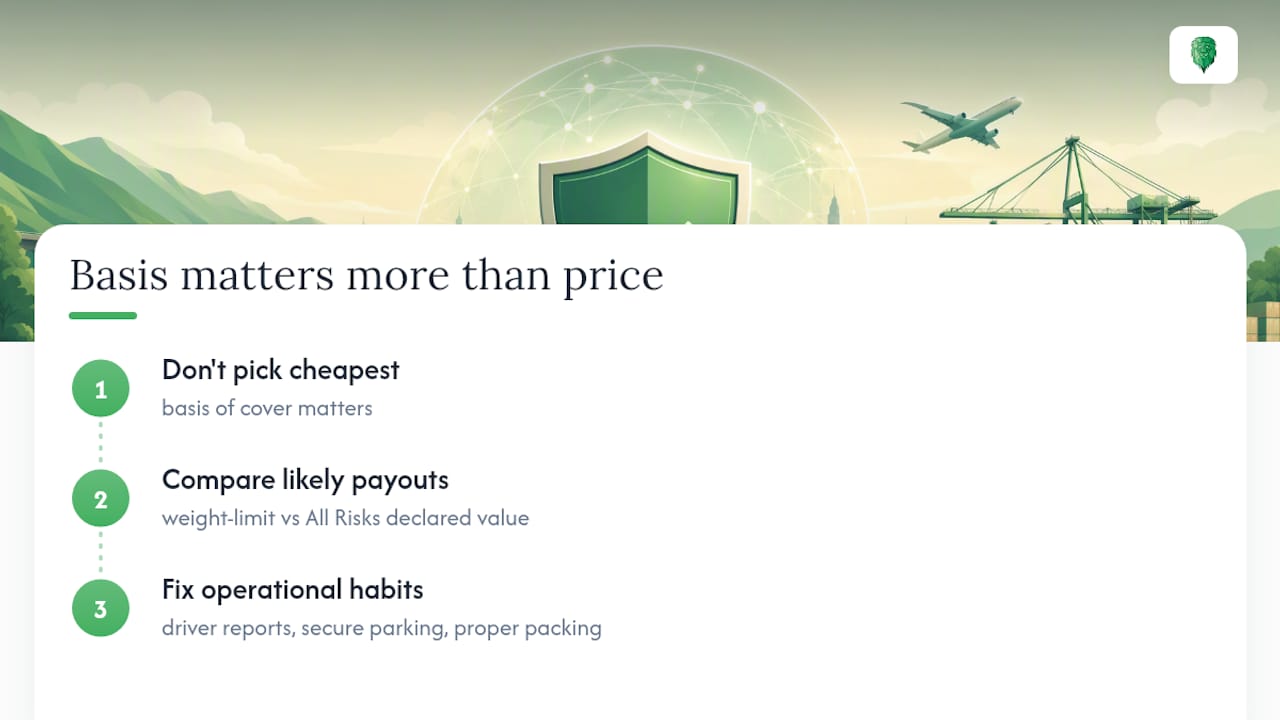
What the evidence in this guide actually supports is a two-step priority. First, work out what a typical high-value load would actually receive under a weight-based limit versus an All Risks declared value, because that gap is often much larger than people expect. Second, fix your operational habits, driver condition reports, secure parking, proper packing, because a technically excellent policy still won’t pay out if you can’t evidence the loss or you breached a security condition nobody read twice.
Buy the cover that matches your actual risk, not the one that matches your budget.
Sources
- Goods in transit insurance | Markel Direct UK
- Goods-in-Transit Insurance | Avis Insurance
- Goods In Transit Insurance for removal contractors | UK Sure
- Goods in Transit Insurance | AXA UK
FAQ
How much is goods in transit insurance in the UK?
Costs vary widely by declared limit, fleet size, and goods type, but specialist removal contractor policies have published starting points from an entry-level annual premium for basic cover, rising for higher-value loads or larger fleets.
Is goods in transit insurance a legal requirement?
No. GIT insurance isn’t legally required for every UK transporter, though many courier networks and commercial clients make it a condition of working with them.
What does goods in transit insurance actually cover?
It covers theft, loss, and accidental damage to goods while they’re being transported, and often extends to loading, unloading, and temporary storage between collection and delivery.
What counts as “goods in transit” for insurance purposes?
Goods in transit means any items being moved by road on behalf of a business, whether that’s a customer’s furniture, palletised stock, or courier parcels, as distinct from the vehicle itself or the driver’s own tools.
Does goods in transit cover theft from a parked vehicle overnight?
Usually not, unless strict security conditions are met. Standard insurer guidance excludes overnight theft from unattended vehicles unless the vehicle was garaged, locked, and goods kept out of sight.