Which home movers in the UK are worth your time?
Home movers. Choosing the right removal service is one of the most consequential decisions you’ll make during a house move. Get it right and moving day feels manageable. Get it wrong and you’re chasing a van with your sofa strapped to the roof. Here’s a quick shortlist of the options worth considering:
- Van-247delivery: UK-wide coverage with over 15 years’ experience, insured removals, flexible booking, and value-added services including packing and disassembly. Best for families and individuals who want a professional, stress-free move without coordinating multiple suppliers.
- AnyVan: A marketplace connecting you with vetted transport providers across the UK. Offers competitive pricing and flexible scheduling, including part-load options. Best for budget-conscious movers who are happy to self-pack and work around shared transport windows.
- Association of Independent Movers (AIM): Not a removal company itself, but the UK’s leading trade body for independent removal firms. AIM membership signals a verified Code of Practice, formal complaints procedures, and confirmed insurance. Use AIM’s directory to find vetted local movers near you.
All three options carry meaningful trust signals: AIM verifies membership directly on its website rather than relying on company-issued badges, Van-247delivery offers insured transport with written quotes, and AnyVan vets its network of providers before listing them.
How do you prepare effectively for a home move?
Moving day is a marathon, not a sprint. The families who sail through it are the ones who started planning weeks earlier. Here are ten steps that make the difference:
- Set your moving date early. Book your removal company at least four to six weeks in advance, especially if you’re moving between April and September when demand peaks.
- Declutter before you pack. Sell, donate, or dispose of anything you haven’t used in a year. Fewer boxes means lower costs and less unpacking stress.
- Get written quotes from at least three movers. Verbal estimates are not binding. Written quotes protect you and make comparisons straightforward.
- Confirm what’s included. Ask whether packing materials, disassembly, and access charges are covered. Hidden fees are the most common complaint in the removals industry.
- Notify your utility providers. Contact your gas, electricity, water, and broadband suppliers at least two weeks before your move date.
- Redirect your post. Royal Mail’s redirection service takes a few days to activate, so set it up early.
- Update your address with banks, HMRC, the DVLA, and your GP. Missing one of these causes headaches that can drag on for months.
- Pack a moving day essentials bag. Kettle, mugs, phone charger, toilet roll, a change of clothes, and any medications. Treat it as your moving day survival kit.
- Label every box clearly. Write the destination room and a brief contents summary on at least two sides of each box.
- Do a final walkthrough. Check lofts, garages, sheds, and under-stair cupboards before handing over the keys.
Pro Tip: Book a parking suspension for your street at least a week in advance if you live on a busy road. Your local council handles this, and it typically costs £45–£110 per day. Without it, your removal van may not be able to park close enough to load efficiently.

How do you pack fragile items safely?
Packing is where most moving damage happens, and it’s almost always avoidable. A room-by-room approach keeps things organised and cuts unpacking time significantly.
- Use quality materials. Double-walled boxes, bubble wrap, packing paper, and strong tape are worth the small extra cost. Supermarket boxes are often weakened from previous use.
- Wrap each fragile item individually. Glasses, plates, and ornaments need their own layer of packing paper before going into the box. Never stack unwrapped items directly on top of each other.
- Fill every gap. Empty space inside a box lets items shift and collide in transit. Use crumpled paper, foam peanuts, or even clean towels to fill voids.
- Pack plates vertically, not flat. Plates survive transit far better on their edges, the same way they sit in a dishwasher rack.
- Label fragile boxes on every side. “Fragile, this way up” on the top alone isn’t enough. Removal crews handle dozens of boxes quickly, so make it impossible to miss.
- Keep heavy items at the bottom. Books and dense kitchenware go in first; lighter fragile items sit on top.
Pro Tip: For especially delicate items like mirrors, artwork, or antiques, double-box them: wrap the item, place it in a snug inner box, then pack that box inside a larger outer box with cushioning on all sides. It adds five minutes per item and can save you hundreds in replacement costs.
If you’d rather leave packing to the professionals, packing services from a full-service removal company cover all materials and labour, which is particularly useful for large or complex moves.
What size van do you actually need for your move?
Choosing the wrong van size is one of the most avoidable moving mistakes. Too small and you’ll need multiple trips or leave items behind. Too large and you’re paying for empty space.
- Small van (up to 3.5m³): Suitable for a studio flat or a single room. Fits a bed, a few boxes, and a small sofa.
- Medium van (up to 7m³): Works well for a one-bedroom flat. Handles a bed, wardrobe, small sofa, and around 20–30 boxes.
- Large van (up to 14m³): Covers most two-bedroom homes comfortably, including white goods and a moderate amount of furniture.
- Luton van or box van (up to 18m³): The standard choice for three-bedroom homes. Fits a full household including large sofas, dining tables, and appliances.
- Removal lorry (24m³ and above): Needed for four-bedroom homes and larger, or for households with a lot of bulky furniture.
Access matters as much as volume. Narrow streets, low bridges, and permit-only zones can rule out larger vehicles entirely, particularly in city centres and older residential areas. Always tell your removal company about any access restrictions at both your current and new address before they quote.

Why does moving insurance matter so much?
Your home contents insurance almost certainly does not cover your belongings while they’re in transit. That gap is where goods-in-transit insurance comes in, and it’s the policy your removal company should carry as standard.
- Goods-in-transit insurance covers your belongings against loss or damage while they’re being loaded, transported, and unloaded. Check the per-item limit and the total claim cap before you sign anything.
- Public liability insurance protects you if the removal crew causes accidental damage to your property or a third party’s property during the move. A reputable company carries both.
- What’s typically not covered: items packed by the owner (rather than the removal company), pre-existing damage, and certain high-value items like jewellery or cash unless declared separately.
- How to verify: ask for a copy of the insurance certificate before your move date. Any company unwilling to provide this in writing is a red flag.
Van-247delivery includes insurance coverage as part of its standard service, which removes the guesswork around whether your belongings are protected during transit.
What does a home move actually cost in the UK?
Moving costs catch a lot of people off guard, mainly because the headline quote rarely tells the full story. The average cost for a 3-bedroom move over a moderate distance is about £969, rising to £1,575 when full packing services are included.
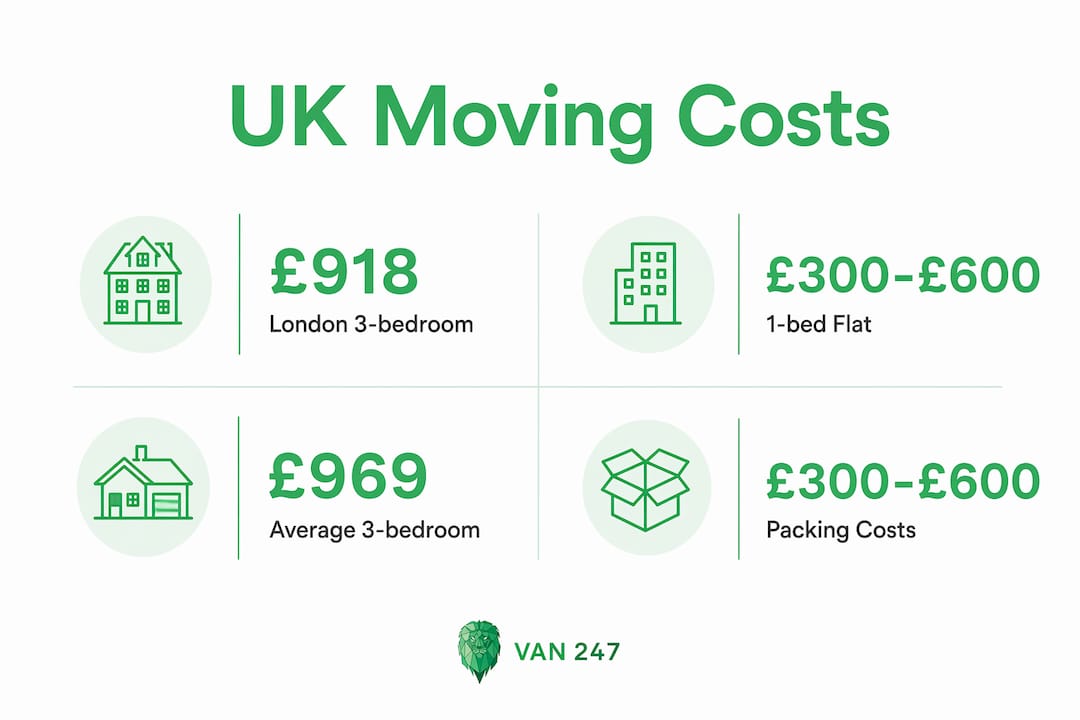
Regional variation is significant. London removals for a 3-bedroom home average around £918, while the same move in Liverpool averages about £694. The London figure reflects congestion charges, parking restrictions, and higher labour costs rather than distance alone.
| Home size | Basic removal (no packing) | With full packing service |
|---|---|---|
| 1-bedroom flat | £300–£600 | — |
| 2-bedroom home | £300–£600 | — |
| 3-bedroom home | £969 | £1,575 |
| 4-bedroom home | — | — |
Beyond the base quote, several additional costs can add up quickly. Packing services typically cost £300–£600 for a full-service pack, parking suspension permits run £45–£110 per day, and waiting time charges are commonly billed at around £35 per hour. Timing your move also affects the price: peak season surcharges apply during late spring through early autumn, and moving at month-end can increase costs to some degree.
For a detailed breakdown of removal van costs by location and home size, the figures vary more than most people expect before they start getting quotes.
How do you choose a reliable home mover in the UK?
The removal industry has no universal licensing requirement, which means the quality gap between companies is wide. Here’s how to separate the trustworthy from the risky:
- Verify AIM membership directly. Don’t rely on a badge on a company’s website. Check the AIM member directory yourself. Membership confirms a Code of Practice, verified insurance, and access to a formal complaints procedure.
- Check vehicle compliance. Removal companies must hold valid MOT certificates and, for vehicles over 3.5 tonnes, a Goods Vehicle Operator’s Licence. Both are verifiable through government online registers.
- Insist on a pre-move survey. For any home larger than a one-bedroom flat, a reputable mover will conduct an in-person or video survey before issuing a final quote. A binding price quoted over the phone without a survey is a warning sign.
- Get everything in writing. Your quote should explicitly list what’s included: packing, disassembly, access charges, and insurance. Written quotes are required from AIM members before work begins.
- Look for a verifiable business address. A company with only a mobile number and a generic email address is harder to hold accountable if something goes wrong.
Red flags to watch for
- No physical business address listed
- Pressure to pay a large deposit upfront in cash
- Quotes significantly below every other estimate you’ve received
- Reluctance to provide insurance details in writing
- No mention of a pre-move survey for a large property
Pro Tip: Search the company name alongside “reviews” and “complaints” before booking. Check Trustpilot and Google Reviews, but also look at how the company responds to negative feedback. A professional response to a complaint tells you more than a string of five-star reviews.
What storage options are available during a move?
Sometimes the timing between leaving one home and moving into another doesn’t line up neatly. Storage bridges that gap, and there are several ways to approach it.
- Self-storage units: You rent a unit, load it yourself, and access it whenever you need. Flexible and often cost-effective for longer periods, but you handle all the logistics.
- Portable storage containers: A container is delivered to your door, you fill it at your own pace, and it’s collected and stored until you need it delivered to your new address. Useful when you want to avoid multiple van trips.
- Full-service storage with your removal company: Your removal company collects, stores, and redelivers your belongings as part of a single contract. This is the least stressful option because your items stay insured under the same policy throughout.
Using storage during a move is particularly useful when you’re renovating a new property before moving in, when there’s a gap between exchange and completion, or when downsizing and you haven’t yet decided what to keep. Combining storage with your removal booking often works out cheaper than arranging them separately, and it keeps accountability with a single company.
Van-247delivery: professional UK home removals with real peace of mind
Moving house is stressful enough without worrying whether your belongings are in safe hands. Van-247delivery offers a straightforward alternative to piecing together a move from multiple suppliers.
With over 15 years serving households across the UK, Van-247delivery handles house removals from a single room to a full family home. Every move comes with insurance coverage, flexible booking, and the option to add packing, disassembly, and storage to the same booking. There’s no need to coordinate separately with a packing company, a storage facility, and a van hire firm. One call, one quote, one team on the day.
For families who want a professional moving company without the complexity of managing multiple contractors, Van-247delivery is worth a direct quote.
Key takeaways
Choosing a verified, insured removal company and starting your preparation early are the two decisions that have the greatest impact on how smoothly your move goes.
| Point | Details |
|---|---|
| Verify your mover’s credentials | Check AIM membership directly on the AIM website; never rely on a badge alone. |
| Get written quotes with all costs listed | Packing, access charges, and waiting time fees should all appear in writing before you commit. |
| Budget realistically for a 3-bedroom move | Expect a basic removal cost and plan for additional expenses if you require full packing services. |
| Plan storage early if your dates don’t align | Full-service storage through your removal company keeps your belongings insured under one policy. |
| Van-247delivery for a full-service move | Insured, UK-wide removals with packing and disassembly options, backed by 15+ years’ experience. |
What most people get wrong about choosing a removal company
There’s a tendency to treat a house move like booking a taxi: find the cheapest option, confirm the date, and assume it’ll work out. The removals industry rewards the opposite approach.
The most underappreciated step is the pre-move survey. Reputable companies insist on it for homes larger than a one-bedroom flat, not because they want to upsell you, but because an accurate survey is the only way to give you a price that won’t change on the day. A quote issued without one is essentially a guess, and the risk of that guess being wrong falls entirely on you.
Trade association membership, particularly through AIM, is genuinely useful rather than just a marketing badge. The formal complaints procedure alone is worth something: if a dispute arises, you have a structured route to resolution rather than a dead-end argument with a company that’s already been paid. Verifying membership takes about 30 seconds on the AIM website, and most people never bother.
The cheapest quote is rarely the cheapest move. Access charges, waiting time fees, and inadequate insurance coverage can add hundreds of pounds to a low headline price. The families who come out ahead financially are usually the ones who compared three written quotes, asked the right questions, and chose a company they could hold accountable.
FAQ
How much does it cost to move a 3-bedroom house in the UK?
A standard 3-bedroom removal over a moderate distance costs around £969, rising to approximately £1,575 with a full packing service included.
What are the red flags when hiring movers?
Watch for companies that quote a binding price over the phone without a survey, refuse to provide insurance details in writing, or ask for a large cash deposit upfront. These are the clearest signs of an unreliable operator.
What’s the cheapest way to move house in the UK?
Self-packing, choosing a mid-week date outside peak season (late spring through early autumn), and booking well in advance all reduce costs. Flexible moving dates give removal companies more scheduling options, which often translates to a lower quote.
What is the average cost to move house in the UK?
Costs vary by home size and region, but a 3-bedroom move averages about £969 for a basic removal. London moves tend to cost more due to congestion and parking restrictions, while cities like Liverpool average about £694 for the same home size.