For most UK moves the answer is two or three movers. Two is the usual minimum and suits a flat or a small house with sensible access. Three is worth it when you have a bigger home, stairs, heavy furniture or a tight time window. Anything beyond that is for large houses, offices and awkward specialist items. Below, we explain how to decide, what changes the number and how to avoid paying for people you don’t need.
TL;DR
- Two movers is the standard minimum crew. It suits a studio, a one or two bedroom flat or a small house with easy access.
- Three movers is the sensible choice for a three bedroom home, a lot of heavy furniture, several flights of stairs or a fixed deadline.
- Four or more is for large family houses, offices and moves with a lot of bulky or fragile items.
- Access matters as much as volume. Stairs, long carries, no parking and lifts can add a mover quicker than extra boxes can.
- Ask for crew size, van size and hours in writing. A good quote states all three.
Table of Contents
- Why the number of movers matters
- What most UK removals firms treat as the minimum
- Quick guide: crew size by home size
- 2 movers vs 3 movers: how to choose
- What changes the number of movers
- How to work out your own number: a simple method
- Office moves, furniture deliveries and pallets
- Our perspective: more people isn’t always better
- Get a crew sized to your move
- Mistakes to avoid when choosing a crew
- FAQ
- Sources
Why the number of movers matters
Moving day is a marathon, not a sprint. The crew size you pick decides how long it takes, how safely your things are handled and, usually, what you pay.
Too few movers and the day drags on. Tired people drop things, scuff walls and take risks with wardrobes on staircases. Too many and you pay for hands standing around because only so many people can fit through a front door or onto a van ramp at once.
The aim is simple: enough people to keep the job moving smoothly, and no more.
What most UK removals firms treat as the minimum
The usual starting point is two people. The HomeOwners Alliance notes that you’ll usually pay a two-hour minimum charge and a minimum of two removal men, with the price rising as the job needs more time and more people.
There’s also a safety reason for two. The Health and Safety Executive describes manual handling as lifting, carrying, supporting or moving heavy or bulky loads by hand or bodily force. It advises using mechanical aids for heavy or awkward items where possible, or otherwise making sure people lift and carry safely. A sofa, a chest of drawers or a washing machine is exactly that kind of load, and one person alone shouldn’t be handling it.
So when someone offers a single “man with van” for a whole house move, ask what happens with the wardrobe, the bed frame and the fridge freezer.
Quick guide: crew size by home size. Part of how many movers
These are rules of thumb from years of moving homes across the UK, not fixed laws. Your inventory and access can push the number either way.
| Property | Typical crew | When to add one more |
|---|---|---|
| Studio or one bedroom flat | 2 | Third-floor walk-up with no lift, or a lot of heavy items |
| Two bedroom flat or small house | 2 or 3 | Heavy furniture, loft or garage contents, a tight time slot |
| Three bedroom house | 3 | Long driveway carries, large wardrobes, a piano or a full garage |
| Four bedroom house or larger | 3 or 4 | Multiple floors, outbuildings, a large amount of fragile items |
| Office | 3 to 6+ | Depends on desks, IT equipment and the time you can be closed |
The table gives a starting point. The next section covers what moves you up or down it.
2 movers vs 3 movers: how to choose
This is the question behind most searches, so let’s be direct.
When two movers is enough
Two movers is a good fit when:
- you’re moving from a studio, one bedroom flat or compact house;
- most of your belongings are in boxes rather than big furniture;
- there’s parking right outside both addresses;
- you’re on the ground or first floor, or there’s a working lift;
- you aren’t in a rush and the job can stretch across the day.
Two people working steadily will be efficient in this situation. Adding a third would mostly add cost.
When three movers is worth it
A third person earns their place when:
- you have a three bedroom home or a busy two bedroom one;
- there are heavy items such as a large sofa, a solid wood wardrobe, a sofa bed or an American-style fridge freezer;
- you have several flights of stairs, or a narrow stairwell where items must be passed along;
- you need to be out by a set time, for example on a completion day with a chain;
- one person can pack and wrap in the house while two carry to the van.
A third mover also changes the flow. With two, someone is always stepping away from the van to help with a heavy piece. With three, one can stay organised in the van, loading it properly while the other two carry. A well-packed van means fewer breakages and fewer wasted miles.
Does a third mover cost much more?
It costs more per hour, but not always more in total. A larger crew finishes sooner, so you may pay the higher hourly rate for fewer hours. For a house with plenty of furniture, three people for a shorter day can be close to the cost of two people for a long one. Ask for a quote that shows both options, with hours listed.
One thing to watch: waiting time. If your crew is held up because keys haven’t arrived or the van can’t get close, you pay for each person standing around. Our waiting time charge is £24 per hour per man, so a bigger crew costs more when the day stalls. Having keys, parking and access sorted before the crew arrives is the cheapest way to save money.
What changes the number of movers? Part of how many movers
Volume is only part of the picture. These factors regularly move a job from two people to three.
Stairs and access
A flat on the fourth floor without a lift is a different job from a ground floor flat with the same belongings. Count the flights, check the stairwell width and note any tight turns. Think also about the walk from the front door to where the van can park. A 50 metre carry, repeated 100 times, adds up.
Heavy and awkward furniture
Bulky items need more than raw strength. A wardrobe that fits through the door only at an angle needs someone to guide it. Where possible, items can be taken apart first. Our furniture assembly and disassembly option removes a lot of the awkwardness, because a bed frame in pieces is far easier for two people than a rigid one.
Fragile and valuable items
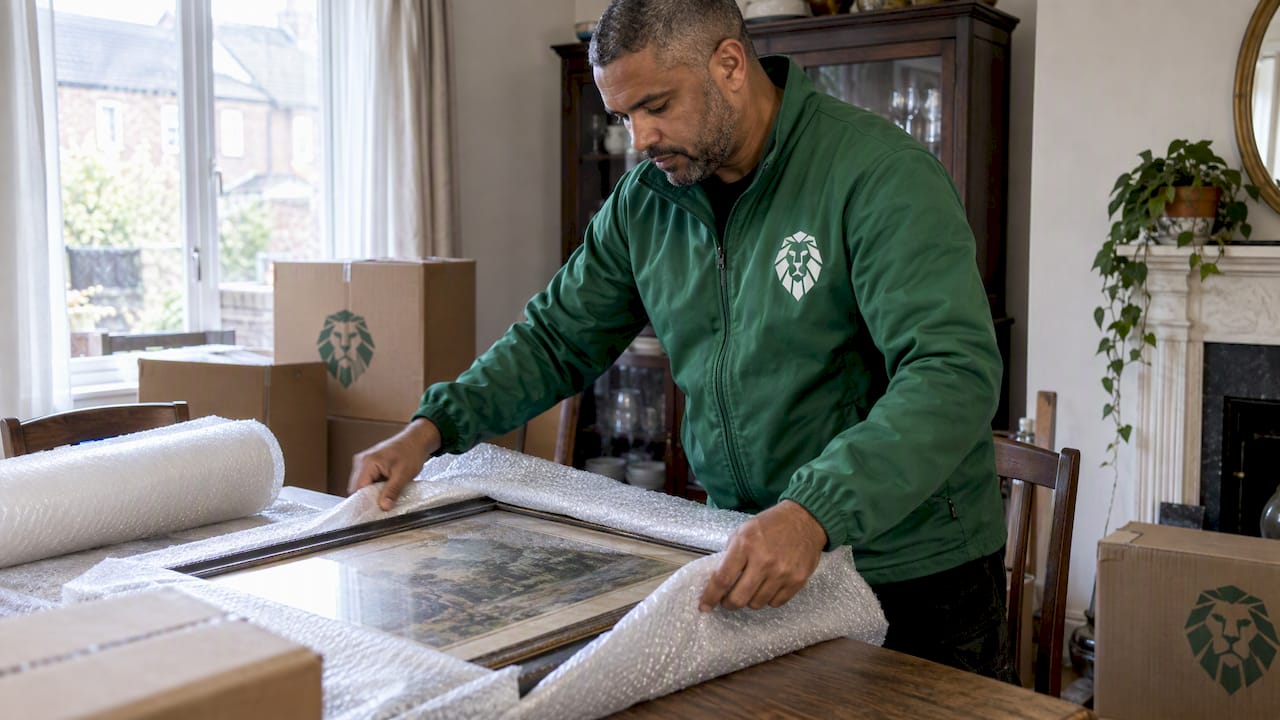
Glass tables, mirrors, artwork and TVs need careful, slower handling. Often it’s the wrapping and padding that takes the time, not the carrying. If you have a lot of fragile items, a third mover who focuses on wrapping can keep the day on schedule. For a sense of what gets packed and how, see our guide to what movers pack room by room.
Parking and timing
If the van has to park a few streets away, or you’re in a city centre with loading restrictions, every trip takes longer. More hands can offset that. Likewise, if you must be out of the old place by midday, a bigger crew is insurance against delay.
Unusual items
Pianos, safes, large gym equipment and hot tubs aren’t ordinary furniture. They need specialist crews, equipment and planning, and the number of people depends on the item itself. Piano moves in particular are not a job for a standard two-person crew with a rented trolley. Our piano removal service covers this, and our guide to nationwide piano transport explains how it works.
How to work out your own number: a simple method, part of how many movers
You don’t need to be an estimator. Follow these steps and you’ll be close.
- List your big items. Beds, wardrobes, sofas, tables, white goods, bookcases. Mark anything you can’t lift comfortably with another person.
- Count boxes roughly. Professional estimators work from a usable inventory, property and access details, extras and any specialist handling, as one UK removals estimating guide explains. Your list does the same job.
- Note access at both ends. Floors, lifts, stairs, distance from the van to the door, parking.
- Decide on extras. Do you want packing, dismantling or unpacking done for you? These change the time and sometimes the crew.
- Set your deadline. A flexible day suits a smaller crew. A hard deadline suggests a larger one.
- Ask for the quote in full. A quote should state crew size, vehicle size and expected hours. If any of these three is missing, ask.
A worked example, part of how many movers
Take a three bedroom semi with a sofa, a double wardrobe, two single beds, a king-size bed, a dining table and a fridge freezer. There’s a first-floor bedroom level, a drive with parking, and a garage full of tools.
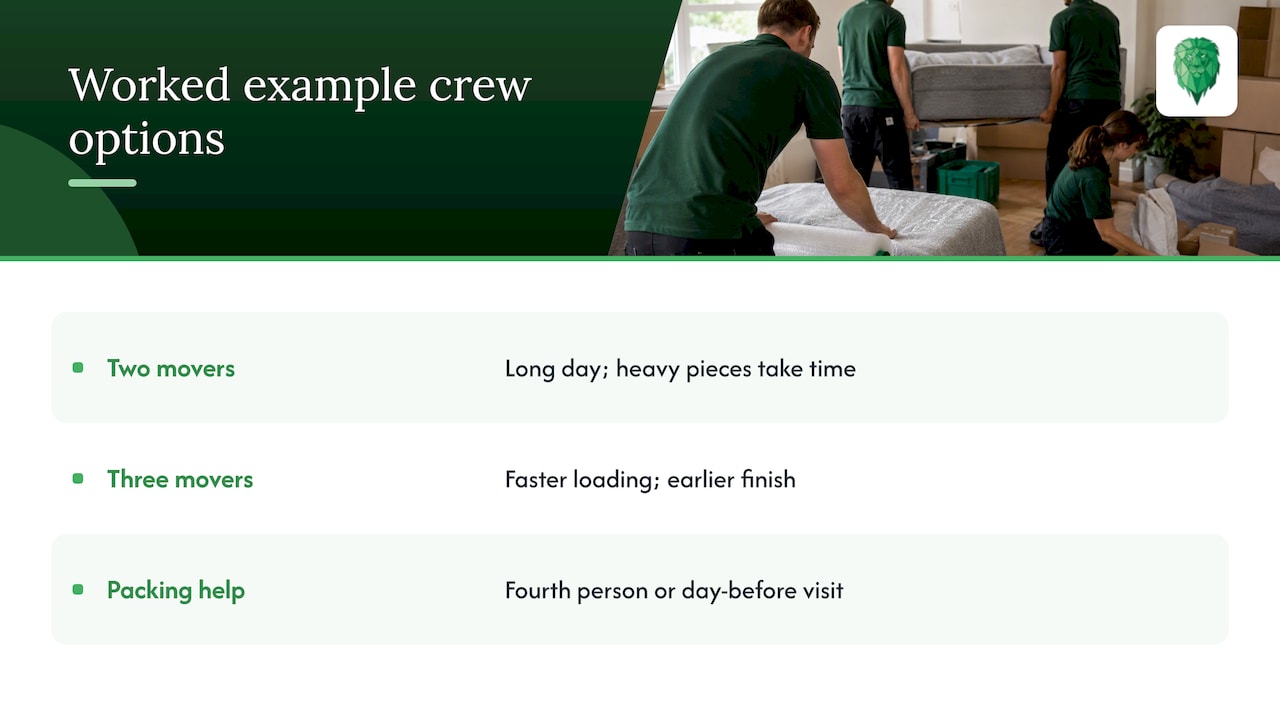
Two movers can do it, but expect a long day and a lot of time spent on the heavy pieces. Three movers will usually load faster, keep the van better organised and finish earlier, which matters if you’re handing over keys at a set time. If you also want packing, a fourth person or a separate packing visit the day before keeps moving day calm.
Office moves, furniture deliveries and pallets
The same logic applies outside homes, with different numbers.
Office relocation
Offices usually need more people because the time window is smaller. Closing for a weekend is far cheaper than closing for a week. Desks, filing cabinets, IT equipment and meeting room furniture all need handling, and servers or network kit need careful treatment. A larger crew, a clear plan and labelled workstations make the difference. Our office relocation service covers moving, server relocation and reinstalling Wi-Fi and video conferencing. If you’re in the capital, see our office relocation company London page.
Furniture and large items
A single sofa, a wardrobe or a delivered dining set rarely needs a full removals crew. Two people is the norm, with a third only for something unusually heavy or in a tricky building. Our furniture and large items service is built for this kind of job, so you aren’t paying for a whole house crew to move one piece.
Pallet delivery
Pallets are handled with equipment such as pallet trucks and tail-lifts rather than muscle, so the number of people is usually small. The key is that someone is there to receive the goods and that the delivery point suits the vehicle. If that’s what you need, take a look at our pallet delivery service.
Our perspective: more people isn’t always better, part of how many movers
We’ve been moving homes and businesses for over 15 years, and the pattern is consistent. The moves that go wrong rarely go wrong because of crew size alone. They go wrong because the crew was never told about the loft, the third-floor walk-up or the car that blocks the drive.
Here’s how we think about it:
- Tell us everything. Photos of tricky stairs and a list of the heavy items let us pick the right crew first time.
- Choose the crew for the hardest part of the job. If the heavy wardrobe is the problem, plan around it.
- Pay for the people who do real work. An extra mover is worth it when they shorten the day, not when they stand in the hall.
- Insurance and care come with the job. Insured transport and careful handling matter more than headcount.
If you’re unsure between two and three, tell us what you’re moving and we’ll say honestly which one fits. A friendly conversation beats guessing.
— Claudiu
Get a crew sized to your move
We offer house removals across the UK, including packing, unpacking, storage and cleaning after your move, as well as man and van for smaller jobs. Tell us about your home, your access and your timing through our instant online quote on the Van-247 homepage, and we’ll recommend a crew that fits. If you’re moving in London, our removals London page has local details. For the wider picture, our step-by-step guide to moving house in the UK walks you through everything from booking to unpacking.
Mistakes to avoid when choosing a crew, part of how many movers
- Booking the cheapest crew without checking its size. A low price for one person may mean you’re helping carry the wardrobe.
- Forgetting the small stuff. Garages, lofts and sheds can double the volume. Include them on your list.
- Not mentioning access problems. Stairs, narrow doors and parking distance should be on the quote.
- Ignoring timing. If you need to be out at a specific time, say so when booking.
- Helping with heavy items to save money. It’s risky for you and not the same as a trained crew. If you’re thinking about it, remember the HSE’s point that heavy and awkward loads call for mechanical aids or proper lifting technique.
FAQ
How many movers do I need for a two bedroom flat?
Usually two or three. Two works if you have mostly boxes, easy access and a flexible day. Add a third if you have heavy furniture, several flights of stairs or a fixed deadline.
Is 2 men or 3 men better for a house move?
For a three bedroom house or larger, three is usually better value because the job finishes sooner and the van is loaded more carefully. For a small home with easy access, two is plenty. The deciding factors are stairs, heavy items and your timetable.
Can one person do a house move?
One person can handle boxes and small items, but not heavy furniture safely. The HSE treats lifting and carrying heavy or bulky loads by hand as manual handling, and advises mechanical aids or safe lifting techniques. For beds, wardrobes, sofas and appliances, you want at least two people.
Do I pay more for extra movers?
Yes, the hourly rate rises with each person, but the job takes fewer hours. Ask your removals company for a quote showing crew size, van size and hours. Be aware that waiting time, such as delays with keys or parking, is charged per person.
How many people does it take to move a piano?
It depends on the piano. An upright and a grand need different equipment and crews, and stairs change things again. A specialist piano service will assess it first rather than send a standard house removals crew.
Sources
- How Much Do Removals Cost? – HomeOwners Alliance
- Manual handling – HSE
- How to Estimate a Removals Job in the UK (2026 Guide)
- How to quote for removals and house clearance