Large item courier packaging; packing a large item for a courier comes down to five jobs: measure it properly, pick packaging that suits its weight and shape, stop it moving inside, label it clearly, and check everything before the driver arrives. Do those well and most damage and surcharges never happen. Below we walk through each step, with the mistakes we see most often, so you can pack a wardrobe, a mirror, a TV, a pallet of stock or an awkward piece of equipment without the stress.
TL;DR
- Measure the longest, widest and tallest points, including handles, feet and fittings, and weigh the item before you book. Wrong measurements are the commonest reason for re-quotes.
- Match the packaging to the weight, the shape and the journey, not just the thickest board you can find.
- Fill every gap so the item cannot shift, and protect corners and edges first.
- Heavy or bulky goods usually travel best on a pallet that the load does not overhang.
- Label on two sides, remove old labels, keep your paperwork to hand and photograph the item before collection.
Table of Contents
- What counts as a large item for courier delivery?
- Choosing the right box or packaging
- How to wrap and cushion a large item
- When a pallet is the better answer
- Labels, documents and final checks
- Our view: pack for the journey, not for the doorstep
- Let us take care of the heavy lifting
- Common mistakes and how to avoid them
- FAQ
- Sources
What counts as a large item for courier delivery? Part of large item courier packaging
There is no single definition. Every carrier draws its own line, and the line moves depending on the service. A parcel that is perfectly normal for one service can be “oversize” or “heavy” on another, and some services will not take it at all. In practice, think of an item as large when any of these apply:
- It is longer than a standard parcel box, or you cannot lift it comfortably alone.
- It is an awkward shape: a flat-pack wardrobe, a mirror, a bike, a framed picture, a sofa, a table top.
- It is heavy enough that it needs two people or a trolley.
- It needs to sit on a pallet to be moved safely.
The practical message: do not guess which category you are in. Take three measurements and a weight, then check them against the service you are booking. Our large parcel delivery page explains how we handle big consignments, and if your item is closer to furniture than a parcel, our furniture and large items service is built for exactly that.
Measure like the courier will
Measure the maximum length, width and height, and include anything that sticks out: handles, legs, hinges, fittings and protrusions. Packaging specialists advise measuring this way and giving the weight too, because the packaging and the vehicle both depend on it.
A quick routine:
- Measure the item itself, with a tape, in centimetres.
- Add the packaging. Foam, board and wrap add several centimetres on every side.
- Weigh it. If it is too heavy for the bathroom scales, weigh yourself holding it and subtract your own weight, or use the manufacturer’s stated weight.
- Write all four numbers down and use the packed figures when you book.
Quote the packed size, not the bare item. If you book on the naked dimensions and the packed item is bigger, the driver may not be able to take it, or the price may change.
Choosing the right box or packaging
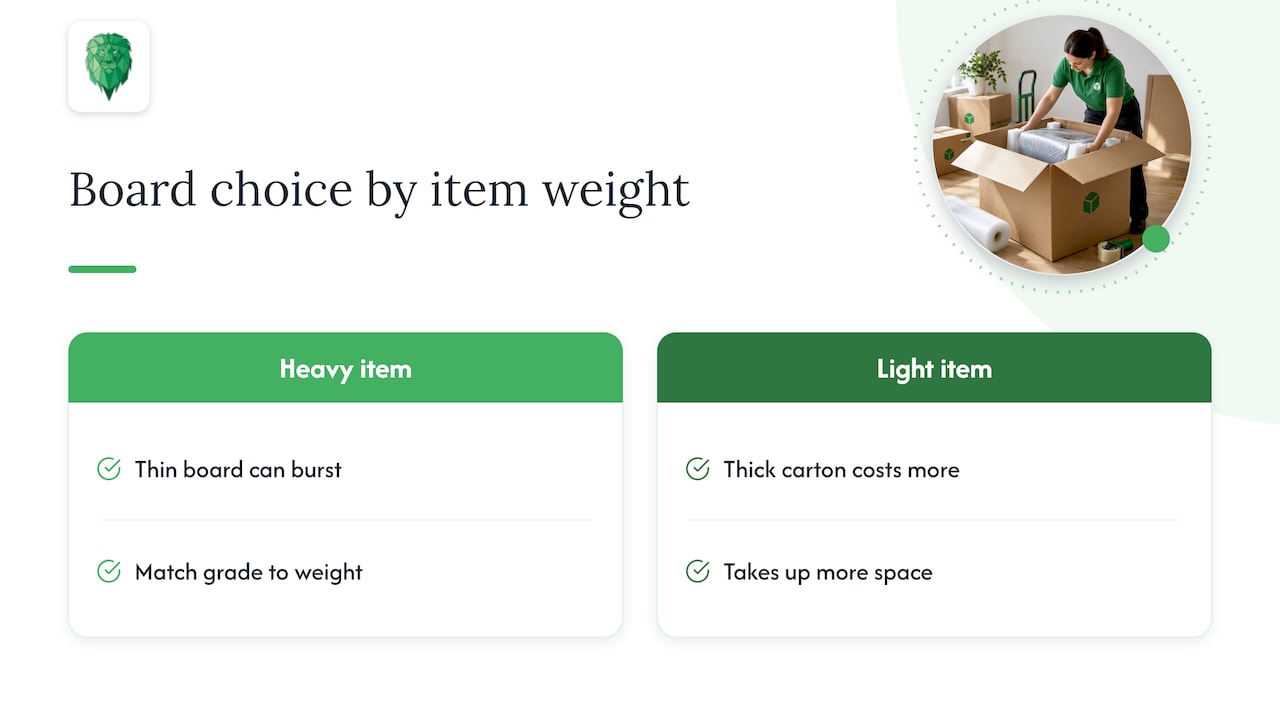
The temptation is to buy the strongest box going. It is better to ask what the item needs. Barton Jones Packaging advises matching the board grade to the weight, the stacking conditions and the delivery journey, rather than simply choosing the strongest board. That makes sense: a heavy item in thin board will burst, but a light item in a very thick carton just costs more to send and takes up more space.
Quick guide by item type, part of large item courier packaging
| Item | Sensible packaging | Watch out for |
|---|---|---|
| Flat-pack furniture | Original box, taped, with corners protected | Split box seams, boxes that have been opened and re-taped |
| Assembled furniture | Blankets or foam sheets, stretch wrap, corner guards | Drawers and doors that open in transit |
| TV or monitor | Original box and inserts, or a purpose-made TV carton | Pressure on the screen, laying it flat |
| Mirror or framed art | Corner protectors, rigid board either side, a picture or mirror carton | Glass breaking; tape a cross on the glass |
| Bike | Bike box, wheels out, handlebars turned, frame wrapped | Derailleur and pedals catching |
| Heavy equipment or stock | Pallet, boxes inside, strapping and stretch film | Overhang beyond the pallet edge |
| Awkward shapes | Made-to-measure or multi-part packaging | Gaps and loose parts |
For odd shapes, the same guidance notes that awkward products may need telescopic, multi-part or palletised packaging. If your item does not fit a standard carton, look for a two-part telescopic box or build a protective frame instead of forcing it into the nearest box.
New box or old box?
The original manufacturer’s box is often your best option, because it was designed around the product. Use it only if it is clean, dry and rigid, with no crushed corners. A box that has already been through one journey has lost some of its strength. If the original is tired, wrap the product, place it in a fresh outer carton and keep the old box as an inner layer.
How to wrap and cushion a large item, part of large item courier packaging
The aim is simple: the item should not be able to move, rub or take a knock directly. Treat packing as three layers.
- Surface layer. Wrap the item in paper, a soft blanket or a film to prevent scratches. Wrap loose parts separately.
- Cushion layer. Use foam, bubble wrap, corrugated sheets or moulded corner protection. Pad corners and edges first, because that is where most knocks land.
- Outer layer. A rigid carton, a crate or a frame, closed with strong tape and, for heavy items, strapping.
The principle behind it, which packaging guidance also stresses, is to immobilise the product with inserts or corner protection. Give it a gentle shake before you close the box. If you can hear or feel movement, add more fill.
Fill the gaps
Empty space is the enemy. Even a well-padded item will slide around if the box is too big. Fill voids with paper, foam or cardboard inserts until the item is snug. Leave a margin of padding between the item and every wall of the box, so a drop on one side does not travel straight to the product.
Fragile and valuable items
For glass, ceramics, electronics and anything you would be upset to lose, go a step further:
- Use double-boxing: the wrapped item in an inner box, surrounded by cushioning inside a stronger outer box.
- Keep fragile surfaces away from the outer walls.
- Take the item apart if you safely can: remove legs from tables, shelves from cabinets, glass from frames. Smaller parts are easier to protect, and loose pieces can be packed separately and labelled.
- Mark the packaging as fragile, but do not rely on the label. Pack as if nobody will read it.
If you would rather not take things apart yourself, we offer furniture disassembly and assembly with our man and van service, so your item arrives ready to use.
Packing awkward or very heavy pieces
Some things simply do not suit a cardboard box: a piano, a large cabinet, a safe, a workshop machine. For these, specialist handling matters more than packaging. Pianos in particular are heavy, delicate and awkward at the same time, and we move them with a trained crew through our piano transport service rather than as a parcel.
When a pallet is the better answer, part of large item courier packaging
For heavy or bulky goods, palletising is often the safest and cheapest way to send them. Packaging guidance recommends using a pallet where the pack is heavy or bulky, and the reasons are practical: the pallet spreads the weight, keeps the load off the floor and lets it be moved with a forklift or pallet truck instead of by hand.
How to secure a pallet
- Keep the load inside the pallet. The package should fit the pallet without overhanging. Anything that sticks out can be caught, crushed or knocked off.
- Put the heaviest boxes at the bottom and build upwards in a stable pattern, like brickwork.
- Keep the stack even with a flat top, so nothing slides when another pallet is placed nearby.
- Wrap and strap. Stretch film binds the load and attaches it to the pallet; straps or edge protectors add strength for heavier loads. The load must stay stable when wrapped or strapped.
- Add a cover or top sheet if the load could be damaged by dust, damp or scuffs.
- Check the pallet itself. A cracked or damaged pallet is a bad foundation.
Our own palletising guide goes through this step by step, and it is worth a read before you wrap. If you want the pallet collected and delivered across the UK, see our pallet delivery service, or the pallet transport page to start a quote.
Do not forget cover for the load, part of large item courier packaging
Packing well lowers the risk, but it does not remove it. For valuable pallets, think about whether the standard cover is enough for what is on the pallet. We cover that in our article on pallet insurance in the UK.
Labels, documents and final checks, part of large item courier packaging
The best packing in the world is wasted if the parcel goes to the wrong place or the driver cannot find the paperwork. Spend ten minutes on this before collection.
Labelling, part of large item courier packaging
- Put the delivery address and a contact phone number on at least two sides of the item, or on two sides of the pallet.
- Remove or cover old labels and barcodes, so a scanner cannot read the wrong one.
- Keep the label flat and fully stuck down, on a surface that is not wrapped in film that could peel it.
- Put a spare copy of the address inside the package.
- Add handling marks such as “this way up” or “fragile” where they make sense, and put them on the outside layer.
Documents and details to have ready, part of large item courier packaging
- Your booking confirmation and any reference number.
- The measured size and weight you gave when booking.
- The name and phone number of the person who will hand over the goods and the person who will receive them.
- Access notes for both ends: stairs, lifts, parking, narrow doors, loading times.
- A list of what is inside, especially if it is valuable.
Check what you are allowed to send. Many carriers will not carry certain goods, and rules around items such as loose lithium batteries, liquids and hazardous materials are strict. Ask the carrier before you pack, not after.
The five-minute final check, part of large item courier packaging
- Give the packed item a gentle shake and a lift. Nothing should rattle or bend.
- Check tape on every seam and join.
- Check labels and old labels again.
- Take photos from several angles, including the labels. If anything is damaged, you will want a record of the item’s condition at handover.
- Put the item somewhere easy to reach, ideally near the door or on the ground floor, with a clear path.
Our view: pack for the journey, not for the doorstep, part of large item courier packaging
After more than 15 years of moving and delivering, here is what we would tell a friend. Most damage is not caused by one dramatic accident. It comes from small things: a box that was slightly too big, a corner with no protection, a pallet load that overhung by a few centimetres, a label that peeled off. These are all fixable at home with a bit of time and the right materials.
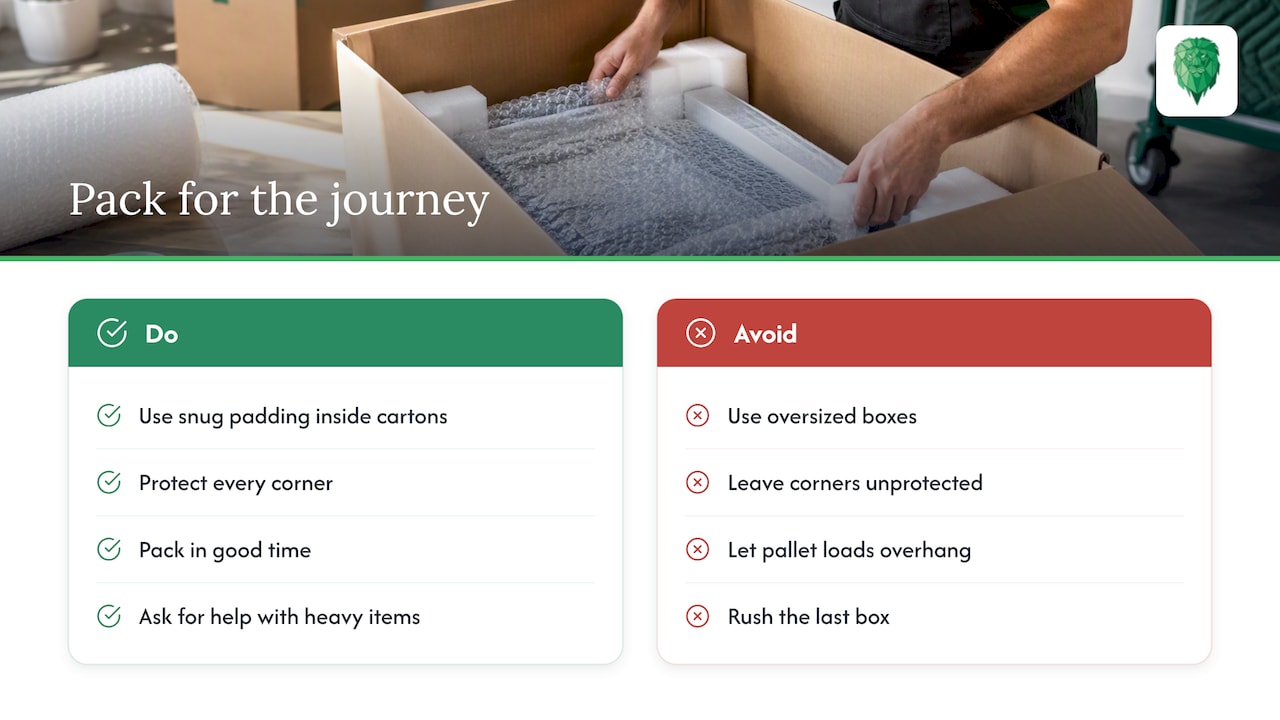
We also think people spend too much time on the outer box and not enough on what happens inside it. A moderate carton with snug padding will outperform a heavy-duty one with empty space around the item. And when something is heavy, valuable or awkward, we would rather you ask for help than risk it. That is what our crews are for: they lift, wrap, load, move and, if you want, reassemble.
Moving day is a marathon, not a sprint. Pack in good time, do not rush the last box, and the rest tends to go smoothly.
— Claudiu
Let us take care of the heavy lifting, part of large item courier packaging
If you would rather hand the job to people who do it every day, we can collect and deliver large items across the UK, with packing, assembly, disassembly and insured transport available around the job. Tell us what you are moving and get an instant online quote.
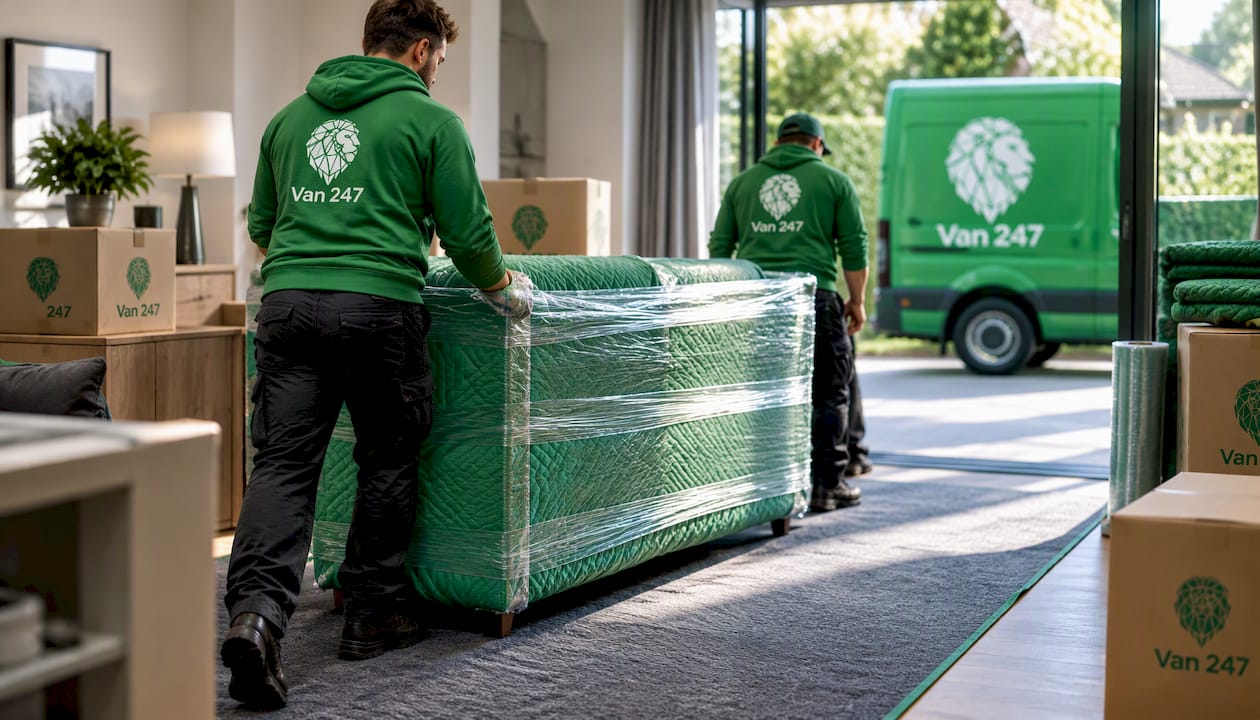
Start with our man and van and packing services, or go straight to furniture and large item removals if you are sending something bulky. If you are relocating a whole home, our house removals team can pack, move, store and unpack for you. Should the crew be kept waiting at collection or delivery, waiting time is charged at £24 per hour per man.
Common mistakes and how to avoid them
| Mistake | What happens | Fix |
|---|---|---|
| Booking with the unpacked size | Re-quote, refusal or a van that is too small | Measure after packing |
| Ignoring protrusions | Item does not fit the box or the space | Include handles, feet and fittings |
| Reusing a weak old box | Box fails under weight | Use a fresh outer carton |
| Leaving empty space | Item moves and hits the walls | Fill every void |
| Overhanging the pallet | Load is caught or crushed | Keep the load inside the pallet edges |
| Old labels left on | Item is scanned wrongly or misrouted | Remove or cover every old label |
| No photos | Hard to show the item’s condition later | Photograph before handover |
FAQ
How do I measure a large item for a courier?
Measure the longest, widest and tallest points in centimetres, including handles, legs and fittings, and weigh the item. Do it again after packing, since padding adds to every dimension, and use the packed figures when you book.
Is it better to use a box or a pallet?
A box suits items that are light enough to lift and that fit a carton snugly. A pallet is usually better for heavy, bulky or stacked goods, because it spreads the weight and lets the load be moved mechanically. Whichever you pick, the load must not overhang or shift.
How do I protect a fragile large item such as a mirror or TV?
Use the original box if it is in good condition, or a purpose-made carton, and protect corners and edges first. Keep a layer of padding between the item and all the walls of the box, and fill any gaps so it cannot move. For the most valuable pieces, double-boxing gives extra protection.
Can you pack the item for me?
Yes. We offer packing as part of our moving and delivery services, along with disassembly and assembly, so your furniture or large item is protected and ready for transport. Tell us what you are sending when you request your quote.
What should I do if my item is damaged in transit?
Take photos of the item and packaging straight away, note the damage on the delivery paperwork if you can, and contact the carrier promptly with your booking details. The photos you took before collection help show the original condition.
Sources