Loading bay booking: if you’re moving house, relocating an office or waiting on a pallet, “loading bay booking” usually means two separate permissions. One is a time slot at the building’s own loading dock. The other is lawful space on the road outside, which often means a council bay suspension or dispensation. Sort both before moving day and the van arrives, unloads and leaves without drama.
This guide explains what each booking is, who to ask, how much notice to allow and what to hand your removal firm. It also covers the safety side, because a booked slot doesn’t make an awkward arrival safe.
TL;DR
- A loading bay is for active loading and unloading only. It is not free parking, and the sign decides the hours and the maximum stay.
- Ask the building manager first whether a dock slot is needed. Then ask the council whether you need a bay suspension or dispensation for the road.
- Notice periods vary by council: Westminster asks for 10 working days, Fife normally asks for three working days. Check yours as soon as you have a date.
- Give your mover the access details: bay location, height limits, lift, route and contact on site.
- A booking is not a safety plan. Pedestrian routes and vehicle manoeuvring still need thinking through.
Table of Contents
- What a loading bay actually is in the UK
- Two bookings, two different people
- Booking a dock slot at an office, flat block or managed site
- Getting space on the road: bay suspensions and dispensations
- What to tell your removal firm
- Moving day is a marathon, not a sprint: building in buffers
- Safety: a booking is not the whole plan
- Our perspective: plan the kerb before the van
- Pallet deliveries and dock appointments
- Booking with Van-247
- FAQ
- Sources
What a loading bay actually is in the UK
A loading bay is a marked place reserved for loading and unloading under the restrictions shown on its sign or road markings. The Department for Transport’s traffic signs framework includes the “LOADING ONLY” legend, but the operating conditions come from the local signs and markings, not from one national rule.
In practice that means:
- You must be actively loading or unloading, not waiting or popping to the shops.
- The permitted hours and maximum stay are whatever the nearby sign says.
- The sign beats what you assumed, what a neighbour told you or what happened last time.
If you’re in London, TfL explains that loading bays on red routes are only available during specified periods and availability is limited. Red-dotted bays generally have peak-time restrictions, while white-dotted bays generally operate through the day but usually have a maximum stay. TfL allows unloading goods that need a vehicle, furniture for example, and collecting pre-ordered goods. It does not allow stopping without loading or unloading, or staying beyond the signed limit.
That last point is the useful one. A bay exists to keep deliveries moving. If goods aren’t continuously going from van to door, you’re probably parked, not loading.
Two bookings, two different people
Here is where most people get caught out. “Booking a loading bay” can mean either of these, and they’re handled by different organisations.
| Building dock slot | Council bay suspension or dispensation | |
|---|---|---|
| What it gives you | Permission to use the building’s private loading dock at a set time | Permission to stop or use a public bay or restricted road space |
| Who controls it | Building manager, landlord, managing agent, facilities team | The council, or TfL on red routes |
| Typical when | Office blocks, flats with a managed dock, retail units, shared industrial sites | Terraces, streets with resident or pay-and-display bays, anywhere with no off-street space |
| What it needs | Date, arrival window, vehicle and driver details | Exact location, dates, vehicle type, payment, advance notice |
| Cost | Set by the building | Set by the council |
Treat them as separate. Having one doesn’t mean you have the other, and the person who confirms your dock slot has no say over the kerb outside.
Booking a dock slot at an office, flat block or managed site, part of loading bay booking
Some managed facilities refuse vehicles that arrive without an advance booking. A published loading dock booking policy from ICC Sydney shows how this model works. It isn’t UK law, but UK managed buildings follow a similar pattern, and the booking details it asks for are a good checklist.
When you contact the building manager, have these ready:
- Date and arrival window. Give a window, not a single minute. Removals rarely run to the second.
- Vehicle details. Type, approximate height and length, and the registration if they ask.
- Driver contact. A mobile number that will be answered on the day.
- Type of job. House move, office relocation, piano, furniture delivery or pallet collection.
- Special access or handling needs. Lift size, stair width, fragile or heavy items, a trolley or tail-lift.
- Where the van will stand and how far it is from the lift or entrance.
Ask these questions back:
- Is there a height restriction at the entrance?
- Is there a maximum time per slot?
- Is there a lift reserved for moves, and does it need booking too?
- Are there set hours for moves, such as weekdays only?
- Is there a deposit or a damage-protection requirement?
If you’re planning an office move, our office relocation service covers the move itself, including server relocation and the reinstallation of Wi-Fi and video conferencing equipment, so it helps to tell us about the dock rules early.
Getting space on the road: bay suspensions and dispensations, part of loading bay booking
If there’s no private dock, the van needs somewhere legal to stand. Don’t lean on an ordinary loading exemption and hope. Apply to the council for a bay suspension or a dispensation, depending on what’s outside your door.
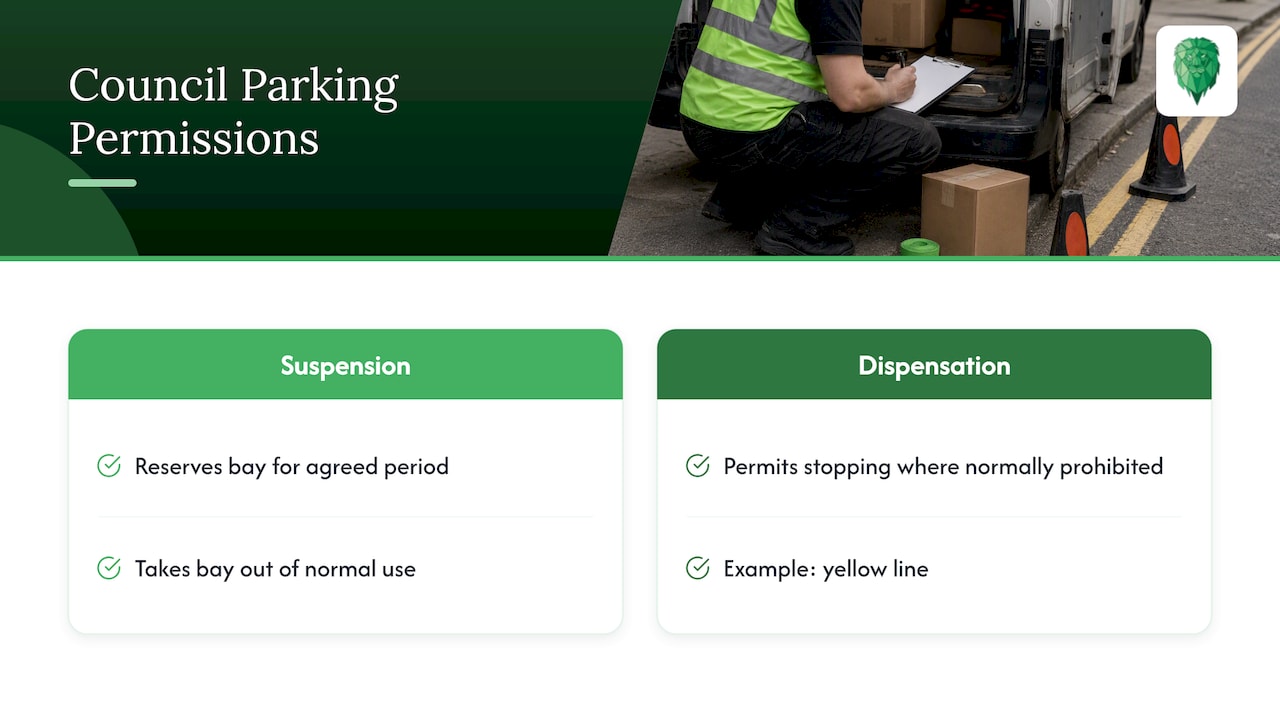
A suspension takes a bay out of normal use for an agreed period. A dispensation lets a vehicle stop where it normally couldn’t, such as on a yellow line. Councils word this differently, so look at your own council’s page.
What councils say: two examples
Notice periods and prices really do vary.
- Westminster. The council says suspensions can cover house or office removal vans, can be booked and paid for online, and need 10 working days’ notice. Applications inside 10 calendar days of the start date carry a £20 short-notice administration fee if granted. Housing-estate land is excluded from its online system.
- Fife. The council normally asks for at least three working days to process applications, with at least 48 hours’ notice for paid bay suspensions. Suspensions normally don’t last longer than seven days.
The lesson is not to memorise either number. It’s to find out who controls your road before you promise anyone a delivery time. It might be the borough, a county council, TfL, a private estate or a housing association. We’ve written a separate piece on why some councils need 10 working days for move-day parking, and it’s worth reading if your date is close.
A simple timeline
| When | What to do |
|---|---|
| As soon as you have a date | Identify who controls the road and the bay outside both addresses |
| 3 to 4 weeks before | Check your council’s notice period and apply if you can |
| 2 weeks before | Confirm any dock slot, lift booking and parking permission in writing |
| 1 week before | Send your mover the access details and contacts |
| Day before | Check the bay is actually coned or suspended where you expect |
| Moving day | Keep a copy of the permit in the van and on the dash |
The weeks-before column is our suggestion for staying comfortably ahead, not a rule. Your council’s own page is the final word.
Do you need it at both ends?
Usually yes. Collection and delivery addresses are separate streets with separate rules. A quiet cul-de-sac with off-street space might need nothing, while the flat you’re moving into on a busy high street may need a suspension and a dock slot.
What to tell your removal firm, part of loading bay booking
A good mover can plan around almost anything if they know about it in advance. A bad surprise on the day costs time, and on our side waiting time is charged at £24 per hour per man. We’d much rather spend that hour on your sofa than on a kerb.
Send us:
- The permit or booking confirmation, with times and exact bay location.
- Parking or dock restrictions: height, weight, hours, maximum stay.
- Distance from the van to the front door, and any stairs, lifts or steps.
- Who to ring on site and who holds the dock key or barrier code.
- Anything unusual: a narrow lane, a one-way system, a market day, roadworks.
If you’re not sure about any of this, tell us what you do know. We’ve been moving people for over 15 years and have seen most layouts.
Moving day is a marathon, not a sprint: building in buffers
Booked windows are tidy on paper. On the day, traffic, a lift that’s out of service and a neighbour’s delivery can shift things. Here’s how to keep it calm:
- Ask for a slightly wider dock window than you think you need.
- Keep your first and last loads of the day straightforward.
- Have the lift booked for the same window as the dock.
- Pack a “first night” bag so a delayed delivery doesn’t ruin the evening.
- Take photos of the bay signs and any cones on arrival, in case of a dispute later.
If you coordinate several people, such as movers, a landlord, a decorator and a cleaner, a written schedule helps. A US guide on setup and teardown timing for events takes the same approach of fixed arrival windows and safe unloading, and the idea carries over to a UK move even though the rules it cites are American.
Safety: a booking is not the whole plan, part of loading bay booking
A confirmed slot tells the site you’re coming. It doesn’t make the arrival safe. The Health and Safety Executive’s workplace transport guidance says workplace loading bays should be positioned so vehicles can manoeuvre, have clearly marked edges and provide pedestrian exits. Wide bays generally need exits at both ends or an alternative refuge. It also recommends clear traffic-route signs and a site plan at entrances, especially where visiting drivers are involved.
What that means if you manage a site or are the contact for a move:
- Send visiting drivers clear instructions before they arrive: route, restrictions, unloading point and pedestrian arrangements.
- Keep people and vehicles apart while the van reverses or the tail-lift is down.
- Think about weather, as wet ramps and dark evenings change things.
- Be extra careful with office relocations, server moves and valuable or fragile consignments, where congestion and foot traffic create avoidable risk.
If you manage a commercial site and are unsure whether your loading area meets requirements, raise it with your health and safety lead or the HSE guidance directly. Don’t rely on a mover to fix a layout problem.
Our perspective: plan the kerb before the van
We see the same pattern again and again. People spend weeks choosing a removal firm and ten minutes thinking about where the van will stand. Then moving day arrives, the bay is full of a neighbour’s car and the crew are clocking up waiting time.
The jobs that go smoothly have three things in common. The customer asked the building manager about a slot early. They checked with the council who controls the road. And they told us everything, including the awkward bits. Narrow streets, long carries and reserved lifts aren’t a problem for us if we know before we set off. They’re a problem when we find them on the day.
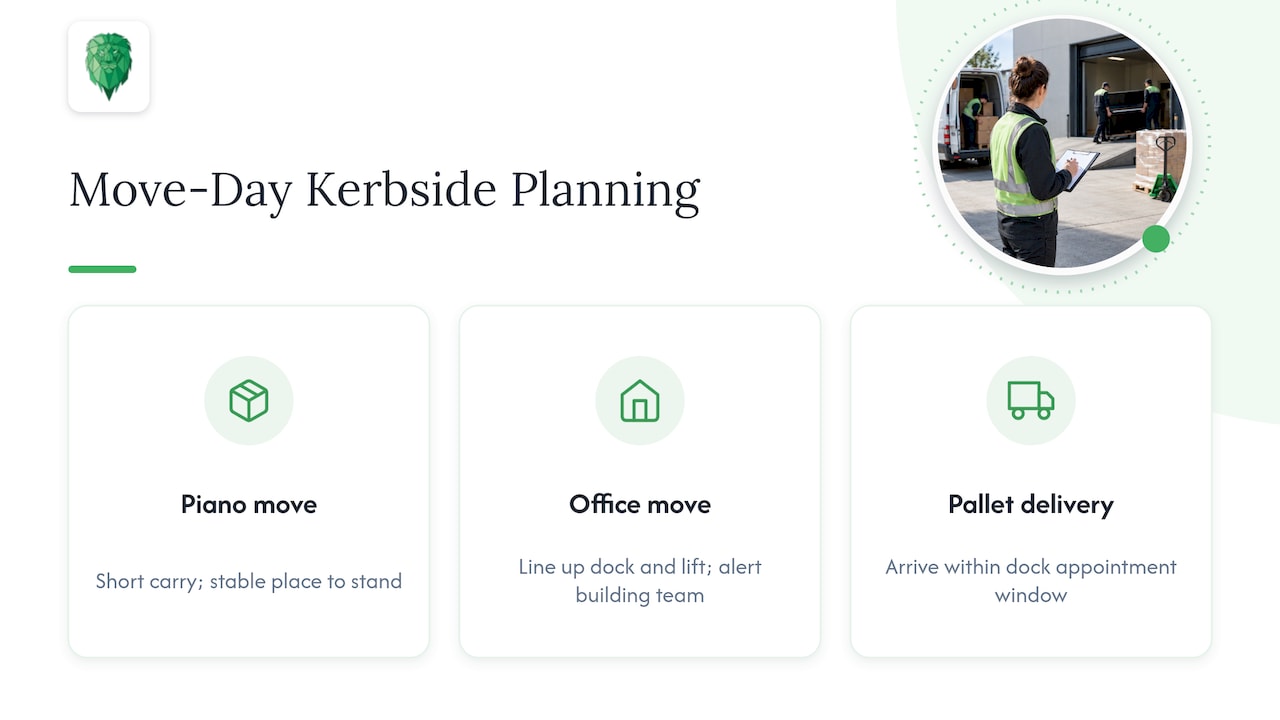
It matters even more for the bigger or more delicate jobs. A piano needs a short, clear carry and a stable place to stand. A full office move needs the dock and lift lined up, ideally with the building’s own team aware. A pallet delivery to a unit with a dock appointment needs the driver to arrive in the window, not before it. We’d rather you ask us twice than guess once.
— Claudiu
Pallet deliveries and dock appointments, part of loading bay booking
When readers ask about pallet delivery times, they’re often really asking whether the receiving site will let the driver in. Some facilities need an appointment, some don’t, and rules can depend on the volume. One freight facility, for example, states that no dock appointment is needed when shipping under 10 pallets, though that’s one operator’s rule and not a general one.
For your own delivery:
- Ask the receiver whether an appointment is needed and what the window is.
- Check whether the site has a forklift or whether the vehicle needs a tail-lift.
- Give the carrier a contact name and number for the site.
- Confirm opening hours, especially for Friday afternoons and bank holidays.
We confirm timings for each job at the quote stage rather than quoting a blanket figure, because the route, the size of the load and the receiving site all change the answer. Our pallet delivery service handles this alongside collection, and if you’re sending to a site with a dock, we’ll plan the arrival window with you.
Booking with Van-247
Whether it’s a flat, a house, a piano or an office, we can plan the move around your access details. Our house removals service includes optional packing, unpacking, storage and post-move cleaning. For single large items, see our furniture and large items service, and for a piano, our piano removal page explains how we handle it. You can get an instant quote through our website, and tell us about any loading or parking restrictions as you book.
FAQ
Can anyone park in a loading bay?
No. A loading bay is for active loading and unloading under the conditions on its sign. If you stop without loading, or stay beyond the signed time, you can be fined. Always read the nearby sign for hours and maximum stay.
How far ahead should I book a bay suspension for a house move?
It depends on the council. Westminster asks for 10 working days’ notice, while Fife normally asks for at least three working days. Check your council’s page as soon as you have a date, and apply early to avoid short-notice fees.
Do I need a loading bay booking for a pallet delivery?
Only if the receiving site requires dock appointments. Some do, and some set thresholds based on volume. Ask the site manager before the driver sets off, and pass the appointment window and a contact number to your carrier.
Is a loading bay booking the same as a parking suspension?
No. A loading bay or dock booking is usually with the building and covers its private loading area. A parking suspension or dispensation comes from the council and covers public road space. For many moves you’ll need to confirm both.
Sources
- DfT: Traffic signs working drawings, TSRGD 2016 Schedule 4
- TfL: Loading for the public on red routes
- ICC Sydney: Loading dock booking
- Westminster City Council: Parking bay suspensions
- Fife Council: Parking dispensations and parking suspensions
- HSE: Workplace transport, safe workplace
- ShipNetwork: Dock appointments