A marble table is one of the few pieces of furniture that can crack under its own weight, so moving it takes a plan, not just muscle. The safe way is to take the top off the base, carry it upright with enough people, pad every contact point, and secure it properly in the vehicle. If you are unsure at any stage, hand it to a team that moves heavy, fragile pieces every week. You can do this well, and this guide walks you through each step.
TL;DR
- Check the marble for cracks, old repairs and weak spots before anyone lifts it, and separate the top from the base.
- Carry the top vertically, never flat, with padded straps or moving equipment and more than one pair of hands.
- Plan the route first: measure doors, stairs and lifts, and clear the destination before the table leaves the room.
- Secure the load so it is stable before you tighten any strap. Friction and weight alone are not enough.
- A heavy or fragile top is a job for specialists. Booking one is cheaper than replacing a cracked slab.
Table of Contents
- Why marble needs more care than other tables
- Step 1: Assess the table before you touch it
- Step 2: Separate the top from the base
- Step 3: Plan the route before anyone lifts
- Step 4: Wrap and pad every part
- Step 5: Lift and carry the top the right way
- Step 6: Load and secure it in the vehicle
- Step 7: Handle stairs, lifts and tight doors
- Can you move a marble table by yourself?
- When to call in specialist movers
- A simple moving-day checklist
- Move your marble table with our team
- FAQ
- Sources
Why marble needs more care than other tables, part of marble table moving
Marble looks solid, but it is easier to damage than most people expect. National Museums Scotland’s handling guidance explains that marble is porous and has a softer surface than non-porous stone, which makes it susceptible to abrasion and bruising during handling. In plain terms: a scrape from a strap buckle, a knock on a door frame or a bump against a stair rail can leave a mark that stays.
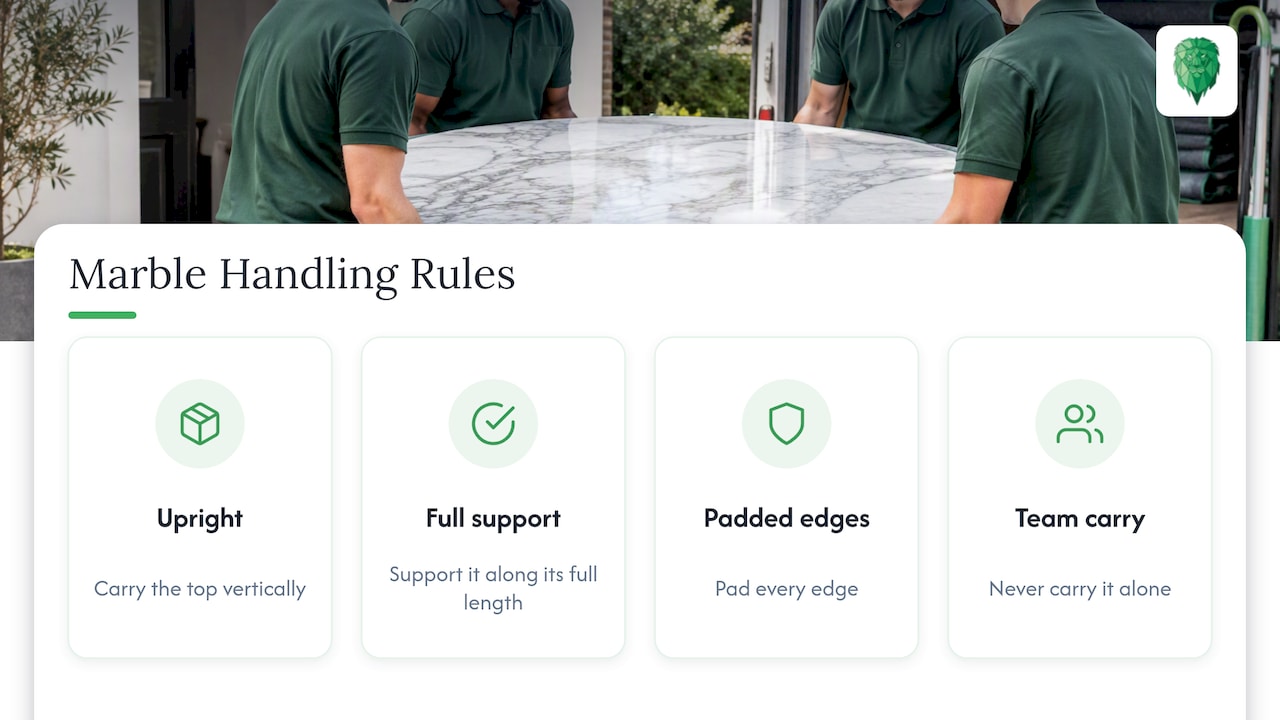
The same guidance says marble tops and other large stone slabs should be carried vertically, because they may break under their own weight. That one idea shapes almost everything below. A slab that is fine lying on a base can snap when it is lifted flat and bends in the middle.
So the goal is simple: keep the top upright, supported along its length, padded on every edge and never carried by one person.
Step 1: Assess the table before you touch it, part of marble table moving
Take ten minutes before moving day to look at what you actually have. The museum guidance advises assessing an object’s condition, including past repairs and weak points, before handling it. For a table, that means:
- Cracks and hairlines: run your eye along the edges and around any cut-outs. A crack that is already there is where the slab will fail.
- Old repairs: glued joins and filled chips are weaker than the stone around them.
- Thin or overhanging areas: corners, rounded edges and the underside of a wide overhang take the most stress when lifted.
- How it is attached: is the top simply resting on the base, held by brackets, or fixed with adhesive?
Take photos from several angles before you start. If the table is damaged later, clear before-and-after pictures make any conversation with a mover or insurer far easier.
If you spot cracks or repairs, or you simply cannot tell whether the stone is robust enough to move, the guidance is to seek specialist advice. That is not a failure of DIY spirit. It is exactly what a conservator or specialist large-object mover is for.
Step 2: Separate the top from the base, part of marble table moving
Where you can, move the component parts separately. The museum guidance says parts should be treated separately, and this is the single biggest thing you can do to lower the risk.
A typical marble dining or coffee table has three parts:
- The marble top: the heavy, fragile piece.
- The base or legs: often wood, metal or stone, and often heavier than people assume.
- Fixings: brackets, screws, bolts and sometimes adhesive pads.
Tips for taking it apart:
- Lay a thick blanket on the floor before you start, in case anything slips.
- Put screws and brackets into a labelled bag and tape it to the underside of the base, so nothing is lost.
- If the top is glued on, do not force it. Stop and ask a specialist, because prying can chip or crack the stone.
- If the legs are not removable, you are moving a one-piece table. Plan for extra people and extra padding.
If you have a table with a glass top as well as a marble one, the same logic applies, and our guide to moving a glass table safely covers the extra steps.
Step 3: Plan the route before anyone lifts, part of marble table moving
Moving day is a marathon, not a sprint, and the table is the part where you slow down. The museum guidance says to plan the route before starting, think about the lifts available, clear obstructions, arrange doors and lifts, and prepare a clear destination. It also makes a point many people miss: the shortest route may not be the safest. For large objects, the route needs enough clearance for the load and its weight, and it should put the least stress on the piece.
Walk the route with a tape measure and check:
- Width of every door and hallway: measure the top on its edge, plus a few centimetres either side for hands and padding.
- Turns and corners: a long slab carried upright needs space to pivot. Tight dog-legs in a hallway are the usual trouble spot.
- Stairs and landings: how many flights, how wide, and is there somewhere to rest the slab halfway?
- Lifts: check the internal dimensions and the weight limit, not just the door width.
- The destination: know exactly where the table will stand and clear that space, so nobody has to hold a slab while you move a sofa.
The HSE’s guidance on carrying tasks recommends level, debris-free floors, open aisles and clear access ways, and says to avoid steps, stairs and steep slopes by using hoists, powered conveyors or lifts where possible. At home, that translates to: lift the rugs, remove the shoes and boxes from the hallway, prop the doors open, and use a lift instead of stairs if you have one.
Stairs are the highest-risk part of most moves. We have a separate guide on protecting stairs during a move that is worth reading before the day.
Step 4: Wrap and pad every part, part of marble table moving
Good padding is what separates a safe move from an expensive one. The museum guidance says to prepare padding for corners, strap contact points and the places where the piece will be set down, and to avoid tilting it or putting weight on edges.
Here is a practical wrapping plan:
| Part | What to use | Why |
|---|---|---|
| Marble top (faces) | Soft, clean blanket or acid-free paper, then moving pad | Protects the polished surface from abrasion |
| Marble top (edges and corners) | Corner protectors or folded foam, taped to the pad | Corners take the knocks and chip first |
| Strap contact points | Extra pad under every strap | Stops pressure marks and bruising |
| Base and legs | Moving pad, taped in rings, then shrink wrap if needed | Protects the base and nearby walls |
| Screws and brackets | Labelled bag taped to the base | Keeps reassembly simple |
Two small but important rules: do not tape directly onto marble, because adhesive can leave residue on porous stone, and keep the wrapping snug enough that it cannot slide off mid-carry. For a full run-through of the method professionals use, see how movers wrap furniture.
It also helps to dress for the job. The museum guidance advises avoiding clothing or jewellery that could scratch or snag the marble, so take off watches, rings, belt buckles and bracelets, and wear gloves with a good grip.
Step 5: Lift and carry the top the right way, part of marble table moving
This is the step where most damage happens, so keep it calm and slow.
- Raise it vertically. The museum guidance says to raise large slabs on their edge, then lift and carry them vertically. Do not lift one end and let the other drag.
- Use equipment when you can. The HSE says manual handling covers lifting, carrying, supporting or moving heavy or bulky loads by hand, and advises using mechanical aids for heavy or awkward items wherever possible. A sack truck with a padded edge, a panel trolley or a pair of carrying straps takes a lot of strain out of the job.
- Pad your straps. If you use straps, secure them firmly and put padding at every contact point so they cannot slip or mark the stone.
- Never grip by the edges alone. Support the slab along its length, with hands under the lower edge and a helper steadying the top.
- Talk through every move. One person leads: “lift on three”, “turning left”, “stop”. Silence is how corners get chipped.
- Set it down carefully. Have padding ready before you lower it, and never rest the slab’s weight on a single corner or edge.
The HSE’s ergonomic approach is to redesign the task so the object is moved with aids rather than carried, and to improve grip, access, floor conditions and staffing where handling cannot be avoided. Treat that as your checklist: better equipment, clearer floors, more people.
Step 6: Load and secure it in the vehicle, part of marble table moving
A perfect carry can still end with a cracked top if the slab shifts on the road. GOV.UK’s load-securing guidance says to use a vehicle with a suitable, sound load platform, bodywork and anchorage points. The load should be stabilised before it is secured with a suitable system, and you should not rely on weight or friction alone. It also says there is no single solution for every load, and that you should check the vehicle’s gross and axle weight limits.
For a marble top, that means:
- Stand it on its long edge on padding, leaning against a padded bulkhead or the van wall, and not lying flat under other items.
- Block it from moving. For heavy loads, GOV.UK’s guidance on carrying different types of load says physical blocking and stabilisation should work together with lashings, because restraints should not be the only defence against a heavy load shifting. Chocks, dunnage and cradles all help.
- Use proper anchor points. The HSE says loads must be safely anchored to the vehicle, and that anchor points must be compatible with the securing equipment and firmly connected to the vehicle structure.
- Keep other items away. Do not stack boxes or other furniture against the slab, and do not let the base roll into it.
- Load it last in, first out if you can, so it is not moved around while you pack the rest.
If you are borrowing a car or a small hatchback, be realistic. A flat top in the back of an estate with a few bungee cords is exactly how marble breaks. A proper van with load restraints is the minimum.
Step 7: Handle stairs, lifts and tight doors, part of marble table moving
These are the pinch points, and they are where a plan pays off.
Stairs. Use more people than you think you need, one below and one above, with a spotter at each turn. Rest the slab on padded landings and not on the stair edges. If the staircase has a tight turn, consider whether the table can go another way, such as through a balcony or a large window, which a specialist team can assess.
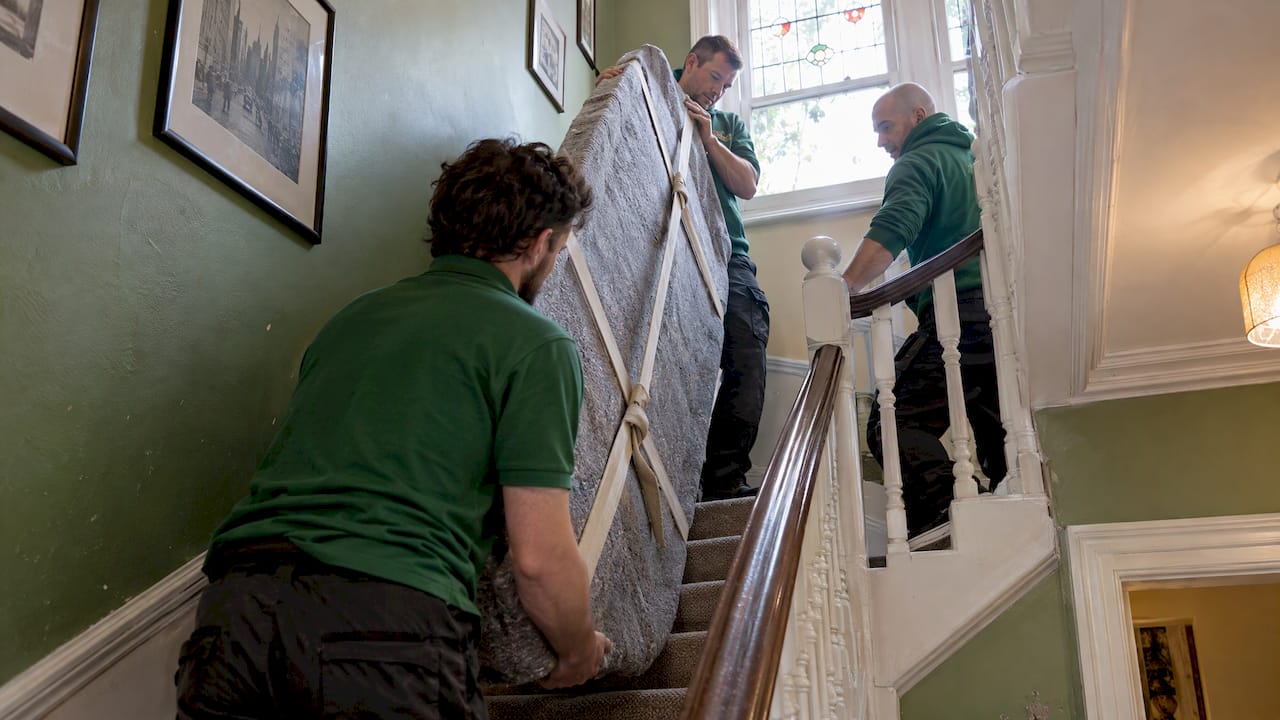
Lifts. Check the weight limit and the internal dimensions first. Stand the slab on its edge, padded, and never ride in the lift with it if there is not enough room to stand safely.
Narrow doors. Take the door off its hinges if the slab clears by only a whisker. A few minutes with a screwdriver beats a chipped edge.
The HSE’s manual handling guidance also notes that simple lifting guidelines do not apply in some situations, including team handling, complex operations and awkward or difficult-to-grasp loads, where a fuller assessment is needed. A marble top on a staircase fits all three.
Can you move a marble table by yourself? Part of marble table moving
Short answer: no. The museum guidance is clear that a heavy marble table should not be moved by one person. Large stone items need several people and may call for specialist equipment such as a forklift or pallet truck. For anything large and heavy, it recommends asking a conservator or specialist large-object mover for advice.
That is not only about the table. It is also about you. Team lifts and awkward loads are exactly where generic “lift with your knees” advice stops being enough, which is why the HSE asks for a task-specific assessment. If a slab is heavy enough that you are wondering whether you can manage it, you already have your answer.
A realistic split looks like this:
- Small marble coffee table or side table: two confident adults, the right equipment, and the steps above.
- Dining table with a large top, or anything with stairs involved: a professional team.
- Antique, repaired or cracked piece: a professional team, ideally one with experience of stone.
Our view on moving marble
After more than 15 years of moving furniture across the UK, we have seen the same pattern again and again: marble rarely breaks because of one big accident. It breaks because of small shortcuts, such as a top carried flat for “just a few steps”, a strap with no padding, or a slab left leaning on a bare tailgate.
That is why we treat a marble table as its own job. We look at the piece, the route and the destination before the van arrives, we separate the top from the base, and we pad, lift and secure each part for what it is. Our insured transport covers the journey, and we can add packing and furniture disassembly and assembly so you do not have to wrestle with brackets on the day.
If you are on the fence about doing it yourself, our honest advice is this: the cost of a careful team is small next to the cost of a replacement slab, and the peace of mind is worth more than either.
Claudiu
When to call in specialist movers, part of marble table moving
Book help if any of these apply:
- The top is wider than a standard dining table, or you cannot lift one end comfortably.
- You can see cracks, repairs or chips.
- The route includes stairs, a tight turn, a lift with a weight limit, or a narrow door.
- The top is glued down and will not separate.
- You do not have a suitable vehicle, or you would be relying on rope and bungee cords.
- You are moving house and the table is one of dozens of things you need to handle that day.
When you ask for a quote, give the mover the details that matter: the dimensions of the top, how it attaches to the base, the number of stairs and any lifts, and a couple of photos. A team that asks questions about the route and the table is a good sign. One that quotes without asking anything is not.
For wider reading on how we handle awkward pieces, see our guide to furniture delivery services.
A simple moving-day checklist
Print this, or screenshot it:
- Photograph the table from every angle, noting cracks and repairs.
- Measure the top, the base, all doors, stairs and lifts.
- Clear the route and the destination.
- Remove jewellery and watches, and put on gloves.
- Separate the top from the base, and bag and label the fixings.
- Wrap the top, corners and edges, and pad every strap point.
- Lift the top vertically with enough people and, where possible, equipment.
- Stand it on its long edge in the vehicle, blocked and secured, with nothing stacked against it.
- Carry it in the same way at the other end, and set it down on padding.
- Unwrap, inspect and photograph again before you refit the base.
Move your marble table with our team
If you would rather not carry a slab down the stairs yourself, we can take care of it. We handle large and fragile items every day as part of our furniture and large items service, and we can include packing, disassembly and reassembly. If the table is part of a bigger move, our house removals service covers the lot, with insured transport and flexible booking.
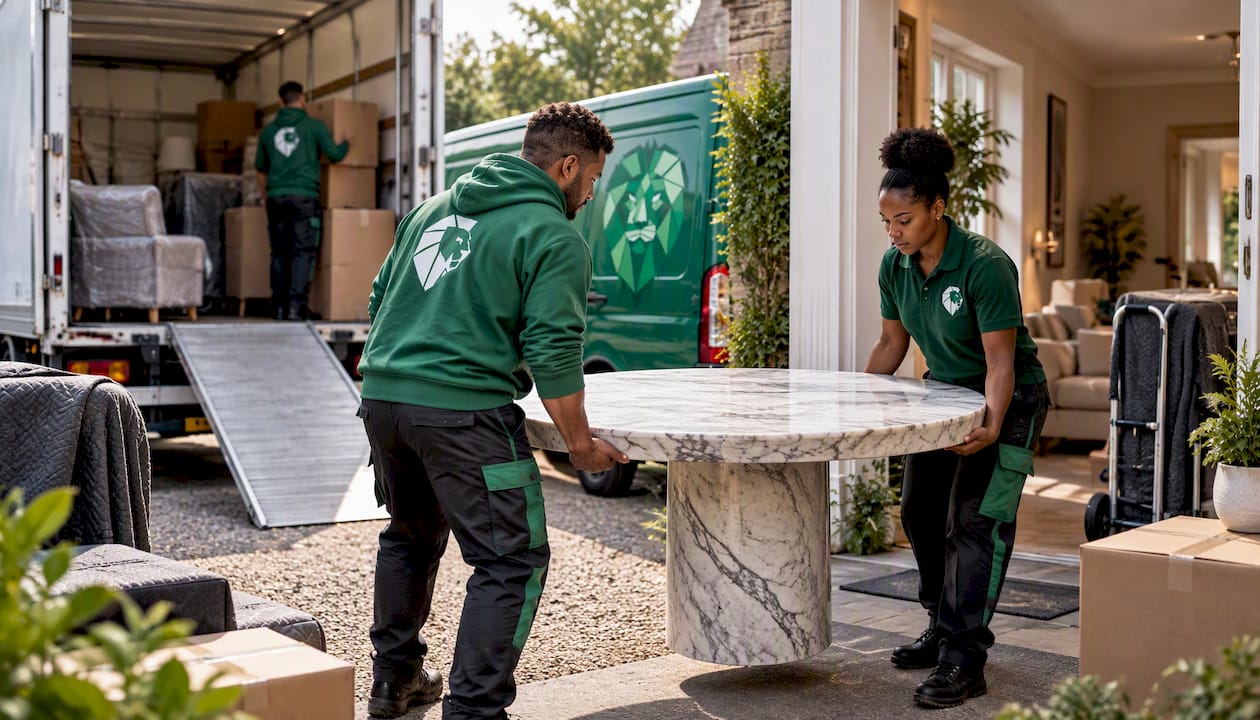
Tell us about the table and the route, and we will confirm what is involved. You can start an instant quote on our website. If the job runs longer than planned, waiting time is charged at £24 per hour per man, so sharing access details in advance keeps things smooth.
FAQ
How do you transport a marble table top?
Separate it from the base, wrap it in padding with extra protection on the corners, and carry it vertically with more than one person. In the vehicle, stand it on its edge, block it from moving and secure it to proper anchor points. Never lay it flat or rely on friction alone.
Is it possible to move heavy furniture by yourself?
For small, light pieces, yes. For a marble top, the museum guidance says not to, as large stone needs several people and may need specialist equipment. The HSE also notes that team lifts and awkward loads need a proper assessment, not generic lifting advice.
Can a marble table be moved up and down stairs?
Yes, but it is one of the riskiest parts of the job. Use enough people, pad the landings and the slab, and keep the top vertical throughout. If the stairs are narrow or have tight turns, a professional team can plan an alternative route.
Should I take the top off the base before moving?
Whenever you can. Moving the parts separately lowers the weight of each lift and protects the joint between top and base. If the top is glued or fixed in a way you cannot undo easily, stop and ask a specialist rather than forcing it.
What should I do if the marble is already cracked?
Do not lift it until it has been assessed. Seek specialist advice from a conservator or a mover experienced with heavy stone, who can decide whether and how it can be moved safely.
Sources
- Advice for Museums: handling guidelines, National Museums Scotland
- Manual handling at work, HSE (INDG143)
- Manual handling, HSE
- Control measures for carrying tasks, HSE
- Securing loads on HGVs and goods vehicles: load securing basics, GOV.UK
- Securing loads on HGVs and goods vehicles: how to carry different types of load, GOV.UK
- Securing loads, HSE