Measure furniture for doorways: the trick to measuring furniture for doorways is to measure the route, not just the door. You need the furniture’s width, depth, height and diagonal depth, the clear opening of every doorway between the street and the final room, and the space at each turn. Do that before moving day and you’ll know whether your sofa, bed or wardrobe goes through, how it needs to be tilted, and what to take off first. If the numbers say it’s tight, our team can disassemble and reassemble it for you as part of a furniture removal.
TL;DR
- Measure the furniture in four ways: width, depth, height and diagonal depth. The diagonal is the number that tells you whether a tilted sofa will pass.
- Measure doors with the door fully open, at the narrowest point, and use the smallest figure you find. Leave about 5cm spare for hands.
- A sofa that clears every door can still jam where a hallway meets the stairs, so measure both sides of each turn and the ceiling height there.
- If it doesn’t fit, work through the easy gains first: legs, cushions, the door off its hinges, then disassembly.
- Sofa beds, futons and bed frames each have one extra thing to check before you start.
Table of Contents
- Why the door is the problem, not the room
- What you need before you start
- How to measure the furniture
- How to measure a doorway properly
- Measure the hallways, stairs and landings
- Will my sofa fit through the door? Three checks in order
- Tight turns: where hallways meet stairs
- Couch too big for the door? Fixes in order
- Moving a sofa bed or a futon
- Moving a bed frame
- Moving furniture up narrow stairs
- Mark the final room too
- When we step in
- Our view on measuring
- FAQ
- Sources
Why the door is the problem, not the room, part of measure furniture for doorways
Most people measure the space where the furniture will live and forget the journey. The sofa has to get there first. Along the way it meets a front door, a hallway, maybe a porch step, a stair turn, a landing and a bedroom or living room door. The narrowest of those sets the limit for the whole move.
It helps to know how much room doors really give you. A door leaf is wider than the opening you can carry something through, because the frame, stop and open door all eat into it. In new homes in England, Approved Document M (the building regulations guidance on access) asks for a clear doorway opening of 750mm to 800mm, depending on the corridor width and the angle you approach from. Older houses have no such guarantee, and plenty of internal doors in flats and period properties are narrower than you’d expect. That’s why you measure, rather than assume.
What you need before you start, part of measure furniture for doorways
Keep it simple. You’ll need:
- A tape measure (metal, ideally, so it holds its line over a gap)
- A pen and paper or your phone’s notes
- A straight edge such as a ruler or a long spirit level, for the diagonal depth
- Masking tape, for marking the furniture’s footprint in the final room
- A second person, so one of you can hold the tape while the other reads it
Write everything in one unit. Millimetres or centimetres are easiest in the UK, and mixing in inches from a product listing is how mistakes sneak in.
How to measure the furniture, part of measure furniture for doorways
Take four measurements on anything bulky:
- Width: the longest side, such as arm to arm on a sofa.
- Depth: front to back at the deepest point.
- Height: floor to the top of the highest part, usually the back.
- Diagonal depth: the clever one. Hold the straight edge from the top of the back to the front of the arm or seat base and measure the shortest line that clears the shape. It is always shorter than the full depth, and it’s the figure that decides whether a piece can be tilted through a tight opening.
If the piece arrives wrapped or boxed, measure it packaged too. For corner, chaise and modular sofas, the largest single section matters more for access than the assembled size, because many are built in pieces once inside the room, as Denelli’s UK measuring guide explains.
Measure the legs while you’re there. Many sofas have legs that unscrew, which can shave a few centimetres off the height. Dunelm’s furniture sizing guide says most of its sofas have removable legs that reduce the height by 3.5cm to 18cm, so check yours before you write the height down.
How to measure a doorway properly, part of measure furniture for doorways
This is where most people go wrong. The number on the door isn’t the number you can use.
- Open the door fully. You want the clear opening at its narrowest point, not frame to frame. Woods Furniture’s guide suggests measuring from the door stop to the face of the open door.
- Check three heights. Measure across at the top, the middle (handle height) and near the floor. Skirting boards, hinges and handles can all pinch the gap. Use the smallest figure.
- Measure the height from the floor or threshold to the underside of the frame, including any draught strip or threshold bar.
- Note anything in the way. Radiators, porch walls, steps, a door that can’t open fully, a coat rack, a bannister post. These cut the usable width more than the frame does.
- Allow some spare. Woods Furniture recommends at least 5cm spare at every point, because walls are rarely perfectly straight and hands need somewhere to go.
Then do the same for each internal door on the route. A common mistake is measuring the front door, feeling relieved, and discovering the living room door is 10cm narrower.
Measure the hallways, stairs and landings, part of measure furniture for doorways
Walk the whole route from where the van will park to the room where the furniture ends up. Write down:
- Hallway width at its narrowest point, including radiators, meter boxes and shoe racks
- Stair width between the handrail and the wall
- Ceiling height wherever the piece has to turn, tilt or stand on end, including under the stairs and on landings
- Landing size, because you need space to swing the piece round
- Lift doors and lift interior, if there is one
For stairs, Dunelm’s guide gives a straightforward rule: the narrowest stair width must be bigger than the furniture’s height, and the landing must be bigger than its height, width and depth. If you have a ceiling lower than the furniture’s width on a turn, standing it on end won’t work either.
If you want a second opinion on how to plan a delivery route through entrances, hallways, stairs, lifts and landings, there’s a useful walk-through on checking your delivery route before the day.
Will my sofa fit through the door? Three checks in order, part of measure furniture for doorways
Once you have the numbers, compare the sofa to the smallest clear opening on the route. Go through these in order and stop at the first one that works:
- Upright: if the sofa’s depth is smaller than the clear width, you can carry it through standing on its feet.
- On its back: if the sofa’s height is smaller than the clear width, you can lay it on its back and slide it through. Take the legs off first if they unscrew.
- Tilted and angled: if the diagonal depth is smaller than the clear width, tilt it back, feed one arm through at an angle and rotate it through.
Dunelm’s version of this is a two-plan test. Plan A: if the clear door width is greater than the furniture’s height, it can go through on its back. Plan B: if the frame height is taller than the furniture’s width, it fits upright. Woods Furniture describes the same three modes: straight through, tilted and angled, and stood on end for tight corners, where the ceiling must be higher than the sofa’s width.
A worked example
Say your sofa is 200cm wide, 95cm deep and 85cm high, with a diagonal depth of 80cm. Your living room door has a clear opening of 70cm once the door is open.
- Upright: 95cm depth against 70cm. No.
- On its back: 85cm height against 70cm. No.
- Tilted: 80cm diagonal against 70cm. No, not yet.
Now take the legs off. If they come off, you might drop the height by 10cm, making it 75cm. That still doesn’t clear 70cm on its back. Lift the door off its hinges and you may gain a few centimetres of width, taking you to around 73cm. Still too tight for comfort once you add the 5cm of hand room. This is the point where disassembly (taking the back or arms off, if the design allows) is the sensible option, rather than forcing it and damaging the frame or the plaster.
The same sofa against a 76cm opening works on its back with the legs off, and with a margin.
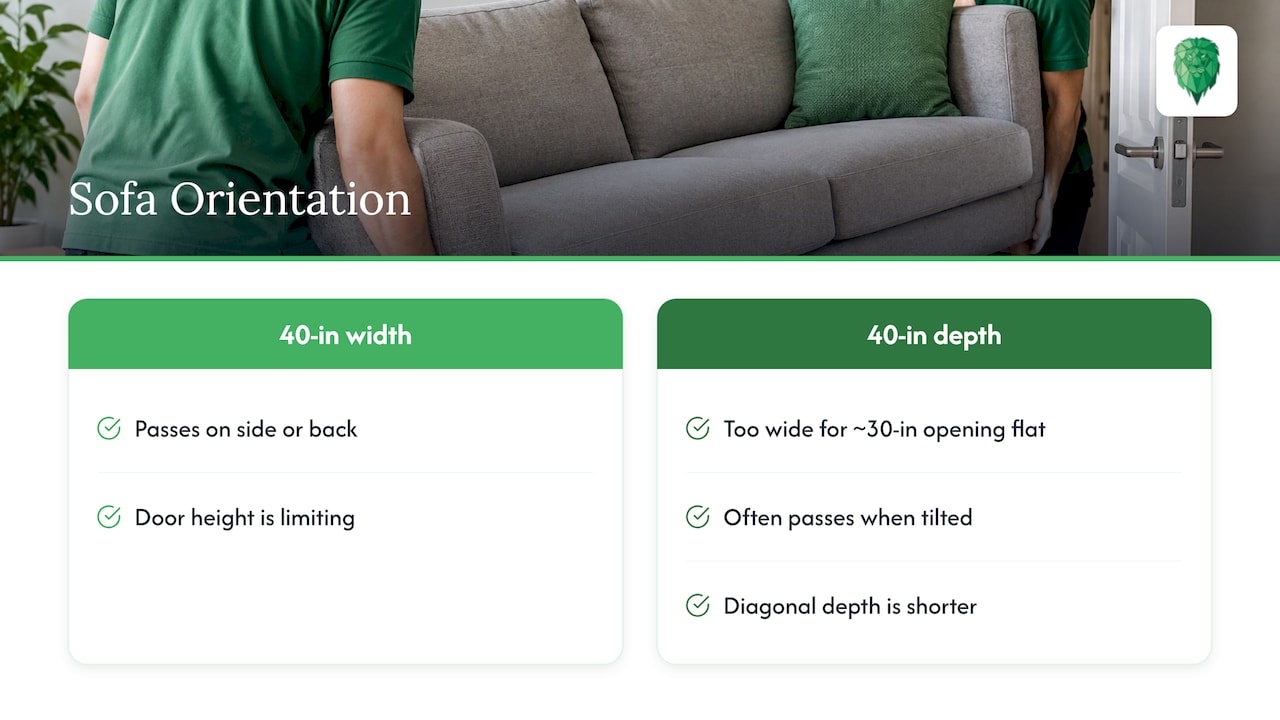
What about a 40-inch sofa and a 32-inch door? Part of measure furniture for doorways
This is a common search, and it depends on which 40-inch number you hold. If 40 inches (about 102cm) is the width, it travels on its side or back and the door’s height is the limit, so it passes easily. If 40 inches is the depth, it won’t go through a 32-inch (about 81cm) door flat, because the clear opening is closer to 30 inches once the stop and door are accounted for. It will often pass tilted, because the diagonal depth is shorter than the full depth. Measure it rather than guess: that’s what the diagonal is for.
Tight turns: where hallways meet stairs, part of measure furniture for doorways
A sofa that slips through every door can still stick at a right-angled turn. At a corner the piece has to swing across two passages at once, so the width of both matters, plus the ceiling height where it pivots. Measure both passage widths at the turn, and the height above it.
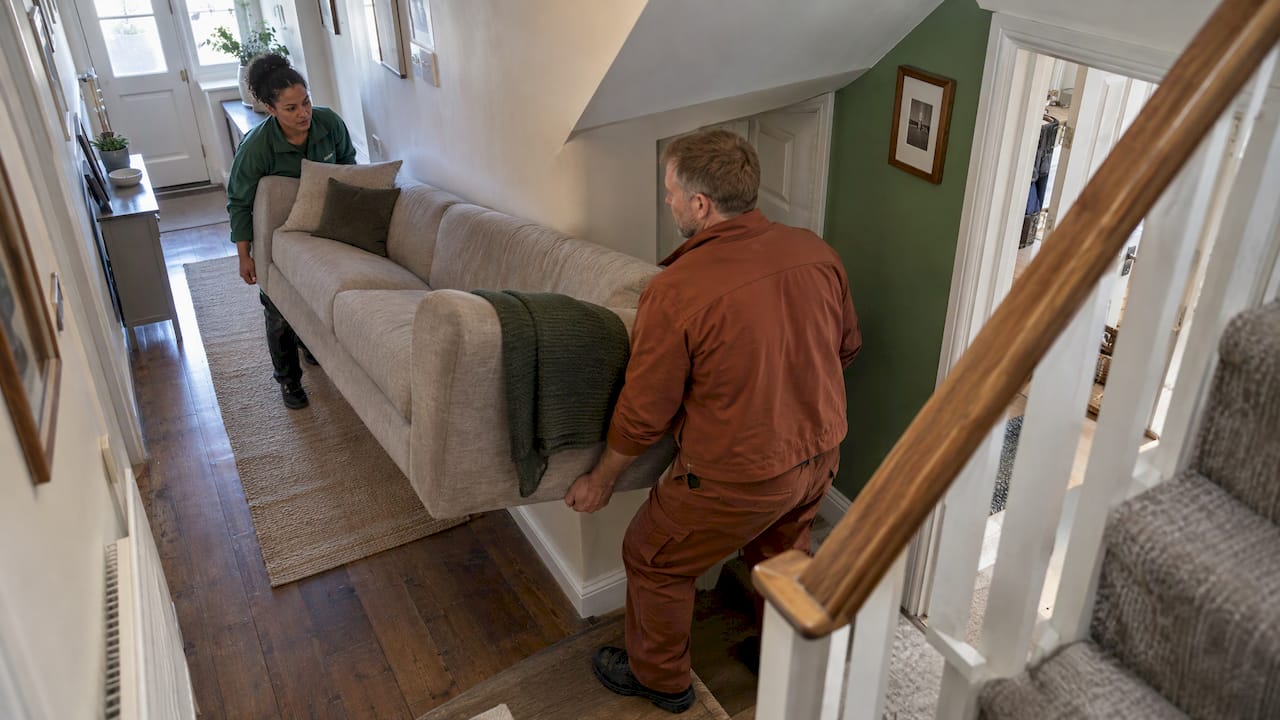
If you want a clear picture of how turning space works where a hallway meets the stairs, this piece on turning space at hallway corners shows the logic of checking clearances in small spaces.
A quick trick: cut a piece of card or cardboard to the sofa’s depth and width footprint, then try walking it through the route with a friend. It won’t be perfect, but it shows you the pinch points quickly.
Couch too big for the door? Fixes in order, part of measure furniture for doorways
Work from the easiest gain to the hardest and stop as soon as you’ve recovered the gap. Typical gains look like this (they vary with the design):
| Fix | What it gives you |
|---|---|
| Remove back or seat cushions | A few centimetres of depth |
| Unscrew the legs | Several centimetres of height, often 3.5cm to 18cm on sofas |
| Lift the door off its hinges | Typically 3cm to 5cm of width, and the door stop is gone |
| Take off removable arms or backs | Larger gains in depth, where the design allows |
| Use a wider route such as patio or French doors | Often much more clearance |
Take care with the door. Lift it off the hinges, rather than forcing the pins, and put the screws somewhere safe. Remember too that prising off door-stop trim is a last-minute option, and you’ll need to put it back or repair it.
If nothing on the list works, don’t squeeze it. Forcing a frame through a gap risks cracked timber, scuffed walls and a strained back. At this stage the right move is disassembly, which means getting someone who does this daily to take the piece apart and put it back together at the other end. That’s what our furniture assembly and disassembly is for.
Moving a sofa bed or a futon, part of measure furniture for doorways
Sofa beds and futons are less forgiving than ordinary sofas, because the folding mechanism makes them rigid and heavy. A few things change:
- Measure it folded, and measure the mechanism’s thickness as well as the frame. The folded depth is usually what you’re comparing against the door.
- Don’t fold or unfold it while carrying. Make sure the mechanism is locked closed before you lift it.
- Check the weight honestly. If you’re in doubt about whether two people can handle it safely, get help. Gloucestershire Council’s moving and handling policy, which reflects HSE guidance, draws the line between what people can lift and what they can safely lift.
- Futons often split into a frame and a mattress. Move them separately: the mattress is bulky but flexible, and the frame is the part that needs measuring.
Moving a bed frame, part of measure furniture for doorways
Bed frames are usually long and thin, which makes the doorway width less of a problem and the turn on the stairs more of one. Measure the longest side and the headboard height. Many frames come apart at the rails and the headboard, so keep the fixings together in a labelled bag taped to the frame. Slatted divan bases and ottoman beds are bulkier and rarely come apart, so they’re the ones to measure most carefully.
Moving furniture up narrow stairs, part of measure furniture for doorways
On stairs, the limit is the stair width between the handrail and the wall, and the ceiling above the turn. Long pieces need to be carried at an angle, with the heavy end low. Pay attention to how you lift. The handling guidance reflected in the Gloucestershire policy is to plan the lift, stand with your feet apart and one foot slightly forward, hug the load close to your body, avoid twisting and put the load down before adjusting its position. Slide it into place on the floor rather than adjusting it while you’re holding it.
Mark the final room too, part of measure furniture for doorways
Getting through the door is only half the job. Use masking tape to mark the furniture’s footprint on the floor of the final room. Denelli’s guide suggests this to check walking space and door and drawer opening clearance. It takes five minutes and saves you from carrying a wardrobe in, then finding it blocks the bedroom door.
When we step in, part of measure furniture for doorways
If your measurements say the piece is borderline, or you simply don’t want to risk the plaster, our team can take care of it. We cover house removals, furniture and large item moves, man and van jobs, and piano transport across the UK, and we offer furniture assembly and disassembly, packing and insured transport. After more than 15 years in the business, tight stairs and narrow doors are part of our everyday work.
If you’d like us to look at a sofa, bed or wardrobe before moving day, get an instant quote online or contact our team Hammersmith moving company . For bigger jobs, our house removals page shows what we can add, including packing, unpacking and storage. If a move runs over because access takes longer than planned, our published waiting time is £24 per hour per man. For more on handling bulky pieces, read our guides to moving heavy furniture and measuring and protecting a courier sofa.
Our view on measuring
We’ve spent more than 15 years moving large and awkward items, and the pattern is simple: the jobs that go smoothly are the ones where somebody measured the whole route in advance.
Measure the narrowest point, then measure again. Keep the diagonal depth in your notes, because it’s what lets a sofa tilt through a gap that looks impossible. Photograph the stairs and the turns, and send them to us with the dimensions.
When the maths is tight, the answer is rarely to push harder. It’s to take the piece apart properly, carry it in sections and put it back together at the other end. That’s why we offer furniture assembly and disassembly alongside insured transport, and why we’d rather talk through your route before the day than on the doorstep. Our questions to ask about sofa couriers is a good place to start.
Claudiu
FAQ
How much spare room should I leave when I measure a doorway?
Allow at least 5cm spare at every point on the route. Walls are rarely perfectly straight and your hands need somewhere to go. If you are within a centimetre or two of the clear opening, treat the piece as borderline.
Is the diagonal depth really that important?
Yes, for sofas and armchairs. Tilting a sofa lets it pass through an opening narrower than its full depth, and the diagonal depth is the figure that tells you whether this will work. Measure it with a straight edge from the top of the back to the front of the arm.
Can I take the door off to get a sofa through?
Often, yes. Taking the door off its hinges typically adds 3cm to 5cm of width and removes the door stop from the equation. Keep the hinge pins and screws safe, and check that the opening is still the narrowest point once the door is off.
What if my couch is too big for the door even after taking the legs off?
Try the other gains in order: cushions, removable arms or back, a wider route such as patio doors. If none gets you through with room to spare, have the piece disassembled and rebuilt rather than forcing it. We can do that as part of a move.
Do I need to measure for a bed frame as well?
Yes, but the long length matters less than the headboard height and the turns on the stairs. Check whether the frame separates at the rails and headboard, and bag the fixings together so nothing is lost.