Moving house timeline: most UK house moves generally take a couple of months from offer accepted to moving day, though the legal process alone can run several months if your chain is long or complicated. The date that actually matters is your completion date, and that’s fixed at exchange of contracts, usually a week or so before you get the keys.
So here’s what to do right now, before you read another word:
- Confirm your completion date the moment your solicitor gives you one
- Book your removals firm within 24 hours of that date being set
- Tell your employer and your closest contacts (childcare, school, anyone relying on your schedule)
A quick reality check: Property Passport’s week-by-week guide recommends starting your formal moving timeline around eight weeks before your target date. If you’re already inside that window, don’t panic. You just need to move faster on the tasks below.
The rest of this guide breaks your move into weekly stages, from the eight-week mark right through to the week after you’ve unpacked. Think of it as your master moving plan. Copy it, adapt it, and tick things off as you go.
Key Takeaways
A UK moving house timeline typically runs eight to twelve weeks from offer to completion, with exchange of contracts fixing the moving date that every other booking depends on.
| Point | Details |
|---|---|
| Confirm completion first | Never book removals or give notice until contracts have exchanged and the date is fixed. |
| Book removals within days | Secure your removals firm as soon as you exchange, since peak dates fill up weeks in advance. |
| Start packing at 6 to 8 weeks | Work room by room, declutter first, and order more boxes than you think you’ll need. |
| Photograph every meter reading | Take timestamped photos at both properties on moving day to avoid billing disputes later. |
| Choose the right service for your job | Van-247delivery offers full house removals with insured, tracked transport, or man-with-a-van for smaller moves. |
Table of Contents
- Your week-by-week moving house timeline
- What to expect on moving day
- Your packing schedule and what supplies to buy
- How long does conveyancing take before you can move?
- When should you book your removals company?
- What does moving house actually cost?
- What experienced UK movers know that first-timers don’t
- Where most moves lose time, and how to avoid it
- Ready to book your move?
- Sources
- FAQ
Your week-by-week moving house timeline
A moving house timeline works because it forces tasks into the right order. You can’t book removals before you know your completion date, and you can’t notify utilities before you know your new address. Miss a step and the whole schedule wobbles.
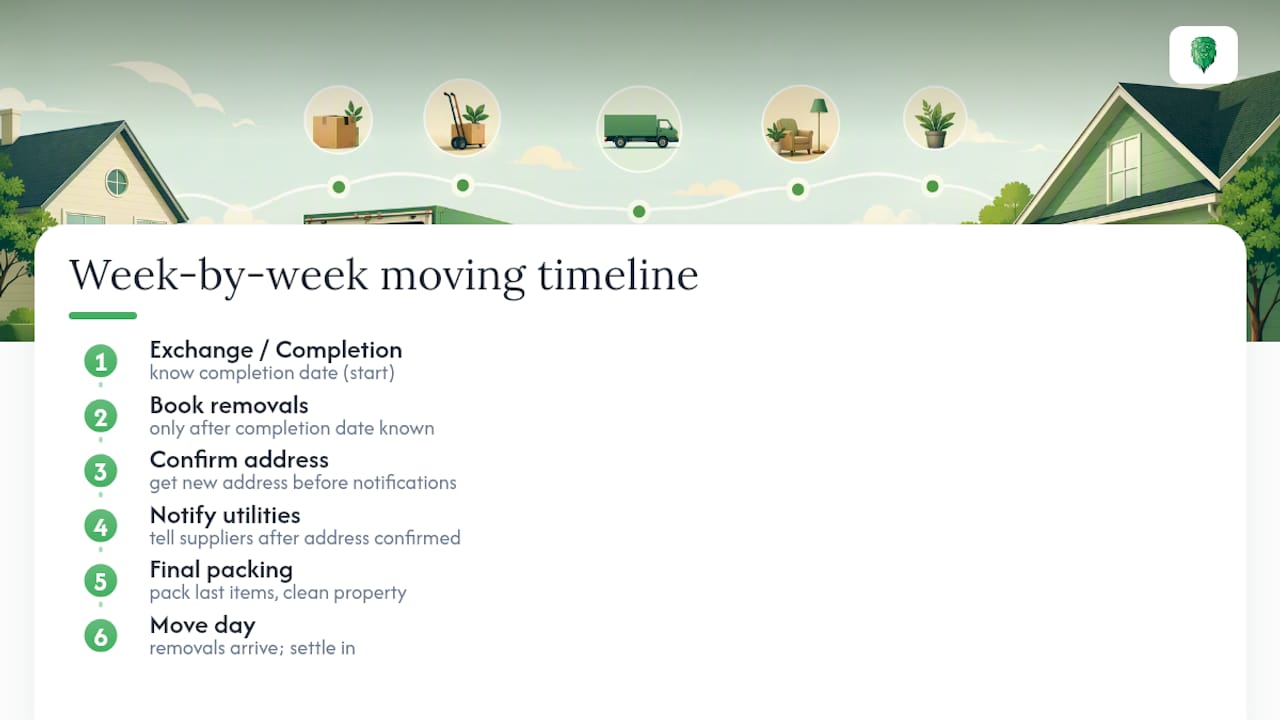
Here’s the timeline broken into windows that map onto how a typical UK purchase and move actually unfolds.
8+ weeks before moving day
This is planning territory, not packing territory. Get the groundwork sorted so the weeks that follow run smoothly.
- Confirm your moving date is realistic. If you’re buying, this depends on your mortgage in principle and where you are in the chain. If you’re renting, check your notice period against your new tenancy start.
- Get your mortgage agreement in principle sorted if you haven’t already. Lenders can take longer than expected during busy periods, and this holds up everything else.
- Start decluttering. Every item you don’t move is an item you don’t have to pack, carry, or pay to transport. Be ruthless with the loft and garage first. They’re always worse than you remember.
- Research schools, GPs, and dentists if you’re moving into a new catchment area. School admissions in particular have their own deadlines that don’t care about your completion date.
- Begin comparing removals companies. You don’t need to book yet, but knowing your options now saves a scramble later.
6 to 4 weeks before moving day
This is where the practical machinery starts turning. According to Property Passport’s checklist, this window is when most of the concrete admin happens.
- Get quotes from at least three removals firms. Ask for a fixed-price job where possible, not just an hourly rate, so you’re not penalised if the day overruns.
- Book your removals company. Weekends, Fridays, and the last week of the month are the busiest slots in the UK removals calendar, so lock in your date as soon as you can.
- Order packing materials. Boxes, tape, bubble wrap, and marker pens don’t need to be expensive, but you’ll need more than you think. Most people underestimate how many boxes they need by a wide margin, so order extra rather than run short.
- Schedule your survey, if you haven’t already, and check your mortgage valuation is booked. RICS sets the professional standards surveyors work to, and the type of survey you choose affects how long this stage takes.
- Start using up food from the freezer so you’ve less to transport or throw away later.
Pro Tip: Ask your removals firm exactly what’s included before you book: is packing an add-on, does the quote cover disassembly of wardrobes and beds, and what happens to the price if completion is delayed by a day or two? Get it in writing.
3 to 2 weeks before moving day
Notifications and admin dominate this stage. It’s tedious but it’s the part that saves you real headaches later.
- Notify utilities (gas, electricity, water, broadband) of your move date at both properties.
- Set up Royal Mail redirection. Processing can take up to five working days, so don’t leave this until the final week. A 12-month redirection is inexpensive and catches anything you forget to update manually.
- Update your address with banks, insurers, subscriptions, and your GP surgery.
- Continue packing non-essential rooms, starting with the loft, spare room, and anything already boxed for storage.
- Arrange time off work for moving day and, ideally, the day either side of it.
1 week before moving day
Everything tightens up here. This is the week you go from “still organising” to “nearly there.”
- Finish packing everything except daily essentials.
- Defrost and clean your fridge and freezer at least 24 hours before moving day so it’s dry and ready to transport.
- Confirm access, parking, and any permits your removals crew will need at both addresses, including lift bookings if you’re in a flat.
- Pack your essentials box: kettle, mugs, toilet roll, chargers, medication, a change of clothes, and anything you’d hate to hunt for on day one.
- Reconfirm timings with your removals firm and check they have the correct addresses and contact numbers.
Moving day
Moving day is a marathon, not a sprint, so pace yourself and don’t expect to unpack the kitchen before lunchtime.
- Do a final walkthrough of your old property, checking cupboards, lofts, and behind doors before the crew leaves.
- Take meter readings at both properties, ideally with a photograph timestamped on your phone as backup.
- Hand over keys and meter readings to whoever’s taking over your old address.
- Prioritise one habitable room at the new property, usually the kitchen or bedroom, so you’ve somewhere functional to retreat to once the boxes are in.
The week after moving day
The move isn’t finished once the van’s gone. There’s a short but important tail of admin.
- Update your driving licence with the DVLA and your vehicle log book if you’ve moved.
- Register with your local authority for council tax at the new address, and confirm your old council knows you’ve left.
- Notify your bank, insurers, and HMRC of your new address if you haven’t already.
- Register to vote at your new address.
- Chase up anything you notified but haven’t heard back from, particularly redirection and any subscriptions that still show your old details.
What to expect on moving day part of moving house timeline
A one-bedroom flat typically takes a few hours door to door, including loading, transit, and unloading. A three-bedroom house usually requires half to most of a day, and larger properties or long-distance moves can take a full day or more.
Several things routinely extend these windows:
- Staircases and lifts. Every flight adds time, and a lift that’s slow or shared with other residents can double your unloading time.
- Distance between the van and the front door. A long driveway or restricted parking means more trips carrying items further.
- Bulky or awkward items. Wardrobes, sofas, and pianos often need disassembly or specialist handling, which adds hours the quote might not have accounted for.
- Chain delays. If you’re in a chain, a late completion further up the line can push your entire day back, sometimes into the afternoon.
Worth knowing: many completions don’t finalise until early afternoon, even though contracts typically state completion happens by 1pm. Build a buffer into your day rather than assuming keys will be in your hand by 10am.
If parking is tight, arrange a temporary parking permit or ask neighbours in advance. A removals van that can’t park close to your door adds real time and cost, particularly if the crew is charged by the hour.

Your packing schedule and what supplies to buy
Start packing non-essential items around six to eight weeks out, working room by room rather than trying to tackle the whole house at once. Declutter before you pack, not after. It’s much easier to decide whether something’s worth keeping when it’s still on a shelf than when it’s already wrapped in bubble wrap.

A sensible order: loft and garage first, then spare rooms, then living areas, then the kitchen, and finally your bedroom and bathroom essentials in the last day or two.
For a typical three-bedroom house, you’ll usually need a substantial number of medium boxes, some heavy-duty double-wall boxes for books and crockery, packing tape and dispenser, bubble wrap or packing paper for fragile items, permanent markers for labelling, and furniture blankets or covers if you’re not using a full-service removals firm.
Pro Tip: Label every box with the room it’s going to and a one-line contents summary, not just “kitchen” or “misc.” When you’re exhausted at 6pm on moving day, you’ll thank yourself for writing “kettle, mugs, tea” on the side.
Keep an inventory as you go, even a simple spreadsheet, and pack a clearly marked essentials box last so it’s the first thing off the van. For a full room-by-room breakdown, Van-247delivery’s moving house packing checklist covers what to pack and when in more detail. Partner advice on preparing furniture and appliances for moving day is also worth a look if you’ve got large or awkward items to disconnect and protect.
How long does conveyancing take before you can move, part of moving house timeline?
Conveyancing is usually the single biggest variable in your moving house timeline, and it’s largely out of your hands once instructed. Gov confirms that the legal and conveyancing steps are what actually set your completion date, not your personal preference for a Friday move.
The stages generally run like this:
- Instruction and searches: your solicitor requests local authority, water, and environmental searches, which can take two to six weeks depending on the local authority’s response times.
- Survey and valuation: your mortgage lender requires a valuation, and you may separately commission a homebuyer’s report or full structural survey. RICS guidance covers the different survey levels available, and a more detailed survey adds time but can flag issues worth negotiating on.
- Mortgage offer: issued once the valuation and your application are approved, typically two to four weeks after application.
- Exchange of contracts: this is the legally binding moment. Once contracts exchange, your completion date is fixed and can’t be changed without both parties agreeing.
- Completion: usually one to two weeks after exchange, though same-day exchange and completion does happen in simpler chain-free transactions.
Chains lengthen this process considerably. Every buyer and seller in the chain needs their own searches, surveys, and mortgage offers to align before anyone can exchange, and one slow link holds up everyone behind it.
When should you book your removals company part of moving house timeline?
Book your removals firm as soon as you have a confirmed completion date, ideally as soon as exchange happens. Waiting until the week of your move often means settling for whichever company has a gap, which is rarely the cheapest or best-reviewed option.
- Get quotes from several companies as soon as you’re within your 6 to 8-week planning window, even before exchange, so you’re not starting from scratch under time pressure.
- Avoid peak periods where possible: month-end, Fridays, and school-holiday weeks are consistently the busiest and most expensive.
- Ask specific questions in your quote request: how many crew members, whether the price is fixed or hourly, what insurance covers accidental damage, whether packing materials are included, and whether large appliances are disconnected and reconnected as part of the job.
- Check the cancellation and delay policy before you sign anything. Completions do slip, and you want to know whether you’ll lose your deposit or simply reschedule if your date moves by a day or two.
- Consider a man-with-a-van service if you’re moving a smaller property or a handful of large items rather than a full household. It’s usually quicker to book and more cost-effective for straightforward jobs.
What does moving house actually cost part of moving house timeline?
Costs vary enormously depending on distance, property size, and how much you do yourself, but a few categories show up on almost every move.
- Removals: the single biggest line item, driven by property size, distance, and whether you choose a fixed-price job or an hourly crew rate.
- Packing materials: boxes, tape, and wrapping typically cost more than people expect, particularly if you’re buying rather than sourcing free boxes.
- Storage: worth budgeting for if there’s a gap between completion dates, even short-term.
- Insurance: some removals quotes include basic cover, but higher-value items may need additional protection.
- Royal Mail redirection: a modest cost for genuine peace of mind that post reaches you.
- Final utility bills: gas, electricity, and water providers will bill you based on your final meter readings, so keeping accurate records avoids disputes.
Getting three quotes rather than accepting the first one you receive is consistently the most effective way to keep costs down.
What experienced UK movers know that first-timers don’t
Van-247delivery has spent over 15 years handling UK removals, from single-item man-with-a-van jobs to full house relocations with insured transport and live tracking. That kind of experience shows up most clearly in how specialist items get handled: a piano or a bulky wardrobe isn’t just “heavy,” it needs specific lifting technique, protective wrapping, and often disassembly that a rushed DIY move tends to get wrong.
A few habits worth borrowing, regardless of who you book:
- Photograph every meter reading at both properties, with a timestamp, before you hand over keys
- Confirm parking and access arrangements with your removals firm at least a week ahead, not the morning of
- Ask whether white goods are disconnected and reconnected as part of the service, since this catches people out constantly
- Build your job brief with rough item counts, access details (stairs, lifts, parking restrictions), and any specialist items flagged upfront, so quotes come back accurate rather than needing revision later
A vague job description is the most common reason a removals quote changes on the day. Give the crew specifics, room counts, awkward items, parking restrictions, and access issues, and the price you’re quoted is the price you pay.
For a fuller walkthrough of what a professional job actually involves, Van-247delivery’s step-by-step house removal guide covers the process end to end.
Where most moves lose time, and how to avoid it part of moving house timeline
The biggest timing mistake I see people make isn’t underestimating packing. It’s underestimating the gap between “we’ve had an offer accepted” and “we have an actual completion date.” People book removals, tell their employer, and even give notice on rented accommodation based on a hoped-for date rather than a confirmed one. When the chain shifts by two weeks, they’re left scrambling.
The second mistake is smaller but just as painful: not photographing meter readings. It sounds trivial until you’re disputing a final bill with a supplier three months after you’ve moved, with no evidence either way.
My honest view is that the whole moving house timeline hinges on one discipline: treat exchange of contracts, not your hoped-for date, as the trigger for every booking you make. Book removals the day you exchange. Don’t book them the day you get an offer accepted. If you’d rather hand that timing pressure to someone else entirely, a professional quote takes the guesswork out of it.
— Claudiu
Ready to book your move?
Once your completion date is confirmed, the fastest way to take the pressure off is to hand the physical move to people who do this every week. Van-247delivery has covered UK removals for over 15 years, offering insured transport, live tracking, and specialist handling for pianos, white goods, and awkward furniture that a lot of firms simply won’t touch.
Whether you need a full-service house removal or just a man-with-a-van for a smaller job, the right service depends on how much you’re moving and how much you want to do yourself. A full house removal makes sense once you’re past a studio or one-bedroom flat’s worth of belongings; below that, a man with a van is usually quicker to book and lighter on cost. Getting an instant quote takes minutes: have your property size, rough item count, access details, and target date ready, and you’ll get pricing without the back-and-forth. Start your house removals quote today and lock in your date before the busy slots fill up.
Sources
A few official and professional sources are worth bookmarking as you work through your timeline:
FAQ
What is the average timeframe for moving house in the UK?
Most UK moves take eight to twelve weeks from offer accepted to completion, though chains, surveys, and mortgage delays can extend this to three to six months in more complex cases.
Why do solicitors need days between exchange and completion?
The gap, typically a week or more, gives solicitors time to transfer funds, register the property change, and coordinate timings across everyone in the chain before keys change hands.
What is a good packing timeline for a house move?
Start packing non-essential items around six to eight weeks before your move, working room by room, and leave only your essentials box and daily items for the final few days.
What are the steps involved in moving house in the UK?
The process runs from mortgage approval and surveys through conveyancing searches, exchange of contracts, and completion, followed by removals, meter readings, and administrative updates like DVLA and council tax notifications.
When should I book a removals company?
Book as soon as you have a confirmed completion date from your solicitor, ideally the same day contracts exchange, since Van-247delivery and other UK removals firms fill their busiest dates weeks in advance.