Moving house with a baby is very doable. The trick is to protect three things: your baby’s feeds, their sleep and your own energy. Everything else (boxes, furniture, forwarding the post) can bend around those. Below you’ll find a simple timeline, a list of what to keep with you, a safety check for moving day and a step-by-step way to settle your baby in once the front door closes behind you.
Moving day is a marathon, not a sprint. You don’t need to do it all yourself, and you don’t need to do it perfectly.
TL;DR
- Keep a baby bag with you, not on the van: feeds, nappies, spare clothes, any medicines and the comfort items your baby uses at bedtime.
- Ask a family member or friend to look after your baby on the day if you can, so you’re free to direct the move.
- Set up the cot and changing area first in the new home, and follow safer sleep guidance: baby on their back, firm flat mattress, nothing else in the cot.
- Keep bedtime exactly the same as usual, even if everything else around it is new.
- Book help with the heavy lifting, packing and furniture assembly so your hands (and attention) stay free for your baby.
Table of Contents
- Plan the move around your baby, not the other way round
- What to keep with you on moving day
- Keeping feeds safe and simple
- Moving-day arrangements that make life easier
- Keeping your baby safe while everything is being carried
- Set up the sleep and changing spaces first
- Helping your baby settle after the move
- Is it better to move before or after the baby arrives?
- Get help with the heavy lifting
- FAQ
- Sources
Plan the move around your baby, not the other way round
Most moves are planned around completion dates and van availability. With a baby, add a second layer: when is your baby at their best?
A few questions help you shape the day:
- When are the longest naps? If your baby naps best in the morning, try to have the heaviest, noisiest work (carrying wardrobes and the sofa) happen while they’re away or asleep somewhere calm.
- When are feeds? Build the day around them rather than squeezing them in between loads.
- Who can step in? A grandparent, a friend or a trusted childminder for even half a day makes a huge difference.
- How old is your baby? A newborn who sleeps most of the day is a very different move from a crawler who wants to explore every open door.
A simple timeline
Four to six weeks before
- Confirm your removal date and tell the team up front that you’ll have a baby on site. Good removers will plan the loading order around it.
- Book your childcare cover for moving day.
- Start decluttering. Baby clothes your little one has outgrown are a great place to begin.
Two to three weeks before
- Pack what you won’t need: out-of-season clothes, spare toys, books, the nursery decorations.
- Check the new home: where will the cot go, where is the nearest socket for a night light or monitor, are there stairs that need a gate?
- If you want help with the packing, our packing service can take the boxes off your plate.
The week before
- Pack a baby bag and a second “first night” box (see below).
- Do a last sort of the fridge and freezer. If you’re expressing or using formula, plan feeds for moving day so you’re not hunting through boxes.
- Keep routines as normal as possible. Familiar bedtimes matter more than ever this week.
The day before
- Pack the bag for the car and put it by the door.
- Take apart anything that needs it. We can do furniture disassembly and assembly, which saves you hours of fiddling with Allen keys while baby is grizzly.
- Charge phones, monitors and the car seat’s fittings if relevant.
Our step-by-step guide to moving house in the UK covers the general checklist, so you can focus this page on the baby parts.
What to keep with you on moving day
The golden rule: anything your baby needs in the first 24 hours travels with you, in the car or on your shoulder. Never on the van.
Your baby bag (within arm’s reach all day)
- Nappies and wipes, plus a changing mat and nappy bags
- Two or three spare outfits and a spare sleepsuit for you if you tend to get sicked on
- Muslin cloths
- Dummies, if you use them, and a spare
- Any medicines your baby takes and a thermometer
- Feeding kit: bottles, formula or pump parts, sterilising supplies
- A favourite toy, blanket-free comfort item or book, and whatever you use at bedtime (a sleep sack, a white noise machine)
- Snacks and a drink for you
The first-night box
This is a single clearly marked box (or two) that goes in the car, not the van, and is the first thing you open:
- Cot sheets (a couple of fitted sheets), and the sleep sack or sleepsuits for the night
- Baby monitor and its charger
- Bath things, a towel and a few toiletries
- Kettle, bottle brush, steriliser or cold-water sterilising tablets
- Night light and a plug adaptor or extension lead
- A few basic tools to put the cot together
- Your own change of clothes, medication and phone chargers
Label it in big letters with a “BABY: OPEN FIRST” sign, and tell your removal team it stays with you. If you want more on what parents typically pack in an essentials box, this step-by-step baby moving guide has a handy list of items to keep to hand.
Keeping feeds safe and simple
Moving day is when feeds get squeezed, and when fridge space disappears. A little planning keeps things safe.
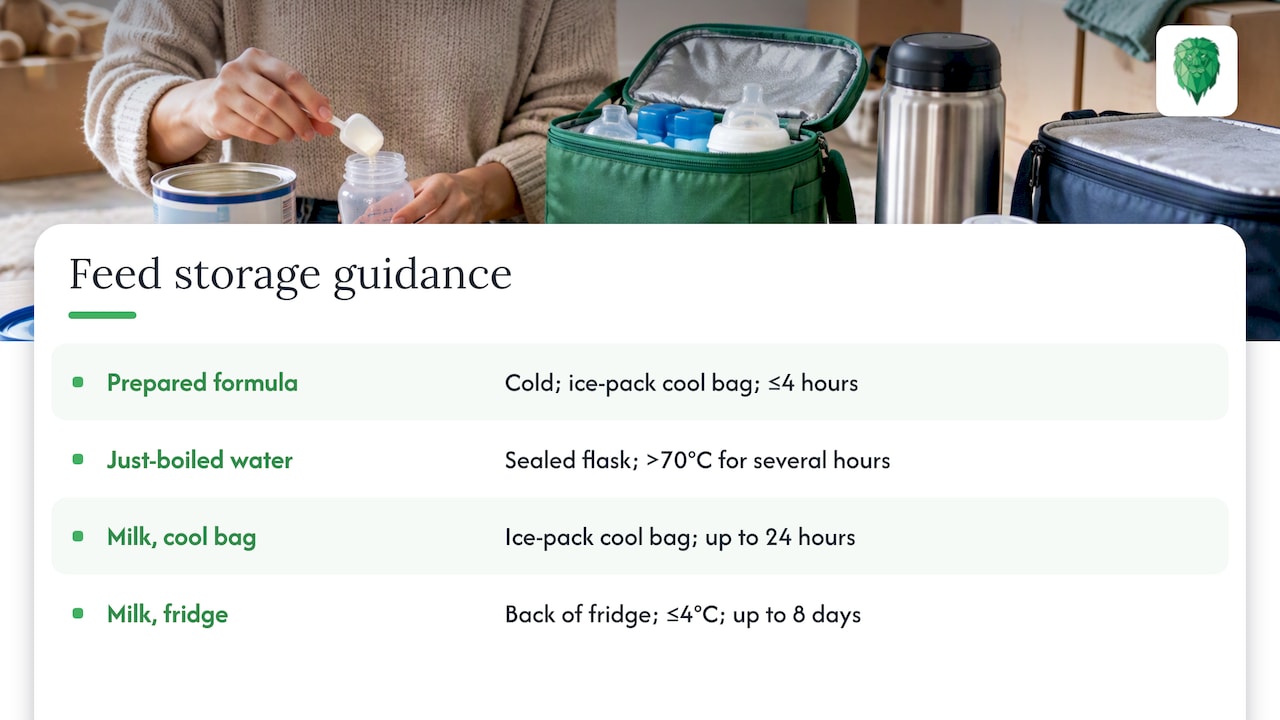
Formula. If you need to take a prepared feed with you, the NHS advises that a one-off feed made at home can be carried cold in a cool bag with an ice pack and used within four hours. A full, sealed flask of just-boiled water stays hot enough to make up a fresh feed later, and the NHS says it stays above 70°C for several hours. Pre-measuring powder into clean, dry containers ahead of time makes a fresh feed fast. The details are on the NHS formula milk questions page.
Expressed milk. If you’re expressing, the NHS guidance on expressing and storing breast milk says milk cooled in the fridge can be carried in a cool bag with ice packs for up to 24 hours, and that it keeps for up to eight days at the back of a fridge at 4°C or lower. That gives you decent breathing room if the fridge is packed away early.
Breastfeeding. Nothing to pack, but pick a quiet spot. Decide on one comfortable chair or room before the day starts, and keep it out of the way of the removal team.
If your baby has a health condition, special feeding needs or you’re unsure about something, ask your health visitor or GP before the move, not on the day.
Moving-day arrangements that make life easier
The best thing you can do for your baby on moving day is to take them out of the middle of it.
Option 1: Baby is elsewhere
If a trusted adult can look after your baby at their home for the day (or for the loading stage), do it. You get to oversee the move and your baby gets a normal, quiet day. Pick them up once the main rooms are ready.
Option 2: Baby stays, but in a protected room
If your baby has to be with you, choose one room, ideally the one with the least traffic, to be the baby base. Put the travel cot or the made-up cot there, with a monitor if needed, and keep the door shut. Tell the team that this room is off limits until the end. In the new home, do the same: pick one calm room as the first space to set up.
Option 3: Share the jobs
If there are two of you, split the roles. One person is with the baby; the other is the point of contact for the removals team. Swap at lunch.
A few smaller things that help
- Park close. Ask whether the van and your car will have clear access, and think about where you’ll leave the car seat.
- Keep paperwork handy. Keys, tenancy or completion documents and ID are easier to manage in one folder. Our removal day paperwork checklist lists what to have ready.
- Watch the waiting time. If you’re held up (a late key release, a long feed), tell the team early. Our waiting time is £24 per hour per man, so a quick chat beforehand helps you plan around naps and feeds without surprises.
- Weather. Rain and a wet-floor hallway are harder with a pram. Our calm plan for moving in bad weather is worth a read if the forecast looks grim.
Keeping your baby safe while everything is being carried
A moving day house is not a normal house. Doors are propped open, boxes sit in hallways and strangers walk through with heavy furniture. A short safety routine protects your baby.
- Keep your baby away from the action. The safest place is a closed, quiet room or somewhere else entirely.
- Take care on the stairs. The NHS says to hold the handrail when carrying a baby on the stairs and to watch out for trip hazards. Keep stairs clear of boxes and, where you can, ask the team to carry items in a way that leaves a clear route. Our guide to stair protection during a move explains how we protect both the stairs and the people using them.
- Never leave your baby on a raised surface. Babies can fall from beds and changing tables, as the NHS baby and toddler safety page explains. On moving day, a changing mat on the floor is safer than a stacked box or half-built chest of drawers. The Healthier Together guidance on falls also recommends changing nappies on the floor, keeping car seats and bouncing chairs on the floor, and strapping babies into highchairs every time.
- Keep walkways clear. Just One Norfolk, an NHS service, advises keeping rooms clear of clutter to avoid trips and falls. After a move, that’s a tall order for a few days, so keep at least one baby-friendly room tidy.
A safety check in the new home
Before your baby spends their first night, run through the basics. The Just One Norfolk guide to a safe home suggests checking that smoke alarms and carbon monoxide detectors work and setting hot water to 60°C to reduce scald risk. Its advice is that home safety is best prepared before a newborn arrives and checked again when the baby starts crawling.
If your baby is mobile or about to be:
- Fit stair gates. nidirect advises that only screw-fixed gates are suitable at the top of stairs, while pressure-mounted gates suit only the bottom.
- Skip the baby walker. Physiotherapists and other health professionals don’t recommend them, because accidents can include falls down stairs, according to this NHS physiotherapy leaflet on baby walkers.
- Move boxes of breakable or sharp items out of reach before you unpack the rest.
Set up the sleep and changing spaces first
If you only do one thing before unpacking the kitchen, set up the cot.
A rested baby makes for a calmer evening, and a calmer evening makes the first night in a new house far less daunting. Follow current safer sleep guidance when you do it:
- Babies aged 12 months and under should sleep on their backs in their own cot, on a firm, flat, waterproof mattress, in a room kept at 16 to 20°C. Babies under six months should have an adult in the same room for every sleep. This comes from England’s safer sleep guidance for early years providers, which is also a good benchmark at home.
- Keep the cot clear. The same guidance says sleep spaces must not contain extras such as toys, pillows, loose bedding, bumpers, wedges or straps.
- The Lullaby Trust gives matching advice for a cot or Moses basket: a firm, flat, waterproof mattress, kept clear of pillows, duvets, toys and other items.
A practical order for the new bedroom:
- Build the cot and put the mattress in before the removal team leaves, or ask us to do the assembly while we’re there.
- Put the fitted sheet on and check nothing else is inside.
- Hang a thermometer in the room to check it sits in that 16 to 20°C range.
- Plug in the monitor and night light.
- Set up a changing spot on the floor or a sturdy, stable surface with everything within reach.
If you’re in a rush, a made-up travel cot gives you a safe sleep space straight away while the bigger cot waits.
Helping your baby settle after the move
Babies don’t understand addresses, but they do notice changes in light, sound and smell. Your job is to keep the familiar things familiar.
Keep bedtime identical
Use the same order, the same songs, the same sleep sack and the same background sound you always do. Your baby may not remember the old house, but they’ll recognise the routine. Even if the room is full of boxes, a predictable bedtime is the anchor.
Protect the longest nap
If you can only manage one thing during the day, make it the longest nap, in a calm room. Everything else flexes around it.
Make feeding easy
Pre-measured formula or pump parts ready to go keep the first few days simple. Don’t worry if you rely on convenience for a little while.
Give it time
Expect a few unsettled nights. Stay close, keep your voice quiet and keep to the routine. If your baby seems unwell, is feeding poorly or you’re worried about their sleep, call your health visitor or GP, or NHS 111 if you need advice out of hours.
Look after yourself, too
You’re moving house and caring for a baby. Eat something. Accept offers of help. Leave the boxes in the spare room for a week. Nobody will judge you for a half-unpacked house.
Introduce the neighbourhood slowly
Once the first few days pass, take short walks. Find the nearest park, GP surgery and pharmacy. Register with a local GP if you’re moving out of your old area, and tell your health visitor about the new address so your baby’s checks continue.
Is it better to move before or after the baby arrives?
There’s no right answer, and many parents simply don’t get to choose. Moving before the birth means you can renovate and settle in while you have more energy. Moving with a baby means you handle the logistics with less spare time, but often with a clear reason to be organised. Whichever applies to you, the principles stay the same: plan early, ask for help and protect the baby’s routine.
Our perspective on moving with a baby
After more than 15 years of helping people move, we’ve seen that the stress on moving day rarely comes from the van. It comes from the parent trying to supervise the loading, answer the door, watch the baby and remember where the kettle went, all at once.
That’s why we think the most useful thing a removal team can do for a family with a baby is to take over as much of the physical work as possible: the packing, the disassembly, the loading, the reassembly of the cot and the unpacking. Our services cover all of those, so your hands and attention stay free for your baby.
We’d always rather hear about the baby at the start. Tell us when the naps are, which room is the baby room and what needs to come off the van first. We can plan the loading order, protect the stairs and be flexible with timings so the day works around you, not the other way round.
The other thing we’d say is: don’t try to be a hero. A move with a baby is a job for a team.
Claudiu
Get help with the heavy lifting
If you’re planning a move with a baby, we can take the heaviest parts of the day off you: packing, furniture disassembly and assembly, loading, transport with insurance, plus storage and unpacking if you need them. You tell us what your baby’s day looks like and we plan around it. See our house removals service for the full range, or get an instant quote and book on the Van-247delivery site.
Moving a short distance or just a few items? Our man and van service and furniture and large items courier cover smaller jobs, like moving a cot, a wardrobe or a chest of drawers ahead of the main move.
FAQ
When is the best time of day to move house with a baby?
There isn’t a universal best time, but an early start often works well because the day’s hardest work is done before the afternoon. Plan around your baby’s longest nap and feeds, and tell your removal team about them in advance so loading can be sequenced to match.
Should my baby be at the house during the move?
If you can arrange for a trusted adult to look after your baby elsewhere, that’s usually the calmest option. If your baby has to be there, choose a quiet, closed-off room as the baby base and keep them away from doorways, stairs and anyone carrying furniture.
What should I pack separately for my baby?
Keep a baby bag with you: nappies, wipes, spare clothes, feeding supplies, any medicines, a thermometer and the comfort items used at bedtime. Add a first-night box with cot sheets, sleep sacks, a monitor and your own essentials, so the cot can be made up before anything else.
How do I keep my baby’s routine going during a move?
Keep bedtime exactly as it always is, protect the longest nap where possible and keep feeds simple with pre-measured formula or ready pump parts. Predictability matters more than perfection, so don’t worry if the rest of the day is messy.
How can I help my baby sleep in the new house?
Set up the cot first, following safer sleep guidance: baby on their back, firm flat waterproof mattress, nothing else in the cot and a room temperature of 16 to 20°C. Then run the same bedtime routine you used before the move.
Sources
- How To Move With a Baby: A Step-by-Step Guide
- Formula milk: common questions, NHS
- Expressing and storing breast milk, NHS
- Baby and toddler safety, NHS
- Falls, Healthier Together
- Making A Safe Home For Your Growing Family, Just One Norfolk
- Guarding children against trips and falls, nidirect
- Babywalkers: are they necessary?, Whittington Health NHS
- Safer sleep, Help for early years providers
- Safer sleep away from home, The Lullaby Trust