No forklift pallet collection: no forklift on site doesn’t mean no collection. A pallet can still leave your premises if the vehicle has a tail lift, the driver has a pallet truck and the route from your door to the kerb is flat, clear and wide enough. Most failed collections come down to access and preparation, not the missing forklift. This guide covers what to check, how to get the pallet ready and what to tell the courier when you book, so the driver can load and go. If you want it handled by people with over 15 years in logistics, you can book a pallet job through our pallet delivery page.
TL;DR
- A forklift is not essential: a tail lift plus a pallet truck can load most standard pallets, provided the ground is firm, level and clear.
- Check your access before booking: surface, slope, width, kerb height and where the vehicle can legally stop.
- Keep the load stable. As a general guide, HSE advises that load height should not exceed the longest base dimension of the pallet.
- Weight and dimensions are the first things a courier needs, so have them ready before you ask for a quote.
- Unwanted or damaged pallets should be marked, set aside and sent for repair or disposal, not reused.
Table of Contents
- What collection without a forklift actually involves
- Why the loading method matters more than you think
- Check your site before you book
- Prepare the pallet so it can move
- When the pallet is damaged or no longer wanted
- What affects cost and timing
- If the pallet can’t be loaded at your site
- Our view: preparation beats equipment
- Book your pallet collection with us
- FAQ
- Sources
What collection without a forklift actually involves, part of no forklift pallet collection
A forklift is just one way of lifting a pallet from the ground to the vehicle bed. When there isn’t one, the job usually relies on two pieces of kit working together:
- A tail lift: a platform at the back of the vehicle that raises and lowers the load between ground and bed.
- A pallet truck: the hand-operated (or powered) trolley with two forks that slides under the pallet and moves it across the floor.
The pallet is wheeled from where it sits to the back of the vehicle, onto the lowered platform, raised, and then moved into the vehicle. Simple enough, but every stage has a condition attached: the floor must be solid, the route clear and the load within what the equipment is rated for.
This suits palletised goods of a normal size: boxed stock, building materials, furniture packed on a pallet, returns, equipment. It becomes harder with very heavy loads, tall or unstable stacks, or pallets sitting at the back of a yard with soft ground in between. None of that is a dead end. It just means the details need to be known before the driver turns up.
Why the loading method matters more than you think, part of no forklift pallet collection
The Association of Pallet Networks (APN) publishes tail lift and pallet truck guidance that treats every tail-lift task as something to be risk-assessed. It points to the things that change the risk on the day: the site conditions, the weight and behaviour of the load, and the state of the floor, including season, surface, incline and weather.
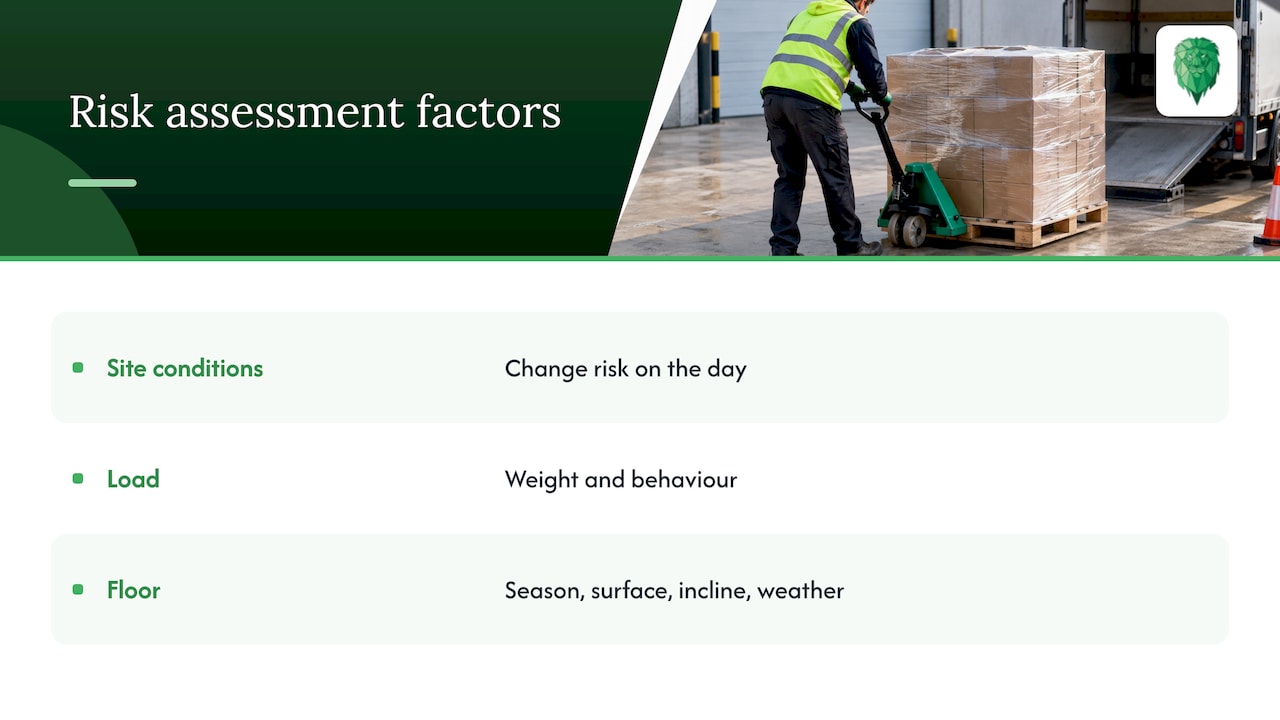
It also says pallet trucks and tail lifts must be rated for the loads they move, and that heavier loads call for power-assisted trucks or other methods. In plain words: a hand pallet truck is fine for a light load on a smooth floor, but a heavy pallet on a ramp in the rain is a different job.
One detail worth knowing: the same guidance notes that tail lifts are often not perfectly flush with the vehicle bed. A raised lip makes the pallet harder to push on, and a downward slope raises the risk of it rolling off. That is why a level, firm pick-up spot matters so much. You can help the driver by choosing the flattest, hardest ground you have for the handover.
Check your site before you book, part of no forklift pallet collection
Walk the route the pallet will take, from where it is stored to where the vehicle will stop. Write down the answers to these:
- Surface: is it concrete or tarmac, or gravel, grass or mud? Soft or uneven ground makes small pallet truck wheels stick and tilt.
- Slope: is there any incline between the pallet and the vehicle? Even a gentle slope matters with a heavy load.
- Width and doors: can a pallet and truck pass through every doorway and gate? A standard pallet is wide, so measure anything tight.
- Kerb or step: is there a drop between your premises and the road or loading bay? Ask about ramps rather than hoping for the best.
- Vehicle access: can a van or small lorry get close, and can it stop safely and legally? Narrow streets, parking restrictions and low barriers all count.
- Weather: wet surfaces change how a load behaves, so mention any outdoor stretch.
- Space to manoeuvre: the driver needs room to lower the tail lift and swing the truck round.
If you’re collecting from a home address, a garage or driveway can work well, as long as the ground is firm and the pallet is already at the front, not buried behind other things. For a business unit, a loading bay or a flat yard is ideal.
Tell the courier about anything that isn’t straightforward when you request the quote. A pick-up that is described accurately is a pick-up that goes smoothly, and it avoids the driver arriving to find a route they cannot use.
Prepare the pallet so it can move, part of no forklift pallet collection
The pallet itself needs to be ready for a truck to lift. The HSE’s pallet safety guidance (PM15) is the official reference here, and a few of its points are easy to apply:
- Inspect the pallet every time it is used. Look for broken boards, protruding nails and cracked blocks. A pallet that isn’t fit for purpose shouldn’t be loaded.
- Keep the load within the pallet. As a general guide, the height of the load should not exceed the longest base dimension of the pallet. On a standard pallet that keeps the stack low enough to stay stable.
- Stack pallets only with care. The HSE says maximum stacking height should be no more than six times the narrowest dimension of the bottom pallet, and only after consultation with the manufacturer or a competent authority.
- Handle empty pallets gently. They should not be dragged or thrown down.
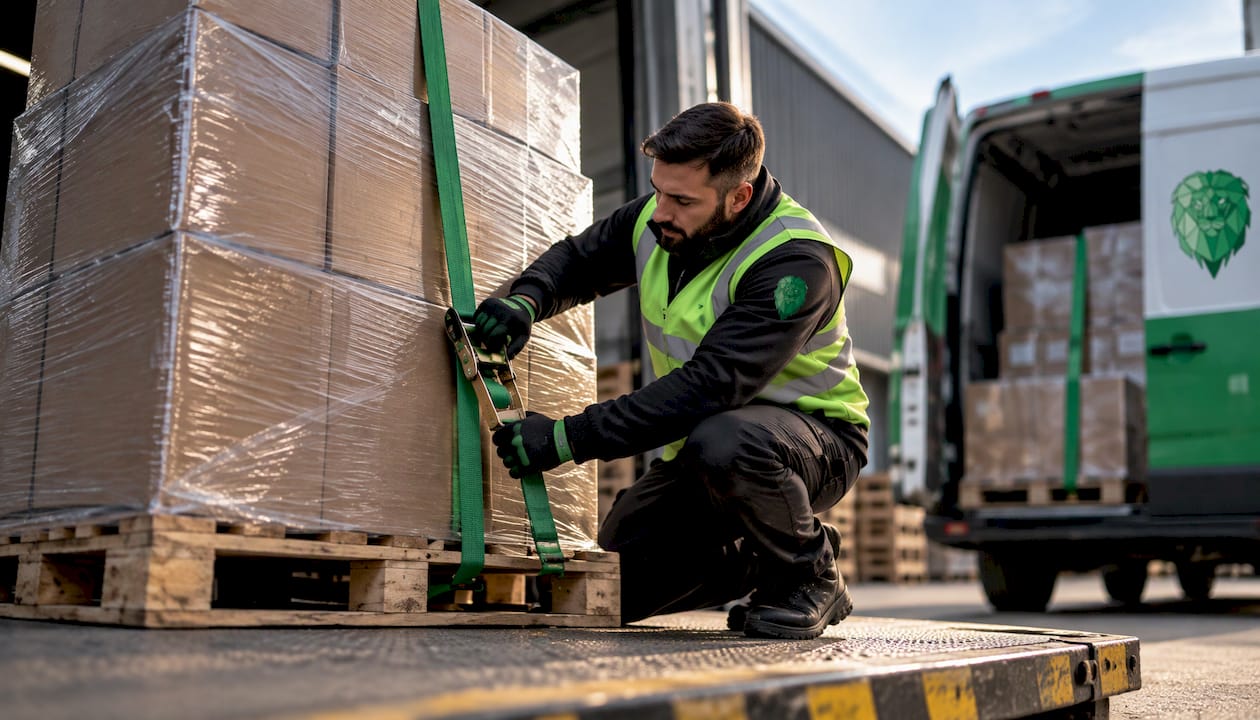
Beyond the HSE points, the practical routine is straightforward: wrap the load securely so nothing shifts, put heavier items at the bottom, keep the edges square, and make sure the forks of a pallet truck can enter from at least two sides without catching on anything. Label the pallet with the destination and, if there is more than one, keep each separate and clearly marked.
If you’re palletising goods yourself for the first time, our palletising guide for the UK walks through the build step by step. For heavy kit that needs careful positioning, such as commercial catering equipment, this piece on stacking commercial ovens safely shows the kind of care that heavy items need.
What to have ready when you request the quote, part of no forklift pallet collection
Have these details to hand, because they decide the vehicle, the equipment and the timing:
| Detail | Why it matters |
|---|---|
| Number of pallets | Sets the vehicle size and loading time |
| Weight per pallet | Must be within what the tail lift and truck are rated for |
| Dimensions including height | Affects what fits and how stable the load is |
| Pick-up address and access notes | Surface, slope, gates and parking |
| Destination address | Confirms the journey and delivery access |
| Preferred collection window | Lets the driver plan the day |
Accurate numbers are not a formality. They are what the driver uses to decide whether the equipment on board is the right equipment for your site.
When the pallet is damaged or no longer wanted, part of no forklift pallet collection
Some people searching this phrase don’t want to send stock anywhere: they have unwanted pallets sitting in the yard, perhaps left behind after a delivery. The HSE’s guidance is clear on what happens to a damaged pallet: it should be marked, isolated and withdrawn for repair or disposal. Pooled pallets that need repair should, in the first instance, go back to the pallet owner or the trademark owner’s authorised representative.
So before you arrange a collection, check the condition and ownership:
- Sound and standard-sized: it can often be reused or passed on.
- Damaged: set it aside and mark it so no one loads it by mistake.
- Branded or pooled: it may belong to someone else and should go back to its owner.
If you’d like us to take pallets away, see our page on pallet collection and disposal.
What affects cost and timing, part of no forklift pallet collection
We don’t publish a flat price for pallet jobs, because the price depends on the job. What typically moves it:
- Number and weight of pallets: more pallets or heavier loads mean a larger vehicle and more handling.
- Distance: collection and delivery addresses set the journey.
- Access: a difficult pick-up takes longer than a clear loading bay.
- Speed: a collection you need quickly is planned differently from one with a flexible window.
- Waiting time: if the pallet isn’t ready when the driver arrives, the clock runs. Our waiting time fee is £24 per hour per man.
The last point is the easiest to control. Have the pallets wrapped, labelled and positioned at the front before the collection window opens, and the driver can load and leave. The cheapest pallet job is nearly always the one that is ready on time.
For how pallet networks move goods between collection and delivery, our articles on how delivery on a pallet works and the delivery pallet process explain each stage.
If the pallet can’t be loaded at your site, part of no forklift pallet collection
Sometimes the site simply cannot take a tail-lift vehicle: a steep drive, a soft yard, a narrow lane. The practical fixes are all about moving the handover point:
- Move the pallet to a flat, hard spot nearer the road before the driver arrives.
- Split a heavy load into smaller, lighter pallets that are easier to handle.
- Use a different pick-up address with better access, such as a unit, loading bay or neighbouring premises with permission.
- Break the pallet down into boxes or items that can be carried, if it is not a true palletised load.
Tell us about the constraint when you book and we can plan around it, rather than finding out at the kerb.
Our view: preparation beats equipment, part of no forklift pallet collection
We have been moving things around the UK for over 15 years, and the pattern is consistent: a collection goes well when the pick-up has been described properly, not when the site has the fanciest kit.
A forklift is a convenience. What a driver really needs is a firm, level spot, a clear route and a pallet that is wrapped and ready. If you can give us those three things, the missing forklift stops being a problem.
That is why we like to treat pallet work as part of a complete service. Our insured transport, our flexible booking and our instant online quote are built so you can describe the job, get it booked and know it is covered. And if the load is part of a bigger move, we can also help with packing, storage and furniture assembly or disassembly, so you aren’t juggling several suppliers.
Moving day is a marathon, not a sprint. Spend ten minutes on the access check and everything after it gets easier.
Claudiu
Book your pallet collection with us
We handle pallet delivery and collection across the UK, backed by over 15 years in logistics, with insured transport and flexible booking. You can describe your pallets and get an instant online quote, then confirm your booking, without chasing anyone on the phone.
If your pallets are part of a house move, an office relocation or a furniture job, we cover those too: see house removals, office relocation or furniture and large items. Start with the pallet delivery page and tell us what you have.
FAQ
Can a pallet really be collected without a forklift?
Yes. A vehicle with a tail lift and a driver with a pallet truck can load most standard pallets, as long as the ground is firm and level and the pallet is within the equipment’s rated load. Heavier or awkward loads may need powered equipment or a different handover point, so give the weight and access details when you ask for a quote.
What should I tell the courier about my site?
Give the number of pallets, weight and dimensions of each, the surface and any slope between the pallet and the road, the width of gates and doors, and where the vehicle can stop. The more accurate these are, the better the driver can match the vehicle and equipment to your site.
How high can I stack a load on a pallet?
The HSE says, as a general guide, that the load height should not exceed the longest base dimension of the pallet. For stacking pallets on top of each other, it advises a maximum of six times the narrowest dimension of the bottom pallet, and only after consulting the manufacturer or a competent authority.
What do I do with a damaged pallet?
Mark it, set it apart from usable pallets and withdraw it for repair or disposal. If it is a pooled pallet that needs repair, the HSE says it should first go back to the pallet owner or the trademark owner’s authorised representative.
Do I pay if the driver has to wait?
Our waiting time fee is £24 per hour per man. Having the pallets wrapped, labelled and in position before the collection window avoids it entirely.