Office move insurance UK isn’t one single policy. It’s a mix of cover: the goods in transit protection that applies while your equipment is on the road, the liability cover your removal company carries, and the business policies you already hold, which may need updating for a new address. Get those three lined up before moving day and you’ll know who pays if a monitor cracks, a server goes missing or someone gets hurt.
This guide walks you through each layer in plain English, tells you what proof of cover to ask for, and shows what to do if a claim goes wrong. Moving is a marathon, not a sprint, and the insurance paperwork is best done weeks ahead, not on the morning the van arrives.
TL;DR
- Goods in transit cover protects items while they are being loaded, driven and unloaded. Check whose policy it is: yours, or your removal company’s.
- Ask your mover for written proof of cover, the limits that apply to your move and any exclusions, before you book.
- If you have employees, employers’ liability insurance is a legal requirement in Great Britain, with a minimum of £5 million cover.
- Tell your own insurer about the move, and check that high-value items such as servers are listed individually.
- If a claim is refused unfairly, use the insurer’s complaints process, then the Financial Ombudsman Service.
Table of Contents
- What office move insurance actually covers
- Does the removal company’s insurance protect you?
- What proof of cover to ask for
- The legal minimum: employers’ liability insurance
- Check your own business policies
- How to reduce the risk before moving day
- Making a claim after an office move
- Our perspective
- Moving your office with Van-247
- A simple insurance timeline for your move
- FAQ
- Sources
What office move insurance actually covers, part of office move insurance UK
When people search for office move insurance, they usually mean one of two things: cover for the goods being moved, or cover for the things that can go wrong around the move (injury, damage to the building, downtime). Both matter.
Goods in transit is the core of it. As an example of how this cover is written, AXA describes its Goods in Transit cover as paying the cost of replacing covered goods that are lost, stolen or damaged in transit, including loading and unloading. It applies to goods already covered under your contents policy, in the UK, and includes goods in vehicles you own, lease or hire as well as goods carried by a third-party carrier.
That last point is the one that matters for an office move. If a removal company carries your desks, PCs and filing cabinets, a policy like this may respond, but only if your own policy is set up that way. Wording differs between insurers, so read yours.
In practice, a sensible office move involves four kinds of protection:
| Cover | What it is for | Whose policy is it usually? |
|---|---|---|
| Goods in transit | Loss, theft or damage to equipment and furniture while loaded, driven and unloaded | The mover’s, yours, or both |
| Public liability | Damage to third-party property or injury to members of the public, such as a scratched lift or a damaged lobby | The mover’s, and yours |
| Employers’ liability | Injury or illness to employees arising from work | Every employer in Great Britain with staff, including the mover for its crew |
| Contents and business interruption | Your equipment at the old and new premises, and lost income if you cannot operate | Yours |
Does the removal company’s insurance protect you? Part of office move insurance UK
Often, yes, in part. But “we’re fully insured” is a statement, not a document. A removal company’s policy protects its legal liability and, depending on the wording, may cover the goods it carries. What it does not do automatically is replace your own cover.
Three things are worth knowing:
- Limits. Cover for goods in transit normally has an upper limit, per item, per load or both. A van carrying a full office can be worth far more than the limit.
- Conditions. Many policies expect items to be packed or protected in a certain way. Unpacked monitors or loose cabling can be treated differently from crated ones.
- Liability versus insurance. A mover is not automatically responsible for every loss. Liability depends on the contract and on what caused the problem. We go deeper on this in our guide to goods in transit versus liability.
If you’re weighing up the questions to put to a supplier, our article on commercial move insurance gives you five to start with.
What proof of cover to ask for, part of office move insurance UK
Don’t settle for a verbal assurance. Before you book, ask the removal company to send you:
- The certificate or policy schedule for goods in transit or removals cover, showing the insurer, the policy period and the limits.
- Public liability confirmation, with the level of cover.
- Employers’ liability certificate. If the mover has staff, this is a legal requirement, so it should be easy to produce. Employers’ liability certificates must be displayed where employees can easily access them, including electronically, according to the HSE guidance on the 1969 Act.
- Exclusions in writing. Ask directly about items such as servers, glass, artwork, cash and documents, and about anything that has to be packed a certain way.
- Excess. Find out who pays it if something is damaged and how much it is.
- How the value of a claim is worked out. Replacement cost is very different from a depreciated value.
- The claims process. Who do you notify, how quickly, and with what evidence?
Keep copies with your move file. If a problem arises on the day, having the paperwork to hand saves a lot of stress.
The legal minimum: employers’ liability insurance, part of office move insurance UK
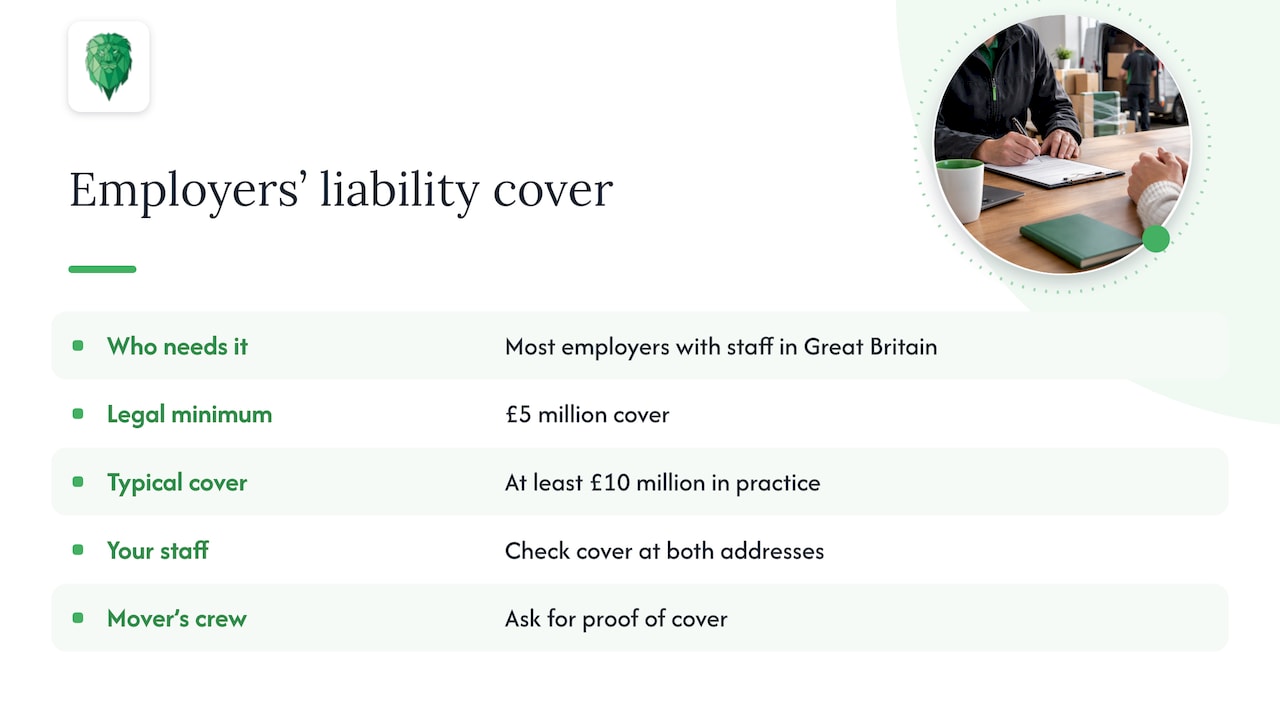
This is the one piece of the puzzle that isn’t optional. According to GOV.UK, employers’ liability insurance is legally required for most businesses with employees in Great Britain, with minimum cover of £5 million, to cover claims for injury or illness arising from work. The HSE guide to the Employers’ Liability (Compulsory Insurance) Act 1969 adds that most insurers provide at least £10 million in practice.
Why does it matter for a move? Because moving day involves lifting, ladders, loading ramps and unfamiliar buildings. If your own staff are helping (carrying plants, taking down pinboards, unplugging kit), your employers’ liability policy is what responds if one of them is hurt. Check that your policy covers your people working at both addresses. And if you’re hiring a removal firm, ask for proof that its own crew are covered too.
Check your own business policies, part of office move insurance UK
Your mover’s insurance is only one layer. Your own policies need a look too.
Tell your insurer you’re moving
A new address changes your risk: different building, different security, possibly a different flood or theft profile. Let your broker or insurer know the date and the new address, and ask for written confirmation that cover continues at the old premises until you hand back the keys and starts at the new premises on the day you take occupation.
Check what’s listed on your schedule
High-value items such as servers, specialist printers or AV equipment should be individually listed on your policy schedule, as this guide to IT assets in an office move points out. If they aren’t, you may find a claim is limited to a general figure. Make an inventory with serial numbers and photos before the move.
Contents, liability and business interruption
A standard business package may include contents, public liability and business interruption sections, but the details vary, and items temporarily away from your premises are often covered only on limited terms. Ask your insurer specifically: Is my equipment covered while it’s in a vehicle? Is there a limit on items in transit? What happens to my income if the new office isn’t ready?
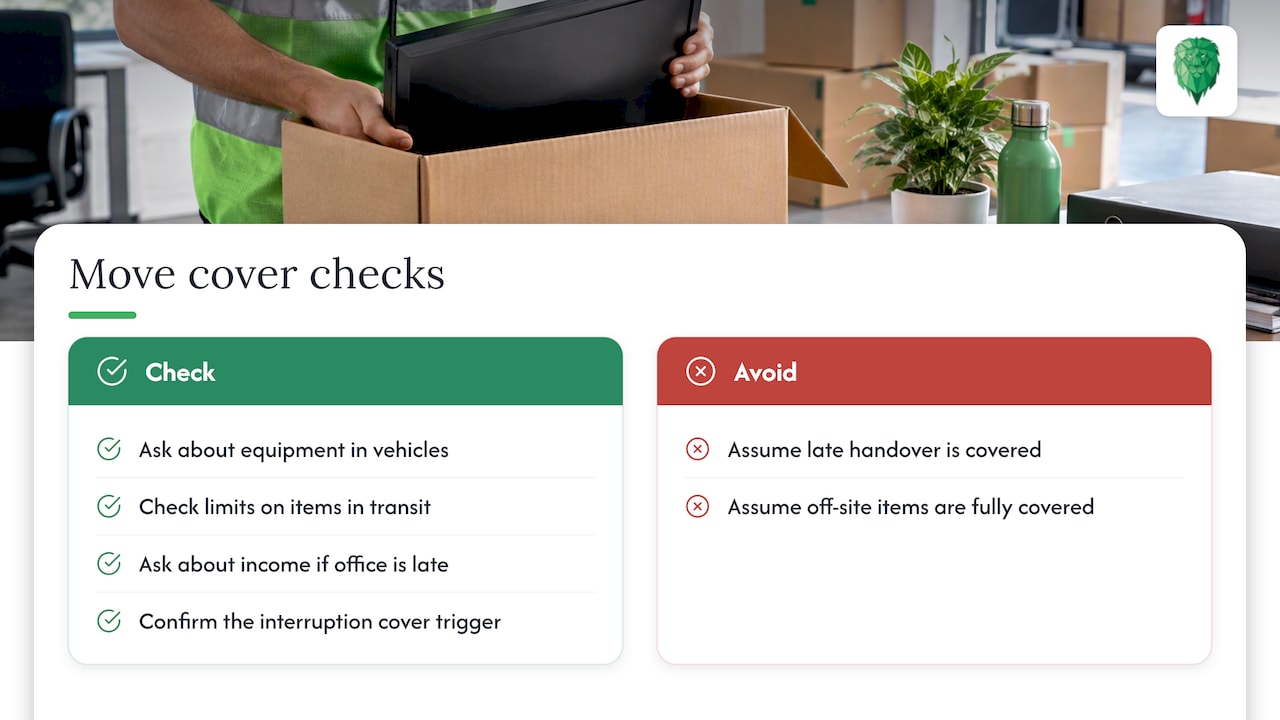
If the downtime risk keeps you up at night, that last question is the most important one. Business interruption cover is usually triggered by an insured event, not by a delayed fit-out, so don’t assume it will help with a late handover.
How to reduce the risk before moving day, part of office move insurance UK
Insurance pays after something goes wrong. The cheaper option is to stop it going wrong. Here’s a checklist that’s doable even for a small team:
- Appoint one person to own the move and the insurance paperwork.
- Make an inventory of everything that’s moving, with photos of high-value items and serial numbers for IT kit.
- Back up your data and take backups off site. Insurance replaces hardware, not your customer records.
- Label everything by room and desk, so that the crew doesn’t have to guess.
- Pack fragile and electronic items properly. Policies can have packing conditions, and proper crates and wrapping make damage less likely anyway.
- Agree building access with both landlords: lift bookings, loading bays, parking, and any requirements for the movers’ own insurance certificates.
- Walk through both premises with the crew lead and note any existing damage, ideally with dated photos.
- Plan IT and comms: who disconnects the servers, who reconnects them, and when the broadband goes live.
For a London-based example of a task list that assigns an owner and a deadline to each step, our office relocation company London page shows how we approach it.
Making a claim after an office move, part of office move insurance UK
If something is damaged or missing, act quickly and keep things factual.
- Note it on the day. If you can, record damage on the delivery paperwork before the crew leaves, and take photos.
- Notify in writing. Contact the removal company and, where relevant, your own insurer as soon as you can. Policies often have time limits for notification.
- Gather evidence: inventory, photos, receipts or valuations, serial numbers and the mover’s certificate.
- Keep the damaged item until the insurer has seen it or told you it can be disposed of.
- Follow the insurer’s process and keep a log of every call and email.
If a claim is refused and you think that’s unfair, Citizens Advice explains that you can use the insurer’s internal complaints process and then escalate to the Financial Ombudsman Service. It also advises treating court action as a last resort. Note that this guidance is written for consumers; if you run a very small business, check with the Financial Ombudsman Service whether your company is eligible to bring a complaint.
Our perspective
In our experience, most office move insurance problems start with a vague assumption, not a bad policy. Someone says “the movers are insured” and nobody asks what that means for a rack of servers or a boardroom table.
That’s why we like to talk about cover before we talk about the van. We transport insured, and we claim over 15 years of experience with large, fragile and valuable items. That experience is why we encourage every customer to ask for the detail: the limits, the exclusions, the packing conditions and who deals with a claim.
An office move is a team effort, so we plan it as one. Packing, disassembly and reassembly of furniture, server relocation, and Wi-Fi and video conference system installation are all part of what we offer for offices, which means fewer hand-offs between suppliers and fewer gaps where a loss could fall between two policies.
Our advice: get the paperwork early, keep it in one folder and make sure whoever is running your move knows where it is.
Claudiu
Moving your office with Van-247
If you’d rather have one team handle the packing, the van and the set-up at the other end, our office relocation service covers moving furniture and equipment, server relocation, and Wi-Fi and video conference system installation and reinstallation. We can also help with packing and with furniture disassembly and assembly.

Tell us what you’re moving and when, and ask for the insurance details at the same time. You can start with an instant quote on our main site. If you’re in a particular area, we also have pages for Manchester, Liverpool, Guildford and Tonbridge. Smaller moves may suit our office removalists service.
If you also send furniture by courier, see what to check in furniture courier insurance.
A simple insurance timeline for your move, part of office move insurance UK
If you like having dates to work to, here’s a rough sequence. Adjust it to the size of your office.
- Eight to six weeks before: read your existing policies. Note the limits, the excess and any exclusions for items in transit. Ask your broker whether the move needs an endorsement.
- Six to four weeks before: request quotes and written proof of cover from removal companies. Compare limits, exclusions and packing conditions, not just price.
- Four to two weeks before: list high-value items individually. Confirm with your insurer the dates when cover at the old and new premises starts and ends. Check with both landlords what insurance certificates they need to see.
- The week before: finalise your inventory, take photos and brief staff on what they should and should not move themselves.
- Moving day: inspect items as they are loaded and unloaded, note any damage on the paperwork, and keep the crew lead’s contact details handy.
- After the move: check everything against the inventory, report any problem promptly in writing, and file your documents for future reference.
None of these steps is hard. They just need doing in the right order, and that’s the part that reduces stress on the day.
FAQ
Is office move insurance compulsory in the UK?
No single policy called “office move insurance” is compulsory. However, if you employ staff, employers’ liability insurance is a legal requirement in Great Britain, with minimum cover of £5 million, as set out by GOV.UK. Cover for your goods in transit and public liability are not legally required for your move, but they are sensible protection.
Does my removal company’s insurance cover my office equipment?
Possibly, but you need to see the policy to be sure. Cover depends on the wording, the limits, the exclusions and how items are packed. Ask for the certificate, the limits that apply to your load and any conditions in writing before you book.
Do I need to tell my own insurer about an office move?
Yes. Tell your insurer or broker the date and new address, and ask for written confirmation of when cover ends at the old premises and begins at the new ones. Also ask whether high-value items need to be listed individually on your schedule.
What should I do if my claim is refused?
Start with the insurer’s internal complaints process. If you are still unhappy, you can escalate to the Financial Ombudsman Service, which Citizens Advice recommends before considering court action. Keep all your evidence and correspondence organised.
Is goods in transit insurance the same as removals insurance?
They overlap but aren’t identical. Goods in transit cover is a business policy for goods being carried, such as the AXA Goods in Transit cover that includes loading and unloading. Removals insurance is the term used more often for cover specific to a move. Always check what each policy says rather than relying on the name.
Sources
- Goods In Transit Insurance | AXA UK
- Employers’ liability insurance | GOV.UK
- Employers’ Liability (Compulsory Insurance) Act 1969: a guide for employers | HSE
- Problems with an insurance claim | Citizens Advice
- Office Move Insurance: Are Your IT Assets Covered? | Cloudswitched