Office packing tips are practical strategies and organisational methods that help teams move office equipment, documents, and furniture with minimal disruption. A well-planned office relocation protects business continuity, reduces the risk of damage to assets, and keeps costs under control. Starting planning at least six months in advance can reduce total relocation costs by up to 20%. That figure alone makes the case for treating your office move as a structured operational programme, not a last-minute scramble. Building a 10–15% contingency fund into your budget from the outset gives you a safety net for the surprises that almost every move brings.
What packing supplies and systems do you need for efficient office packing?
The right materials are the foundation of any well-run office move. Without them, even the best plan falls apart on moving day.
Essential packing materials
Every office move requires a core set of packing supplies. Stock up on these before you begin:
- Double-wall cardboard boxes for heavy files, books, and equipment
- Anti-static bubble wrap for monitors, printers, and electronic peripherals
- Foam inserts and custom padding for fragile or high-value items
- Stretch film to wrap chair bases, desk legs, and grouped cables
- Lockable file boxes for confidential documents and HR records
- Permanent markers and printed labels for clear identification on every box
Reusable plastic moving boxes stack securely, protect contents better, and reduce cardboard waste compared to standard boxes. They are worth considering for departments with high-value or fragile items. The upfront hire cost is typically offset by the reduced risk of damage and the time saved on unpacking.
Inventory and labelling systems
A numbered inventory system is the single most reliable way to track your office contents during a move. Number every box and cross-reference it with a master document that lists contents, destination zone, and department code. Apply colour-coded labels on both the top and side of each box so they are visible whether stacked or standing upright.

| Material | Best use |
|---|---|
| Double-wall boxes | Heavy files, books, desktop equipment |
| Anti-static bubble wrap | Monitors, keyboards, electronic peripherals |
| Foam inserts | Fragile items, small hardware, server components |
| Stretch film | Furniture legs, cable bundles, grouped items |
| Lockable file boxes | Confidential documents, HR and legal files |
| Reusable plastic crates | High-value or fragile department equipment |
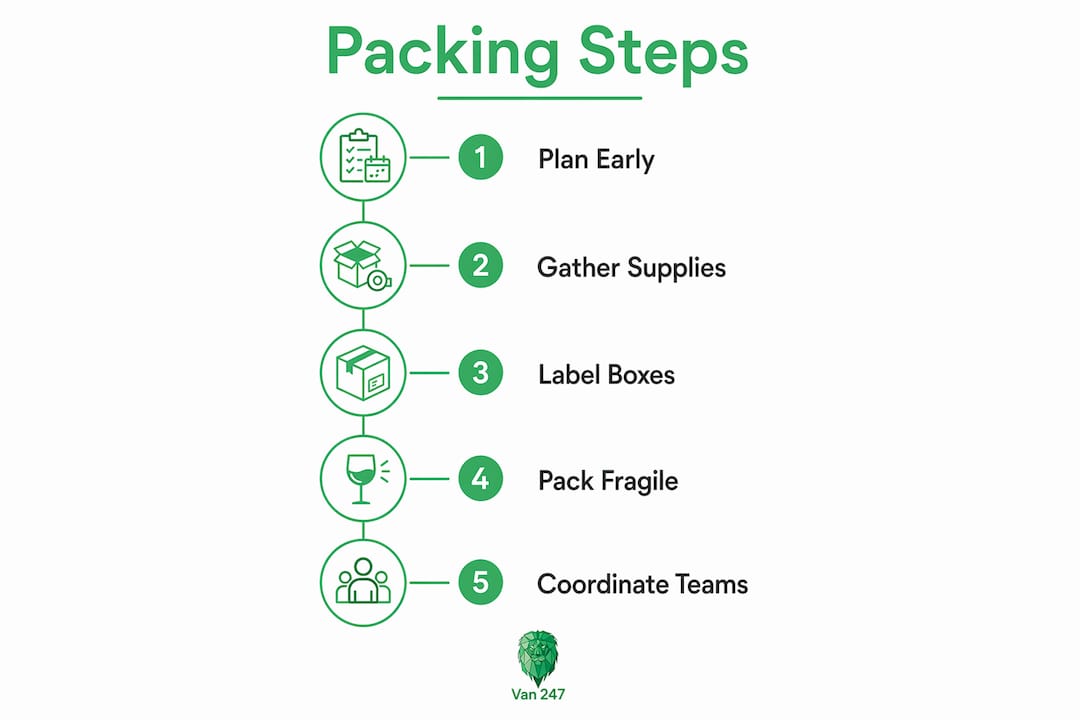
Pro Tip: Prepare packing kits for each department before the move begins. Each kit should include boxes, labels, markers, and tape. This stops teams from hunting for supplies on packing day and keeps the process moving.
How should you sequence packing to protect business continuity?
Packing in the right order is what separates a smooth move from a chaotic one. The sequence you choose directly affects how quickly your team can get back to work at the new premises.
Organising packing by department and item criticality and communicating regularly with team move champions helps maintain business continuity throughout the relocation. Assign a move champion in each department. That person owns the packing process for their area, liaises with the office manager, and confirms that nothing is left behind or mislabelled.
A practical packing sequence
Follow these stages to keep the move orderly and the business running:
- Archive and storage areas first. Pack files, reference materials, and items not used daily. These can be boxed weeks before moving day.
- Shared spaces and communal equipment second. Meeting room furniture, kitchen appliances, and shared printers can be packed once alternatives are in place.
- Individual workstations third. Each employee packs their own desk contents into labelled boxes. Personal items go in a separate clearly marked box.
- Active IT equipment last. Servers, active workstations, and network hardware are packed on the final day before the move, after data backups are confirmed.
- Essentials boxes set aside. Label essentials containers clearly with items like chargers, onboarding paperwork, and key tools so your team can function immediately on arrival.
Clear destination zone labels on every box speed up the unloading process at the new site. Use a simple code such as the department name plus a zone number, for example “Finance Z2” or “IT Z1”. Movers can then place boxes directly in the correct area without needing guidance from your team.
Scheduling the move in waves by priority zone also protects operations. Critical departments such as IT and finance move last and set up first. Less time-sensitive teams move earlier, giving them more time to settle in without pressure.
A detailed moving office checklist keeps every stakeholder aligned and reduces the chance of tasks falling through the gaps. Weekly check-ins with move champions in the weeks leading up to the move catch problems early, before they become delays.
What are the best techniques for packing fragile office equipment?
Sensitive equipment requires a different approach from standard office contents. Getting this wrong is expensive, and the damage is often not discovered until the item is unpacked at the new site.
Specialised packing for sensitive items includes anti-static wraps, custom crates fitted with vibration damping, shock and tilt indicators, and barcode tracking for chain-of-custody management. Custom crating starts with a detailed survey of each item’s dimensions and fragility. Handling markers on the outside of crates tell movers exactly how to carry and position the item.
Key practices for protecting sensitive items
- Wrap all monitors and screens in anti-static bubble wrap before placing in double-wall boxes
- Back up all data before disconnecting any IT hardware
- Label every cable with its device and port using cable ties and printed tags
- Photograph the back of each workstation before disconnecting to speed up reconnection
- Use lockable file boxes for confidential documents and keep these in a separate, tracked consignment if needed
- Attach handling instructions directly to crates and boxes containing fragile or high-value items
- Apply shock and tilt indicators to server equipment and precision hardware
Pro Tip: Photograph every piece of equipment before packing, including serial numbers and existing damage. This creates a pre-move condition record that protects you if a damage claim arises later.
The role of packaging in relocation is often underestimated. The right materials and methods are what stand between your assets and a costly replacement bill.
How do you avoid the most common office packing mistakes?
Even experienced office managers run into the same problems. Knowing what they are means you can sidestep them before they cost you time or money.
| Common problem | Preventative measure |
|---|---|
| Starting too late | Begin planning and packing at least six months before moving day |
| Poor or missing labels | Apply colour-coded labels on top and side of every box before filling |
| Mixing departments in one box | Assign each box to one department only; use department codes on labels |
| Lost or tangled cables | Label every cable before disconnecting; bag and tag by device |
| Underestimating volume | Audit all rooms and storage areas before ordering packing supplies |
| Unexpected lease costs | Restoration clauses can match or exceed moving costs; review your lease before signing |
One cost that catches many office managers off guard is the lease restoration obligation. Many commercial leases require you to return the space to its original condition. This can be as costly as the move itself. Budget for it before you sign the new lease, not after.
Internet provisioning is another area where late action causes real pain. Internet service activation can take 60–90 days in buildings already on the network and over 120 days in off-net locations. Order your connection on the day you sign the lease. Missing this step is one of the most common causes of operational downtime after a move.
Pro Tip: Contact your internet provider, IT support team, and removal company at least three months before moving day. Early engagement gives each party time to plan around your timeline and reduces the risk of clashes on the day.
The business case for planning office moves early is clear. Every week of preparation you invest before moving day pays back in reduced stress, fewer mistakes, and faster setup at the new site.
Key takeaways
Effective office packing requires early planning, the right materials, a clear sequence, and specialist care for sensitive equipment to protect business continuity and reduce costs.
| Point | Details |
|---|---|
| Start planning early | Beginning six months ahead can cut total relocation costs by up to 20%. |
| Use the right materials | Anti-static wrap, double-wall boxes, and lockable file boxes protect different asset types. |
| Pack in sequence | Archive first, active IT last, and set aside clearly labelled essentials boxes for day one. |
| Protect sensitive equipment | Use custom crating, shock indicators, and pre-move photography to safeguard high-value items. |
| Book services early | Internet provisioning can take over 120 days; order on lease signing day to avoid downtime. |
What I have learned from watching office moves go wrong
Office moves that go wrong almost always share one root cause: the packing was treated as a task for the final week rather than a project in its own right. I have seen teams arrive at new offices unable to find their own computers because boxes were labelled with nothing more than a name scrawled in biro. I have watched IT teams spend two days untangling cables that were pulled out in a hurry because nobody photographed the server rack before disconnection.
The advice in this article is not complicated. What makes it hard is the pressure of keeping the business running while simultaneously preparing to move it. That pressure is exactly why structure matters so much. A clear sequence, assigned ownership, and the right materials do not just make the move easier. They make it survivable without burning out your team.
The detail that most office managers overlook is the essentials box. Getting your team functional on day one at the new site, even in a partially unpacked office, is worth more than a perfectly organised archive room. Pack the things people need first and label them so clearly that anyone can find them without asking.
Office relocation is a marathon, not a sprint. The teams that arrive calm and set up quickly are the ones that started packing methodically weeks before moving day, not the night before.
— Claudiu
How Van-247delivery can support your office move
Planning a move is one thing. Executing it with the right logistics partner behind you is another.
Van-247delivery has over 15 years of experience handling office removals across the UK, from single-room relocations to full multi-floor corporate moves. The team handles specialist items including IT equipment, heavy furniture, and fragile assets, with insured transport and flexible scheduling to fit around your business hours. Whether you need a full removal crew or a man and van service for a smaller office, Van-247delivery offers instant quotes and real-time tracking so you always know where your assets are. Get in touch to discuss your requirements and receive a tailored quote.
FAQ
How far in advance should you start packing for an office move?
Start packing non-essential items at least six to eight weeks before moving day. Begin the overall planning process at least six months ahead to reduce costs and avoid last-minute pressure.
What are the best packing supplies for an office move?
Double-wall boxes, anti-static bubble wrap, foam inserts, stretch film, and lockable file boxes cover most office packing needs. Reusable plastic crates are worth hiring for fragile or high-value equipment.
How do you label boxes for an office move?
Number every box and record its contents in a master document. Apply colour-coded labels on both the top and side of each box, including the department name and destination zone code.
How do you pack computers and electronics safely?
Back up all data first, then photograph cable connections before disconnecting. Wrap each item in anti-static bubble wrap, use original packaging where available, and attach handling instructions to the outside of each box.
What is the biggest mistake teams make when packing for an office move?
Starting too late is the most common and costly mistake. Leaving packing until the final week leads to poor labelling, mixed-up boxes, and damaged equipment that could have been avoided with a structured, phased approach.