Online moving quote guide, the safest way to get an accurate online moving quote is to treat the instant estimator as your starting point, not your final figure. Follow it up with a video or in-home survey, which is what turns a rough number into a binding or fixed-price quote. Collect at least three itemised written quotes before you book, and where certainty matters more than saving a few pounds, choose the binding option.
TL;DR:
- Online moving calculators are best used to set a budget range; they lack accuracy for long-distance, high-volume, or specialist items.
- A binding quote requires a survey, either video or in-home, to confirm access, volume, and specific item handling, reducing final cost surprises.
- Always obtain at least three written quotes with detailed line items and confirm whether they are estimates or binding prices before booking.
- Preparing an itemized inventory and documenting access details, parking, and move dates early helps ensure accurate, comparable quotes.
- Regional factors such as congestion charges and property size significantly influence costs, especially in London and the South East, making quotes vary widely.
Table of Contents
- What makes an online moving quote reliable?
- How do online moving calculators actually work?
- Estimate, binding quote or fixed price: what’s the difference?
- What should you prepare before requesting quotes?
- Step-by-step: how to compare online quotes and choose the right mover
- What do UK removals actually cost in 2026?
- How does a professional mover turn a quote into a firm price?
- Why most moving advice gets the calculator vs. survey balance wrong
- Getting your quote sorted with Van-247delivery
- Sources
- FAQ
What makes an online moving quote reliable?
An online moving estimate is only as trustworthy as what it actually spells out. Before you accept anything, check that it covers the full job, not a stripped-down version designed to look cheap.
A dependable quote should include:
- Labour costs, broken down by crew size and expected hours
- Vehicle and fuel charges, especially for longer distances
- Insurance cover, specifically goods-in-transit protection
- Parking, permits or congestion charges where they apply
- Add-ons such as packing materials, furniture dismantling, or storage
Beyond the line items, the quote should state plainly whether it’s an estimate, a binding quote, or a fixed/capped price. It should also confirm what kind of survey the price is based on, video or in-person, along with any access notes the surveyor recorded. Finally, look for written terms covering payment schedule and cancellation policy. If any of that is missing, ask for it before you sign anything.
How do online moving calculators actually work, part of online moving quote guide?
Online calculators run your inputs (property size, distance, rough inventory) through pricing algorithms built from historical job data. They’re fast and useful for budgeting, but they can’t see your actual belongings, your staircase, or the awkward wardrobe that won’t fit through the door. That’s the fundamental gap between an algorithmic calculator and a proper human survey.
These tools tend to be reasonably accurate for straightforward, local, hourly-charged moves, a one-bedroom flat moving three miles across town, for instance. They become much less reliable for long-distance relocations, high-volume house moves, or anything involving specialist items like pianos or antiques, where a moving cost calculator cannot account for the complexity.
That’s why most calculators return a range rather than a fixed number. According to Move, the smartest approach is combining that calculator range with one or more survey-backed quotes rather than treating either figure alone as gospel. Use the calculator to set your budget expectations, then let the survey sharpen the number.

Estimate, binding quote or fixed price: what’s the difference, part of online moving quote guide?
This is the part most people skip, and it’s the part that causes the most arguments on moving day. There are three quote types you’ll come across in the UK, and each carries a different level of risk for you.
- Non-binding estimate: a rough figure based on limited information. If your move takes longer or involves more items than expected, you pay more. The risk sits with you.
- Binding quote: the mover commits to a price, usually based on a completed survey, subject to specific listed exclusions (access issues, extra volume, additional services).
- Fixed/capped price: similar to a binding quote but framed as a price ceiling. You won’t pay more than the stated amount barring genuinely unforeseen circumstances.
MyJobQuote’s guidance on quotes and estimates makes the risk transfer clear: a binding quote shifts volume and time risk onto the mover, while an estimate leaves you exposed. To get a binding quote online, you’ll almost always need to complete a survey first, whether that’s a fifteen-minute video call or an in-home visit. Skipping that step is how “cheap” quotes turn into expensive surprises.
What should you prepare before requesting quotes, part of online moving quote guide?
Good preparation is what separates an accurate quote from a guessing game. The more detail you hand over upfront, the less room there is for the final bill to drift from the one you agreed.
- Build a simple room-by-room inventory. You don’t need to count teaspoons, but list major furniture, appliances, and anything unusually heavy, fragile, or oversized (a piano, a wardrobe that needs dismantling, a fish tank).
- Take photos and short video clips of every room. For a virtual survey, walk through each space slowly, showing wardrobes and cupboards open, and don’t forget the loft, garage, or shed if they’re being cleared too.
- Record access details. Note stairs, narrow hallways, lift availability, and how far the removal van will need to carry items from the door, known as the “long carry.” This single factor changes labour quotes more than almost anything else.
- Check parking and permit requirements for both your current and new address, particularly in cities where restrictions or charges apply.
- Decide your move date early. Weekends, month-ends, and school-holiday periods carry a premium almost everywhere in the UK.
Pro Tip: Book your survey and request quotes at least four to six weeks before your target move date. Popular Friday and Saturday slots in peak summer months fill up fast, and a rushed quote is far more likely to miss something.
Step-by-step: how to compare online quotes and choose the right mover, part of online moving quote guide
Once you’ve got several quotes in hand, comparing them properly is where most of the real savings, and the real protection against nasty surprises, actually happen.
- Normalise the scope of each quote. Make sure every quote covers the same services. If one includes packing materials and another doesn’t, you’re not comparing like with like.
- Check every line item against your inventory. If a quote is missing your piano, your garden furniture, or the contents of your loft, flag it before you sign, not on moving day.
- Look for trust signals. Membership of the British Association of Removers or Association of Independent Movers, a clear written claims procedure, and confirmed goods-in-transit insurance all matter more than a slightly lower headline price.
- Weigh certainty against cost. A binding quote that’s £50 to £100 higher than a rough estimate can genuinely work out cheaper than an estimate that balloons once the crew sees your actual belongings.
- Ask clarifying questions before you commit. If a quote lists exclusions such as “subject to access” or “subject to volume assessment,” ask exactly how that’s measured and what triggers an extra charge.
Negotiation on removals pricing is fairly normal, particularly on flexible dates or off-peak weekdays. Providers will often match or beat a competitor’s written quote if you show them the itemised breakdown, so don’t be shy about asking.
- Get at least three written quotes before deciding, a habit consistently recommended by the HomeOwners Alliance.
- For larger or specialist moves, insist on a survey rather than a phone estimate.
- Keep every written quote until the job is complete and invoiced, in case a dispute arises later.
If you’re moving specialist items like a piano or a valuable instrument, the survey stage is where you should flag it explicitly, since a specialist shipping workflow for delicate or oversized items differs significantly from standard furniture handling.
What do UK removals actually cost in 2026, part of online moving quote guide?
Prices vary by property size, distance, and how much of the packing you take on yourself. According to the Association of Independent Movers, typical 2026 UK ranges for local moves look like this:
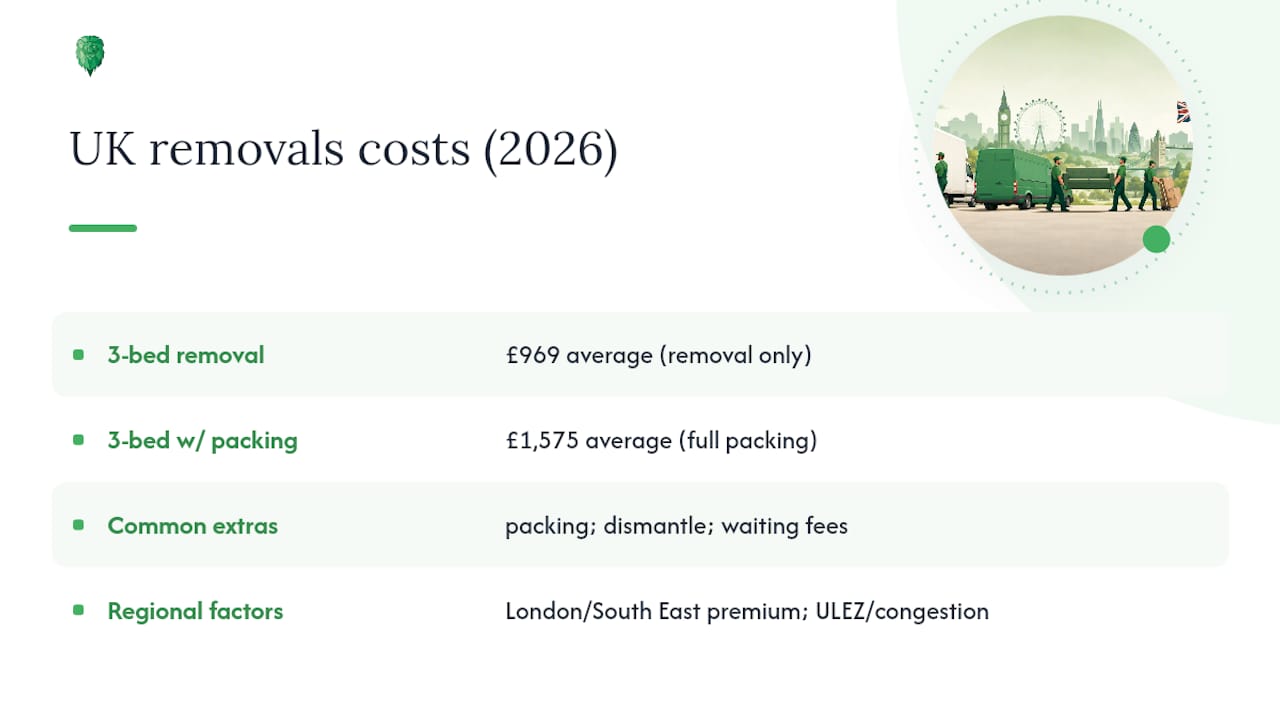
A separate analysis of over 1,200 completed UK moves found a 3-bedroom move averaged £969 for the removal alone across roughly 100 miles, rising to about £1,575 once a full packing service was added, according to MovingCost.co.uk’s real move dataset.
Common extras that push totals up include full packing services, furniture dismantling and reassembly, and waiting time if you’re not ready when the crew arrives. Clarify waiting time charges in writing, since “late keys” and delays are a frequent source of day-of disputes.
Regional factors matter too. London and the South East typically carry a premium, and city moves often add congestion charge or ULEZ costs that instant estimators frequently leave out. If a quote comes in well below these benchmarks with no explanation, treat it as a red flag rather than a bargain, and check what factors affect moving furniture across the country if your move covers real distance.
How does a professional mover turn a quote into a firm price?
A reputable UK removals firm doesn’t rely on a single instant form to set your final price. It combines an online calculator for a quick ballpark with a follow-up survey, video or in-person, to confirm the details that actually drive cost.
What that typically looks like in practice:
- An instant online quote gives you a baseline figure within minutes.
- A short video call or in-home visit checks access, volume, and any awkward items.
- The final written quote reflects insured transport, with goods-in-transit cover clearly stated.
- Experience built up over 15+ years handling UK removals means fewer surprises with stairs, narrow doorways, or fragile items.
The details you supply directly shape how accurate that final number is. A clear inventory, honest photos of cluttered rooms, and upfront notes about parking restrictions all reduce the gap between your quote and your final invoice.
Pro Tip: If you’re unsure whether an item needs special handling, mention it during the survey rather than assuming it’s covered. A missed detail, like a piano on the second floor, is the most common cause of on-the-day price changes.
Why most moving advice gets the calculator vs. survey balance wrong
Most guides treat online calculators and professional surveys as competing options, pick one or the other. That framing is backwards. The calculator’s real job is narrowing your budget range before you spend time on calls; the survey’s job is turning that range into a number you can actually rely on. Skip the calculator and you waste time getting quotes for moves you can’t afford. Skip the survey and you’re gambling on moving day.
The advice that gets underplayed is normalising quotes before comparing them. Two quotes that look £200 apart often aren’t comparable at all, one includes packing materials and insurance, the other doesn’t. Readers who compare headline totals instead of line items are the ones who end up disputing charges afterwards.
If there’s one habit worth adopting above all others, it’s asking every provider to specify exactly how their exclusions get triggered, particularly around access and volume. That single question, more than any amount of shopping around, is what separates a smooth move from a stressful one.
— Claudiu
Getting your quote sorted with Van-247delivery
Some companies offer a workflow like the one described in this guide: an instant online quote to set your budget, followed by a video or in-home survey that turns that estimate into a firm, written price, often backed by insured transport and options for packing or storage.
Booking is straightforward: request your instant quote, arrange a survey at a time that suits you, and once you’ve reviewed the itemised breakdown, confirm and lock in your date. If your move is smaller, a man with a van service might suit you better than a full removal crew, and either route gets you a written quote before you commit to anything.
Ready to see your number? Head to the house removals page and get your instant quote started today.
Sources
For benchmarks and quote-type definitions used throughout this guide, see the British Association of Removers, the Association of Independent Movers’ 2026 cost guide, and Checkatrade’s removal cost guide. For a deeper explainer on comparing quotes, read our guide to understanding moving quotes.
- British Association of Removers (BAR)
- Association of Independent Movers — How much do house removals cost in the UK? (2026)
FAQ
Is an online moving quote legally binding?
No, most instant online quotes are non-binding estimates. Only a quote confirmed after a survey, and explicitly labelled binding or fixed, carries that legal weight.
How accurate are online moving cost calculators?
They’re reasonably accurate for simple, local, hourly-based moves but far less reliable for long-distance or high-volume relocations, which is why they’re best used as a budgeting baseline rather than a final figure.
Do I need a survey for a small move?
For smaller local jobs, a brief video call is often enough, but larger or more complex moves benefit from a full in-home or detailed video survey to avoid day-of surprises.
What should an itemised moving quote include?
It should list labour, vehicle and fuel costs, goods-in-transit insurance, parking or permit fees, and any add-ons like packing or storage, with the quote type stated clearly.
How many quotes should I get before booking?
Get at least three written quotes, and where possible, insist on a survey-backed price for larger moves so you’re comparing genuinely equivalent offers.