Yes, a professional out of hours office move lets you relocate equipment, furniture and servers overnight so your office reopens for business on schedule. A professional out of hours office move bundles packing, IT and server handling, furniture dismantle and rebuild, insured transport and managed scheduling into one coordinated night.
TL;DR:
- Confirm that your local council permits noisy work outside standard hours and obtain any necessary approvals at least five days in advance.
- Ensure your site survey includes access points, lift capacities, parking, and power notes to prevent delays during the move.
- Verify the mover’s insurance coverage, UK experience with overnight relocations, and that a designated move-night manager is assigned for clear communication.
- Be aware that out of hours moves incur higher costs from overtime, specialist equipment, security, and permit fees, which should be itemized in a quote.
- Label all IT equipment and agree on reconnection priorities beforehand to minimize server downtime and streamline the post-move setup.
Table of Contents
- What’s included in an out of hours office move
- Why move outside normal hours
- Legal, council and health and safety considerations
- Planning checklist and timeline for the move
- Cost drivers and how to read a quote
- Questions to ask before you book a mover
- What we’ve learned from running these moves
- Book an out of hours office move with us
- FAQ
- Sources
What’s included in an out of hours office move
An out of hours office move usually runs in one of three windows: evening (after 6pm), overnight (through to early morning) or weekend. Crews work in shifts matched to the size of the job, often with a second team arriving partway through the night to keep momentum up when the first shift tires.
The scope typically covers:
- Labelled packing and crate management so nothing gets lost between floors or buildings.
- Furniture dismantle and rebuild, including desks, partitions and storage units.
- Lifts, hoists and trolleys for bulky items that will not fit through standard doorways.
- Specialist handling for servers and networking equipment, including careful disconnection and reconnection.
- Security and access arrangements for late entry, including sign-in procedures and controlled areas for sensitive equipment.
Matching these elements against a supplier’s actual offering is the quickest way to tell a genuine out of hours specialist from a firm that simply works late once in a while.
Why move outside normal hours
The main draw is simple: your customers and staff barely notice the move happened. Work finishes on a Friday evening, equipment goes in overnight, and desks are ready on Monday morning rather than mid-week with half the office in boxes.
Typical outcomes include:
- A same-day reopen, with the office fully usable the next working morning.
- Staged moves for larger offices, so one department relocates while another stays operational.
- A built-in recovery window for IT testing before staff arrive.
Out of hours moves cost more to run, and that trade-off is worth naming plainly: overtime premiums, possible permit fees and extra security cover for late access all add to the bill. The Control of Noise at Work Regulations 2005 also require that extended working hours are factored into risk planning, which shapes how crews schedule noisier tasks. Weigh the downtime saved against those added costs before committing to a date.
Legal, council and health and safety considerations
Out of hours does not mean unregulated. Before you book a date, check what your building and local authority actually permit.
- Confirm building access rules with your facilities manager or landlord, including concierge cover and keyholding for late entry.
- Check whether your local council requires prior approval for noisy work outside standard hours. The City of London’s guidance requires written approval for noisy works outside standard or reduced-impact hours, with applications submitted with sufficient advance notice.
- Liaise with nearby occupiers. City of London guidance recommends contacting premises within proximity of works that may cause noise disturbance, particularly for jobs spanning several nights.
- Confirm your mover holds a current noise risk assessment that accounts for extended hours, as required under the Control of Noise at Work Regulations 2005.
Pro Tip: If council approval is likely to take time, schedule the noisiest tasks, such as dismantling metal shelving, for reduced-impact hours and leave quieter packing work for the deep overnight slot.
Planning checklist and timeline for the move
A good out of hours move is won or lost in the week before it happens, not on the night itself.
Pre-move actions:
- Carry out a site survey covering access points, lift sizes, parking and any restricted zones.
- Build a full IT inventory, including which servers, switches and cables go where.
- Confirm access permissions, signage and building sign-off in writing.
- Agree a backup and testing plan for servers before anything is disconnected.
Scheduling priorities:
- Set a firm arrival window with built-in contingency time for delays.
- Stage larger moves by floor or department rather than attempting everything in one pass.
Move night priorities:
- Label every crate by destination room and priority.
- Reconnect IT systems in a set order, with critical servers first.
- Keep a single point of contact managing security sign-off and snagging.
Post-move tasks follow quickly: testing every system before staff arrive, a final clean, waste removal, and a handover walk-through with your facilities lead.
Cost drivers and how to read a quote
Quotes for out of hours moves vary more than daytime ones, largely because of what happens around the edges of the job itself.
The main cost drivers are:
- Overtime pay for crews working evening, night or weekend shifts.
- Specialist equipment such as server-safe crates, hoists or extra vehicles.
- Access restrictions that need extra security staff or longer sign-in procedures.
- Permit or notification fees where council approval is required.
Quotes tend to come structured as hourly, fixed-price or staged by phase. Whichever structure you’re offered, insist on clarity over three things: waiting-time charges (our own rate is £24 per hour per man), a contingency allowance for delays, and confirmation that insurance is included rather than optional.
Cutting costs by limiting IT reconnection to “essentials only” saves money on the night, but it shifts the risk of slow Monday-morning troubleshooting onto your own team. Decide upfront whether that trade-off suits you.
Questions to ask before you book a mover
Choosing the right supplier for an overnight move comes down to a handful of checks you can run before signing anything.
- Ask exactly what the insurance covers during out of hours operations, including transport, storage and on-site handling.
- Ask for evidence of UK experience with overnight office moves and server relocations specifically, not general removals.
- Request copies of risk assessments and method statements covering noise, access and IT handling.
- Confirm the escalation plan: who you call at 2am if something goes wrong.
- Check operational guarantees: crew sizing, spare equipment on hand and a replacement vehicle if one breaks down.
Pro Tip: Ask for a named move-night manager rather than “a team lead on the day”. A single accountable person cuts confusion when decisions need to be made fast.
What we’ve learned from running these moves
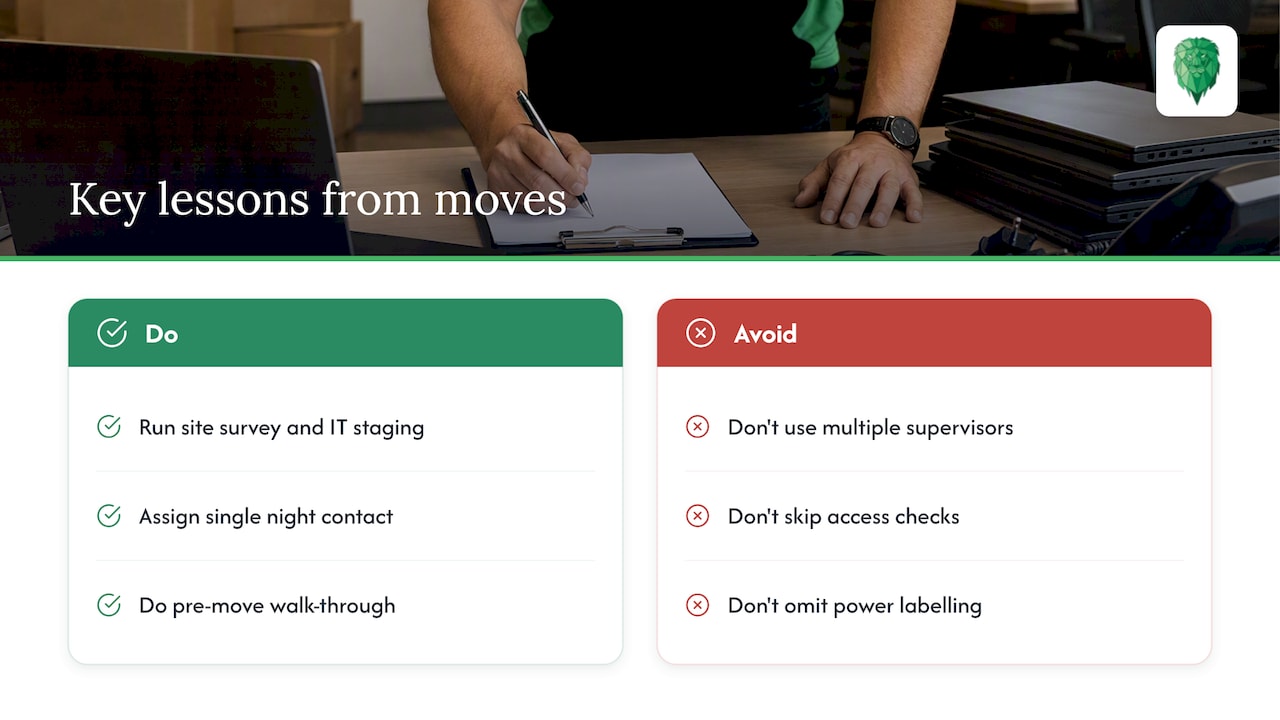
We lean heavily on site surveys and IT staging before the first van arrives, because most problems on move night trace back to something missed days earlier. A single point of contact managing the whole night, rather than several supervisors giving different instructions, keeps things calm when something unexpected happens.
The most common issues we see are access oversights (a fob that doesn’t work after 10pm) and missing power notes (nobody flagged which sockets feed the server room). Both are avoidable with a proper walk-through beforehand.
— Claudiu
Book an out of hours office move with us
We handle office relocations with the same crews who manage server moves, packing and insured transport, so you’re not juggling separate suppliers for one night of work. Relevant services for an out of hours office move include office removals, server relocation, Wi-Fi and video conferencing reinstallation, packing, furniture assembly and disassembly, and move-night coordination from start to finish.

To request a quote, tell us your preferred window (evening, overnight or weekend), your server and IT requirements, and any building access restrictions we’ll need to work around. We’ll come back with insured, scheduled crews who’ve handled this before.
If your move involves a long-distance or international leg alongside the office relocation itself, All In Moving manages that side with a single dedicated team and transparent pricing, which can sit alongside our local out of hours work for the office end of the job.
- Request a quote through our office relocation service page.
- Ask about packing, storage and unpacking through our house removals services.
- Flag any bulky freight or off-site storage needs through our pallet delivery option.
Get in touch with your move date in mind and we’ll build the schedule around it.
FAQ
What counts as an out of hours office move?
It’s a relocation scheduled in the evening, overnight or at weekends, usually to avoid disrupting business during normal working hours. It typically bundles packing, furniture handling, IT and server relocation, and insured transport into one managed night.
Do we need council permission for a weekend office move?
Possibly, depending on noise levels and location. The City of London requires written approval for noisy works outside standard hours, with applications submitted at least five working days ahead, and other councils apply similar site-specific rules.
How much does an out of hours office move cost?
Costs vary by job size, access restrictions and whether permits are needed, so pricing is generally quoted rather than fixed. The waiting-time fee can be charged per hour per person, and a tailored quote is usually provided once the move’s scope is known.
How do we minimise IT downtime during the move?
Label every server, switch and cable before disconnection, and agree a reconnection priority list so critical systems come back online first. Running a pre-move test where feasible also catches issues before staff arrive the next morning.
Does noise risk assessment apply to overnight moving work?
Yes, UK employers must account for work carried out during extended or unusual hours as part of their noise risk assessments under the Control of Noise at Work Regulations 2005. Movers should hold a current assessment covering overnight and weekend shifts before taking on the job.
Sources
- Construction, demolition and street works – City of London
- Noise at work: Employers’ responsibilities – HSE