Pack plates for moving: the safest way to pack plates for moving is to wrap each one on its own, stand them on their edges like records in a small, strong box, and fill every gap until nothing moves when you give the box a gentle shake. That is the whole secret. The rest of this guide shows you how to do it calmly, in the right order, and what to do about the awkward bits: heavy dinner plates, patterned china, bowls and the box you will be tempted to overfill.
If you would rather not spend an evening wrapping crockery, our team can pack the whole kitchen for you as part of a house removal. More on that further down.
TL;DR
- Pack plates upright on their edges, never flat in a pile. Edges are stronger than faces.
- Wrap every plate separately in clean packing paper, and add bubble wrap only for the really precious pieces.
- Use small, sturdy boxes with a thick cushion of crumpled paper at the bottom, on top and in every gap.
- Shake test the box before sealing: if you hear or feel movement, add more padding.
- Label every side FRAGILE, PLATES and KITCHEN, and load plate boxes on the floor of the van, never on top of lighter cartons.
Table of Contents
- Why plates break in a move (and why it is usually not the plate’s fault)
- What you need before you start
- How to pack plates for moving, step by step
- Packing bowls, china and other dishes
- A worked example: a family kitchen
- Loading and carrying plate boxes
- Common mistakes to avoid
- When it makes sense to let us pack
- Our view on packing plates
- FAQ
- Sources
Why plates break in a move (and why it is usually not the plate’s fault), part of pack plates for moving
Plates are tougher than they look. A dinner plate sits happily in a cupboard for years, and it can take quite a knock when pressure is spread along its edge. What it cannot take is a stack of other plates pressing on its face, or a box that lets everything slide around on the journey.
So most breakages come down to two things:
- Flat stacking. Piles of plates put the weight on the middle of each one. Every bump in the road adds to it.
- Movement inside the box. Gaps let plates knock against each other, and a chip or crack follows.
Once you know that, the method makes sense. Stand the plates up, wrap them well and leave no space for anything to shift. Professional packers describe the same approach: packing plates vertically in tall, sturdy boxes is the standard advice, and a professional packer interviewed there also notes that packing paper is more flexible and quicker to use than bubble wrap.
What you need before you start, part of pack plates for moving
Gather everything first. Nothing slows you down like hunting for tape halfway through a stack of plates.
| Item | What it is for | Tip |
|---|---|---|
| Small, sturdy boxes (double-wall if you can) | Holding the plates | Small boxes stop you overpacking. A full box of crockery gets heavy fast. |
| Packing paper | Wrapping each plate | Use clean, plain paper. Newspaper ink can rub off onto white china. |
| Bubble wrap | Extra layer for fine or precious pieces | Keep it for heirlooms and thin china, not every plate. |
| Tissue paper | First layer on painted or gilded plates | Soft against decoration, with paper or bubble outside. |
| Spare paper or void fill | Cushioning the base, top and gaps | You will use more than you expect. |
| Strong packing tape | Sealing boxes and closing paper wraps | Tape the paper, never the crockery. |
| Marker pen | Labelling | Thick and dark, so the label reads from across the room. |
| Clean tea towels | Padding and wrapping small groups | Handy for filling awkward spaces. |
If you want a box made for the job, our guide to dish packing boxes explains the sizes movers like to use for kitchenware.
How to pack plates for moving, step by step. Part of pack plates for moving
Set aside a clear table and work through one box at a time. A good rhythm is one box, one cup of tea, one tick on your list. Moving is a marathon, not a sprint, and rushing the wrapping is where the damage starts.
Step 1: Prepare the box
Tape the base of the box well, running tape across the seam and then along both edges, so the bottom cannot give way under the weight.
Now build a cushion. Crumple sheets of packing paper into loose balls and layer them across the bottom until you have a thick, springy bed. Think of it as a mattress for the plates. This layer takes the shocks when the box is put down, so be generous with it.
Step 2: Sort your plates
Before you wrap anything, sort by size and type:
- Everyday dinner plates
- Side plates and bowls
- Good china and anything patterned, gilded or hand painted
- Chipped or cracked plates (be honest here: a plate that is already damaged is the first to fail)
Pack similar sizes together. Mixed sizes leave gaps and uneven pressure, and the biggest plates should go at the back or bottom of the box, with smaller ones towards the front.
Step 3: Wrap each plate individually
This is the step that makes the difference, and it is easy once you have done two or three.
- Lay a sheet of packing paper flat. Place the plate in the middle of it, a little turned so that its edge points towards a corner of the paper.
- Pull the nearest corner across the face of the plate.
- Fold in the sides and roll the plate over, bringing the remaining corners across so that the face, the back and the rim are all covered.
- Add a second sheet and repeat for a double layer. For large dinner plates, or anything that feels thin once wrapped, a double wrap is worth the extra few seconds.
- Tuck the last corners underneath and close with a short strip of tape stuck to the paper.
A good test: you should no longer be able to see or feel the plate through the paper.
You can tape two wrapped plates together for a bit of extra strength, but do not go beyond a pair. Bigger bundles are heavy and hard to place.
Where it goes wrong: one sheet of thin paper for a heavy plate, or paper that has been wrapped loosely so the rim pokes out. The rim is the part that chips first.
Step 4: Stand the plates on their edges
Place the wrapped plates upright in the box, side by side, like books on a shelf or records in a crate. Standing on the edge spreads the load along the strongest part of the plate. Lying flat leaves the whole weight on the face.
Put a layer of paper or a folded tea towel in front of the first plate, and keep the row snug. If you have a lot of plates, make a second row and place a sheet of cardboard or thick paper between the rows.
For every plate you add, check the row is firm but not squeezed. Too tight and you put stress on the edges. Too loose and the plates rattle.
Step 5: Fill every gap
This is where most DIY packing falls short. Push loosely scrunched paper, spare bubble wrap or cloth into every space down the sides and between the rows. The aim is a box that feels solid from every angle.
Then add a final cushioning layer across the top, so that when you close the flaps the contents are held gently in place.
Step 6: The shake test
Before you tape the lid, lift one side of the box a little and give it a gentle tilt. Listen for movement. Then close the flaps, and do it again.
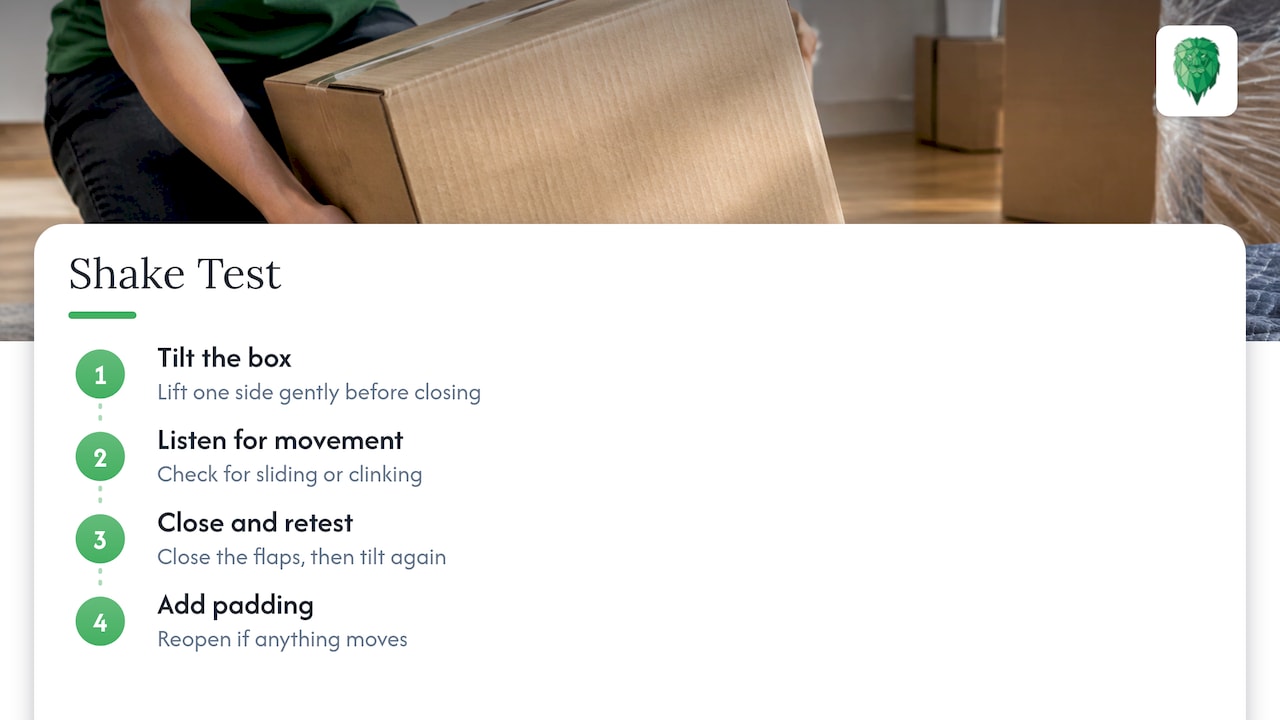
If you can feel anything slide or hear anything clink, open it up and add more padding. This takes thirty seconds and is the best insurance you can give your crockery.
Step 7: Seal and label
Seal the box with strong tape along the centre seam and along both edges. Then label it on the top and on at least two sides:
- FRAGILE
- PLATES (or CHINA)
- KITCHEN
- THIS WAY UP, with arrows
Labelling on several sides matters because boxes get stacked and turned, and you will not always see the top. It also helps whoever is carrying the box on moving day know to treat it gently, and tells you which room it belongs in when you arrive.
Packing bowls, China and other dishes, part of pack plates for moving
Plates are the simple case. Here is how the rest of the cupboard works.
Bowls
Wrap bowls one at a time, just like plates. Smaller bowls can nest after wrapping, with a layer of paper between each, but wrap them first. Heavy serving bowls deserve their own wrap with an extra layer of bubble wrap, and they should sit in the centre of the box, surrounded by cushioning on every side. You can place standard bowls on their rims or at an angle, whichever sits most snugly in your box.
Fine China and painted plates, part of pack plates for moving
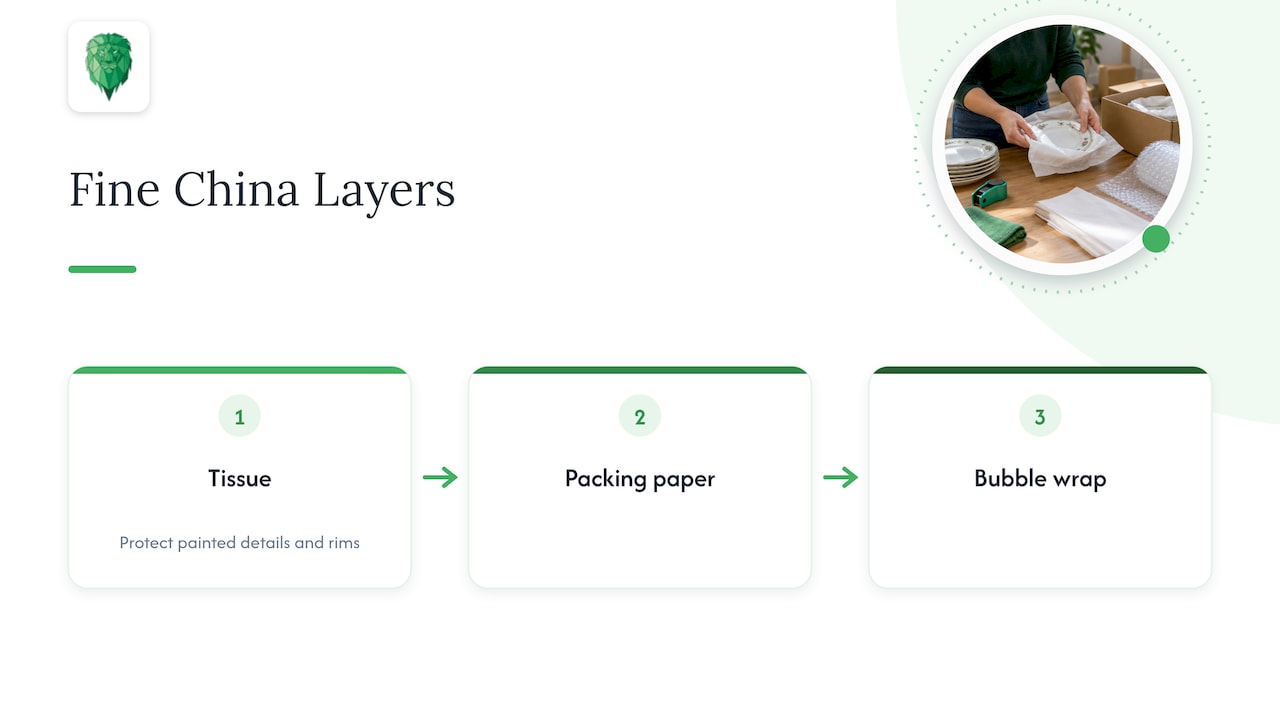
For a set that has been in the family, think in layers. Tissue first, so that nothing rubs against painted details, gilded edges or patterned rims. Then packing paper, and then a layer of bubble wrap on the outside. Keep these in a box of their own, with plenty of padding, and label it clearly. Our guide to moving fragile items safely covers the other delicate things in your home, such as mirrors, ornaments and glassware.
Cups, mugs and glasses
These are packed differently. Rather than standing on edge, glasses and cups go in upright or on their sides, as if you were laying a table, with dividers or cardboard between them and a layer of cardboard between each level. For wine glasses and thin crystal, wrap the stem first, then wrap the whole glass again, and keep them upright with dividers between them.
Gravy boats, teapots and lids
Handles and spouts are the weak points. Wrap them separately, or pad them with extra paper before wrapping the whole piece. Lids should travel wrapped, in the same box as their pot, so you can find them again.
A worked example: a family kitchen. Part of pack plates for moving
Say you have a typical set of dinnerware for a family of four: twelve dinner plates, twelve side plates and twelve bowls, plus a few serving dishes.
Here is a sensible plan:
- Box 1: the twelve dinner plates, in two rows of six, with a divider between the rows.
- Box 2: the twelve side plates, in the same layout.
- Box 3: the twelve bowls, wrapped and nested in groups of two or three, with paper between.
- Box 4: serving dishes, each in their own wrap, with the heaviest in the centre.
That is four small boxes, and one person working steadily can usually do the lot in an evening, with a break for tea. If that sounds like a lot, it is worth knowing you do not have to do it all alone: more on that below.
Loading and carrying plate boxes, part of pack plates for moving
A well-packed box can still be damaged by how it travels.
- Carry them level. Lift from the bottom, with both hands, and do not tip the box.
- Load them on the floor of the vehicle. Heavy crockery boxes go at the bottom, never on top of lighter cartons that could be crushed or pushed over.
- Keep them tight and level. Plate boxes should be packed close together so they cannot topple or slide when the vehicle brakes or turns.
- Do not wedge them under wobbly furniture. And do not leave a soft bag, such as a duvet, as the only thing holding a heavy box of crockery in place.
- Unpack them early. Put the kitchen boxes in the kitchen, and open them first. A calm first night with plates to eat from is a good feeling.
For tips on awkward items on stairs, our article on transporting furniture up and down stairs is a handy companion for moving day.
Common mistakes to avoid
Most plate breakages come from the same short list. If you avoid these, you are in very good shape.
- Using big boxes. A large box of plates becomes too heavy to lift safely, and puts a lot of pressure on whatever is at the bottom.
- Packing plates flat. The weight sits on the faces, and one bump can crack the lot.
- Skipping the base cushion. The bottom of the box takes the hardest knocks.
- Using newspaper next to white China. Ink can transfer, and newsprint is thinner than packing paper.
- Leaving gaps. Movement inside the box is the main enemy.
- Forgetting to label. A box not marked as fragile will end up under other things.
- Leaving it to the last minute. Start with the things you rarely use, such as the good China, a few weeks before moving day, and keep a small set of everyday plates until the final morning.
When it makes sense to let us pack, part of pack plates for moving
Hand-wrapping plates is simple, and plenty of people enjoy getting it done. But the kitchen is often the biggest packing job in the house, and it tends to land in the last busy week before a move, alongside everything else.
If you would rather free up that time, we offer packing as part of our house removals service, and we can also help with unpacking, storage, and disassembling and reassembling furniture. We have more than 15 years of experience moving homes across the UK, our transport is insured, and you can get an instant online quote to see what a move looks like for your home.
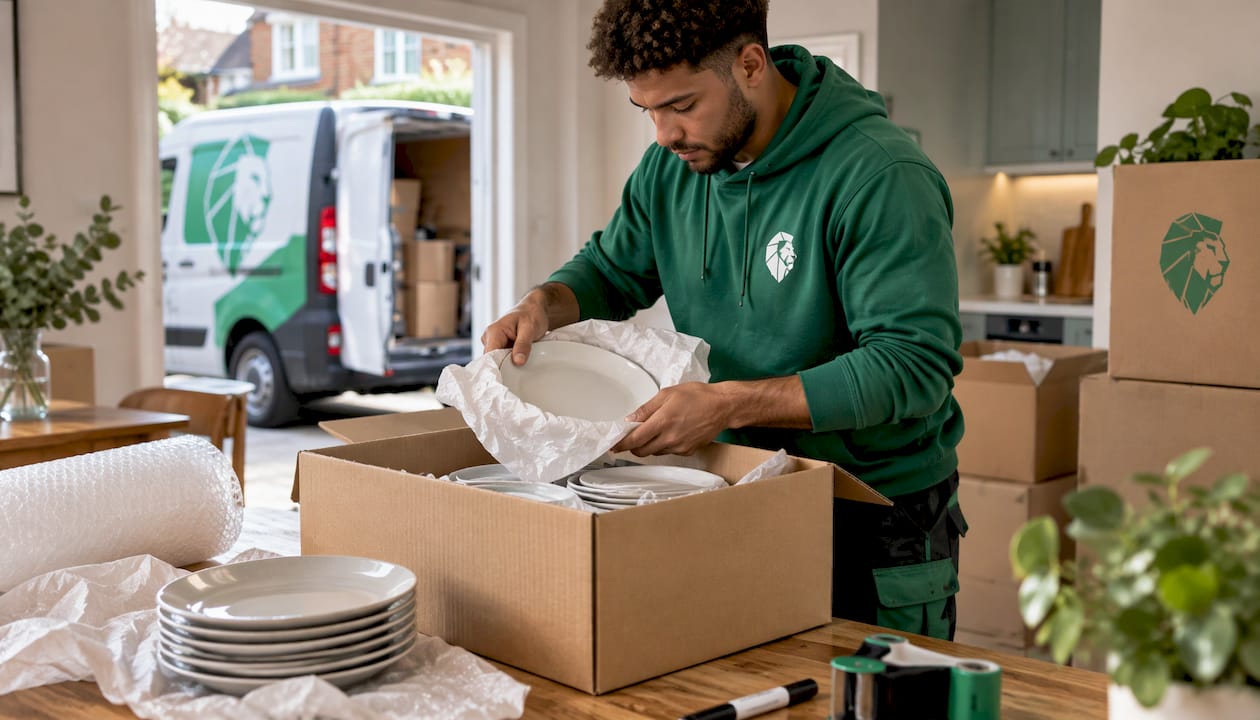
You can read more about our professional packing services, or start from our home page to get a quote for your move. If you do pack some boxes yourself, tell us when you book, so that we know what to expect on the day.
Our view on packing plates
Over the years we have learned that the kitchen is the room people worry about most. Plates, glasses and family china carry memories as well as a price tag, and the idea of opening a box to find a chip or a crack is what keeps people up at night.
Our advice is simple. Pack small, pack upright, wrap each piece and leave no room for movement. Do those four things and most of the risk is gone before the van even arrives.
We built our service around taking the stress out of days like this. With over 15 years in moving, we know that a calm, well-planned move starts with good packing, and we offer packing, unpacking, storage and insured transport so that you can decide how much you want to do yourself and how much you want to hand over.
If you have a houseful of fragile things, or simply no time to wrap them, ask us about packing. It is one of the easiest ways to make moving day feel lighter.
Claudiu
FAQ
Should I pack plates flat or upright?
Upright, on their edges, like records in a crate. The edge of a plate is its strongest part, so it spreads the load better than the face does. Flat stacks put the weight of every plate onto the one at the bottom, which raises the risk of cracks.
Can I use newspaper to wrap plates?
It is best avoided, especially for white or light-coloured china, because the ink can rub off onto the surface. Plain, clean packing paper is thicker and cleaner. If you only have newspaper, use it as an outer layer or for cushioning in the gaps, with clean paper wrapped directly around each plate.
Do I need bubble wrap for every plate?
No. Packing paper is enough for everyday plates, as long as each one is wrapped separately and the box is padded properly. Save bubble wrap for fine china, heirlooms, thin crystal and heavy serving bowls, where an extra layer is worth having.
How many plates can go in one box?
That depends on the size of the box, but a small, sturdy box is better than a big one. Fill it so the plates sit snugly in rows with cushioning around them, and stop when the box is still easy to lift with both hands. If it feels heavy, split the load across two boxes.
What is the best way to pack plates if I am short of time?
Wrap in plain paper, stand the plates in a small box with a thick base cushion, fill the gaps and do the shake test. If that is too much on top of everything else, we can pack your kitchen as part of a move: have a look at our professional packing services.