Pallet insurance UK: most UK pallet carriers insure your goods under RHA conditions of carriage, which cap standard liability at roughly £1.30 per kilogram. That figure sounds reassuring until you do the maths on a heavy pallet, which is exactly why carriers sell paid per-kilogram top-ups and declared-value policies for anything above modest replacement cost. Household goods, poorly packed items and overhanging loads are usually excluded outright, and a claim only succeeds with photographic evidence and a properly annotated delivery note. Some logistics providers arrange pallet collection with optional enhanced cover, so you’re not stuck guessing which tier fits your shipment.
TL;DR:
- Standard UK pallet insurance based on RHA conditions covers only about £1.30 per kilogram, which is insufficient for high-value shipments like electronics or stock worth thousands of pounds.
- Upgrading coverage through per-kilogram top-ups or declared-value policies can significantly increase insured sums, with the latter requiring detailed packing and labeling checks by insurers.
- Goods in Transit insurance is necessary for regular business shipping or high-value loads, while household items and poorly packed pallets are usually excluded from standard policies.
- Immediate action and detailed documentation, including photographs and marking damages on delivery notes, are crucial for successful claims, especially within short reporting deadlines.
- Comparing policies solely on premium without reviewing exclusions and conditions risks underinsurance; a written list of exclusions and sample claims scenarios helps ensure proper coverage.
Table of Contents
- What does standard pallet insurance UK cover actually mean?
- Can you buy extra cover for a higher-value pallet?
- Who actually needs Goods in Transit cover rather than standard liability?
- What should you do the moment a pallet arrives damaged?
- How do you choose the right pallet cover for your business?
- How Van-247delivery reduces pallet insurance risk
- Is basic cover ever enough, or should you always upgrade?
- Get your pallet moving with insured cover that fits
- Where this information comes from
- Sources
- FAQ
What does standard pallet insurance UK cover actually mean?
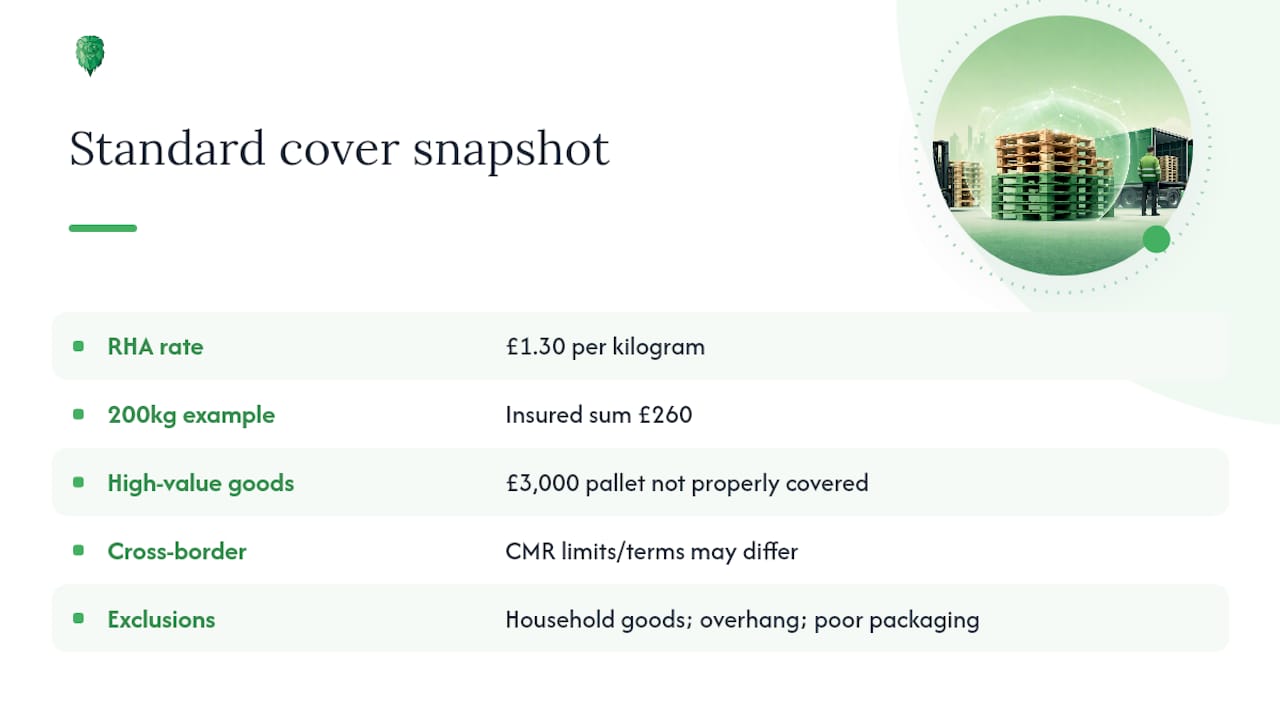
When a carrier quotes you a price for pallet delivery, the insurance built into that quote almost always follows RHA conditions of carriage, the terms most road hauliers in Britain trade under. The standard liability figure most pallet networks apply is £1.30 per kilogram, so a 200kg pallet carries an insured sum of £260 regardless of what’s actually inside it. That’s the calculation worth doing before you book anything, because a pallet of electronics or stock worth £3,000 gets nowhere near proper cover under the standard rate.
CMR rules take over when a pallet crosses an international border, and the limits and conditions can differ from the domestic RHA figure, so check the terms specifically for any leg leaving the UK. Standard policies also carry consistent exclusions across the industry: household goods and house-move items, pallets that overhang their base, and anything let down by inadequate packaging rarely qualify for a payout. Prohibited or restricted goods sit outside cover entirely, whatever the circumstances.
Can you buy extra cover for a higher-value pallet? Part of pallet insurance uk
Yes, and most established carriers offer at least two upgrade routes. The first is a per-kilogram top-up, where you pay a small additional fee to lift your rate from the standard £1.30/kg to something closer to £5.00 per kilogram. On that 200kg pallet, that turns £260 of cover into £1,000, which is often enough for mid-value stock without the paperwork of a full declared-value policy.
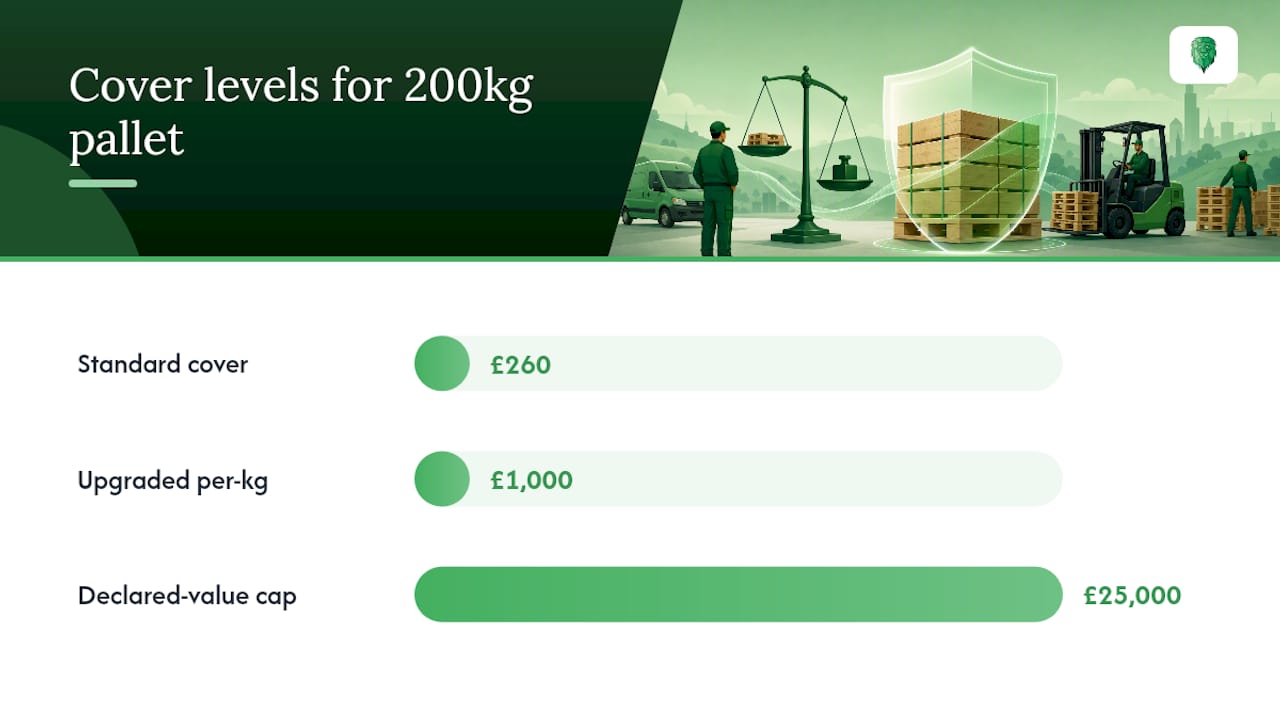
The second route is extended or declared-value insurance, where you insure a single shipment up to a stated cap, sometimes as high as £25,000. Carriers will not simply take your word on value. Expect underwriting checks on how the goods are packed, whether the pallet is properly confined and shrink-wrapped, and whether labelling meets their standard before they’ll honour the higher limit. Skip these steps and you risk the insurer treating the claim as if standard cover applied all along.
Who actually needs Goods in Transit cover rather than standard liability? Part of pallet insurance uk
Standard per-kilogram cover suits low-value, easily replaceable goods sent occasionally. It stops suiting you the moment you’re a business shipping regularly, working under contractual obligations to clients, or trading through a pallet network.
Pallet network members and hauliers often need to carry Goods in Transit or hauliers liability insurance with limits well above the RHA figure, because network membership and client contracts frequently demand it. Specialist brokers routinely arrange this alongside enhanced indemnity cover for exactly this audience.
Private individuals sending household items should know standard pallet policies almost always exclude house-move goods, so a separate removals policy is the safer route rather than relying on your carrier’s baseline cover. Owner-drivers and small fleets have their own middle ground: single-shipment placements for occasional high-value loads, or annual fleet Goods in Transit cover if pallet work is a regular part of the business.
What should you do the moment a pallet arrives damaged? Part of pallet insurance uk
Speed matters more than most shippers realise, and the way you act in the first few minutes at delivery often decides whether a claim succeeds at all.
- Inspect before you sign. Check the pallet and its wrapping while the driver is still there, not after they’ve left.
- Photograph everything. Damage, shortages, torn shrink-wrap, a collapsed pallet base. Timestamp them if your phone allows it.
- Mark the delivery note. Write “damaged” or “short” clearly on the paperwork before signing. An unqualified signature can be treated as acceptance in good condition.
- Keep the packaging. Insurers frequently want to see the original wrapping and pallet as evidence of how the damage occurred.
- Report formally within the carrier’s deadline. Most set a short reporting window, often just a few days, so don’t leave this for the following week.
- Submit full documentation. Consignment note, invoice showing value, and your photographs, all sent together rather than piecemeal.
- Expect a defined timescale. Insurers typically acknowledge a claim quickly, then settle once evidence is reviewed, though excesses and sub-limits will reduce the final pay-out.
Preserving the delivery note and photographs at the point of handover is the single biggest factor in whether a claim gets paid in full or gets disputed.
How do you choose the right pallet cover for your business? Part of pallet insurance uk
Comparing pallet cover on premium alone is one of the most common mistakes shippers make, and brokers consistently warn that comparison sites can prioritise cheap pricing over sound wording. A cheaper policy with wide exclusions can cost far more than the premium it saved.
Before committing to a policy, work through this checklist:
- Decide whether per-kilogram cover or declared value suits your typical shipment value.
- Read the exclusions list in full, not just the headline liability figure.
- Check the excess and how it applies per claim.
- Confirm whether cover is named-perils or all-risks, which changes what’s actually payable.
- Ask if depot handling and cross-docking are covered, since pallet delivery involves multiple handoff points that single-leg haulage doesn’t.
- Check what packaging standard the insurer requires before they’ll pay out.
Pro Tip: Ask any insurer or broker for a written list of exclusions and a sample claims scenario before you buy. If they can’t produce one quickly, that tells you something about how smoothly a real claim would go.
For pallet network operators or businesses with contractual cover requirements, a specialist haulage broker who can place Goods in Transit and enhanced indemnity limits is usually worth the conversation, even if it costs slightly more than a generic quote.
How Van-247delivery reduces pallet insurance risk
Experienced logistics providers have established methods in how pallets are prepared before they ever leave the depot. Secure loading, proper shrink-wrapping, and condition notes taken at handover all reduce the chance of a dispute later, because the evidence a claim needs already exists before anything goes wrong.
Our pallet delivery service includes tracking and optional insurance, and we follow documented safety standards on loading and handling throughout. If you want to talk through declared-value options or need packing support for a higher-value shipment, get in touch before booking so the cover matches what’s actually on the pallet.
Is basic cover ever enough, or should you always upgrade?
Standard per-kilogram liability is genuinely fine for low-value, replaceable stock. Where it falls short is mixed-value pallets sent regularly by SMEs, and that’s where declared value or annual Goods in Transit cover earns its keep. Whatever tier you choose, keep photographic evidence from every shipment and get any extra cover confirmed in writing, not just promised on a phone call.
— Claudiu
Get your pallet moving with insured cover that fits
Some providers offer a direct route to insured pallet transport without the guesswork of comparing carrier small print yourself. Where the industry standard leaves a heavy or valuable pallet under-covered at £1.30/kg, they can provide advice on declared-value pricing and packing support so the cover matches what’s on the pallet.
Booking is simple: get a quote for pallet delivery, tell us the value of what you’re sending, and we’ll advise whether standard cover, a per-kilogram top-up, or full declared value suits the shipment. If you’re moving household items rather than commercial stock, our house removals team can advise separately, since household goods sit outside standard pallet cover entirely. Get in touch today to arrange collection and confirm your insurance options before your pallet leaves the depot.
Where this information comes from
The RHA liability figure and top-up pricing come from a national pallet network’s own published insurance terms, useful for understanding the industry baseline. Broker guidance on Goods in Transit and network cover explains why business shippers often need more than the standard rate. Detail on depot and cross-dock risk explains why pallet insurance underwriting differs from single-leg haulage, and independent advice on comparing brokers versus price sites supports the case for checking wording before buying.
This article is general information, not a substitute for advice from a qualified financial advisor. Consult a qualified financial professional about your own circumstances before acting on anything here.
Sources
- Pallet Network Insurance | Goods in Transit & Haulage Cover | Avis Insurance
- Pallet Delivery Insurance UK for Freight | Insure24
- Independent insurance broker vs comparison sites — WS Insurance
FAQ
How much does pallet delivery cost in the UK?
Pallet delivery pricing depends on weight, dimensions, distance and how quickly you need collection, so costs vary widely between carriers. Van-247delivery provides instant quotes through its pallet delivery page rather than a fixed published rate.
How many pallet networks operate in the UK?
The UK has several established pallet networks operating hub-and-spoke systems across the country. Each with its own carrier members and insurance terms. Coverage and liability limits can differ between networks. Which is why checking the specific carrier’s terms matters more than assuming a single industry standard applies everywhere.
What is the best pallet delivery service in the UK?
The right choice depends on your priorities: speed, tracking, insurance flexibility, or handling of specific goods types. Van-247delivery offers insured pallet transport with tracking and optional declared-value cover, backed by extensive UK logistics experience.
What is the maximum weight allowed for a pallet in the UK?
Standard UK pallets typically have practical weight limits set by the carrier and the pallet type itself, commonly around one tonne for a standard Euro or UK pallet. Though this varies by network and vehicle. Always check the specific weight limit with your carrier before booking, since exceeding it can affect both transport and insurance validity.
Does standard pallet insurance cover household items?
No. Standard pallet insurance policies almost always exclude household goods and house-move items, regardless of the per-kilogram liability figure quoted. Private shippers moving household items should arrange separate removals cover through a service like house removals instead of relying on pallet network insurance.