A piano access assessment is the pre-move site survey that decides whether your piano can be moved safely and what equipment or permission you will need. It checks every doorway, stair, lift and corridor your piano must pass through, alongside the instrument’s own dimensions. Arrange one before you book a moving date: take a measurement checklist to your mover, or ask a specialist like Van-247delivery to carry out a full survey and quote for insured transport.
TL;DR:
- Record clear doorway, stair, corridor, and lift measurements, then send labeled photos from two angles; movers can often quote without another site visit.
- HSE guidance requires a formal risk assessment when hazardous lifting cannot be avoided, particularly for long carries, tight turns, or lifting outside recommended zones.
- Narrow routes may require dismantling, door removal, team handling, or a hoist, with extra labor, permits, equipment hire, and insurance costs reflected in the quote.
- Book early for a fixed move date: formal MAC or RAPP reviews and specialist equipment can take longer to arrange than a routine survey.
Table of Contents
- What a piano access assessment checks
- How to measure and record access yourself
- When you need a formal manual handling risk assessment
- Common access problems and the fixes a survey recommends
- What to prepare before the surveyor arrives
- How long a piano access assessment takes
- Qualifications to look for in a piano surveyor
- Reading the report and planning your move around it
- Safety precautions during the move itself
- Why a professional survey pays for itself
- Ready to book your piano access survey?
- FAQ
- Sources
What a piano access assessment checks
A thorough survey looks at the whole journey your piano will take, not just the piano itself. Surveyors work through the same checklist every time, because missing one measurement can mean a piano gets stuck halfway down a corridor on moving day.
Here’s what gets checked:
- External approach: vehicle access to the property, parking restrictions and whether a permit is needed for kerbside loading.
- Doorways and corridors: clear width and height of every door, plus the width of hallways and landings the piano must pass through.
- Stairs: stair width, headroom at the stairhead, and the tightness of any turns or half-landings.
- Lifts: internal lift dimensions, weight capacity and whether a goods or service lift is available.
- The piano itself: length, width, height, and which parts (legs, lid, pedals) can be removed to reduce the overall size.
- Floors and hazards: floor strength, surface finish, and any obstacles or trip hazards along the route.
A survey that covers all of these gives you and your mover a realistic picture of what the move actually involves, rather than a guess based on a phone description.
How to measure and record access yourself
If you want to prepare before a surveyor arrives, or you are putting together your own figures for a quote, a consistent method makes all the difference. The goal is a record that anyone, including a mover who has never seen your home, can read and trust.
- Gather your tools: a tape measure, a laser measure if you have one, and a smartphone camera.
- Measure every doorway: record clear width and height, not the frame’s outer edge.
- Measure corridors and stairs: note the narrowest point in each corridor and the stair width at its tightest turn.
- Check stairhead clearance: measure the headroom where stairs meet a landing or ceiling slope.
- Measure any lift: internal width, depth and height, plus the stated weight limit.
- Note the turning radius: work out how much space exists at each corner for tilting or angling the piano.
- Measure the piano: length, width and height, and list any parts that come off, such as legs or a music desk. Note the approximate weight if you know it.
- Sketch the route: draw a simple plan from the piano’s current position to the vehicle, marking every control point.
- Photograph each control point from two angles, with a person or open door in shot for scale.
- Package everything together: save your measurements, sketch and photos as one labelled PDF or a single zipped folder before sending it to a mover.
Pro Tip: Label photos with the room name and direction of travel (for example, “hallway, facing front door”) so a surveyor can follow your route without needing to ask.
A clear set of measurements and photos often lets a mover give you a firm quote without a second site visit, saving you time before the move date.
When you need a formal manual handling risk assessment
HSE guidance requires a suitable and sufficient manual handling risk assessment wherever hazardous manual handling cannot be avoided, and a piano move very often falls into that category. The assessment has to consider the task, the load, the working environment and the capability of the people doing the lifting.
Certain situations push a move past a simple checklist and into territory that needs a more detailed look:
- Hands need to work outside the recommended lifting zones set out in HSE manual handling guidance.
- The load is heavy, awkwardly shaped, or has to be carried a long distance.
- The move involves frequent lifts or a team handling operation rather than a single lift.
- Space is severely constrained, such as a stairwell with multiple tight turns.
When simple filters flag one of these issues, HSE’s assessment checklists point towards tools such as MAC (Manual Handling Assessment Charts) and RAPP (Risk Assessment of Pushing and Pulling), which help movers size up the right team and equipment for the job. In practice, this escalation usually applies to external hoisting, narrow stairwells with low headroom, or routes with several awkward turns in succession.
Common access problems and the fixes a survey recommends
Most access problems fall into a handful of categories, and each has a standard set of fixes that experienced movers reach for.
- Narrow doorways and tight turns: partial dismantling of the piano, temporary removal of a door or frame, angling the instrument through the gap, or, where nothing else works, an external hoist.
- Stairwell headroom and fragile stairs: specialist team-handling techniques, protective covering at the stairhead, and temporary protection for delicate surfaces, as covered in our stair protection guidance.
- No vehicle access or a long carry: a smaller vehicle paired with a short carry, use of a piano trolley, or arranging permission for kerbside loading in advance.
- Lift constraints: handling the piano via the stairs instead, bringing in an external crane for upper floors, or using a specialist technique for narrow service lifts.
Each of these fixes changes the quote in a predictable way. Extra labour, hire of specialist equipment such as a hoist or crane, any permit costs for street access, and an added insurance loading for higher-risk handling all tend to show up once a survey identifies one of these problems. Spotting the issue early, rather than discovering it on moving day, is usually what keeps the final cost close to the original estimate.
What to prepare before the surveyor arrives
A little preparation turns a site visit into a quick, accurate process rather than a long back-and-forth.
- Labelled photos and measurements from your own walkthrough, plus the piano’s make, model and any known service notes.
- Access permissions, parking details, a building manager’s contact if you live in a managed block, and confirmation of lift or service-lift availability.
- Any building restrictions that apply, such as listed building conditions or fragile flooring that needs protecting.
- Your preferred time window for the move, so the surveyor can flag any clashes early.
- A direct question for the surveyor: ask whether your move needs a formal MAC-based assessment given the route you’ve described.
Handing over this information up front means the surveyor can confirm or adjust your own measurements rather than starting from scratch.
How long a piano access assessment takes
Timelines vary with the complexity of the property, but a typical piano access assessment follows a predictable shape. Booking the survey usually takes a few minutes, whether by phone or through an online quote request, and most movers can offer an appointment within a matter of days.
The on-site visit itself tends to be brief: a straightforward home with clear access might only need a short walkthrough, while a property with multiple staircases, a lift, or an unusual layout takes longer because the surveyor is checking more control points. Photographing and measuring each stage of the route adds time proportionally to the number of turns, doors and floor changes involved.
Once the visit is complete, turning the findings into a written report is usually the fastest part of the process, because the surveyor is working from measurements and photos taken on site rather than starting from a blank page. If your access details are straightforward and well documented in advance, using the measurement method described earlier in this guide, some movers can skip the in-person visit altogether and issue a report from photos and figures alone.
Complex properties, particularly those needing a formal manual handling assessment with MAC or RAPP scoring, take longer to turn around because the surveyor has to work through each risk factor individually rather than relying on a standard checklist. If your move date is fixed, it’s worth arranging the survey as early as possible so there’s time to organise any specialist equipment the report identifies.
Qualifications to look for in a piano surveyor
Not every mover who offers a quote has the experience to properly assess piano access, so it’s worth knowing what separates a reliable surveyor from someone simply guessing dimensions over the phone.
Look for a surveyor or moving company with hands-on experience specifically in piano transport, not just general house removals: pianos combine awkward shape, concentrated weight and delicate internal mechanisms in a way that ordinary furniture doesn’t. A reliable assessor should be comfortable applying manual handling principles in line with HSE guidance, including recognising when a job needs a formal MAC or RAPP-based assessment rather than a simple checklist.
Ask whether the surveyor documents their findings in writing, with measurements, photos and a clear method statement for the move itself. A credible assessor should also be able to explain how access difficulties translate into practical fixes, whether that means door removal, team-handling techniques or specialist equipment, and should be upfront about when a job needs a larger team or extra equipment hire.
Insurance is another marker worth checking directly: ask whether the assessment and the move itself are covered, since a survey is only useful if the mover carrying it out is also equipped to deliver the move safely once the report is written.
Reading the report and planning your move around it
Once you have a written assessment, the real value comes from using it properly rather than filing it away. Start with the stated route: the report should describe, step by step, how the piano will travel from its current position to the vehicle, including every point where a fix such as door removal or team handling is required.
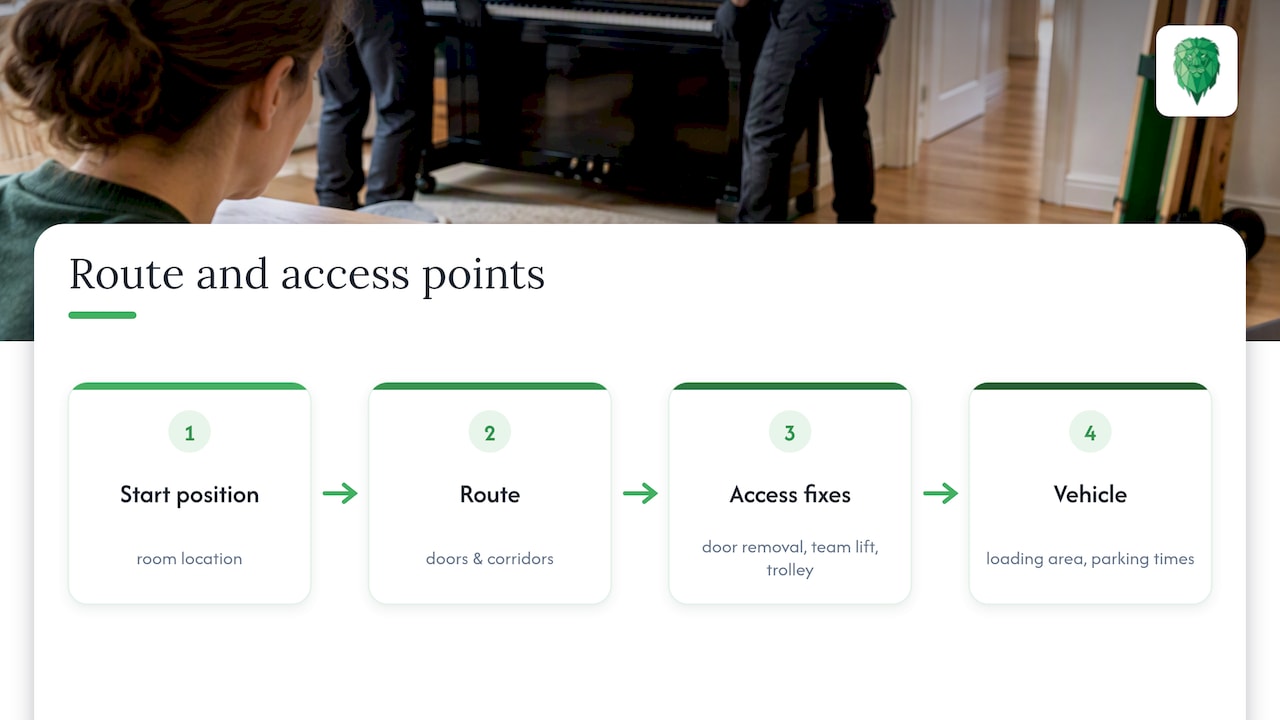
Check the equipment list against what’s been recommended. If the report calls for a piano trolley, protective blankets, or a specialist hoist, confirm these are included in your quote rather than assumed. Where the report flags a need for a formal manual handling assessment, make sure that assessment has actually been carried out before the move date, not left as a note for “on the day.”
Pay close attention to any time windows or access conditions mentioned, such as restricted parking hours or a lift that’s only available at certain times, and share these with everyone involved in the move, including building management if you live in a shared block. Finally, treat the report as a working document: if anything changes before moving day, such as a new obstacle in a corridor or a change of exit route, tell your mover so the plan can be adjusted rather than discovered as a problem on the day itself.
Safety precautions during the move itself, part of Piano Access Assessment
The assessment’s real purpose is to shape what happens on moving day, and a few safety protocols come directly out of a good survey. Protective blankets and padding go on the piano itself and on any walls, door frames or banisters along the confirmed route, particularly at the tight corners the survey identified.
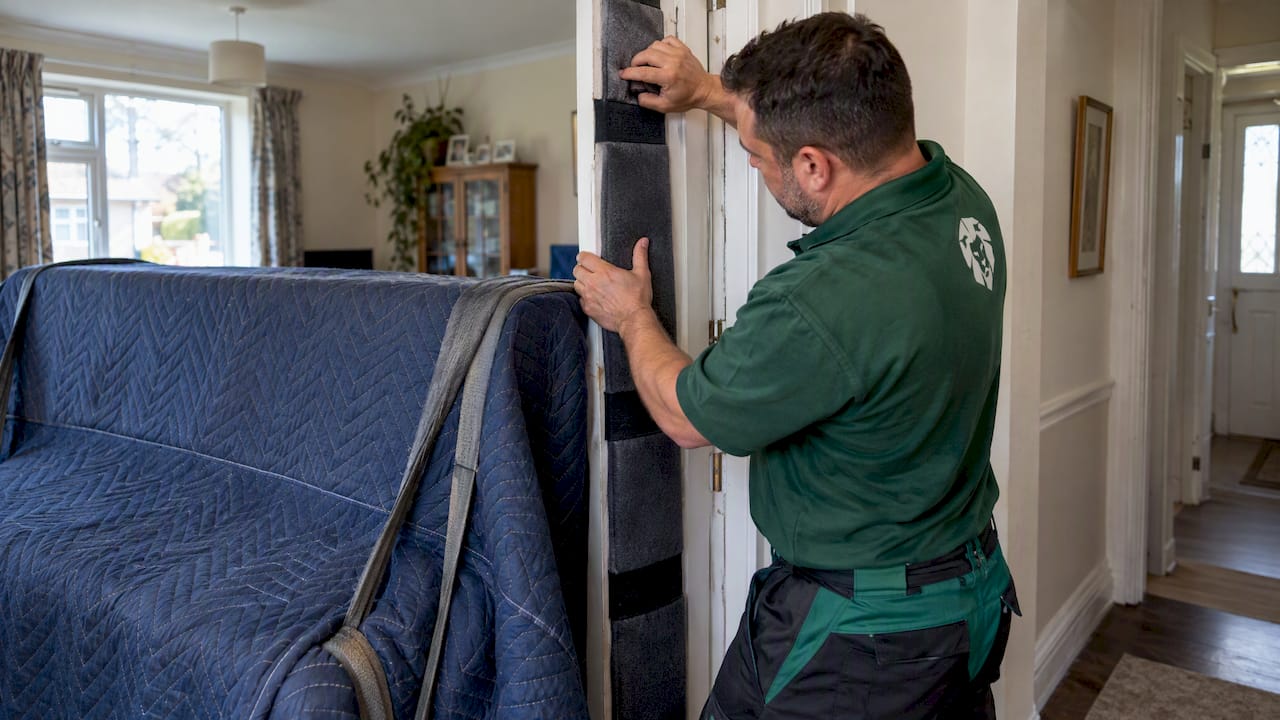
Team size is set by the assessment rather than guesswork. A job flagged for team handling under HSE-aligned principles should arrive with enough people to manage the lift safely. Not the minimum a mover thinks might work. Equipment such as piano trolleys, straps and ramps should match what the report specified. And stairhead protection should be in place before the piano is moved, not added partway through.
Clear communication matters just as much as equipment. Everyone handling the piano should understand the agreed route. And the location of each tricky point, such as a low stairhead. Or a narrow turn, before lifting begins. Where a fix like temporary door removal was planned in the assessment. It should be done in advance rather than attempted mid-lift. Following the report closely, rather than improvising around an access problem on the day. Is what keeps both the piano and the people moving it safe.
Why a professional survey pays for itself
Guessing at access, or accepting a quote with no site visit. Is how pianos end up stuck on a half-landing or quotes balloon on the day. A proper survey reduces surprises, protects against damage, and clarifies exactly where insurance and liability sit if something goes wrong. Experienced surveyors combine careful measurement with a genuine risk assessment to produce a safe working method. Not just a number on a page. We back that process with insured transport, dismantling and specialist handling where the survey calls for it.
— Claudiu
Ready to book your piano access survey?
If you’ve worked through the checklist above, you’re already most of the way to a fast, accurate quote. Our piano transport service includes a pre-move access survey, insured transport, dismantling. And reassembly where needed, and the specialist equipment that tricky routes call for.
To get the quickest possible quote:
- Send us your labelled photos and measurements from the method described earlier in this guide.
- Let us know about any access restrictions, such as parking permits or lift availability.
- Mention your preferred moving date so we can plan around any specialist equipment the survey identifies.
Head to our piano transport page to request your quote. And get the move properly assessed before you commit to a date.
FAQ
What does a piano access assessment actually involve?
It’s a site survey that checks your route, including doorways, stairs, lifts and corridors, against the dimensions of your piano. The surveyor records measurements and photos, then advises on any fixes needed, such as door removal or specialist handling.
Do I need a formal risk assessment for every piano move?
Not every move needs one. HSE guidance says a detailed assessment, often using MAC or RAPP tools. Is needed when hands must work outside guideline lifting zones. Loads are heavy or awkward, or space is severely constrained.
Can I carry out my own access assessment before booking a mover?
Yes. Measuring doorways, corridors, stairs and your piano yourself. Then photographing each control point from two angles, gives a mover enough information for an accurate quote. Many movers can issue a report from this information alone if it’s clearly labelled.
What happens if the survey finds my piano won’t fit through a doorway?
The surveyor will recommend a remedial option such as partial dismantling. Temporary removal of a door or frame, angling the piano through the gap, or an external hoist for severe cases. These fixes are factored into your quote once identified, including the piano transport booked through Van-247delivery.
How do I prepare my property before the surveyor or moving team arrives?
Clear the route of obstacles, confirm parking or permit arrangements, and have your measurements and photos ready to share. If you live in a managed building, let the building manager know the date and confirm lift availability in advance.