Removal company accreditations: the accreditations worth trusting are BAR membership (with its Advanced Payment Guarantee), CTSI approved code oversight, FAIM/FIDI for international moves, and relevant BS EN standards. Each guarantees something different, from payment protection to audit history, and none of them mean much unless you check they’re current. Here’s how to verify each one before you book.
TL;DR:
- Verification of current accreditation status is essential, as badges can be outdated or meaningless if the membership or audit has lapsed.
- The most relevant credentials for domestic moves are BAR membership with the APG, while international moves should prioritize FAIM certification and recent audits.
- Supporting documents like the actual APG certificate, insurance, and dispute resolution contacts provide stronger proof than website logos alone.
- Asking straightforward questions about membership numbers, audit dates, and coverage caps helps confirm a company’s compliance and trustworthiness.
- Smaller or unaccredited firms may still be suitable, but require written contracts, confirmed insurance, and local references to mitigate risk.
Table of Contents
- What do removal company accreditations mean?
- What does each removal accreditation actually guarantee?
- How can you verify accreditation claims and spot the limits?
- What questions should you ask an accredited removal company?
- Which accreditations matter most for your type of move?
- How Van-247delivery treats accreditation signals when vetting standards
- Getting the same protections without chasing logos
- Where to verify removal accreditations yourself
- Sources
- FAQ
What do removal company accreditations mean?
Not every badge on a removal firm’s website means the same thing, and that’s exactly why “removal company accreditations” gets searched so often. Some are formal certifications with audits and penalties for non-compliance. Others are looser networks you can join by paying a fee. Here’s what you’re actually looking at:
- BAR membership and the APG: British Association of Removers members get external auditing and consumer payment protection for private home moves, refreshed annually.
- CTSI approved code: independent oversight of BAR’s Code of Practice, run by the Chartered Trading Standards Institute rather than the industry itself.
- FAIM/FIDI: an international mover quality certification built on third-party audits, aimed squarely at cross-border relocations.
- BS EN and BS standards: recognised British and European technical standards covering how removals and commercial moves should be carried out.
- IAM and similar networks: international trade associations that signal connections and shared resources, but function more like membership clubs than certification bodies.
Knowing which category a badge falls into tells you how much weight to give it.
What does each removal accreditation actually guarantee? Part of removal company accreditations
Badges look similar from a distance. Up close, they cover very different ground, and the differences matter when something goes wrong with your move.
BAR membership isn’t handed out for a subscription fee. Companies have to meet strict criteria covering premises, vehicles, staff conduct, and financial standing, and membership can be pulled for non-compliance. BAR members go through an extensive external audit every year and commit to a Trading Standards-approved Code of Practice, which is what separates BAR from a simple trade listing.
The Advanced Payment Guarantee (APG) is the part most home movers actually care about. It protects deposits and advance payments made to a full UK-based BAR member, but it comes with real boundaries:
- It applies to private individuals, not businesses contracting commercial moves.
- Coverage has caps and route limitations, and some cross-border combinations sit outside the scheme entirely.
- Claims require evidence of reasonable costs to complete the move, not just a receipt for the deposit.
Statistic worth remembering:
FAIM’s certification cycle runs on a three-year external audit, backed by mandatory annual self-assessments in between. That cadence matters because a logo earned three years ago tells you almost nothing about a company’s standards today unless the self-assessments have kept pace.
CTSI’s approved code oversight
adds a layer BAR doesn’t provide alone. CTSI lists BAR as the code sponsor and independently monitors the criteria members must meet, giving you a second body to check claims against rather than relying on BAR to mark its own homework.
British Standards
such as BS EN 12522 and BS 8522 set out technical expectations for how removals and commercial relocations should run, and many BAR members hold these alongside their membership. They’re less visible to the public than BAR or FAIM badges but useful when a commercial client wants documented process standards.
IAM and comparable international bodies function differently again. Membership signals a network of contacts and shared logistics resources across borders, which is genuinely useful for complex moves, but it isn’t the same as an audited certification. Ask what a company’s IAM membership actually verifies before assuming it matches FAIM’s rigour.
How can you verify accreditation claims and spot the limits? Part of removal company accreditations
A badge on a website is a claim, not proof. Verifying it takes minutes and saves you from a company that’s let its membership lapse or, worse, never had it.
- Search the membership database directly. BAR and CTSI both run searchable member lists on their own sites, so check the company’s current membership status rather than trusting a logo alone.
- Check the audit date, not just the badge. Ask when the last external audit happened. For FAIM-certified firms, that should sit within the three-year cycle, with a recent self-assessment on file.
- Ask to see the actual APG certificate. This confirms geographic scope (UK-only versus worldwide) and the scheme’s monetary caps, which vary and aren’t visible from the badge itself.
- Request supporting paperwork alongside the accreditation: insurance certificates, written contract terms, VAT registration, and a named dispute-resolution contact.
- Report mismatches. If a company’s website shows a logo that the issuing body’s database doesn’t confirm, that’s a signal worth acting on, not ignoring.
Pro Tip: Ask the removal company to email you their APG certificate number before you pay a deposit. A legitimate BAR member will produce it without hesitation; a company that stalls or gets vague is telling you something.
What questions should you ask an accredited removal company? Part of removal company accreditations
Before you book, a short phone call or email exchange can confirm whether an accreditation actually applies to your move rather than sitting on the website as decoration.
- “Can you confirm your current BAR/CTSI membership number so I can verify it?”
- “If I’m moving internationally, can you show me your FAIM certificate and the date of your last independent audit?”
- “Does your Advanced Payment Guarantee apply to private individuals like me, and what’s the coverage cap?”
- “Is your insurance cover for private customers or business clients, and does it match my type of move?”
- “What’s your dispute-resolution process if something goes wrong, and how long does it typically take?”
Any accredited company should answer these without friction. Hesitation, vague answers, or a refusal to produce documents is the clearest red flag you’ll get before signing anything.
Which accreditations matter most for your type of move? Part of removal company accreditations
The right badge to prioritise depends heavily on what you’re actually moving.
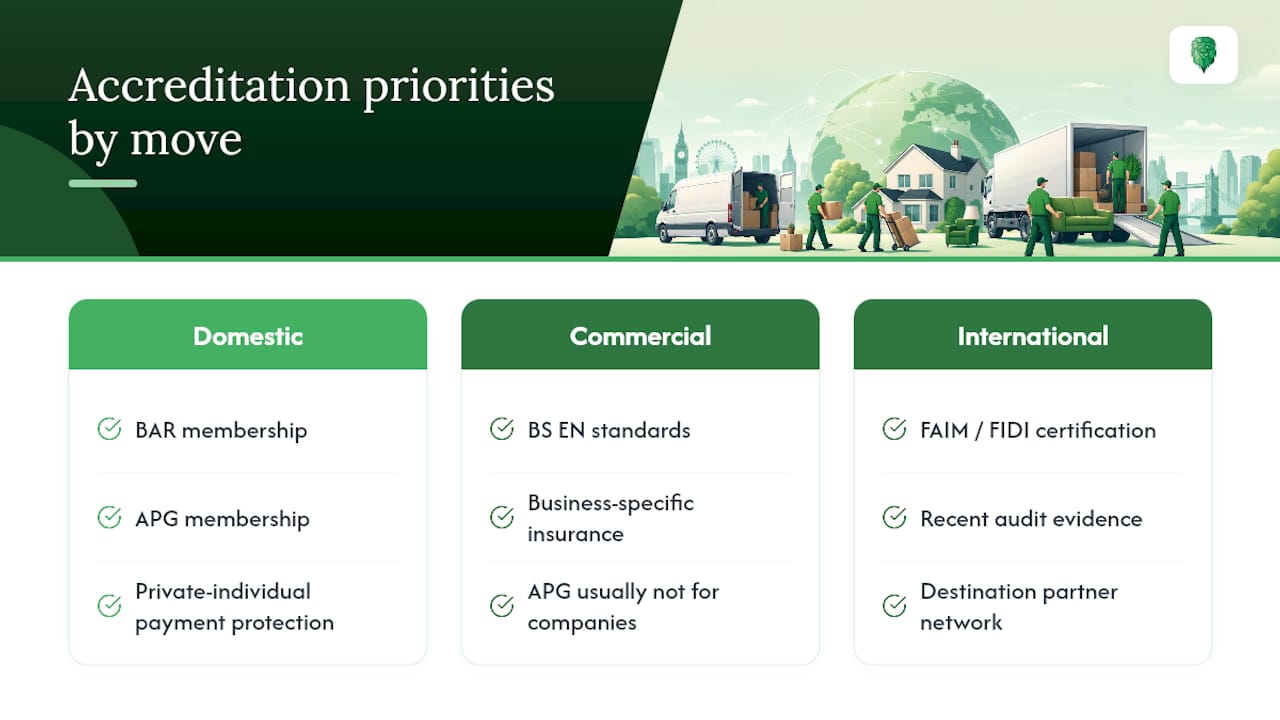
For a domestic home move, BAR membership and the APG matter most, since that’s where private-individual payment protection actually applies. About commercial or office relocation, look instead at BS EN standards and business-specific insurance, since APG protection generally doesn’t extend to company contracts. And for a international move, FAIM/FIDI certification and recent audit evidence take priority, alongside a look at the partner network handling the destination end.
Smaller local moves sometimes involve firms too small to hold formal accreditation at all. That doesn’t automatically rule them out, but it does shift the burden onto you: get a written contract, confirm insurance cover in writing, and ask for local references before paying anything upfront.
How Van-247delivery treats accreditation signals when vetting standards
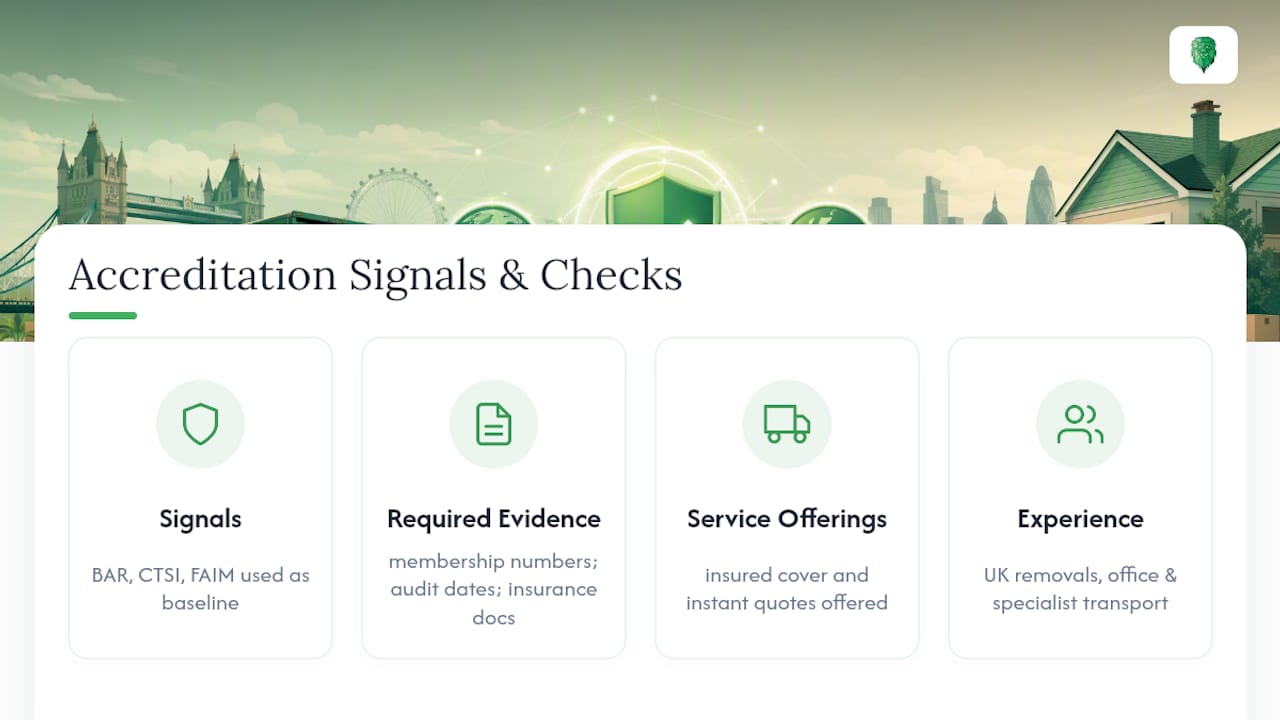
We treat BAR, CTSI, and FAIM signals as a baseline when judging what “trustworthy” actually looks like in this industry, and we ask suppliers for the same evidence this guide recommends: current membership numbers, audit dates, and insurance documentation. With experience handling UK removals, office relocations, and specialist transport, insured cover and instant quotes are offered as part of the service.
— Claudiu
Getting the same protections without chasing logos
This company offers a practical alternative to hunting for badges yourself: their experience in UK moving, insured transport, and instant online quotes aim to provide protections described in this guide without requiring verification from scratch on every job.
Whether you need a full house removal, help with furniture and large items, or an office relocation handled with the same attention to insurance and process that BAR-style accreditation demands, you can ask us directly for proof of insurance cover before you book. We’ll confirm it in writing, no chasing required. If you’re ready to see costs for your own move, get an instant quote and check availability for your dates today.
Where to verify removal accreditations yourself
Checking a claim takes minutes once you know where to look:
- BAR membership search and APG details
- CTSI’s Approved Code Scheme page for oversight status
- FIDI’s FAIM certification page for international mover audits
- The relevant British Standard reference number, quoted directly by the removal company
Always check the audit date shown, not just whether a badge appears at all.
Sources
FAQ
Which UK removal company is considered the best?
There’s no single official “best” removal company in the UK, since quality varies by move type and route. The most reliable way to judge one is checking whether it holds current BAR membership with APG cover, a CTSI-approved code status, and, for international jobs, active FAIM certification.
How do I start a removal company in the UK?
Starting a removal company legally requires standard business registration, appropriate goods-in-transit and public liability insurance, and compliant vehicles and drivers. Joining BAR or seeking CTSI-approved code status isn’t mandatory to trade, but it’s how a new firm signals it meets audited, Trading Standards-monitored criteria rather than operating without oversight.
Which moving company has the best reputation?
Reputation is best judged through verifiable signals rather than marketing claims: current BAR membership. A CTSI-monitored code status, insurance documentation, and, for international movers, a recent FAIM audit date. A company that produces these on request, alongside genuine customer references, has earned its reputation rather than assumed it.
What is the average cost of a removal company in the UK?
Removal costs vary widely depending on distance, property size, and services like packing or storage. So there’s no single fixed UK average. Van-247delivery’s current prices for house removals, office relocations. And specialist transport are available on the site through an instant quote, with waiting time charged at £24 per hour per man where it applies.