Testimonials are firsthand accounts from previous customers that reveal the real quality of a moving company’s service. They sit at the heart of how most people decide which mover to trust, and for good reason. The role of testimonials in choosing movers goes far beyond star ratings. In the moving industry, the standard term for this body of evidence is “social proof,” and it works because most people moving home are novices who rely on others’ experiences to set their expectations. Reading what real customers say cuts through marketing claims and gives you a clearer picture of what moving day will actually look like.
How to critically assess moving company testimonials
Not all testimonials carry equal weight. A single glowing review on a company’s own website tells you very little. Reading at least 20 recent reviews across a minimum of two independent platforms gives you enough data to spot recurring patterns, whether that is consistent praise for punctuality or repeated complaints about hidden charges.

The platforms worth checking include Google Business Profile, Trustpilot, and the Better Business Bureau (BBB). Each attracts a different type of reviewer, so cross-referencing them filters out curated or fake feedback. Look for reviews posted within the last six months, since a company’s standards can shift quickly after a change in management or staffing.
Watch for these red flags when reading testimonials:
- Generic praise with no specifics. Phrases like “great service, highly recommend” without any detail about the move itself are often unreliable.
- A sudden cluster of five-star reviews. A spike in perfect scores over a short period can indicate manufactured feedback.
- No mention of problems. Every real moving operation encounters minor issues. Reviews that describe a flawless experience with zero friction are statistically unlikely.
- Mismatch between review dates and company age. A company claiming ten years of trading but with reviews only from the past three months warrants scrutiny.
Pro Tip: Search for testimonials that mention your specific moving need. If you are moving a piano, look for reviews that mention piano moves explicitly. Generic praise does not confirm specialist capability.
Specific mentions of niche services in testimonials are far more informative than broad compliments. A reviewer who describes how a team handled a Steinway grand up three flights of stairs tells you something a five-star rating never could.
What negative reviews reveal about a mover’s integrity
How a company handles a complaint tells you more about its character than how it performs on a perfect day. Companies that respond calmly and constructively to one and two-star reviews consistently show higher reliability than those that ignore criticism or reply defensively.
Think about what a defensive response actually signals. It suggests the company prioritises its image over the customer’s experience. A calm, solution-focused reply, even to an unfair review, shows the team is trained to handle pressure professionally.
Look for these qualities in owner responses to negative feedback:
- Acknowledgement of the issue without deflecting blame onto the customer.
- A specific resolution offered, such as a refund, a follow-up call, or a replacement item.
- A tone that stays professional, even when the reviewer is clearly frustrated.
“Resolution stories in testimonials are more trustworthy than perfect ratings without complaints. Companies that respond professionally to complaints and resolve issues are often more reliable than those with only perfect scores.”
Emotional stories in reviews carry more weight in consumer decisions than numerical ratings alone. A narrative describing how a mover replaced a damaged item without argument is worth ten five-star ratings from customers who simply had an uneventful move.
How testimonials fit into the broader trust stack
Testimonials are one layer of a multi-level verification process, not the whole picture. The “trust stack” is a layered approach combining customer reviews, licensing records, insurance certificates, and community feedback to build a complete picture of a mover’s reliability.
Relying solely on testimonials creates a blind spot. Complaints often stem from pricing mismatches rather than operational failures, which means a company with strong reviews could still hit you with unexpected charges if you have not verified its quoting process independently.
Pro Tip: Ask any mover you are considering to provide their FMCSA registration number (for international moves) or their British Association of Removers (BAR) membership details. Cross-reference these with what customers say about transparency in their reviews.
The table below summarises the trust factors worth verifying before you book:
| Trust factor | What to check | Why it matters |
|---|---|---|
| Customer testimonials | Google, Trustpilot, BBB | Reveals real operational experience |
| Licensing and registration | BAR membership, FMCSA (international) | Confirms legal authority to operate |
| Insurance certificate | Public liability, goods in transit | Protects your belongings if damage occurs |
| Volume of reviews | Minimum 20 recent reviews | Provides statistical reliability |
| Response to complaints | Owner replies on review platforms | Indicates how problems are managed |
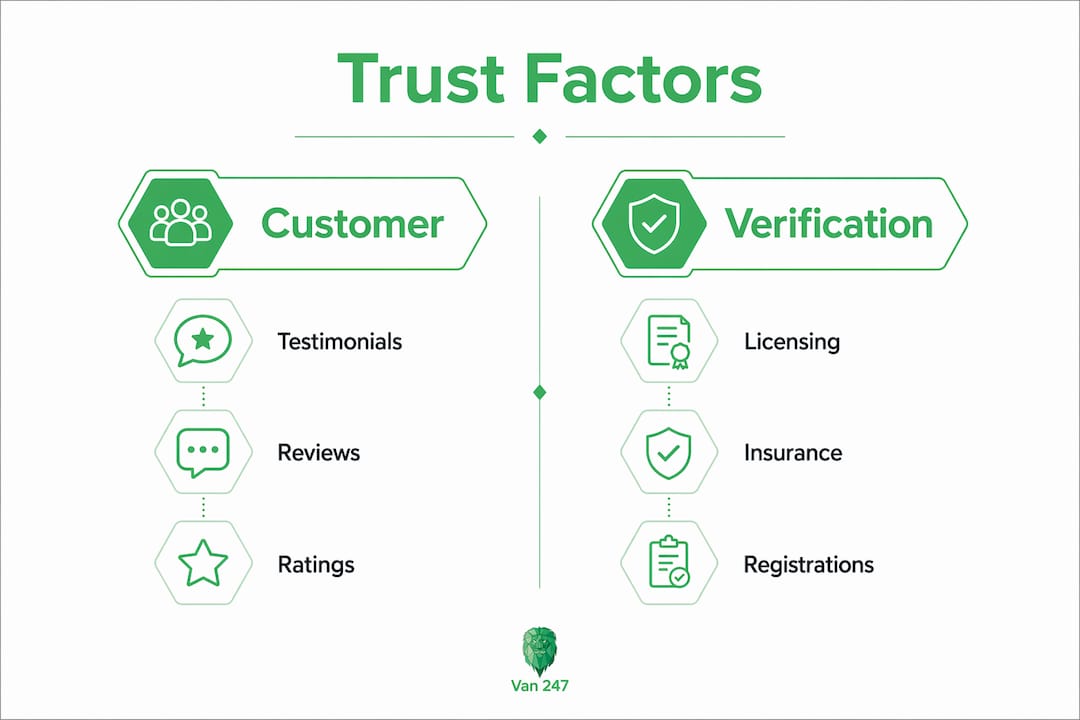
A layered approach combining reviews, licensing, and community feedback provides the strongest consumer trust foundation. No single signal is enough on its own.
Common pitfalls when interpreting moving company reviews
The most common mistake people make is focusing on the star rating and skipping the written content. A company with a 4.8-star average from twelve reviews is statistically less reliable than one with a 4.4-star average from 200 reviews. Companies with 50 or more reviews and consistent scores in the 4.3–4.7 range are generally more trustworthy than those with a handful of perfect scores.
Other pitfalls to avoid:
- Ignoring the date of reviews. A company that was excellent three years ago may have declined since. Prioritise reviews from the past twelve months.
- Dismissing negative reviews too quickly. One bad review among fifty is noise. Five bad reviews describing the same issue is a pattern.
- Overlooking reviews that match your move type. A company praised for small flat moves may struggle with a four-bedroom house clearance. Match the testimonial context to your situation.
- Trusting testimonials on the company’s own website without verification. These are curated by the business and cannot be taken at face value without independent corroboration.
Detailed customer narratives help you emotionally simulate the moving experience, which aids your judgement in ways that numbers alone cannot. Reading a story about a team that arrived on time, wrapped furniture carefully, and finished an hour early gives you a concrete mental picture of what to expect.
Practical steps to use testimonials when selecting a mover
A structured approach to reading testimonials saves time and reduces the risk of a poor choice. Follow these steps before you commit to any moving company:
- Collect reviews from at least two independent platforms. Google Business Profile and Trustpilot are the most reliable starting points in the UK.
- Filter for recency. Read only reviews posted within the past twelve months unless the company has very few recent ones.
- Search for your specific move type. Use keywords like “piano,” “antique,” “office,” or “long distance” in the review search to find relevant experiences.
- Note the volume. Aim for companies with at least 20 recent reviews before drawing conclusions.
- Read the owner responses. Check how the company replies to its lowest-rated reviews. This single step reveals more about company culture than any marketing copy.
- Cross-check with official credentials. Verify BAR membership or equivalent licensing alongside your testimonial research.
- Ask targeted questions. Use what you have read to challenge the mover directly. If reviews mention late arrivals, ask how they handle scheduling delays.
Pro Tip: When you hire professional movers, ask them to share two or three customer references from moves similar to yours. A reputable company will provide these without hesitation.
Social proof drives heavy reliance on testimonials among people moving home for the first time or after a long gap. Using a structured process turns that instinct into a reliable decision-making tool rather than a gut feeling.
Key takeaways
Testimonials are the most direct window into a moving company’s real performance, but they work best when read critically, in volume, and alongside official verification.
| Point | Details |
|---|---|
| Read across platforms | Check at least two independent review sites to filter curated or fake feedback. |
| Volume beats perfection | Companies with 50+ consistent reviews are more reliable than those with a few perfect scores. |
| Negative responses reveal character | A calm, constructive reply to a complaint signals higher integrity than a defensive one. |
| Match reviews to your move type | Niche service mentions confirm specialist capability that generic praise cannot. |
| Testimonials need a trust stack | Combine customer feedback with licensing, insurance, and BAR membership checks. |
Why I think most people read testimonials the wrong way
I have spent years watching people make moving decisions, and the pattern is almost always the same. They glance at the star rating, read two or three of the most recent reviews, and call it done. That approach misses the most useful information entirely.
The reviews that taught me the most were never the five-star ones. They were the three-star reviews where a customer described a problem and then explained how the company fixed it. Those stories tell you whether a business has the maturity to own its mistakes. A mover that replaces a damaged item without argument and follows up with a phone call is a company worth trusting with your home.
I also think people underestimate how much context matters. A company praised for moving studio flats in central London may be completely out of its depth with a rural four-bedroom house clearance. Reading reviews that match your specific situation is not optional. It is the whole point of the exercise.
The online reviews and trust-building research I find most compelling consistently shows that emotional narratives in reviews outperform star ratings as predictors of customer satisfaction. That finding aligns with everything I have observed. Numbers give you a shortcut. Stories give you the truth.
My honest advice: spend twenty minutes reading reviews properly before you spend twenty minutes getting quotes. The time investment pays off every single time.
— Claudiu
Van-247delivery: testimonials you can trust, service you can rely on
Choosing a mover is one of the most consequential decisions you make during a house move. Van-247delivery has built its reputation over more than 15 years on consistent customer feedback, verified credentials, and transparent pricing.
Customer testimonials for Van-247delivery consistently highlight punctual teams, careful handling of fragile items, and clear communication from booking to delivery. You can read verified reviews and explore the full range of house removal services directly on the website. For smaller moves, the man and van service offers the same professional standards at a scale that fits your needs. Every booking includes insurance cover, so your belongings are protected from the moment the team arrives.
FAQ
What is the role of testimonials in choosing movers?
Testimonials provide firsthand accounts of a mover’s reliability, punctuality, and care for belongings. They translate marketing claims into real customer experiences, helping you assess whether a company delivers on its promises.
How many reviews should I read before choosing a moving company?
Reading at least 20 recent reviews across two or more independent platforms gives you enough data to identify consistent patterns and avoid misleading outliers.
Are testimonials on a moving company’s own website reliable?
Testimonials hosted on a company’s own website are curated by the business and should be treated as a starting point only. Always cross-reference them with independent platforms such as Google Business Profile or Trustpilot.
What should I look for in a mover’s response to negative reviews?
Look for calm acknowledgement of the issue, a specific resolution offered, and a professional tone. Companies responding constructively to low-rated reviews show higher reliability than those that ignore or dispute complaints.
Do testimonials replace the need to check a mover’s licence and insurance?
Testimonials complement but do not replace official checks. Verifying BAR membership, insurance certificates, and licensing records alongside customer feedback gives you the most complete picture of a mover’s trustworthiness. You can also explore how trust signals work online to understand why both layers matter.