Moving large items without proper preparation is one of those things that sounds manageable until you are standing in a doorway with a sofa wedged at an angle and nowhere to go. Whether you are clearing a house, relocating an office. Or delivering oversized equipment, knowing the right ways to move large items makes the difference between a smooth job and an expensive mishap.
This guide walks you through practical methods, the right tools, and the kind of tips that save your back, your walls, and your sanity.
Table of Contents
- Key takeaways
- 1. Plan and prepare before you lift anything
- 2. Use furniture sliders for flat-surface moves
- 3. Use dollies for heavier or longer moves
- 4. Moving large items on stairs and in tight spaces
- 5. Moving large appliances safely
- 6. Comparing the main methods and tools
- My honest take on moving large items
- Need help moving large items across the UK?
- FAQ
Key takeaways
| Point | Details |
|---|---|
| Measure everything first | Check furniture dimensions against all access points before you lift a single thing. |
| Disassembly reduces risk | Removing drawers and legs cuts weight and helps items fit through tight spaces. |
| Use the right tools | Sliders, dollies, and lifting straps dramatically reduce effort and injury risk. |
| Stairs need a clear system | The high-low carry method with good communication keeps stair moves safe. |
| Know when to call professionals | Some moves exceed safe DIY limits. Hiring help is often the smarter choice. |
1. Plan and prepare before you lift anything
Good preparation is what separates a controlled move from a chaotic one. Before you grab a corner or recruit a friend, spend time assessing the job properly.
Measuring furniture and every access point is the single most important step before a large item move. That means doorways, hallways, stair widths, ceiling heights, and even the turning radius in corridors. A wardrobe that fits through the front door may not make the turn at the landing. Write the numbers down. Compare them to your furniture dimensions. Surprises at this stage cost you nothing. Surprises mid-move cost you time, money, and paint.
Here is a preparation checklist to work through before moving day:
- Measure the item at its widest, tallest, and deepest points
- Measure every doorway, corridor, and staircase along the route
- Note any low ceilings, tight turns, or uneven floor surfaces
- Plan the exact route from current position to final destination
- Gather all equipment before you begin (sliders, straps, blankets, tape)
- Protect floors with hardboard or blankets along the moving path
- Protect door frames and walls with cardboard or corner guards
Pro Tip: Route engineering matters as much as the lift itself. Walk the full path with a tape measure before anything is moved, and mentally visualise each stage of the move. This process regularly reveals problems that would otherwise only appear when it is too late.
Removing drawers, legs, and loose parts can cut weight by over 25% and helps bulky items pass through gaps they otherwise could not. Take photographs before disassembly so you can reassemble correctly, and keep screws in labelled bags taped to the item itself.
2. Use furniture sliders for flat-surface moves
Furniture sliders are one of the most underrated tools for moving large items on level ground. They fit under the legs or base of an item and allow you to glide it across the floor with a fraction of the usual effort.
The key is matching the slider to the floor surface:
- Hard floors (wood, tile, laminate): Use felt-padded sliders, which grip the item but glide smoothly underneath
- Carpet: Use hard plastic sliders, which cut through carpet pile rather than catching on it
- Mixed surfaces: Carry a set of both types and swap as needed
| Slider type | Best surface | Cost (approx.) | Notes |
|---|---|---|---|
| Felt-bottom sliders | Hard floors | £5 to £15 per set | Gentle on wood and tile |
| Hard plastic sliders | Carpet | £5 to £12 per set | Glide over carpet fibres |
| Reusable rubber sliders | Any surface | £10 to £25 per set | More durable for repeated use |
Sliders work brilliantly for moving sofas, wardrobes, and dining tables across a room or through a doorway. They are less suitable for items that need to travel over thresholds, lips, or uneven surfaces.
Pro Tip: If you do not have sliders to hand, old carpet offcuts placed face-down work as a temporary substitute on hard floors. A few folded towels can do a similar job in a pinch.
3. Use dollies for heavier or longer moves
A dolly takes the weight completely off you. It is the right choice when sliders are not enough, particularly for very heavy items or moves that cover more distance inside a building.
There are two main types worth knowing:
Flat dollies are low platforms on four wheels. They are ideal for boxes, appliances, and items with a stable flat base. Load the item on top, secure it with a strap if needed, and push it to its destination.
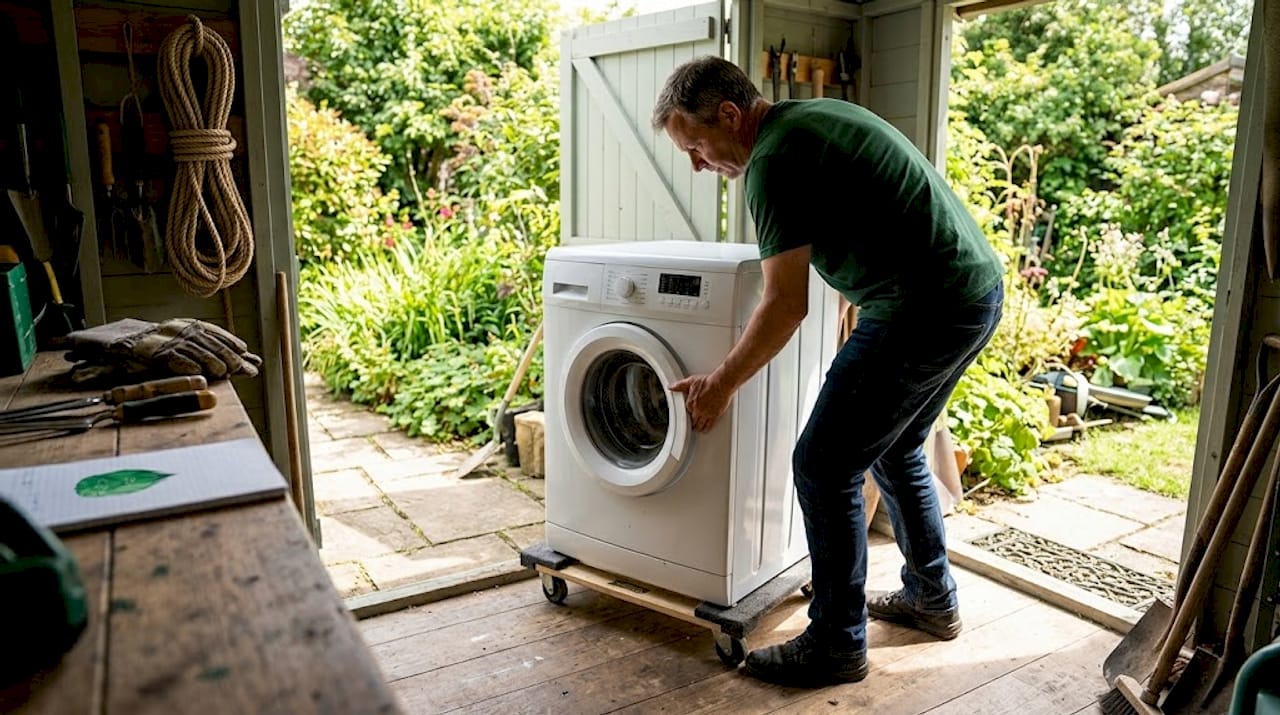
Appliance dollies (also called sack trucks) have a vertical back and a small ledge at the base. They tilt back to balance the item against the dolly frame, making them perfect for fridges, washing machines, and tall furniture. The item leans against the frame and the dolly takes the weight.
When loading a dolly, centre the weight over the wheels and secure the item with a strap before moving. Leaning weight too far forward or back makes steering difficult and increases the risk of the item sliding off.
4. Moving large items on stairs and in tight spaces
Stairs are where most moving injuries happen. Tight spaces are where most furniture gets damaged. Both situations require a clear plan before you start.
Here is a step-by-step approach for stair moves:
- Clear the staircase completely. Remove any rugs, cables, or objects from every step
- Pad the bannisters, walls, and any sharp edges with moving blankets or cardboard
- Decide which person takes the low position (bottom of the stairs) and which takes the high position (top)
- The person at the bottom guides and supports most of the weight, the person at the top controls the tilt and direction
- Agree on verbal signals before you start: “ready”, “hold”, “step” and “stop” should mean the same thing to both of you
- Move one step at a time. Never rush
Stair-climbing dollies and lifting straps can reduce the physical effort on stairs by 60 to 70%. Lifting straps loop under the item and over the shoulders of both carriers, shifting the load from your arms to your legs and core. This gives you far better control and dramatically reduces strain.
Pro Tip: Leverage and centre of gravity matter more than strength on stairs. Keep the item tilted at roughly the same angle as the staircase (30 to 45 degrees) and move together in sync. Brute force without coordination is what causes accidents.
The high-low carry method with two people keeps the item roughly level even on steep stairs. The person at the bottom holds lower handles or supports the base, the person at the top holds higher up or along the top edge. Practise the communication before you tackle the stairs.
If the item cannot safely pass through the space, stop. Professional movers may decline moves that exceed safe limits, and there is wisdom in that. Forcing a piece of furniture through a space that is genuinely too small will damage both the item and your property.
Read more about moving furniture on stairs before you tackle a particularly difficult staircase.
5. Moving large appliances safely, Van-247 know about ways to move large items
Large appliances need specific handling. They are heavy, often awkward in shape, and some of them have components that can be permanently damaged if not handled correctly.
Key points to follow:
- Fridges and fridge freezers: Keep them upright during the move. Tilting beyond 45 degrees risks oil migrating into the compressor. If the appliance is tilted during transit, let it stand upright for 4 to 24 hours before switching it on
- Washing machines: Remove the drum by fitting transit bolts before moving. Without them, the drum can move freely and damage internal components
- Cookers and ovens: Disconnect professionally if gas is involved. Remove all racks and loose internal parts before moving
- Use an appliance dolly: It is the correct tool for tall, top-heavy machines. Secure the appliance to the dolly frame with two straps at minimum
Moving blankets protect both the appliance and the walls around it. Wrap the item fully before loading it onto a dolly, paying particular attention to corners and control panels.
Shrink wrap is useful but often overused. Apply it to secure doors, drawers, or lids that might swing open during the move. Wrapping an entire appliance in shrink wrap without padding underneath offers minimal protection and wastes time. Use it strategically.
Read the dedicated guide on moving a fridge freezer if you are handling one of these for the first time.
6. Comparing the main methods and tools
Choosing between methods depends on the item, the environment, and your available resources. Here is a side-by-side comparison to help you decide.
| Method | Best for | Effort level | Approximate cost | Key risk |
|---|---|---|---|---|
| Furniture sliders | Flat-surface repositioning | Low | £5 to £25 | Ineffective on uneven floors |
| Flat dolly | Heavy boxes, appliances, short moves | Low to medium | £20 to £60 hire | Tipping if uneven load |
| Appliance dolly | Tall appliances, fridges, machines | Medium | £25 to £70 hire | Requires two people safely |
| Lifting straps | Stair moves, two-person lifts | Medium | £15 to £40 | Needs matched strength levels |
| Professional movers | Complex routes, heavy items, business moves | None (for you) | Varies by job | Cost, but offsets all physical risk |
A few practical observations on combining methods:
- Use sliders to move an item to the doorway, then switch to a dolly for the corridor
- Use lifting straps for the stair section, then transfer back to a dolly on the landing
- Wrap items in moving blankets before any method that involves tilting or repositioning
For commercial moves involving oversized equipment, cargo tie-down requirements state that the combined working load limit of all straps must equal at least 50% of the cargo weight. This is worth knowing if you are securing large items in a van or lorry for any distance.
My honest take on moving large items
I have watched a lot of moves go wrong for the same reason: people underestimate the planning and overestimate their strength. The injury usually happens in the first ten minutes, before anyone has found a rhythm.
In my experience, the biggest mistake is skipping the measurement stage. People assume a sofa will fit through a door because it looks like it should. It frequently does not. That assumption costs time, causes damage, and occasionally leads to items being left behind or written off entirely.
What I have also noticed is that the right tools change everything. Moving straps genuinely make 200-lb items feel like 70 to 100 lbs per person. That is not marketing. That is physics. Shoulder carry with straps engages your legs and core, which are far stronger than your arms and back. Most people do not reach for straps until they are already exhausted.
The other thing I would say: DIY moves are absolutely achievable for most household furniture on flat ground. Stairs change the calculation significantly. If the staircase is steep, narrow, or turns sharply, and the item is heavy or very large, calling in professional help is not admitting defeat. It is simply the most efficient solution. You can find useful preparation guidance in this furniture delivery tips article if you want to think through a specific move in more detail.
Moving day is a marathon, not a sprint. Take your time. The item will get there.
— Claudiu
Need help moving large items across the UK? Van-247 will find ways to move large items
Sometimes the smartest move is letting someone else do the heavy lifting. Van-247delivery has been handling large item moves across the UK for over 15 years, with experienced teams and the right equipment for every job.
Whether you need a full house removal service or a reliable man with a van for a single bulky item, Van-247delivery offers insured, flexible transport with instant quotes and real-time tracking.
Businesses moving oversized equipment or stock can also take advantage of professional pallet delivery services with proper securement and nationwide coverage. Get a quote today and let the team take the stress out of your next big move.
Frequently Asked Questions
What is the easiest way to move heavy furniture without movers?
Use furniture sliders on flat surfaces and a dolly for longer distances. Disassemble the item first to reduce weight, and always measure your route before you start.
How do you move a large item up stairs safely?
Use the high-low carry method with two people, clear the staircase completely, and consider using lifting straps to reduce effort by up to 70%. Communicate clearly and move one step at a time.
Can you move a fridge freezer on its side?
Tilting a fridge freezer beyond 45 degrees risks oil displacement in the compressor. If it is moved on its side, stand it upright and wait 4 to 24 hours before switching it on again.
What tools do I need for moving large items?
The core toolkit includes furniture sliders, a flat or appliance dolly, lifting straps, moving blankets, and packing tape. Stair-climbing dollies are worth hiring for multi-floor moves.
When should I hire professional movers for large items?
Hire professionals when items are very heavy, the route involves tight stairs or sharp turns, or when there is a risk of injury or property damage that outweighs the cost of help.