Stair protection during move: protect stairs by planning the route, choosing surface-compatible protection, securing coverings flat and padding rails, and prioritising carrying safety above all else. Get these five things right and you’ll avoid the two most common stair disasters: scuffed treads and slips on loose coverings. It’s not complicated, but it does take a bit of forethought before the first box goes anywhere near the top step.
TL;DR:
- Proper planning of the route and inspecting the staircase before protection application are essential to identify potential hazards and measure narrow points.
- Using surface-appropriate protection, such as self-adhesive film for carpeted stairs or padded runners for hard surfaces, helps prevent surface damage and slips.
- Securing coverings flat and testing the protection with an empty walk reduces the risk of tripping caused by loose or uneven surfaces.
- Protecting handrails, newel posts, walls, and door frames minimizes damage from knocks during the move process.
- Hiring professional movers ensures correct route assessment, proper protection, and safer manual handling for complex or heavy items.
Table of Contents
- Plan the route and inspect the staircase before you start
- Choose protection that matches your stair finish
- How to fit and secure stair protection so it stays put
- Protect bannisters, newel posts and the walls around them
- Carrying safety and manual-handling controls for stairs
- Tools, materials and a ready-to-use checklist
- Common mistakes and how to avoid them
- Industry tips from experienced movers
- The one habit that actually prevents stair damage
- How a removal service can protect your stairs for you
- Sources
- FAQ
Plan the route and inspect the staircase before you start, part of stair protection during move
Before you touch a single roll of protective film, walk your whole route from front door to final room, empty-handed. This sounds like an obvious step, and it is, but it’s the one most people skip when they’re racing against the clock on moving day.
Pay close attention to:
- Landings, turns and any point where the staircase changes direction or width.
- Doorways, light switches and anything at head height that a mattress or wardrobe could catch on.
- Newel posts and handrail brackets that stick out further than you’d expect.
- Lighting: dim stairwells hide trip hazards, so check every bulb works before moving day.
Once you’ve walked it, measure the effective tread width at the tightest points, especially where the staircase turns or narrows near a newel post. This tells you what will and won’t fit, and where you’ll need extra hands rather than brute force.
Fit your chosen protection while the stairs are completely clear of furniture and boxes. Trying to lay a runner around someone’s feet, or worse, around a sofa that’s already stuck halfway up, is how coverings end up bunched, torn or fixed badly. Once everything is in place, do a full empty-handed walk up and down the stairs to check nothing has shifted, nothing feels loose underfoot, and the handrail is still fully accessible. This test run takes two minutes and saves you from discovering a problem while you’re carrying a wardrobe.
Choose protection that matches your stair finish, part of stair protection during move
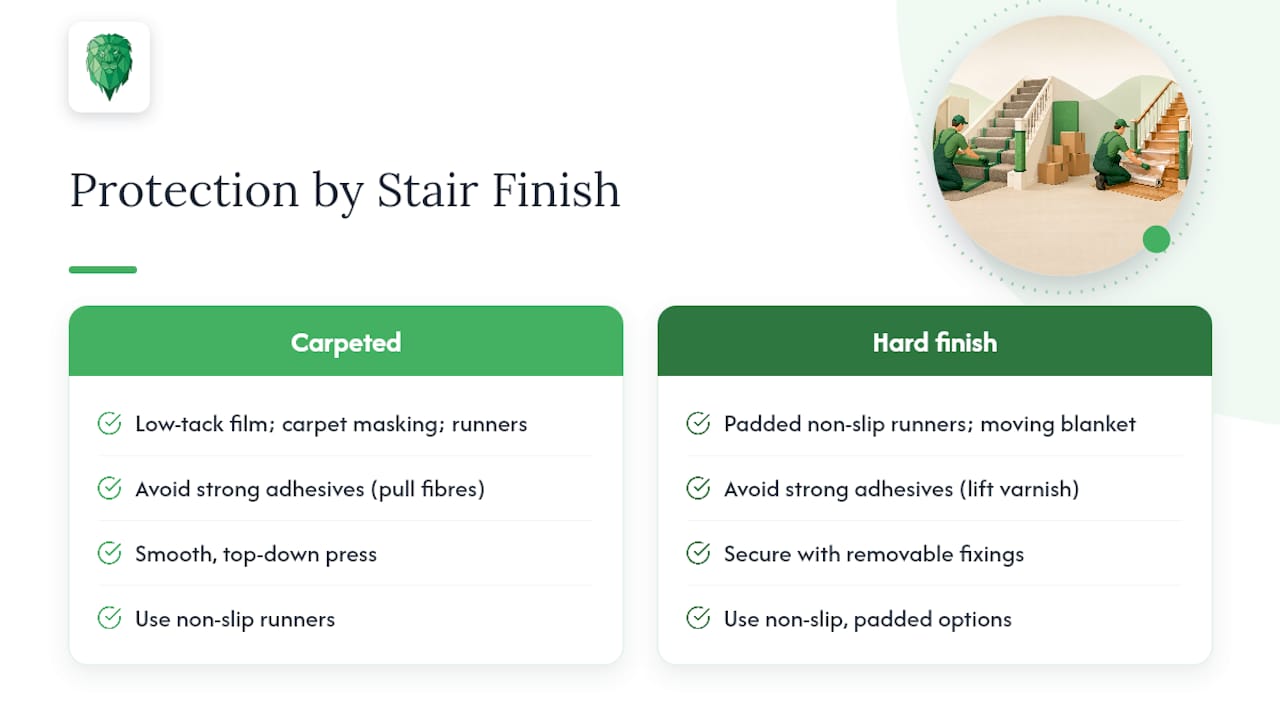
Not all stair protection works on all stairs, and using the wrong type is one of the fastest ways to damage a surface you were trying to protect in the first place.
Carpeted stairs
need a gentler approach than hard flooring. Low-tack self-adhesive carpet film, purpose-made carpet masking, and non-slip runners all work well because they don’t rely on strong adhesives that pull at fibres. Smooth application matters here: press film on gradually from the top of each tread downward rather than dropping a whole sheet and pressing at random, which tends to trap air bubbles and create ridges that catch feet or furniture legs.
Hard-finished stairs,
meaning hardwood, painted timber, tile or stone, respond better to padded, non-slip runners or a moving-blanket system secured with removable fixings. For the sections that take the heaviest traffic, such as the bottom three steps where most items get set down or turned, a soft protective board adds an extra layer of cushioning against knocks and drops.
The reason this split matters comes down to adhesive strength and surface porosity. Strong packing tapes and some plastic films can lift varnish, discolour paint or leave a sticky residue on delicate hardwood finishes that no amount of scrubbing will fully remove. Carpet fibres have the opposite problem: aggressive adhesives can pull threads loose or leave a matted patch that never quite recovers. Always test any adhesive product on a small, hidden section first, whether that’s the underside of a tread nosing or a corner of carpet near a skirting board, and give it a few minutes before deciding it’s safe to use on the whole run.
Pro Tip: Buy slightly more protective film or runner than you think you need. Running out halfway up the stairs, mid-move, means either an awkward gap in coverage or a rushed trip to the shop.
How to fit and secure stair protection so it stays put, part of stair protection during move
Getting protection to lie flat and stay flat is the difference between a staircase that’s genuinely safer and one that just looks protected until the first heavy box goes past.
- Clean and dry every tread thoroughly before fitting anything. Dust, grit or damp under a runner or film creates lumps and stops adhesive from gripping properly.
- Align seams so they run along the edge of each tread rather than across the middle, where a foot or furniture corner is most likely to land.
- Secure edges with painter’s tape or removable adhesive strips rather than anything permanent, and never let a fixing point narrow the usable width of the tread.
- For temporary protective boards on particularly high-traffic sections, use low-profile staples or clips rather than nails, so you’re not adding new damage while preventing old damage.
- Once fitted, do an empty-handed ascent and descent to check nothing lifts, slips or catches underfoot.
Recheck the whole route periodically during the move, particularly after wet weather has brought moisture in on shoes, or after a few hours of heavy traffic has started to loosen edges. According to UK Slip Resistance Group guidance, a covering that loses its flatness or reduces the effective tread width becomes a fall risk in its own right, so the protection itself needs the same scrutiny you’d give an unprotected staircase.
A covering only protects you if it stays flat and doesn’t shrink the step you’re putting your foot on.
Protect bannisters, newel posts and the walls around them, part of stair protection during move
A staircase isn’t just the treads. The handrail, the posts at the top and bottom, and the walls and door frames on either side all take knocks during a move, and they’re easy to forget while you’re focused on the steps themselves.
- Wrap handrails and newel posts in moving blankets or foam pipe insulation, secured with tape that won’t mark the wood underneath.
- Fit corner protectors on any exposed wall corners along the route, and tape cardboard sheets over skirting boards and door frames where furniture is likely to brush past.
- Pad sharp furniture edges too. Protecting the stairs but sending an unpadded chest of drawers into a plaster corner just moves the damage a few inches to the left.
Think of the whole route, treads, rails, walls and door frames, as one connected system rather than a series of separate problems. Professional movers tend to protect it this way because a gap in coverage at a newel post undoes a lot of careful work on the treads either side of it.
Carrying safety and manual-handling controls for stairs, part of stair protection during move
Protecting the surfaces is only half the job. The other half is protecting the people carrying things up and down them, and this is where a lot of DIY moves come unstuck.
HSE manual-handling guidance is built around a simple principle: reduce the risk before you lift, rather than trying to lift your way through the risk. In practice on a staircase, that means splitting heavy loads into smaller pieces where possible, bringing in an extra pair of hands for anything awkward, and using mechanical aids such as a sack truck or hoist wherever the layout allows it.
Before any carry, run through a quick check:
- Is the route lit well enough to see every step clearly?
- Is the handrail fully accessible, with nothing propped against it?
- Is the tread width unobstructed by protection edges, boxes or trailing cables?
- If any of these fail, stop and fix it before carrying, not halfway up.
Clear communication matters just as much as physical technique. Agree on simple commands with whoever’s helping you, such as “stop”, “turn” and “set down”, before you start, and stick to them. For very large or awkward items, Building Standards guidance on stairs and ramps points to handrail access and slip resistance as the real safety priorities, not folk rules about staircase geometry. When something genuinely won’t go safely with the team you have, that’s the moment to call in professional help rather than push through.
Pro Tip: If you can’t see the person you’re carrying with, or you can’t hear their commands over noise, stop the carry. Awkward stairs and poor communication are a bad combination.
Tools, materials and a ready-to-use checklist, part of stair protection during move
You don’t need a huge kit to protect a staircase properly, just the right items used correctly.
- Self-adhesive carpet film or carpet masking for carpeted stairs, enough to cover every tread with some spare.
- Padded, non-slip runners or moving blankets for hard-finished stairs.
- Protective boards for high-impact sections such as the bottom few steps.
- Painter’s tape and removable adhesive strips for securing edges without damaging finishes.
- Foam pipe insulation or spare blankets for handrails and newel posts.
- Corner protectors and cardboard sheets for walls and door frames.
For a single house move, a few rolls of film or one full runner set usually covers a standard staircase. If you’re dealing with a particularly long or awkward staircase, or you’re moving large furniture that needs serious protection along the whole route, it’s often cheaper to hire protective boards for the day than to buy materials you’ll only use once.
Common mistakes and how to avoid them, part of stair protection during move
Most stair-protection problems come from rushing the fitting stage rather than picking the wrong materials in the first place.
- Loose or folded coverings create trip hazards that are often worse than having no protection at all, so smooth everything flat before you start carrying.
- Incompatible adhesive tape on delicate hardwood or painted finishes can lift varnish or leave marks that outlast the move itself.
- Blocking the handrail or letting protection edges narrow the tread width removes the exact safety features you need most on a staircase.
Industry tips from experienced movers, part of stair protection during move
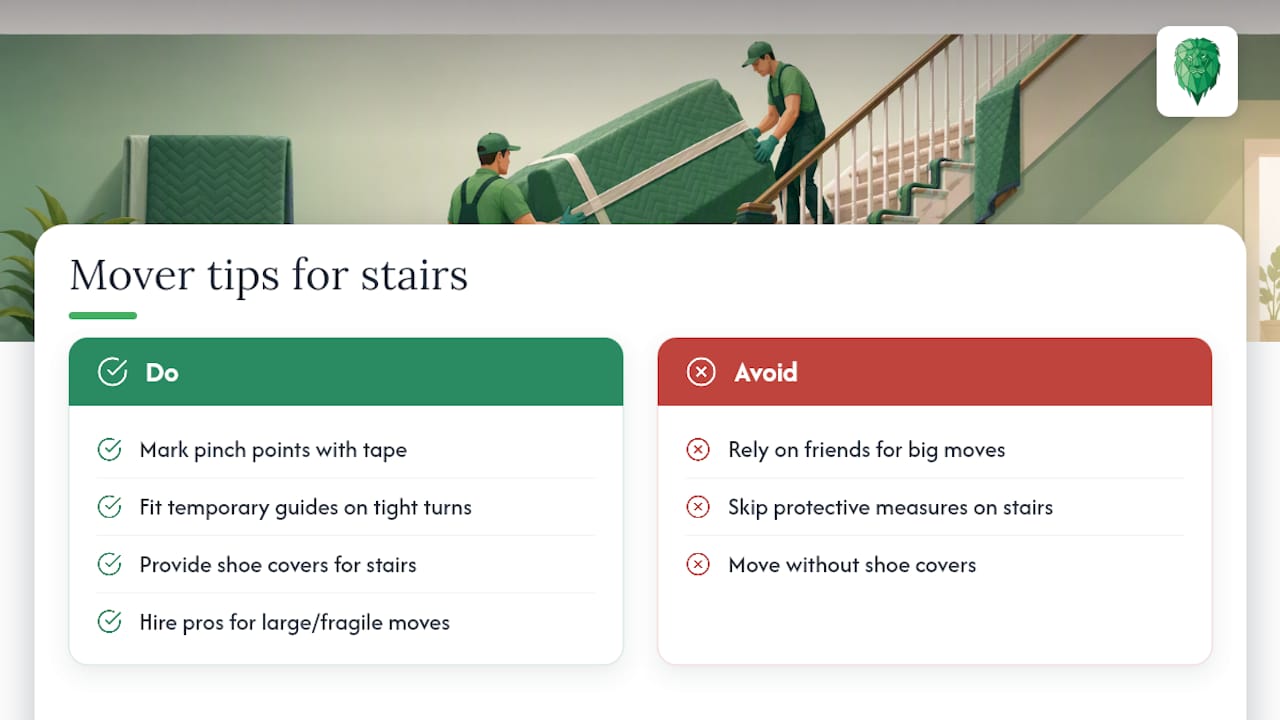
Removal crews tend to mark pinch points with tape before the move even starts, so everyone carrying items knows exactly where a wardrobe or sofa is likely to catch. Many also pre-fit temporary guides at tight turns and hand out shoe covers to stop grit and mud grinding into carpeted stairs throughout the day.
If you’re moving anything unusually large, heavy or fragile, such as a piano, a wardrobe with a narrow stairwell to navigate, or a full house of furniture down several flights, booking a professional crew rather than relying on friends is often the safer call. Add-ons like insurance and a packing service exist precisely because stairs are where a lot of accidental damage happens, and having it covered takes one worry off your list.
The one habit that actually prevents stair damage
The most overlooked risk isn’t the wrong tape or the wrong runner, it’s skipping the empty-handed test walk before the first item goes up or down. Do that walk every time, and get a second pair of hands for anything you’re not completely confident carrying alone. If in doubt, ask a professional rather than guessing.
— Claudiu
How a removal service can protect your stairs for you
If reading all of this has made you realise your staircase is trickier than you’d hoped, you’re not alone, and you don’t have to solve it with trial and error on the day. A booked removal crew brings the route planning, the right protective materials for your specific stair finish, and carriers who are used to reading pinch points before they become problems.

With Van-247delivery, that means a team that assesses your staircase as part of the job, fits carpet-safe or hard-floor protection correctly the first time, and carries large or awkward items with the manual-handling discipline that keeps both your walls and your movers safe. Experience in the trade means the pinch points, the narrow turns and the “that sofa will never fit” moments are rarely a surprise.
Services worth knowing about if stairs are your main worry:
- House Removals for a fully planned, insured move through your whole property, stairs included.
- Furniture and Large Items for single awkward pieces that need dedicated handling rather than a full house move.
- Piano Removal for one of the trickiest staircase jobs there is.
- Man and Van if you want a straightforward booking with a quote up front.
Get an instant quote through any of these pages and let a trained crew handle the staircase, the protection and the carrying, so the only thing you need to worry about is where the furniture goes once it’s inside.
Sources
For formal requirements beyond this guide, see HSE’s manual handling guidance, the Manual Handling Operations Regulations 1992 guidance L23, and Building Standards guidance on stairs and ramps.
FAQ
How can I protect my stairs during a move?
Plan your route first, then choose protection that matches your stair finish: carpet film or masking for carpeted stairs, padded non-slip runners for hard-finished stairs. Secure everything flat, pad the handrail and newel posts, and test the route empty handed before carrying anything.
What do movers use to protect floors?
Movers commonly use floor runners, padded moving blankets, carpet film or masking, cardboard, and protective boards on high-impact areas. The right choice depends on whether the surface is carpeted or hard-finished, and coverings need to stay flat and stable throughout the job.
What is the 27 rule for stairs?
There’s no recognised moving-safety standard called the “27 rule”. Official stair safety guidance focuses on handrail access, slip resistance and removing trip hazards rather than any fixed numerical rule.
What is the best carpet stair protector for moving?
Low-tack self-adhesive carpet film is a common choice because it grips the tread without pulling at fibres, and it can be paired with a non-slip runner for extra cushioning under heavy furniture. Always test adhesive products on a hidden section of carpet first.
Do I need help protecting stairs for a big move?
For narrow, long or heavily furnished staircases, an extra pair of hands or a professional crew makes the job considerably safer, particularly for large or awkward items. Van-247delivery offers house removals and large-item transport with trained carriers who handle route planning and protection as part of the job.